So we're back in humid South Florida, after a rather hectic afternoon & evening's travels: driving hell-bent for leather down the Massachusetts turnpike after spending a bit too long over lunch; dropping off the rental car at the Enterprise station – a good 10-minutes' drive from the airport, & with only a bare hour to spare before the flight left – only to learn that the flimsy little wagon (a PT Cruiser of all things – damn the government for bailing out Lee Iaccoca all those years ago!) had an unseen dent under its front bumper (something we & our insurance company'll be sorting out for weeks to come no doubt); elbowing our way in true Manhattanite pushiness thru the obviously not-as-in-a-hurry-as-us people waiting at security, where the Logan Airport authorities in their wisdom were funnelling three lines of passengers thru a single metal detector. But we made the flight, & got home in fairly good time, only to realize that we'd just gotten used to a chill in the air and leaves on the ground. One of my Florida-bred students, touchingly, brought up in class the other day "those trees they have up north that they get syrup out of, right?" I wish I taken her a picture of the blazing-red maples.
***
Thinking again of nonfiction, creative & otherwise. The books on the trip turned out to be neither Delany nor Austen (& not even Catullus), but a couple of serendipitous last-minute finds: Lytton Strachey's biography of Queen Victoria & Clive Wilmer's splendid Penguin edition of John Ruskin's Unto This Last (interestingly enough, the first Ruskin I ever read, in one of the mid-century Everyman hardcovers). Wilmer's done the book proud, both thru scrupulous editing and helpful endnotes, but also by taking the opportunity to surround Unto This Last – not a long book – with a wide range of Ruskin's writings addressing the issues of art & political economy, from "The King of the Golden River" to Fors Clavigera. I've been a Ruskin admirer for years & years now, & have only gotten around to Strachey fairly recently, & then only the famous Eminent Victorians, the book that put the snark into snarkiness. Queen Victoria is a much gentler book, tho by no means free of irony (a necessary nutrient, I believe). It shows off to great advantage Strachey's rather wonderful prose style, which I realized early on is no more or less than an updating of 18th-century cadential prose to a 20th-century sensibility. Ruskin, of course, is fit to teach anyone prose writing.
***
"But is it creative nonfiction?" I found myself asking, with flat phrases from Lee Gutkind's troops-rousing editorials in Creative Nonfiction ringing (or dully thumping) in my mind? Well of course it isn't. At least not to the extent that Strachey & Ruskin are consciously writing within already defined genres – Strachey the biography, Ruskin the work of political economy, or, more broadly defined, the Victorian hortatory essay (I may just have coined a new genre there myself...).
I of course have no desire to trespass on the turves of any of my colleagues in the creative writing industry, which is why I'm reluctant to designate anything I write "creative nonfiction," though it may be nonfiction & certainly feels creative, at least while I've pounding it out. But I'm also thoroughly & consistently suspicious of all attempts at genre-defining, which in the end serve more to fence some things out from institutional attention than they do to draw attention to others. I deeply regret the academy's tendency, over the last half-century, to define "poetry" as "lyric," & more specifically as "one- to two-page personal lyric."
I find myself agreeing with Michael Peverett (whose prose I'll read any day, in almost any mood): the whole exercise smacks of the sociological, of an emergent branch of the American creative writing industry, under the pressure of various institutional demands, seeking to define itself by plucking out outstanding contemporary exemplars of its practice, by press-ganging past writers into the fold, & by drawing lines around what is & what isn't kosher under the banner. Maybe I'm just reacting allergically to Gutkind's rather pedestrian effusions, which seem to rule out about 80% of what I find interesting in nonfiction writing. But I worry that creative nonfiction, which seems in recent years to have begun to get a real foothold in the MFA mills, seems to be passing up a golden opportunity: rather than taking a purely negative definition – it's not verse, & it's not fiction – & running with the extraordinary freedom & openness those two rules provide, folks like Gutkind seem to want to reduce the form to something like "the personal essay & memoir."
Not that there's anything wrong with those forms – I'd take Montaigne & Pepys with me to that desert island, if I were allowed just a couple more books – but what about everything else? If the term "creative nonfiction" doesn't include Zukofsky's Bottom: on Shakespeare, Benjamin's Arcades Project, Ruskin's Fors Clavigera, Boswell's Life of Johnson, and Guy Davenport's The Geography of the Imagination – not to mention all of Emerson's essays, lots of MFK Fisher, Carlyle's The French Revolution, & Stein's portraits – then I'm afraid it's not of much use to me.
***
Mildly amusing sidebar: Thinking o'er this CNF business, & wondering "do I ever write this stuff?" I kept stumbling over the phrase "literary journalism," used as one of the subgenres of the CNF master-genre. Oh, sure, thought I – I do that; I write lots of omnibus book reviews & career-spanning commentaries on writers that aren't really hard-boiled criticism. But then I realized that "literary journalism" didn't mean "writing about literary subjects for periodicals," but "journalism that's a cut above most newspaper & magazine writing in terms of its attention to language, theme, etc." In other words, the word literary is being used in that execrable & lazy manner as a vague synonym for "good." As one finds "literary" a new sub-genre in fiction: here we have your science fiction, here's your erotic fiction, here's your mystery & fantasy, & here's your literary fiction. And if you hang around long enough, you get to migrate from one shelf to the other, as Wilkie Collins & Edgar Poe did.
Monday, October 15, 2007

Thursday, October 11, 2007
Ad Interim
With a remarkably increased iPod memory, I've been busily ripping & rediscovering old favorites: Miles's sublime Sketches of Spain, for instance, every note of which I know, but which I haven't listened through for a half-decade or more; or the effervescent Relaxin' with the Miles Davis Quintet, with its sprightly & sensitive readings of Frank Loesser & Rogers & Hart tunes. And exploring the vast library of things my friend the Grillo pressed on me: astonishing how dated '80s-era Cabaret Voltaire sounds, when it was such an avant-garde rush at the time.
***
And cooking me up some "creative nonfiction" – as with any "assignment," using the opportunity to get some a few things straight in my own all too cluttered & muddled head. How's "The Strenuous Labor of the Concept" as a title?
***
We're off to points north for a long weekend to (with luck) see some actual deciduous trees turning red & yellow, & to feel the much-missed bite of autumn nights. In a quandary over what to bring reading-wise. Somehow Hegel seems too heavy for such a jaunt. I've just acquired a copy of Samuel Delany's Phallos, which looks like great fun – a homoerotic Lacanian romp in the form of a pirated internet "summary" of a lost 1960s pornographic novel (posing as an 18th-century or late Victorian production) set in antiquity, shot thru with Delany's characteristic winking footnotes & nail-chewed ugly-but-attractive objects of desire – but I'm afraid I'd finish it on the plane up, & then be left bookless. Perhaps the solution – could it be? – is Emma.
***
And cooking me up some "creative nonfiction" – as with any "assignment," using the opportunity to get some a few things straight in my own all too cluttered & muddled head. How's "The Strenuous Labor of the Concept" as a title?
***
We're off to points north for a long weekend to (with luck) see some actual deciduous trees turning red & yellow, & to feel the much-missed bite of autumn nights. In a quandary over what to bring reading-wise. Somehow Hegel seems too heavy for such a jaunt. I've just acquired a copy of Samuel Delany's Phallos, which looks like great fun – a homoerotic Lacanian romp in the form of a pirated internet "summary" of a lost 1960s pornographic novel (posing as an 18th-century or late Victorian production) set in antiquity, shot thru with Delany's characteristic winking footnotes & nail-chewed ugly-but-attractive objects of desire – but I'm afraid I'd finish it on the plane up, & then be left bookless. Perhaps the solution – could it be? – is Emma.
Wednesday, October 10, 2007
Victorian parenting

Virginia Woolf on her father, Leslie Stephen: "Even today there may be parents who would doubt the wisdom of allowing a girl of fifteen the free run of a large and quite unexpurgated library. But my father allowed it. There were certain facts – very briefly, very shyly he referred to them. Yet 'Read what you like,' he said, and all his books, 'mangy and worthless,' as he called them, but certainly they were many and various, were to be had without asking. To read what one liked because one liked it, never to pretend to admire what one did not – that was his only lesson in the art of reading. To write in the fewest possible words, as clearly as possible, exactly what one meant – that was his only lesson in the art of writing."
Monday, October 08, 2007
but is it creative?
Thanks so much for the kind comments on the last post, all the happy returns & so forth. The birthday was – yes – survived, & I managed to repress my Mr Ramsay-like feelings of having wasted my potential & having nothing to look forward to but a long darkening corridor of increasing aphasia (did I ever mention the first day of classes when I couldn't lay my hands on the word "syllabus"?), of having my students & friends finish my sentences for me, of being increasingly unable to type the word "have" ("ahve") or to remember that funny chord in "Maggie May," etc. – repressed them all in favor of several days of familial sunshine & a rather wonderful (thanks, Mrs R!) dinner party. I overdid the dal, as usual, & ended up sending three containers home with various guests; but there remain lentils, rice, vindaloo & palak paneer enough for supper tonight & lunch tomorrow (yum!).
***
The big ticket gift item was an upgrade to my old iPod, which at almost 4 years old is beginning to feel its age – won't hold a battery charge for more than a few hours, takes forever to warm up, etc. The new "classic" iPod has a hard drive larger than my laptop, actually, so I can't really imagine ever quite filling it up, even if I were to take the time to rip every CD in the closet. (No, I have yet to warm up to the not-so-new world of exclusively downloaded music, though I'm quite amused by the concept of Radiohead's new album, which you can download on a "choose your own price" basis.)
The new iPod is packed with super-sharp color graphics which are nice but to me rather beside the point – after all, this is a audio delivery device, so far as I'm concerned. The only upgrade that I'm really keen on is in the time-wasting "games" category: where my old 2nd-generation machine had a pong-like game called "Brick," in which one bounced a dot off of slightly larger dots with a flipper-like stick, the new one has something called "Vortex," where you bounce a beautifully rendered white ball down a tunnel against exploding bricks. Wee-hoo. There goes the time that would have been devoted to my next book.
***
I have been asked, & have accepted, a colleague's invitation to participate in a "creative nonfiction" reading. Problem is of course that I have no idea what "creative nonfiction" is, aside from a fairly new MFA program job description. (The Bourdieu in me answers that that is precisely what it is.) I figure, well, I sometimes write things that aren't poems, & that aren't book reviews or critical essays or bits of biography, & that aren't blog entries – so maybe that's creative nonfiction. But is it creative?
As Richard Thompson says, "So they say to you, 'Ooh, that's a funny chord, innit?' And I say, 'That's jazz!' 'Bit of a bum note there, eh?' So I play it again, and say, 'That's jazz!'"
***
The big ticket gift item was an upgrade to my old iPod, which at almost 4 years old is beginning to feel its age – won't hold a battery charge for more than a few hours, takes forever to warm up, etc. The new "classic" iPod has a hard drive larger than my laptop, actually, so I can't really imagine ever quite filling it up, even if I were to take the time to rip every CD in the closet. (No, I have yet to warm up to the not-so-new world of exclusively downloaded music, though I'm quite amused by the concept of Radiohead's new album, which you can download on a "choose your own price" basis.)
The new iPod is packed with super-sharp color graphics which are nice but to me rather beside the point – after all, this is a audio delivery device, so far as I'm concerned. The only upgrade that I'm really keen on is in the time-wasting "games" category: where my old 2nd-generation machine had a pong-like game called "Brick," in which one bounced a dot off of slightly larger dots with a flipper-like stick, the new one has something called "Vortex," where you bounce a beautifully rendered white ball down a tunnel against exploding bricks. Wee-hoo. There goes the time that would have been devoted to my next book.
***
I have been asked, & have accepted, a colleague's invitation to participate in a "creative nonfiction" reading. Problem is of course that I have no idea what "creative nonfiction" is, aside from a fairly new MFA program job description. (The Bourdieu in me answers that that is precisely what it is.) I figure, well, I sometimes write things that aren't poems, & that aren't book reviews or critical essays or bits of biography, & that aren't blog entries – so maybe that's creative nonfiction. But is it creative?
As Richard Thompson says, "So they say to you, 'Ooh, that's a funny chord, innit?' And I say, 'That's jazz!' 'Bit of a bum note there, eh?' So I play it again, and say, 'That's jazz!'"
Wednesday, October 03, 2007
dark alphabet
The weather, which has been horrendous for the last few days – torrential rains, kid-waking 3am thunderstorms – turned unexpected lovely today, just in time (as of twenty or thirty minutes ago) for me to face my least favorite of anniversaries: my birthday. My ophthalmologist used to tell me that I was his "pediatric patient," given the average 75+ age of his other clients; but there comes a time when only very old people still call you "young man,"and even then with a trace of irony.
I have not entered middle age gracefully, but kicking & screaming against the loss of a youth which was, in retrospect, not really wasted but enjoyed rather copiously. But more & more I hear "time's winged chariot" & all that. I find myself ruefully sympathizing with Woolf's otherwise maddening Mr Ramsay, who, if thought is like a piano keyboard divided into twenty-six alphabetical notes, has reached Q, & is somehow stuck there:
***
For the other Pete Cosey fans out there – watch yesterday's video, & tell me if the man isn't a deity! – there's a fascinating in-depth interview with public radio station KJZZ here. Well worth 45 minutes of your time.
***
And a shout out to my oldest friend Th., who has just celebrated his own only slightly less numerous birthday.
I have not entered middle age gracefully, but kicking & screaming against the loss of a youth which was, in retrospect, not really wasted but enjoyed rather copiously. But more & more I hear "time's winged chariot" & all that. I find myself ruefully sympathizing with Woolf's otherwise maddening Mr Ramsay, who, if thought is like a piano keyboard divided into twenty-six alphabetical notes, has reached Q, & is somehow stuck there:
But after Q? What comes next? After Q there are a number of letters the last of which is scarcely visible to mortal eyes, but glimmers red in the distance. Z is only reached once by one man in a generation. Still, if he could reach R it would be something. Here at least was Q. He dug his heels in at Q. Q he was sure of. Q he could demonstrate. If Q then is Q – R – Here he knocked his pipe out, with two or three resonant taps on the handle of the urn, and proceeded. "Then R..." He braced himself. He clenched himself...R is then – what is R?So better to leave behind the alphabet of thought, set aside the Phenomenology of Spirit for a day or two, & concentrate on what makes Mrs Ramsay & Mrs Dalloway happy: a successful dinner party. On the menu for this weekend: jasmine rice with saffron, a red lentil dal, palak paneer, and a brazenly spicy vindaloo, washed down with whatever potables the guests bring.
A shutter, like the leathern eyelid of a lizard, flickered over the intensity of his gaze and obscured the letter R. In that flash of darkness he heard people saying – he was a failure – that R was beyond him. He would never reach R. On to R, once more. R –
***
For the other Pete Cosey fans out there – watch yesterday's video, & tell me if the man isn't a deity! – there's a fascinating in-depth interview with public radio station KJZZ here. Well worth 45 minutes of your time.
***
And a shout out to my oldest friend Th., who has just celebrated his own only slightly less numerous birthday.
Tuesday, October 02, 2007
Pete Cosey is God
My sense is that it's a little more respectable these days to admire Miles Davis's mid-70s "electric" phase, even if the true jazz connoisseurs still pooh-pooh the period during which the man forsook sharp-edged bop for a funky noise stew derived in equal parts from Hendrix, Sly Stone, and Karlheinz Stockhausen. I love Birth of the Cool & Sketches of Spain as much as the next don't-really-know-nuthin-about-music guy, but I'm happy to admit that Agharta, a five-track double album recording a February 1975 matinee in Osaka, is my favorite Miles album.
Even after listening to the record for decades (and more recently digging its companions, Pangaea & Dark Magus), I'm still amazed by the solos and fills of Davis's big-bearded, slouch-seated, bearish guitarist Pete Cosey. Here he is from 1973, playing an extended solo on what looks to be a Vox Phantom 12-string, but which sounds like it's been tuned to some Martian scale:
Even after listening to the record for decades (and more recently digging its companions, Pangaea & Dark Magus), I'm still amazed by the solos and fills of Davis's big-bearded, slouch-seated, bearish guitarist Pete Cosey. Here he is from 1973, playing an extended solo on what looks to be a Vox Phantom 12-string, but which sounds like it's been tuned to some Martian scale:
culinary
 I first read Virginia Woolf's To the Lighthouse over 20 years ago in a class taught by the late Hopkins & Austen scholar Allison Sulloway, one of the most dedicated & literally inspiring scholars I've ever met – one of the people who taught me what little I know about writing, & who made me know what I wanted to do with myself. (Her first book, Gerard Manly Hopkins and the Victorian Temper, was dedicated to the Turkish poet & occasional sojourner in the alt-poetry world Murat Nemet-Nejat, a connection I never got around to figuring out.)
And now once again, as I do every couple of years, I'm rereading To the Lighthouse, & finding my stomach rumbling as I read Woolf's astonishing description of the triumphal main course at Mrs Ramsay's dinner party, the boeuf en daube, a "French recipe of my grandmother's":
And she must take great care, Mrs. Ramsay thought, diving into the soft mass, to choose a specially tender piece for William Bankes. And she peered into the dish, with its shiny walls and its confusion of savoury brown and yellow meats and its bay leaves and its wine, and thought."Boeuf en daube," of course, means no more or less than "beef stew." The recipes I've been looking at – Julia Childs & so forth – make this clear, & frankly I suspect that whatever the dish's attractions for the poor spice-starved early 20th-c. Britons of Woolf's novel, it doesn't hold a candle in terms of complexity to my own labor-intensive gumbo or multiple-meat chili (based on Ron Johnson's recipe): more akin, I suspect, to my modest but comforting Hannukah potroast.
But everybody's got – pardon me – a beef: Buce points out that Woolf (or, more charitably, her character Mrs Ramsay) has gotten it all wrong about the preparation process & serving time of the boeuf en daube, merely a symptom of Woolf's general lack of sympathy for the servant classes in her novels: "The point is not that To the Lighthouse is a bad book. It's actually quite a good book; or at least it is a book full of good paragraphs, and Virginia Woolf seemingly cannot write a bad paragraph. It is a bad novel, because Virginia Woolf has little of the capacity for imaginative empathy that makes a really good novelist." I dunno about "imaginative empathy" – it strikes me that the range of empathies required to depict Mrs R, her overbearing husband, the artist Lily Briscoe, the scientist William Bankes, & the half-dozen other vividly rendered characters is more than most novelists can generate over a career – but she can certainly write food.
John Baker offers a delicious-seeming recipe for Boeuf en daube à la Virginia Woolf, as long as you don't mind converting those kilos & grams into more old-fashioned measures.
Friday, September 28, 2007
When I read a post like "The Complete Language Game,"* I wish I were Jonathan Mayhew.
***
My ideal critic/historian of contemporary poetry would combine the aesthetic subtlety and political ferocity of Adorno, the historical & iconographical learning of Panofsky, & the broad and powerful sociological vision of Bourdieu. And the prose style of Guy Davenport. If the Goddess gives me another 40 years compos mentis, I will be that critic/historian.
***
I've given up looking for my ideal contemporary poet. I write the poems I can write: "ich kann nicht anders."
*As Steven points out in the comments box, that should read "The Complete Sentence Game." Oops.
***
My ideal critic/historian of contemporary poetry would combine the aesthetic subtlety and political ferocity of Adorno, the historical & iconographical learning of Panofsky, & the broad and powerful sociological vision of Bourdieu. And the prose style of Guy Davenport. If the Goddess gives me another 40 years compos mentis, I will be that critic/historian.
***
I've given up looking for my ideal contemporary poet. I write the poems I can write: "ich kann nicht anders."
*As Steven points out in the comments box, that should read "The Complete Sentence Game." Oops.
Various
Nada Gordon has posted a set of "Anti-Rules of Poetry Blogging" – things, that is, one should probably avoid doing – &, by golly, I seem to have been guilty of late of a whole bunch of them:
***
I suppose you lucky souls in more northerly latitudes (something redundant there) are beginning to enjoy the symptoms of fall in the air. Here we've had 4 days of more or less constant, desperate rain, which has only stopped today: visually, a beautiful day, tho it bodes to hit the high 80s, & the mosquitos are out like Eliot's hooded hordes.
***
Like everybody else, I keep reading Ron S day after day, & my naturally phlegmatic temperament only gets me het up when I read something like this:
***
A fascinating piece in the Times' Magazine's "College" issue on New St. Andrews College in Idaho, a experiment in turning out "medieval Protestants" – hardcore evangelicals with rigorous classical educations. Aside from the rigors of Latin & Greek (the latter of which I regret never having undergone), it's just as wingnut as the next evangelical institution. Still, you gotta love that the coffeehouse is called "Bucer's."
***
From John Latta's "Rag-bag islet" yesterday, a graceful & exemplary meditation (aided by André Furlani) on Lu Chi, Guy Davenport, & wasps. (John, how the hell do you get permalinks for single entries??)
***
Two additions to the blogroll: Nada Gordon (long overdue) & Mark Wallace, an old interlocutor from my DC days – another life, it seems, but grand to see him taking up the weblog medium.
Avoid any mention of poetry altogether.So I'll try to be a trifle more "on task" (as we used to say of the sighthound who was best at following the "rabbit" at the coursing events) in the future. Like, maybe even actually writing about poetry for a change, rather than the irritations of sloppy editing or the outrages of textbook publishers. But not quite yet...
There is no such thing as irrelevant content: found text, recipes, videos, random observations – all good.
Especially, do not ever ever “engage current debate.”
Use gimmicks: a flickr badge and a label cloud are signs of a “quality blog.”
Don't set yourself up as an authority on anything.
Blog as frequently or as infrequently as you please: you owe no one anything.
You may use your blog as a catalogue of pet peeves if you like.
***
I suppose you lucky souls in more northerly latitudes (something redundant there) are beginning to enjoy the symptoms of fall in the air. Here we've had 4 days of more or less constant, desperate rain, which has only stopped today: visually, a beautiful day, tho it bodes to hit the high 80s, & the mosquitos are out like Eliot's hooded hordes.
***
Like everybody else, I keep reading Ron S day after day, & my naturally phlegmatic temperament only gets me het up when I read something like this:
asking for source data on a 900 page manuscript like The Alphabet is not so far from inviting a 2,000 page response. I suppose some day some enterprising grad student is going to comb through Ketjak and identify just how many sentences there were lifted directly from Quine – it could be done. But I’m not in the slightest inclined to think that doing so would tell you any more about the poem. In that same vein, the various annotations for works like Ulysses, The Cantos or Finnegans Wake always strike me as telling me a little about what the author may have been thinking about around the time of composition, but they are almost mute on what the works themselves actually say. Annotating, reading & interpreting are, after all, three different acts. Everyone who has ever written about 2197 has done so with a sense of a science fiction framework & what that might mean to those texts. I can’t think of anyone who has as yet noticed that the number is 13 cubed, which means that it represents the total of sentences in the work. From the perspective of reading, does that matter? I suspect not.Leaving aside the stunningly presumptious anticipation of some "enterprising grad student"'s future attentions, the lumping together of the very different annotative enterprises directed at Ulysses, The Cantos, & Finnegans Wake strikes me as just plain sloppy. What's being annotated in each case is strikingly different (for Ulysses, there're great stretches that simply explain 1904 Dublin culture & geography for a 21st-c. reader; for The Cantos, it's mostly sourcing of quotations & translating of foreign phrases, as well as – not yet nearly enough – background historical context; for Finnegans Wake, it's largely philology). And while everybody's entitled to read however they see fit, & while I'd never downplay the value of a "cold" reading of a difficult, referential text (that was what got me into, & thru, Maximus the first time around), any reader who values authorial intention (old-fashioned, yes, but take it or leave it) is going to have to come around to the annotations at some point. Sure, "annotating, reading & interpreting are, after all, three different acts," but it's pretty damned theoretically slippery to separate the latter two in such a briskly cavalier fashion. (Plug here for Jeff Twitchell's Zukofsky exemplary annotations site.)
***
A fascinating piece in the Times' Magazine's "College" issue on New St. Andrews College in Idaho, a experiment in turning out "medieval Protestants" – hardcore evangelicals with rigorous classical educations. Aside from the rigors of Latin & Greek (the latter of which I regret never having undergone), it's just as wingnut as the next evangelical institution. Still, you gotta love that the coffeehouse is called "Bucer's."
***
From John Latta's "Rag-bag islet" yesterday, a graceful & exemplary meditation (aided by André Furlani) on Lu Chi, Guy Davenport, & wasps. (John, how the hell do you get permalinks for single entries??)
***
Two additions to the blogroll: Nada Gordon (long overdue) & Mark Wallace, an old interlocutor from my DC days – another life, it seems, but grand to see him taking up the weblog medium.
Tuesday, September 25, 2007
Ghost essay
On the syllabus for tomorrow:
Week 5: 26 SeptemberThis just in from WW Norton, after a fairly heated e-mail on my part:
Eliot, The Waste Land continued; Leavis, “The Significance of the Modern Waste Land” (Norton Critical Ed. 173-85; Bush, “Unknown Terror and Mystery” (Norton Critical Ed. 246-58; Froula, “Corpse, Monument, Hypocrite Lecteur: Text and Transference in the Reception of The Waste Land” (Norton Critical Ed. 275-86).
Dear Professor Scroggins,Caveat lector – & lecturer!
Your comments regarding the Norton Critical Edition of The Waste Land were passed along to me today. The book is not [a] revised edition and we do not have one planned for the foreseeable future.
Professor Froula required that her essay "Corpse, Monument, Hypocrite Lecteur: Text and Transference in the Reception of The Waste Land" be removed from the book after the tenth printing. The essay was deleted per her request in 2006 and any reference to her was removed from the book. This was an exceptional case; deletions between printings are in no way a typical practice for Norton Critical Editions. To avoid further confusion, any mention of Professor Froula's inclusion in the book will be removed from the website- many thanks for notifying us to this oversight.
Again, we regret any problems and frustration that Professor Froula's request caused.
Many thanks,
––––––––
Editorial Assistant
Saturday, September 22, 2007
Stardust / The Historical Record
Stardust. What's not to like? Stunning visual effects; Claire Danes transformed over the years since the last thing I saw her in – Romeo + Juliet – into a grown-up actor more lambently beautiful for her utter lack of conventional beauty, & able to turn in a convincing imitation of Gwyneth Paltrow; Michelle Pfeiffer reprising her role in Witches of Eastwick & Peter O'Toole his in Caligula; Robert DeNiro as a cross-dressing, can-can-dancing aerial pirate. The Princess Bride on special effects steroids. Yes, as we're told, a great "date film."
An exercise in both nostalgia & "world elsewhere" wish-fulfillment. Tristan makes it to the way interesting fantasy realm of Stormhold, defeats the witches & the ineffectual but nasty princes, gets the girl – a "star" in every sense – & discovers to boot (in a Shakespearean Romance-like turn) that he's the heir to the throne.
But what's he left behind? Nothing more onerous or constraining that a filmmaker's fantasy of a turn-of-the-century English agrarian town, a kind of Shire, where his object object of desire has the hots for the local Flashman (closeted, we learn). The contemporary fairy-tale, in which not merely the realm of faery but the realm of "reality" has been emptied of all true discomfort or social conflict. At least the dire film version of CS Lewis's dire Christian screed The Lion etc. had the decent idea of showing its children in flight from the Blitz.
***
The splendid British poet & bookdealer Peter Riley posts the following on the UK Poetry Listserv under the title "The Historical Record (I hope he doesn't mind me copying him):
Perhaps the LOC is a kind of time-capsule, a last-ditch stand against oblivion. But I wonder that we aren't taking more care of our legacy in the alt-poetry world. Send your books to the Library of Congress; make your university (or public) library order your books, & books by the poets you admire; donate your books to collections that ought to have them (Buffalo, San Diego, etc.).
An exercise in both nostalgia & "world elsewhere" wish-fulfillment. Tristan makes it to the way interesting fantasy realm of Stormhold, defeats the witches & the ineffectual but nasty princes, gets the girl – a "star" in every sense – & discovers to boot (in a Shakespearean Romance-like turn) that he's the heir to the throne.
But what's he left behind? Nothing more onerous or constraining that a filmmaker's fantasy of a turn-of-the-century English agrarian town, a kind of Shire, where his object object of desire has the hots for the local Flashman (closeted, we learn). The contemporary fairy-tale, in which not merely the realm of faery but the realm of "reality" has been emptied of all true discomfort or social conflict. At least the dire film version of CS Lewis's dire Christian screed The Lion etc. had the decent idea of showing its children in flight from the Blitz.
***
The splendid British poet & bookdealer Peter Riley posts the following on the UK Poetry Listserv under the title "The Historical Record (I hope he doesn't mind me copying him):
After a small amount of rather scrappy research, I am beginning to think that possibly all or most of the poetry books published by print-on-demand presses since about 2000, are not getting into the copyright libraries. (It is a statutory obligation for all publishers to deliver six free copies of all books on publication to the British Library, [the National Libraries of Scotland and Wales, and the Oxford, Cambridge, & Trinity College libraries]).There's a similar provision in place under US copyright law, tho many of us seem unaware of its provision requiring that two copies of each book published in the US be deposited with the Library of Congress. And while Riley speaks of the print-on-demand phenomenon, I think this is a problem endemic to all small press publishing. A spotcheck reveals no copies of Jessica Smith's Organic Furniture Cellar, nor of Henry Gould's most recent books, nor of either of the two excellent Cultural Society books – Zach Barocas's Among Other Things and Joel Bettridge's That Abrupt Here – but their holdings of Bruce Andrews's books seem remarkably spotty, as well (at least four titles missing, including I Don't Have Any Paper So Shut Up), & Tina Darragh has published far more than the three titles they hold.
It's difficult to be certain because it can take libraries a long time to get a book catalogued and sometimes some (e.g. poetry) items are classed as "secondary" and do not show in the main catalogue . But I've looked for about 25 books published between 1999 and 2002 in the on-line catalogue of Cambridge University Library and I've only found two of them. The books not there included two entitled "Collected Poems". For comparison I looked up five books published by Carcanet post 2002, and they were all there.
I tried to compare this with the British Library, and they do seem to have more, but their on-line catalogue is such hell I had to abandon the search.
I find this rather worrying. They really should be there, it is the historical record of our activity. The print-on-demand "boom" has been in many ways a saviour of the situation for poets, able at last to get real books out without submitting themselves to the "big" publishing machine. But many of these books are probably produced in small quantities and the copyright system is some kind of guarantee that they won't disappear for ever. I know from my experience as a bookseller that it is quite possible for a book published in, say, 1870 in several hundred copies, to have vanished without trace by 1990.
Perhaps the LOC is a kind of time-capsule, a last-ditch stand against oblivion. But I wonder that we aren't taking more care of our legacy in the alt-poetry world. Send your books to the Library of Congress; make your university (or public) library order your books, & books by the poets you admire; donate your books to collections that ought to have them (Buffalo, San Diego, etc.).
Wednesday, September 19, 2007
Git yerself some kulchur
There's a brand new update at Zach Barocas's always excellent Cultural Society, including work by Joseph Bradshaw, Derrick Buisch, Cary Conover, Jon Curley, Tom Fisher, Roberto Harrison, Philip Jenks, Joseph Massey & Jess Mynes, Amanda Nadelberg, Peter O'Leary, Gregory J. Ott, John Phillips, Christopher Rizzo, Cindy Savett, Kate Schapira, Melissa Severin, Sandra Simonds, Shannon Tharp, Bronwen Tate, Jen Tynes, & Tyrone Williams. (Click on "texts.")
And a (longish) poem by me, "Of Systems Subject, Political, and Private." Do go read; tokenish prize to whoever can first identify the source of the title.
And a (longish) poem by me, "Of Systems Subject, Political, and Private." Do go read; tokenish prize to whoever can first identify the source of the title.
Tuesday, September 18, 2007
Nit-pickery
Just finished Michael North's Reading 1922: A Return to the Scene of the Modern (OUP, 1999). Not bad at all; does a fine if uninspiring job of putting the grand warhorses of 1922 (Ulysses, The Waste Land, etc.) back into their contemporary context, pulls some interesting threads together. Provocative rebuttals of Huyssen's high culture/low culture "great divide" & Jameson's modernism/postmodernism schematizations. But doesn't have the same satisfyingly chewy theoretical density of Marc Manganaro's Culture, 1922: The Emergence of a Concept (Princeton UP, 2002), which is one of those critical books that enables you (as somebody at Cornell, acc. to the dire David Lehmann, said of de Man's "Rhetoric of Temporality") to save yr dope money for a week.
But the book immediately at hand is North's Norton Critical Edition of The Waste Land (2001), which I keep assigning to classes largely for its critical essays (& of course to support independent publishing). Problem with these Critical Editions – & here I include every Norton CE I've ever used – is that you can't really trust the explanatory notes. Not TS Eliot's notes – everybody knows they're whacked – but North's notes: you know, the ones at the foot of the page, the ones most students take as gospel truth. (After all, they were written by this UCLA professor, he knows so much more than I do...)
I can't claim to have checked every note, but here's a few flyspecks in the notes to the poem itself:
•In a note to the Petronius epigraph ("NAM Sibyllam quiden Cumis" etc.), we're told that the quotation is "(Greek)." Well, 5 words of it are; but obviously the rest is in Latin.
•The battle of Mylae (1st Punic War) took place in 260BCE, not "206" as the note has it. (Okay, that's a typo – but who's reading proof here?)
•Headnote to "A Game of Chess": "Eliot takes the title of this section from a satirical play of the same name by Thomas Middleton (1570?-1627). First produced in 1625, A Game of Chess was suppressed because of the way in which it allegorized English conflict with Spain as a chess match." How many howlers can North fit into one note? Middleton was born in 1580, not "1570?"; the title of his play is A Game at Chess, not A Game of Chess; and the play was first produced in 1624, not 1625. These are well-documented matters.
•Headnote to "What the Thunder Said": "Eliot's headnote to this section helps us to see these lines as a description of the betrayal, arrest, interrogation, and crucifixion of Christ..." Eliot's headnote – "In the first part of Part V three themes are employed: the journey to Emmaus, the approach to the Chapel Perilous (see Miss Weston's book) and the present decay of eastern Europe" – does nothing of the sort.
Everybody thinks they're an editor, I guess; but who's editing the editors?
But the book immediately at hand is North's Norton Critical Edition of The Waste Land (2001), which I keep assigning to classes largely for its critical essays (& of course to support independent publishing). Problem with these Critical Editions – & here I include every Norton CE I've ever used – is that you can't really trust the explanatory notes. Not TS Eliot's notes – everybody knows they're whacked – but North's notes: you know, the ones at the foot of the page, the ones most students take as gospel truth. (After all, they were written by this UCLA professor, he knows so much more than I do...)
I can't claim to have checked every note, but here's a few flyspecks in the notes to the poem itself:
•In a note to the Petronius epigraph ("NAM Sibyllam quiden Cumis" etc.), we're told that the quotation is "(Greek)." Well, 5 words of it are; but obviously the rest is in Latin.
•The battle of Mylae (1st Punic War) took place in 260BCE, not "206" as the note has it. (Okay, that's a typo – but who's reading proof here?)
•Headnote to "A Game of Chess": "Eliot takes the title of this section from a satirical play of the same name by Thomas Middleton (1570?-1627). First produced in 1625, A Game of Chess was suppressed because of the way in which it allegorized English conflict with Spain as a chess match." How many howlers can North fit into one note? Middleton was born in 1580, not "1570?"; the title of his play is A Game at Chess, not A Game of Chess; and the play was first produced in 1624, not 1625. These are well-documented matters.
•Headnote to "What the Thunder Said": "Eliot's headnote to this section helps us to see these lines as a description of the betrayal, arrest, interrogation, and crucifixion of Christ..." Eliot's headnote – "In the first part of Part V three themes are employed: the journey to Emmaus, the approach to the Chapel Perilous (see Miss Weston's book) and the present decay of eastern Europe" – does nothing of the sort.
Everybody thinks they're an editor, I guess; but who's editing the editors?
Sunday, September 16, 2007
All of Beckett (almost)
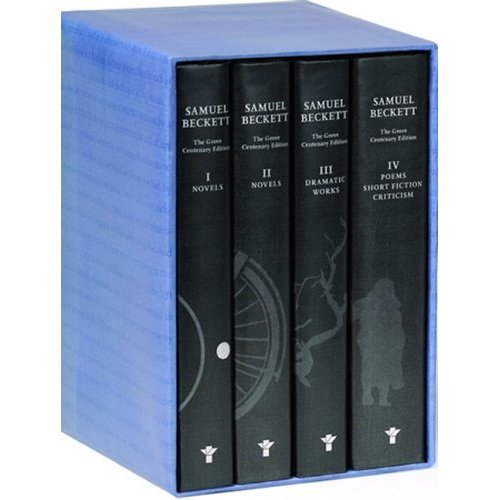
So far as I can tell, there's no European equivalent to Grove Press's 4-volume Centenary Edition of Samuel Beckett's works (published last year, & which I have been carrying about, reading thru, & generally caressing ever since I received my copy for Christmas). No Pleiade Beckett in French, as one might expect, nor has Calder, his English publisher, issued a set analogous or identical to Grove's American enterprise.
Mind you, this is a lovely edition. It brings together almost everything (I'll get back to that "almost") that Beckett ever published in English, or translated into English himself. (A very few of his translations, early on, were done in collaboration with other translators, I assume before Beckett realized the aesthetic potential in the act of self-translation.) The omission of works existing only in French is quite deliberate, according to Paul Auster, the Grove Centenary Edition's (henceforward GCE's) series editor, & he concedes that this means that, however definitive it may be in presenting the works upon which Beckett's vast reputation rests, the edition "does not constitute a Collected Works."
Auster has for the most part chosen wisely in assigning superstar writers to introduce each volume: Colm Tóibín's introduction to the 1st volume of "Irish" novels is excellent; Salman Rushdie's introduction to the 2nd volume of novels – the Trilogy and How It Is – is luminous; & JM Coetze's introduction to the final volume of poetry, short fiction, & criticism is wonderfully hard-nosed & critically uncompromising. (Only Edward Albee's introduction to the Dramatic Works falls short, amounting to a page & a half of noting how really cool Beckett's plays are. Was Harold Pinter, Wole Soyinka, or Tom Stoppard otherwise occupied?)
But I fear, with my own obsessive anality coming to the fore, that I'm still dissatisfied with this edition, despite its lovely design & really wonderful typography – such an improvement over the hodge-podge of mostly dreadfully designed Grove paperbacks in my office. It's about the text, in part. The Grove website claims that "Typographical errors that remained uncorrected in the various prior Grove editions of Beckett's work have been corrected in consultation with Beckett scholars C.J. Ackerley and S E. Gontarski," but the books themselves make no note of textual matters save for the following: "Design and textual supervision by Laura Lindgren." She's done a lovely job of the design, for sure: but I'd feel much better about the texts – Watt is almost legendary for its longstanding corruption – if I'd been at least assured somewhere in the books themselves that real textual editors were on the job. (Ideally, of course, there'd be 20 or 30 pages of textual notes at the end of each volume detailing corrections & variations, but perhaps that's asking too much.)
And then there's the contents themselves: I can entirely understand the GCE's leaving out Beckett's posthumously published works, the novel Dream of Fair to Middling Women & the play Eleuthéria (which was written in French, & which SB himself didn't translate). But Auster is a trifle disingenuous when he claims that all that has been omitted from the 4 volumes are "a number of untranslated French poems and short critical essays." "Those with a knowledge of French," he continues helpfully, "can find them in Collected Poems in English and French and Disjecta, both available from Grove Press." (My inner copyeditor adds that those without a knowledge of French can find them there as well, tho they won't be able to read them.)
A glance at the contents of Disjecta, however, shows one that more than just a few French-language essays have been omitted from the GCE. (For the record, the GCE's "criticism" section consists of precisely 3 items: the Finnegans Wake essay "Dante...Bruno.Vico..Joyce," the book Proust, & the "Three Dialogues" with Georges Duthuit.) Leaving aside the Disjecta pieces in French & German, & leaving aside the various excerpts from letters, there remain almost 20 reviews & notes on writers, poets, & painters – all in English – that for some reason passed thru the GCE's editorial sieve. Reviews & notes on Mörike, on Rilke, on Ezra Pound; on such Irish modernists as Denis Devlin & Thomas McGreevy; on painters Jack B. Yeats & Avigdor Arikha. And finally, a 12-page fragment of Human Wishes, SB's play about Samuel Johnson.
I'm all in favor of honoring authors' posthumous desires about what to publish & what to leave unpublished (tho I suspect Grove's decision not to include Dream of Fair to Middling Women and Eleuthéria had more to do with the fact that they're in print from other publishers than with Beckett's wishes). But these pieces in Disjecta – written in English or translated into English by SB, published in his lifetime with his (grudging) permission – seem to meet all possible criteria for inclusion in the big 4-volume set. It would be silly to claim they're essential bits of the Beckett oeuvre, but I for one would like their exclusion to be explained a bit more clearly.
But enough grousing. Despite its teeny omissions, & despite the "black box" nature of its textual editing, this is my working Beckett from here on out: an extraordinary collection, beautifully produced & wonderfully readable to boot. Nothing like being brought face to face with the emptiness & inanity of human existence thru a nice piece of bibliographic art.
Saturday, September 15, 2007
1st Review!
So I learn, from Bob Archambeau, Charles Bernstein, & various others in far-flung places, that The Poem of a Life: A Biography of Louis Zukofsky, has gotten its first review – by Marjorie Perloff in the 7 September TLS. Well, I'm chuffed, even tho I haven't seen the thing yet, having gooberishly let my subscription lapse.
An appeal then: any of you out there who get the TLS & wouldn't mind passing the issue – or the clipped review therefrom – along to me when you're done? [There are at least 6 nail parlors & 4 posh gyms within a five-mile radius of Culture Industry central, but I've phoned every bookshop & newstand in the book, & nobody carries the damned thing.]
An appeal then: any of you out there who get the TLS & wouldn't mind passing the issue – or the clipped review therefrom – along to me when you're done? [There are at least 6 nail parlors & 4 posh gyms within a five-mile radius of Culture Industry central, but I've phoned every bookshop & newstand in the book, & nobody carries the damned thing.]
Friday, September 14, 2007
unlikely source
Happened upon this bit of sub-Kipling schoolboy good cheer, as writen in an autograph book:
When a bit of sunshine hits youThe author? Samuel Beckett. As biographer Anthony Cronin comments, the boy in whose book Beckett inscribed these lines "thought that they were an accurate reflection of his attitude. It is fairly safe to say that no one would ever think so again."
After passing of a cloud,
And a bit of laughter gets you
And your spine is feeling proud,
Don't forget to up and fling it
At a soul that's feeling blue,
For the moment that you sling it
It's a boomerang to you.
Hamm: Go and see is she dead.Poetics of the pause.
[Clov goes to bins, raises the lid of Nell's, stoops, looks into it. Pause.]
Clov: Looks like it.
[He closes the lid, straightens up. Hamm raises his toque. Pause. He puts it on again.]
Hamm: [with his hand to his toque] And Nagg?
[Clov raises lid of Nagg's bin, stoops, looks into it. Pause.]
Clov: Doesn't look like it.
[He closes the lid, straightens up.]
Hamm: [letting go his toque] What's he doing?
[Clov raises lid of Nagg's bin, stoops, looks into it. Pause.]
Clov: He's crying.
[He closes lid, straightens up.]
Hamm: Then he's living.
Monday, September 10, 2007
Shax?
Now that I'm just pissing blood & tiny pointy shards, as opposed to writhing prostrate in full-flank agony, I can get back to actual blogging. I'm pleased to see my colleague Emily over at Incertus getting exercised by the silliness of the anti-Stratfordians again – always a healthy workout for the cardio-vascular system, I think. Like 6-day Creationists & Holocaust deniers, those who deny Wm Shakespeare's (or as they style it, thinking they're saying something significant, "Shakespere's") authorship of "Shakespeare" will always be with us – indeed, I encourage Creationists & Holocaust deniers to look into the authorship "controversy," since they're liable to do a great deal less harm in that little wing of the grand crank factory than in the world at large.
The whole business is only irritating when celebrities get involved – as with this latest Derek Jacobi/Mark Rylance business, or earlier with John Gielgud & Kenneth Branagh, or Walt Whitman & Charlie Chaplin – because then public attention starts getting drawn to the whole non-question. The problem, of course, is that if there were any real controversy over who wrote Shakespeare, the people capable of solving it would be clear-sighted scholars with an encyclopedic knowledge of Renaissance literature & a firm grasp of early modern culture – the culture of the playhouse, of the literary marketplace, of the publishing industry, & so forth.
It's pretty hard to find such animals among actors & creative writers, I'm afraid. Indeed, a 1st-rate analytical mind, tho it never hurts, is far from necessary equipment for acting well or writing well: Do you want Johnny Depp to do your taxes? To edit your term paper? I adore Yeats & Whitman as poets, but I'm the 1st to admit that their intellects were serious effing muddles. So, frankly, who gives a rat's ass what Derek Jacobi or Mark Rylance think about the authorship question?
Culture Industry has visited the authorship "controversy" at least once before, in connection with an Oxfordian book; it sprang to my mind the other day, when I was googling Henry Peachum & anagrams (don't ask) & fell afoul of a whole nest of mind-bendingly obtuse websites on the subject. In my random moments, I keep coming up with lists of questions to ask the anti-Stratfordians:
1) Since you wonder at the fact that Shax of Straford didn't leave any books in his will, what's the data on books in the wills of other dramatists of the period: Middleton, Chapman, Heywood?
2) No letters in Shax's hand? How many letters do we have from Middleton, Chapman, Fletcher, Ford?
[The problem with demanding of Shakespeare the whole written trail that characterizes someone like Goethe or Wordsworth – autographs in people's notebooks, recounted table-talk, laundry-lists, etc. – is that Shax lived before the author became a celebrity. The William Shakespeare who wrote the plays was not the deified Shakespeare of the 19th & 20th centuries, or even the proto-deified Shakespeare of the 18th. He was simply WS, a player & playwright, a script doctor & collaborator, a guy who worked up old stories into playable scripts & rolfed antiquated plays for a contemporary audience.]
3) If there is really such a paucity of information about Shakespeare – a fairly prolific early modern playwright, though by no means among the most prolific – then name one other early modern playwright (other than Ben Jonson, an indefatigable self-promotional machine) about whom we know as much. Thomas Heywood, who claimed to have had a hand in over 200 plays, but whose birth date we don't know? George Chapman? Thomas Middleton?
4) If, as Derek Jacobi is so convinced, "an author writes about his own experience" – a simple-minded equation essential to the thought-processes (generously so-called) of at least the Oxfordians – please explain Sir Walter Scott's 27 novels, not one of which is based on events of his life. Then explain the personal roots of Robert Browning's dramatic monologues, Alfred Tennyson's Idylls of the King, & Edmund Spenser's Faerie Queene.
Unlike Amy & Emily, I'm not inclined to get worked up over the elitism inherent in claiming that a person of Shakespeare's social background couldn't have written the plays. The elitism's certainly there, & just as ugly as such elitism always is. But everyone who knows literature knows that social elitism simply has no force in the world of letters, that far too many great writers came from the working or middling classes (John Clare, Ben Jonson, Louis Zukofsky, James Joyce) for class origin to be an ultimate bar to the imagination.
Instead, I sympathize and pity the anti-Stratfordians. They love their "Shakespeare" – or some plaster Jesus of a Shakespeare: I've yet to read an anti-Stratfordian book (& I've read way too many of them) that goes beyond a kind of muzzy high-school-level affectionate appreciation of the dramas – so much that they want to know everything about his life. But there is just so little to know about him. So they spend their time constructing Dumas-like conspiracy theories that give the man who wrote the plays an existence as exciting as Lawrence of Arabia's. If they need a new thrill, maybe they should try reading The Seven Pillars of Wisdom.
***
The real scandal in the BBC story, by the way, comes in the last section, where we learn that a copy of the Jacobi/Rylance declaration has been "presented to Dr William Leahy, head of English at London's Brunel University and convenor of the first MA in Shakespeare authorship studies, to be launched later this month." This is, mind you, the equivalent of Georgia Tech announcing that they will be offering an MA in Intelligent Design studies; or MIT announcing a chair in Phlogiston Theory. Isambard Kingdom Brunel – great architect of suspension bridges, chief engineer of the Great Western Railway, builder of the Thames Tunnel – is spinning in his railway-gauge grave.
The whole business is only irritating when celebrities get involved – as with this latest Derek Jacobi/Mark Rylance business, or earlier with John Gielgud & Kenneth Branagh, or Walt Whitman & Charlie Chaplin – because then public attention starts getting drawn to the whole non-question. The problem, of course, is that if there were any real controversy over who wrote Shakespeare, the people capable of solving it would be clear-sighted scholars with an encyclopedic knowledge of Renaissance literature & a firm grasp of early modern culture – the culture of the playhouse, of the literary marketplace, of the publishing industry, & so forth.
It's pretty hard to find such animals among actors & creative writers, I'm afraid. Indeed, a 1st-rate analytical mind, tho it never hurts, is far from necessary equipment for acting well or writing well: Do you want Johnny Depp to do your taxes? To edit your term paper? I adore Yeats & Whitman as poets, but I'm the 1st to admit that their intellects were serious effing muddles. So, frankly, who gives a rat's ass what Derek Jacobi or Mark Rylance think about the authorship question?
Culture Industry has visited the authorship "controversy" at least once before, in connection with an Oxfordian book; it sprang to my mind the other day, when I was googling Henry Peachum & anagrams (don't ask) & fell afoul of a whole nest of mind-bendingly obtuse websites on the subject. In my random moments, I keep coming up with lists of questions to ask the anti-Stratfordians:
1) Since you wonder at the fact that Shax of Straford didn't leave any books in his will, what's the data on books in the wills of other dramatists of the period: Middleton, Chapman, Heywood?
2) No letters in Shax's hand? How many letters do we have from Middleton, Chapman, Fletcher, Ford?
[The problem with demanding of Shakespeare the whole written trail that characterizes someone like Goethe or Wordsworth – autographs in people's notebooks, recounted table-talk, laundry-lists, etc. – is that Shax lived before the author became a celebrity. The William Shakespeare who wrote the plays was not the deified Shakespeare of the 19th & 20th centuries, or even the proto-deified Shakespeare of the 18th. He was simply WS, a player & playwright, a script doctor & collaborator, a guy who worked up old stories into playable scripts & rolfed antiquated plays for a contemporary audience.]
3) If there is really such a paucity of information about Shakespeare – a fairly prolific early modern playwright, though by no means among the most prolific – then name one other early modern playwright (other than Ben Jonson, an indefatigable self-promotional machine) about whom we know as much. Thomas Heywood, who claimed to have had a hand in over 200 plays, but whose birth date we don't know? George Chapman? Thomas Middleton?
4) If, as Derek Jacobi is so convinced, "an author writes about his own experience" – a simple-minded equation essential to the thought-processes (generously so-called) of at least the Oxfordians – please explain Sir Walter Scott's 27 novels, not one of which is based on events of his life. Then explain the personal roots of Robert Browning's dramatic monologues, Alfred Tennyson's Idylls of the King, & Edmund Spenser's Faerie Queene.
Unlike Amy & Emily, I'm not inclined to get worked up over the elitism inherent in claiming that a person of Shakespeare's social background couldn't have written the plays. The elitism's certainly there, & just as ugly as such elitism always is. But everyone who knows literature knows that social elitism simply has no force in the world of letters, that far too many great writers came from the working or middling classes (John Clare, Ben Jonson, Louis Zukofsky, James Joyce) for class origin to be an ultimate bar to the imagination.
Instead, I sympathize and pity the anti-Stratfordians. They love their "Shakespeare" – or some plaster Jesus of a Shakespeare: I've yet to read an anti-Stratfordian book (& I've read way too many of them) that goes beyond a kind of muzzy high-school-level affectionate appreciation of the dramas – so much that they want to know everything about his life. But there is just so little to know about him. So they spend their time constructing Dumas-like conspiracy theories that give the man who wrote the plays an existence as exciting as Lawrence of Arabia's. If they need a new thrill, maybe they should try reading The Seven Pillars of Wisdom.
***
The real scandal in the BBC story, by the way, comes in the last section, where we learn that a copy of the Jacobi/Rylance declaration has been "presented to Dr William Leahy, head of English at London's Brunel University and convenor of the first MA in Shakespeare authorship studies, to be launched later this month." This is, mind you, the equivalent of Georgia Tech announcing that they will be offering an MA in Intelligent Design studies; or MIT announcing a chair in Phlogiston Theory. Isambard Kingdom Brunel – great architect of suspension bridges, chief engineer of the Great Western Railway, builder of the Thames Tunnel – is spinning in his railway-gauge grave.
Friday, September 07, 2007
Embodiment, ii
[Guy Davenport, from the introduction to Montaigne's Travel Journal:]
He is, in a surprisingly modern sense, a tourist, with a tourist's interest in the amenities of the table and the bedroom. He is also, as we are never allowed to forget, a man in pain looking for a cure. His body cannot use certain minerals, such as calcium, which accumulate as pellets in his kidneys and bladder. The pain of a kidney stone is fierce, and in a male can be comparable to a woman's labor. The frequent "colic" in this journal (assuming that to be Montaigne's word for an attack of the stone) is a severe nausea in combination with the feeling that one's back is broken and that one's bowels need to move. Montaigne was fortunate in being able to pass his kidney stones. Another sufferer, Sir Walter Scott, could not, and abided pain of excruciating intensity for as long as two weeks at a time, helplessly screaming and hearing the New Testament read to him. Montaigne's constant scrutiny of his urine in a chamber pot, his colics and dizzy spells, his ability to drink heroic amounts of hot sulfurous water, locate his journal in a time when the body was still part of personality. Later, it would disappear. Dickens' characters, for instance, have no kidney stones because they have no kidneys. From Smollett to Ulysses, there is not a kidney in English literature.
He is, in a surprisingly modern sense, a tourist, with a tourist's interest in the amenities of the table and the bedroom. He is also, as we are never allowed to forget, a man in pain looking for a cure. His body cannot use certain minerals, such as calcium, which accumulate as pellets in his kidneys and bladder. The pain of a kidney stone is fierce, and in a male can be comparable to a woman's labor. The frequent "colic" in this journal (assuming that to be Montaigne's word for an attack of the stone) is a severe nausea in combination with the feeling that one's back is broken and that one's bowels need to move. Montaigne was fortunate in being able to pass his kidney stones. Another sufferer, Sir Walter Scott, could not, and abided pain of excruciating intensity for as long as two weeks at a time, helplessly screaming and hearing the New Testament read to him. Montaigne's constant scrutiny of his urine in a chamber pot, his colics and dizzy spells, his ability to drink heroic amounts of hot sulfurous water, locate his journal in a time when the body was still part of personality. Later, it would disappear. Dickens' characters, for instance, have no kidney stones because they have no kidneys. From Smollett to Ulysses, there is not a kidney in English literature.
Monday, September 03, 2007
Embodiment
 My own relationship with my body is at best an equivocal one – & by body I mean the whole apparatus, from fallen-arched feet to mostly-bald head, including my face, the only aspect of my embodiment to make a regular appearance at this address in cyberspace. Even when I was young, thin, & by some accounts not actively ugly, I regarded my physical body as less me than as a kind of container or sheath by which I presented myself to others.
I suspect such residual Cartesianism is fairly widespread among those in the scribbling trades or doing other intellectual labor. We identify our selves with our minds, with our words. We have no trouble identifying Mikhail Baryshnikov squarely with his physique, with an exquisite overall coordination among brain, talents, skills, & toning. But who would associate the agile graces of Wallace Stevens's lyrics with the portly, hypertensive animal from which they emanated?
And the virtual community of the blogosphere, where one can circulate for years without attaching a face even to the bloggers whose writing you most admire, conduces to a kind of self-disembodiment even as one blogs.
This particular Labor Day Weekend, however, will go down for me as The Weekend Of The Kidney Stone; & nothing about it – save for a few rather pleasant but unfortunately brief opiate-fuelled reveries – has been remotely disembodied.
This is pain, my friends – in long, dull stretches; in concentrated, savage waves; sometimes easily quelled with Percocet or prescription-strength doses of Aleve; sometimes entirely ignoring all pharmacologies – this is pain like I've never experienced. And it make me aware of my dear old flabby, greying, obtuse body with a kind of horrifying intensity.
Subscribe to:
Posts (Atom)
