Above all, I found much of Lire Le Capital critically vague. It is perhaps a matter for regret that logical positivism, with its insistence on precision of intellectual commitment, never caught on in Paris. Anglophone philosophy left logical positivism behind long ago, but it is lastingly the better for having engaged with it. The Althusserian vogue could have unfortunate consequences for Marxism in Britain, where lucidity is a precious heritage, and where it is not generally supposed that a theoretical statement, to be one, must be hard to comprehend. (GA Cohen, Karl Marx's Theory of History)
Post-colonial theorists are often to be found agonising about the gap between their own intellectual discourse and the natives of whom they speak; but the gap might look rather less awesome if they did not speak a discourse which most intellectuals, too, find unintelligible. You do not need to hail from a shanty town to find a Spivakian metaphorical muddle like 'many of us are trying to carve out positive negotiations with the epistemic graphing of imperialism' pretentiously opaque. It is hard to see how anyone can write like this and admire the luminous writings of, say, Freud. Post-colonial theory makes heavy weather of a respect for the Other, but its most immediate Other, the reader, is apparently dispensed from this sensitivity. (Terry Eagleton, Figures of Dissent)
Friday, April 30, 2010

Monday, April 26, 2010
Harry Potter's vocational dilemma
It's kind of embarrassing to admit that I'm reading the Harry Potter novels, even more embarrassing to admit that I'm reading them again. But I'm not going all Adorno-Harold Bloom-highbrow when I say that it's an experience rather less than continuously pleasurable.
Here's the thing: P. (aet. 8) is deeply immersed in the books at the moment, most of the way thru #4, Harry Potter and the Goblet of Fire (or, as I like to call it, HP and the Cauldron of Shit). So I thought the least I could do was to gamely keep up with her, or at least try to stay a few chapters ahead. Problem is, when an 8-year-old is obsessing over a book – or at least our 8-year-old – it's hard to get it away from her to read it yourself. So I powered thru Goblet & into the next, mammoth volume, HP and the Order of the Phoenix (which I'm irritating J. by referring to by a title that makes into a piece of bookish pornography). Just finished this 800-pager earlier today, to the detriment of things that really needed to get read.
For the most part, I find the novels pretty benign stuff. Not particularly well-written, by any means, but not awfully ham-fisted. The allegories are pretty thin, and I dislike the Perry Mason-ish wrapping up that seems to end every volume. Phoenix is of course grotesquely overlong. My memories of the last two books, HP and the Half-Pence and HP and the Healthy Fellows (or something like that), are dim, but I remember them seeming even longer than Phoenix, alas. I think the good guys win in the end.
The scenes in HP & the Order etc. where the batrachian Dolores Umbridge (slimy representative of the Ministry of Magic) takes over the Defence Against the Dark Arts class, banning actual spell practice & forcing the students merely to read their textbooks (theory rather than practice – I'm sure there's an anti-Adorno message buried there) reminded me of a moment in my own educational experience – my ninth grade history class, where some poor schmuck of a teacher (he'd taught driver's ed for 30 years, & suddenly found himself forced to teach American history because of budget cuts) had us sitting in class and reading the textbook aloud.
Of course, Dolores Umbridge is Rowling's jab at educational theorists who prescribe syllabi & courses of study from an ivory tower. But I've never been particularly happy reading Rowling's account of the educational experience of Hogwarts: the kids sit around in class praticing stuff the professor have just shown them (doing spells, mixing potions); for homework, they have to go back to the dorms & write essays (measured by inches of parchment) which look for all the world like regurgitations from their textbooks. The only exception (leaving aside Hagrid's Care of Magical Animals course and Sprout's Herbology) is Binns's History of Magic, which consists of interminable, boring lectures.
So, I keep thinking to myself, is this really the way they do it at Eton? The essay homework, especially, seems to replicate some of the least useful parts of my own education, while I seem to recall having Cuthbert Binns in a social studies class in 7th grade. Why aren't I more convinced by the picture Rowling gives us of the education of a young wizard? Why don't I want to teach at Hogwarts?
The answer came to me the other evening: Howgarts isn't really an old-fashioned "public school" at all, for all its house colors, prefects, & top girls & boys – it's a vocational school. It's not Stalky & Company with potions or Tom Brown's School Days with hexes, but a beauty school or car repair academy with wands and brooms. In the end, Sprout's greenhouses and Hagrid's paddocks are the most true-to-life portions of the Hogwarts panorama, places where the students are getting hands-on experience at things they'll need to know as mature witches and wizards. The other classes, where everybody sits at the desks, facing front (or passing magical notes), is conventional classroom with an overlay of exotic subject matter.
A real live school of Witchcraft & Wizardry, one suspects, would be far more like a martial arts dojo – lots of practice rooms with padded floors & walls, lots of open spaces, lockers, showers, & cubbies. Ah, but then Rowling would have had to reinvent The Karate Kid with wands, & one suspects that wouldn't have quite the cachet of a magical Tom Brown – or at least she probably wouldn't be able to recycle so many school-story stereotypes (kindly headmaster, cranky caretaker, grouchy librarian, etc).
Here's the thing: P. (aet. 8) is deeply immersed in the books at the moment, most of the way thru #4, Harry Potter and the Goblet of Fire (or, as I like to call it, HP and the Cauldron of Shit). So I thought the least I could do was to gamely keep up with her, or at least try to stay a few chapters ahead. Problem is, when an 8-year-old is obsessing over a book – or at least our 8-year-old – it's hard to get it away from her to read it yourself. So I powered thru Goblet & into the next, mammoth volume, HP and the Order of the Phoenix (which I'm irritating J. by referring to by a title that makes into a piece of bookish pornography). Just finished this 800-pager earlier today, to the detriment of things that really needed to get read.
Me: This book is 800 pages long. I could be reading Middlemarch.Why re-reading, you ask? Well, as I've perhaps mentioned once or twice, I have no memory for narrative or character. I remember if I liked a novel or disliked it, if I found it riveting or revolting, I remember a striking character or a vivid scene or a particularly nice piece of writing; but there're very few novels I've read, even ones I've read repeatedly & even taught, whose plot I could accurately summarize. So I knew that if P. asked me even the most simple Hogwartish question about the HP books, I'd need to have them more or less fresh in my mind if I didn't want to destroy her entirely healthy sense of paternal omniscience.
J: Middlemarch is harder; you have to pay attention to the words.
Me: True.
For the most part, I find the novels pretty benign stuff. Not particularly well-written, by any means, but not awfully ham-fisted. The allegories are pretty thin, and I dislike the Perry Mason-ish wrapping up that seems to end every volume. Phoenix is of course grotesquely overlong. My memories of the last two books, HP and the Half-Pence and HP and the Healthy Fellows (or something like that), are dim, but I remember them seeming even longer than Phoenix, alas. I think the good guys win in the end.
The scenes in HP & the Order etc. where the batrachian Dolores Umbridge (slimy representative of the Ministry of Magic) takes over the Defence Against the Dark Arts class, banning actual spell practice & forcing the students merely to read their textbooks (theory rather than practice – I'm sure there's an anti-Adorno message buried there) reminded me of a moment in my own educational experience – my ninth grade history class, where some poor schmuck of a teacher (he'd taught driver's ed for 30 years, & suddenly found himself forced to teach American history because of budget cuts) had us sitting in class and reading the textbook aloud.
Of course, Dolores Umbridge is Rowling's jab at educational theorists who prescribe syllabi & courses of study from an ivory tower. But I've never been particularly happy reading Rowling's account of the educational experience of Hogwarts: the kids sit around in class praticing stuff the professor have just shown them (doing spells, mixing potions); for homework, they have to go back to the dorms & write essays (measured by inches of parchment) which look for all the world like regurgitations from their textbooks. The only exception (leaving aside Hagrid's Care of Magical Animals course and Sprout's Herbology) is Binns's History of Magic, which consists of interminable, boring lectures.
So, I keep thinking to myself, is this really the way they do it at Eton? The essay homework, especially, seems to replicate some of the least useful parts of my own education, while I seem to recall having Cuthbert Binns in a social studies class in 7th grade. Why aren't I more convinced by the picture Rowling gives us of the education of a young wizard? Why don't I want to teach at Hogwarts?
The answer came to me the other evening: Howgarts isn't really an old-fashioned "public school" at all, for all its house colors, prefects, & top girls & boys – it's a vocational school. It's not Stalky & Company with potions or Tom Brown's School Days with hexes, but a beauty school or car repair academy with wands and brooms. In the end, Sprout's greenhouses and Hagrid's paddocks are the most true-to-life portions of the Hogwarts panorama, places where the students are getting hands-on experience at things they'll need to know as mature witches and wizards. The other classes, where everybody sits at the desks, facing front (or passing magical notes), is conventional classroom with an overlay of exotic subject matter.
A real live school of Witchcraft & Wizardry, one suspects, would be far more like a martial arts dojo – lots of practice rooms with padded floors & walls, lots of open spaces, lockers, showers, & cubbies. Ah, but then Rowling would have had to reinvent The Karate Kid with wands, & one suspects that wouldn't have quite the cachet of a magical Tom Brown – or at least she probably wouldn't be able to recycle so many school-story stereotypes (kindly headmaster, cranky caretaker, grouchy librarian, etc).
Friday, April 23, 2010
endgame; unfriending the prophets

Tuesday is the last full day of classes, so everything is more or less winding down around here. For some reason, it's been an exhausting semester, even moreso than usual. Maybe I'm just getting old? Or losing my patience?
Our Fair University scheduled its "Authors Reading Series" at the same time as my postwar American poetry grad seminar this Spring, so an ungodly proportion of class time got sacrificed to going to readings: first, a prize reading of MFA program students; then Forrest Gander; and last night, my colleague poet & translator Becka McKay (whose new book, A Meteorologist in the Promised Land, is well worth checking out). Now all of these were good readings, & well worth attending, but they played havoc with my syllabus. As I muttered grumpily to my department chair last night, "Do this to me again & I'm quitting."
I did plenty of gadding about: First a trip to Boise to talk about biography & LZ, then the Louisville Conference; next month it's San Francisco for the ALA, where I'll be on a panel about biographies of 20th-c. American poets. That should be fun, but I'm wishing I could be in Miami (OH) for post-moot right now, or that I could be at the Duncan symposium in Chicago. (Or that I had Hermione Granger's time-turner & could be at both...)
Anyway, I have a few days of breathing room before the final flood of papers, exams, & portfolios washes over me. Maybe I'll try to read a book. Or write some of one.
***
Unfriend. That was the "word of the year" last year, according to the Oxford people. (I found it not once but twice in my last read-thru of Lyrical Ballads, but I suppose Wordsworth's "unfriended" is rather different from "unfriending" someone on Facebook.) I'm not the most assiduous Facebooker, but I suppose I'm as addicted as the next socially-maladjusted academic; ie, checking FB no less than 10 or 15 times a day, commenting obsessively on the things I like or don't like, following links, checking out profiles, & so forth.
I haven't unfriended people very often. (For those who don't follow this business, to "unfriend" means to remove someone from your "friends list" – to sever the connection that has people showing up in each others "news feed" etc.) That's mainly because I only ask to become friends with people whom I know, or whose work I know, & tend to ignore friend requests from people I don't know anything about. (Or, for that matter, from old high school acquaintances with whom I obviously have less than nothing in common anymore.) I've never quite understood the logic of becoming "friends" with 1500 people, unless you've got something to sell – oh, okay, never mind.
Facebook, for all the bitching people do about it, is pretty user-friendly about these kinds of things; if I want to maintain a "friend" status with a high school acquaintance, but my blood pressure can't stand the barking lunacy of the tea-party posts he keeps putting up, I can set the controls so that his status updates are "hidden" from me. And if I go so far as to unfriend someone, they don't even receive a notice – I just don't show up in their news feeds anymore. (I've been unfriended a few times – gosh, I wondered a while back, why aren't I getting updates from that über-hip UC Davis poet/cultural critic anymore? Well, he's been trimming his friends list, & I was dead wood.)
The other day, I found myself so exasperated by the latest series of posts in one chap's ongoing magnum opus of cultural history – posted in five or six daily installments, a relentless attack on contemporary poetry as symptomatic of the decline of Western values in the wake of some vaguely-defined "postmodernism," and "substantiated" with a series of cursory readings of 70s-era work by such up-t0-the-minute hipsters as Robert Bly, James Wright, & WS Merwin, & punctuated with snarky asides about the intellectual & moral vacuity of the contemporary academy – that I found myself engaged in a comment battle. "Elijah" (as I'll call this chap) is it turns out himself a fugitive from the academy, the editor of a fairly well-respected poet's posthumous collected works, & a fervent member of the Baha'i faith, in whose beliefs I suspect he grounds his prophetic calls for a renewal of "mimesis" in poetry in order to pave the way for the single-society world order towards which we're all evolving.
I have a soft spot for utopianism, but little patience with soft-headed utopianism, or with blanket condemnations of contemporary poetic & intellectual culture that seem to be grounded on little more than ideologically-saturated mantras. And heaven help me, but I told Elijah so, announced that my patience was at an end, & unfriended him. (He'll be okay – he's got an audience of some 1200 folks out there, or at least that many "friends.")
But it made me think. Elijah of Facebook has set himself up, not as a rational analyst of society & culture, but as a prophet, a voice crying in the wilderness. Stanley Fish, in How Milton Works, has a beautifully apposite description of Milton's method in the Apology:
almost everything in the world appears to be going in one direction, but a single just man (like Abdiel and the solitary heroes who periodically turn up in the otherwise bleak narrative of books XI and XII of Paradise Lost) knows better, and loudly proclaims his better knowledge – all the while refusing to defend or support it by the usual evidentiary standards, refusing to measure himself "by other mens measures."That's Elijah right there, staunch in his own rightness, never conceding an ell or an inch to counter-argument, satisfied in his ignorance of the last 30 years of the poetry he rails against.
But it occurs to me, if a real-live prophet appeared among us, a thinker whose ideas were so radically against the grain of contemporary trends and common knowledge, wouldn't he similarly appear no better than a crank, a "lunatic of one idea" (Stevens's term)?
Of course, Elijah's not the man – it's all too easy to parse out his "radicalism" as a slightly gamey casserole of Baha'ism & 50s-style cultural conservatism: Jacques Barzun + mysticism. I love reading the Hebrew prophets, and I love reading latter-day prophetic types like Blake, Milton, Ruskin, etc. – but Ishtar help us, soi-disant prophets can be so boring.
Friday, April 16, 2010
a shilling life
My idiosyncracies may not be particularly fruitful, but they're mine, & I have to own up to 'em. It occurred to me the other day as I finished Francis O'Gorman's Ruskin (Sutton Pocket Biographies) (Sutton, 1999) that I've got a real taste for what I can only call "highbrow fast food." That is, while I have more than a half-dozen full-length biographies of John Ruskin on my shelves (& have even read a bunch of them), I also persist in running thru the various super-short capsule "shilling lives" I come upon.
The recent history of the capsule biography – has it been written?? – is I suspect a capsule history of 20th-century intellectual marketing trends. We see capsule biographies, as in Diogenes Laertius' lives of the philosophers, in Plutarch, or in Johnson's Lives of the Poets, emerging even before the full-length biography. And they don't go away with the advent of the post-Boswellian doorstop biography: witness Leslie's Stephen's Dictionary of National Biography, and its various spinoffs.
In the latter part of the 20th century, it seems, short-scale biographical/critical studies, aimed at a wide readership, have gotten even more popular. Should this be dated to the inception of the Frank Kermode-edited Fontana Modern Masters series in 1970? Oxford UP responded to the popularity of the Fontana volumes with its own Past Masters series, & in recent years there seems to have been a spate of "Very Short Introductions," pocket lives, & even graphic novel-style adaptations of various figures' lives. (The interchangeability of many of these series is striking – various volumes of the OUP "Very Short Introductions" series are actually reprints of "Past Masters" volumes.)
Is it all an index of a general readership's thirsty demand for immediate enlightenment? Or is it a symptom of our painfully shrinking attention spans?
***
Herewith an assessment of some of the Ruskin "shorties" out there (if you know of others, do let me know):
Quentin Bell's Ruskin (George Braziller, 1978), which came from my father's library, & was the first Ruskin book I ever read, doesn't quite fit in the "capsule biography" category; it was first published in 1963 as part of the Hogarth Press's "Writers and Critics" series, & is actually quite a substantial assessment of JR's life & career, clocking in at around 150 beautifully-written pages. This is probably still the first book (not by Ruskin) I'd press on someone wanting to know more about Ruskin.
George P. Landow is one of the best of the old-school Ruskin scholars, proprietor of the excellent Victorianweb research site. His The Aesthetic and Critical Theories of John Ruskin (Princeton UP, 1971) is exhaustive & exhausting, but his Ruskin (1985) in the Oxford "Past Masters" series does a splendid job of surveying the life & work in about 90 pages.
Robert Hewison is the most prolific Ruskin scholar I know, paying particular attention to Ruskin's art criticism (of the many Ruskin books he's published, several are exhibition catalogues). Hewison's John Ruskin (2007), in the OUP "Very Interesting People" series, is on its face longer than Landow by about 30 pages, but in reality quite a bit shorter, as it's printed in a larger typeface with far more generous margins & spacing. The "Very Interesting People" series is really just another Oxford recycling project – the series, which features David Levine-style pen & ink caricatures on the covers, & describes itself as "Bite-sized biographies of Britain's most fascinating historical figures, amounts to paperback reprints of some of the more substantial entries in the 2004 Dictionary of National Biography. As befits a DNB entry, Hewison's life of Ruskin is sober & informative, but it's far less lively & searching than Landow's.
Alas, Francis O'Gorman's Ruskin (Sutton, 1999) is the loser among this bunch. The Sutton Pocket Biographies are "Highly readable brief lives of those who have played a significant part in history, and whose contributions still influence contemporary history." For "highly readable," I'm tempted to read "dumbed down." Fontana's Modern Masters & Oxford Past Masters, for all their implicit popular appeal, never condescended: Jonathan Culler on Saussure or Barthes, Martin Esslin on Artaud, Donald Davie on Pound (all Fontana), Anthony Kenny on Aquinas, Rosemary Ashton on George Eliot, Peter Singer on Hege (all Oxford) – all of these were highly sophisticated advanced introductions. But O'Gorman, who's done his share of real Ruskin criticism, seems to take his assignment from Sutton as a kind of scholarly holiday, chance to ramble over the life & trot out a few touchstone quotations from Ruskin; the Sutton Ruskin is breezy, readable, & in the end as forgettable as a 50-minute History Channel biography.
So there, Ruskinian Padwan: begin with Bell, if you can find him. If not, read Landow (read Landow anyway). Hewison is optional; O'Gorman is not recommended.
Of course, what I'm really hoping for is the graphic novel Ruskin (cf. the "For Beginners" series). If there's an artist who's itching to draw JR, I'm game to script it.
The recent history of the capsule biography – has it been written?? – is I suspect a capsule history of 20th-century intellectual marketing trends. We see capsule biographies, as in Diogenes Laertius' lives of the philosophers, in Plutarch, or in Johnson's Lives of the Poets, emerging even before the full-length biography. And they don't go away with the advent of the post-Boswellian doorstop biography: witness Leslie's Stephen's Dictionary of National Biography, and its various spinoffs.
In the latter part of the 20th century, it seems, short-scale biographical/critical studies, aimed at a wide readership, have gotten even more popular. Should this be dated to the inception of the Frank Kermode-edited Fontana Modern Masters series in 1970? Oxford UP responded to the popularity of the Fontana volumes with its own Past Masters series, & in recent years there seems to have been a spate of "Very Short Introductions," pocket lives, & even graphic novel-style adaptations of various figures' lives. (The interchangeability of many of these series is striking – various volumes of the OUP "Very Short Introductions" series are actually reprints of "Past Masters" volumes.)
Is it all an index of a general readership's thirsty demand for immediate enlightenment? Or is it a symptom of our painfully shrinking attention spans?
***
Herewith an assessment of some of the Ruskin "shorties" out there (if you know of others, do let me know):
Quentin Bell's Ruskin (George Braziller, 1978), which came from my father's library, & was the first Ruskin book I ever read, doesn't quite fit in the "capsule biography" category; it was first published in 1963 as part of the Hogarth Press's "Writers and Critics" series, & is actually quite a substantial assessment of JR's life & career, clocking in at around 150 beautifully-written pages. This is probably still the first book (not by Ruskin) I'd press on someone wanting to know more about Ruskin.
George P. Landow is one of the best of the old-school Ruskin scholars, proprietor of the excellent Victorianweb research site. His The Aesthetic and Critical Theories of John Ruskin (Princeton UP, 1971) is exhaustive & exhausting, but his Ruskin (1985) in the Oxford "Past Masters" series does a splendid job of surveying the life & work in about 90 pages.
Robert Hewison is the most prolific Ruskin scholar I know, paying particular attention to Ruskin's art criticism (of the many Ruskin books he's published, several are exhibition catalogues). Hewison's John Ruskin (2007), in the OUP "Very Interesting People" series, is on its face longer than Landow by about 30 pages, but in reality quite a bit shorter, as it's printed in a larger typeface with far more generous margins & spacing. The "Very Interesting People" series is really just another Oxford recycling project – the series, which features David Levine-style pen & ink caricatures on the covers, & describes itself as "Bite-sized biographies of Britain's most fascinating historical figures, amounts to paperback reprints of some of the more substantial entries in the 2004 Dictionary of National Biography. As befits a DNB entry, Hewison's life of Ruskin is sober & informative, but it's far less lively & searching than Landow's.
Alas, Francis O'Gorman's Ruskin (Sutton, 1999) is the loser among this bunch. The Sutton Pocket Biographies are "Highly readable brief lives of those who have played a significant part in history, and whose contributions still influence contemporary history." For "highly readable," I'm tempted to read "dumbed down." Fontana's Modern Masters & Oxford Past Masters, for all their implicit popular appeal, never condescended: Jonathan Culler on Saussure or Barthes, Martin Esslin on Artaud, Donald Davie on Pound (all Fontana), Anthony Kenny on Aquinas, Rosemary Ashton on George Eliot, Peter Singer on Hege (all Oxford) – all of these were highly sophisticated advanced introductions. But O'Gorman, who's done his share of real Ruskin criticism, seems to take his assignment from Sutton as a kind of scholarly holiday, chance to ramble over the life & trot out a few touchstone quotations from Ruskin; the Sutton Ruskin is breezy, readable, & in the end as forgettable as a 50-minute History Channel biography.
So there, Ruskinian Padwan: begin with Bell, if you can find him. If not, read Landow (read Landow anyway). Hewison is optional; O'Gorman is not recommended.
Of course, what I'm really hoping for is the graphic novel Ruskin (cf. the "For Beginners" series). If there's an artist who's itching to draw JR, I'm game to script it.
Tuesday, April 13, 2010
collected works

The semester is winding down, I suppose; there're only a couple more weeks of classes, for the nonce I'm not facing anything that I have to grade, & I'm thinking forward to the Fall. Book orders, that is. I'm teaching a graduate poetry workshop, which is always fun, always an adventure. Between now & the end of July, I guess, I'll settle on a half dozen or 8 recent books of poetry to discuss. Suggestions for assigned texts would be welcome. (If you want me to consider your book, of course, I need to have read a copy – hint, hint.)
The undergraduate Milton class is a bit more of a challenge. I love teaching Milton, have done it maybe four times before. The first couple of times I assigned the more or less recent Riverside Milton, edited by Roy Flannagan; it's got all of the texts I'd want to teach (and many more), presents them in original spelling, and has fairly useful introductions to each selection. But the book, to be frank, isn't a patch on the Riverside Shakespeare and the Riverside Chaucer, two really landmark, rock-solid edition: where they have neatly segregated textual notes and super-clean glosses and explanatory notes, Flannagan bungs all of his annotations – textual, word-defining, interpretive, explanatory, speculative, and (occasionally) just plain wrong – into these huge blocks at the foot of the page. Hey, I live for this scholarly stuff, & even I'm put off by the way the book's presented. (I find I've blogged this same kvetch almost 4 years ago; sigh.)
So a couple of Milton courses back, I switched to Merritt Y. Hughes's John Milton: Complete Poetry and Major Prose, an edition that first came out in 1957, & that's now in print from Hackett. It doesn't have original spelling – which in the case of Paradise Lost may not really be an issue, given that Milton was blind at the time & didn't really have control over the orthography – but its annotations are rather lighter than Flannagan's (maybe too light), and its introductions are much sketchier.
What I'd really like to use is David Kastan's super-fine recent edition of Paradise Lost, plus a volume of the prose, plus a volume of the short poems. But the only semi-affordable prose I can find is Patrides's U Missouri edition of the Selected Prose, which seems to be running about $25 these days (for a wee paperback); and any available decent volume of the short poems is simply outrageously expensive. (You see, I'm thinking of my students.) I suspect I'll hie me to Barnes & Noble sometime in the next few days to check out the recent Modern Library Complete Poetry and Essential Prose, which looks pretty darned decent from what I can see of it in the Amazon preview.
***
Looking back over Milton again has made me think of that odd notion of "covering" or "mastering" an author. I've read all of JM's poetry, much of it multiple times, and I've probably been thru between 50% & 75% of his prose. There aren't a lot of writers I can honestly say I know the whole of. (Of course, I've read everything LZ ever wrote, but he's an exception.) I know all of WC Williams's poetry, but his fiction, plays, and much of his prose are terra incognita. I've read all of Shakespeare's plays and most of his other poetry, but there are a few items of the canon that I've managed to avoid. Faulkner, I know maybe 6 or 7 novels. Woolf, all the novels except 3, but very little of the stories or essays. There are large bodies of writing out there I'd love to plunge into, but am daunted by the sheer breadth and variety of achievement: Wyndham Lewis (I've read Apes of God and Tarr, but nothing else); George Eliot (Daniel Deronda and – too long ago – Middlemarch).
I can understand why some people become Joyceans and more or less get stuck there. It's a large and very rich universe, the big 4 (Dubliners, Portrait, Ulysses, & the Wake) & their minor outriders, but it's also a wholly manageable bigness. I could happily reread Ulysses every couple months till I die, if I had the time. Or Melville, for that matter, though there's a bit more variety there – a Dickens-sized corpus, rereadable on a yearly basis, if that's your inclination.
Which is why I'm fascinated and daunted at the same time by the big maroon monster to the left of my desk: the Ruskin Library Edition, all 39 volumes of hugeness. They probably average out to 500 pages or so apiece, and even after you shave off the 2 volumes of bibliography and index, that still leaves you with something like 18,000 pages of Ruskin to tackle. Quentin Bell, in the preface to his excellent little book on Ruskin, recalls spending an entire year reading thru the Library Edition – but he was careful to add, he wasn't reading anything else, either.
I've probably read more Ruskin than most scholars of 20th- & 21st-century poetry (maybe more than some Victorianists): several volumes of Modern Painters, all of Fors Clavigera, one of Stones of Venice, 7 Lamps of Architecture, Praeterita, all of the social & political volumes, and between a half-dozen and a dozen of thises & thats. Most of these have been read in other editions than the Library Edition, but I reckon I've covered the material in maybe 12 or 13 of the LE volumes. Which leaves a daunting amount of Ruskin still to be read. I'm not surprised that there are a few Ruskinians out there who seem to do nothing else – David Hewison, for instance, who at last count has published 6 or 7 books on Ruskin. And I'm not surprised that there aren't more, for the sheer bulk of the guy's output feels like a kind of vortex into which one can get sucked & never write about anything else again.
For heaven's sake, I've spent too many years being introduced as "the LZ guy" (why not, "that guy who writes for Parnassus," or "minor poet, not conspicuously dishonest"?); perhaps the only move I could make into deeper obscurity would be to become "the Ruskin scholar MS."
Tho, to tell the truth, "the Wyndham Lewis scholar MS" sounds even obscurer.
Monday, April 12, 2010
Julie Carr: 100 Notes on Violence
This winds up the "100 poem-books" project that I so sanguinely began a bit over (gulp) 2 years ago, expecting to dash thru it in maybe 14 months. It's not that I didn't read that many slim (& fat) volumes of contemporary (& older) verse in the year after I started blogging books & putting 'em under this rubric, it's just that, well, there were lots that I didn't feel were really worth blogging about; and there were others that just so knocked me out that I dithered around, thinking about what I'd write, until something else came up; and there were times when I just plain got lazy. So sue me. You can have your money back.
My OCD is awfully fond of numbering things & keeping track of them, however. (Hey, I just finished cataloguing all the books in my office at work!) I suspect I'll continue numbering "notices" of poem-books & tagging them with the tag "more poem-books."
***
100 Notes on Violence, Julie Carr (Ahsahta, 2009)
A beautiful, large-format book with some very ugly things inside, a kind of tour of the American culture of hurt, with special attention to domestic violence against women and the consequences of keeping handguns around the house. Carr has a delicate ear, & her segments are often kinds of mobiles of suspended syntax & thoughtful music (that music, interestingly enough, is often country music), pressed up against sections of dense statistics (gun ownership, death rates, etc.) or intimidating text-blocks presenting the roiling insides of people in the grip of "vengeance" or other varieties of Homeric anger. What's most initially compelling, however, beyond the formal variety of the 100 "notes," is the degree to which Carr speaks in a personal voice; her narrative of her own upbringing & its emotional violence, her lyrics of maternal protection, have an stark attraction that sets all of the book's news-derived material into a frame of emotional immediacy. Of course, she may be making up the "personal" bits – I don't know; and I don't really care: they work, they take the poem beyond reportage & ventriloquizing into a space of scary realism.
(Now that I think about it, the book 100 Notes on Violence most resembles for me at the moment is Rukeyser's Book of the Dead. Go figure.)
[100/100]
My OCD is awfully fond of numbering things & keeping track of them, however. (Hey, I just finished cataloguing all the books in my office at work!) I suspect I'll continue numbering "notices" of poem-books & tagging them with the tag "more poem-books."
***
100 Notes on Violence, Julie Carr (Ahsahta, 2009)
A beautiful, large-format book with some very ugly things inside, a kind of tour of the American culture of hurt, with special attention to domestic violence against women and the consequences of keeping handguns around the house. Carr has a delicate ear, & her segments are often kinds of mobiles of suspended syntax & thoughtful music (that music, interestingly enough, is often country music), pressed up against sections of dense statistics (gun ownership, death rates, etc.) or intimidating text-blocks presenting the roiling insides of people in the grip of "vengeance" or other varieties of Homeric anger. What's most initially compelling, however, beyond the formal variety of the 100 "notes," is the degree to which Carr speaks in a personal voice; her narrative of her own upbringing & its emotional violence, her lyrics of maternal protection, have an stark attraction that sets all of the book's news-derived material into a frame of emotional immediacy. Of course, she may be making up the "personal" bits – I don't know; and I don't really care: they work, they take the poem beyond reportage & ventriloquizing into a space of scary realism.
(Now that I think about it, the book 100 Notes on Violence most resembles for me at the moment is Rukeyser's Book of the Dead. Go figure.)
[100/100]
Wednesday, April 07, 2010
Indefatigable Milton
With my normal skewed sense of immediate priorities, I'm reading around towards the Milton course I'll be teaching this coming Fall (get it – "fall"?). Paradise Lost moves along nicely at a book a sitting, especially in David Kastan's better-than-excellent Hackett edition (a revision of the Merritt Hughes standby). J. came back from the Shakespeare Association with a stack of book table display copies for me, including the luscious recent biography, John Milton: Life, Work, and Thought by Gordon Campbell and Thomas M. Corns. I've only read two lives of JM: Peter Levi's Eden Renewed (well-written but bad) and Barbara Lewalski's enormous biography-of-record.
But the real prize is Annabel Patterson's latest book, Milton's Words (OUP, 2009), a little examination of how Milton uses various "keywords" over his career. I'm only far enough in to be delighted with Patterson's deft prose and amazing gift for analytic summary, but she gives a lovely taste of what's to come in the introduction, where she looks at the fortunes of the rather rare word "indefatigable" (one of those polysyllabic Latin borrowings – Seneca, De Ira – that give my students headaches). Milton uses it only twice, once in Areopagitica (referring to Parliament's "indefatigable Vertue") and once in Paradise Lost.
But before Milton's epic, it was used twice by Milton's friend Andrew Marvell, both times in connection with Oliver Cromwell. In the "Horatian Ode," he addresses the Lord Protector thus:
For his part, Milton takes the word and gives it – yes – to Satan, as the fallen angel describes to his comrades the dangers of his prospective venture to the newly-created Eden:
But the real prize is Annabel Patterson's latest book, Milton's Words (OUP, 2009), a little examination of how Milton uses various "keywords" over his career. I'm only far enough in to be delighted with Patterson's deft prose and amazing gift for analytic summary, but she gives a lovely taste of what's to come in the introduction, where she looks at the fortunes of the rather rare word "indefatigable" (one of those polysyllabic Latin borrowings – Seneca, De Ira – that give my students headaches). Milton uses it only twice, once in Areopagitica (referring to Parliament's "indefatigable Vertue") and once in Paradise Lost.
But before Milton's epic, it was used twice by Milton's friend Andrew Marvell, both times in connection with Oliver Cromwell. In the "Horatian Ode," he addresses the Lord Protector thus:
But thou the Wars and Fortunes Son(Whoosh – three whole feet of the tetrameter taken up with a single latinate adverb – don't try this at home, kids!) And in "The First Anniversary of the Government under O.C.," Marvell writes of how "indefatigable Cromwell hyes / And cuts his way still nearer to the Skyes."
March indefatigably on.
For his part, Milton takes the word and gives it – yes – to Satan, as the fallen angel describes to his comrades the dangers of his prospective venture to the newly-created Eden:
Who shall tempt with wandring feetOf this, Patterson writes:
The dark unbottom'd infinite Abyss
and through the palpable obscure find out
His uncouth way, or spread his aery flight
Upborne with indefatigable wings
Over the vast abrupt. (2.404-9)
You can see that Milton has learned from Marvell the art of fitting that "uncouth" word smoothly into verse. You can see that here the first two un-words are not positives disguised as negatives but actual negatives, scary with the idea of free fall and unknown territory. You might infer, therefore, and especially because it is Satan speaking, speaking speciously, that 'indefatigable' is here also not a positive disguised by syntax as a negative, but a negative doubly darkened by its context. So what does it say to Marvell's second Cromwellian 'indefatigable', which also imagines a flying superhuman figure? I cannot believe that these astonishing words, used only twice by Milton, are not cross-references to each other and Marvell's, implying that Satan is the dark shadow of Marvell's heroic Cromwell. We know that by 1667, when he published Paradise Lost, Milton no longer shared his friend's admiration for Cromwell; he had also, by the way, demolished his own image of a heroic Long Parliament. (7-8)I don't know whether Patterson will keep up this kind of wonderful intellectual nimbleness over all 200 pages of this small book, but I anticipate a kind of heaven of close reading, concordance work, and historical contextualization.
Saturday, April 03, 2010
Ruskin & pubic hair
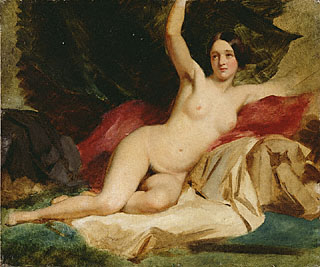 [William Etty, Female Nude (1820)]
"I was told in art school that it was her pubic hair," Martin Corless-Smith opined to me in Boise back in February. The reason, that is, that Ruskin never consummated his 1848 marriage to Euphemia ("Effie") Gray. During the annulment proceedings 6 years later, Effie Ruskin testified that her husband told her "he had imagined women were quite different to what he saw I was, and that the reason he did not make me his Wife was because he was disgusted with my person the first evening April 10th." Ruskin, in his own affidavit, said that "though her face was beautiful, her person was not formed to excite passion. On the contrary, there were certain circumstances in her person which completely checked it." But the doctors who examined Effie in 1854 and pronounced her a virgin noted nothing unusual about her "person"; she would go on to have 8 children with John Everett Millais. So how then had Ruskin misimagined the female form? what was the source of his "disgust"? what about Effie's body checked his "passion"?
For a while in the last century, the theory that Ruskin was freaked out that his wife had pubic hair – he knew only the hairless mounds of classical nude statuary and renaissance painting, the story went – had some currency (Mary Lutyens, who published three full books on the Ruskin marriage, is the source of this one). It's a story that has had legs – I know it's figured in at least 3 poems over the last couple decades (for the record, by John Matthias, Ben Downing, & yr. humble blogger). But Ruskin told his parents in a letter that he had undergraduate acquaintances at Oxford whose drawers were full of "pictures of naked bawds" – presumably unclipped ones. And the Victorian painter William Etty (see above) did pictures which presented the female form in fully unshorn form. So the pubic hair thesis, if not quite untenable, is rather less than convincing.
Was Effie having her period, as one scholar whose work I can't lay hands on speculates? Was it something else, heaven knows what? The precise reason for Ruskin's apotropaic reaction to his wife's anatomy is finally as unrecoverable as the first draft of Book I of Carlyle's French Revolution (which John Stuart Mill's maid burnt as scrap paper). And that's one of the reasons I find it so fascinating. Imagine – an essay ranging over the history of early Victorian representations of the nude (with special attention to pubic hair), over Victorian pornography (the "naked bawds" of the Oxford undergrads), over the sexual preparations & expectations of the young & hopelessly naive products of evangelical Scottish families – & going from there to Ruskin's discovery of JMW Turner's pornographic – yes, okay, he's a great artist, so I should say "erotic," but golly, some of them are just plain pornographic – sketches & the long and murky history of whether or not Ruskin burned them.
So that was what was on my mind when I stumbled over this article, an announcement in the Guardian that Emma Thompson has scripted a new film, now in production, that focuses on Ruskin & his marriage – or rather, on Effie Ruskin & her marriage to the critic. Now I yield to no one in my infatuated admiration for Emma Thompson, but I have deep misgivings about this project. Thompson's husband Greg Wise, who's producing the film & playing Ruskin, seems to have only a hazy grasp of his subject, judging by his remarks here: "He is a pin-up for many artists and was Gandhi's hero too." At any rate, if there's a major film in the works on the subject, maybe I should stop ruminating on Ruskin & pubic hair & get back to actually reading his works.
On that front, I'm working thru Modern Painters II again, this time in the Library Edition, after a detour thru the bulk of the mid-period works on political economy. I'm also trying to tackle the secondary literature in a less scattershot manner than previously. For instance, I've just finished John D. Rosenberg's The Darkening Glass: A Portrait of Ruskin's Genius (Columbia UP, 1961), which can be said to have inaugurated "serious" modern Ruskin studies. It's a very smart book indeed, a cleanly written and enthusiastic overview of JR's career. Rosenberg doesn't mince words when he finds Ruskin falling into silliness or incoherence; nor, a bit more wincingly for me, does he restrain himself from gushing when he finds Ruskin compelling, particularly on the political economy: Unto This Last is great because "Its power is that of truth [my emphasis], as relevant to our age of superabudance as to Ruskin's of relative scarcity." Ouch. But then again – he's right, isn't he? and when's the last time you read a critic use the word "truth" without a trace of irony (& isn't that a trifle refreshing)?
placeholder
It seems somehow anticlimactic that Culture Industry's 750th post is literally a placeholder – a kind of busy, hasty, "I'm not dead yet." It's been a gruelling semester. Conferences & lectures here and there, longish stretches of solo parenting. This past week has been the girls' spring break, which meant lots of juggling back and forth, last-minute favors called in from babysitters, etc. And now J. is away having a marvelous time in Chicago at the Shakespeare Association of America, while I'm left with the responsibility of replacing a bunch of busted home electronics, planning an Easter dinner of sorts, and generally keeping the premises from going up in smoke.
Forrest Gander just wound up a stretch at Our Fair University as the Generous Benefactor Visiting Writer. Gave a nice talk on translation Tuesday & a lovely reading last night, and by all accounts ran a provocative & very fruitful intensive workshop. A very nice man, something which doesn't always go along with being a very good poet.
The postperson & Mr/Ms UPS have been good to me lately. Michael Heller's latest collection of poems, Beckmann Variations and Other Poems, turned up in the box the other day – I can't wait to read this one, if only to see whether he's been able to top the magnificent Eschaton from last year. Today the brown truck dropped off Bob Archambeau's long-awaited Laureates & Heretics: Six Careers in American Poetry; okay, I'll admit to having blurbed this one, so you know I recommend it.
I fired off an email to Cambridge University Press the other week:
Forrest Gander just wound up a stretch at Our Fair University as the Generous Benefactor Visiting Writer. Gave a nice talk on translation Tuesday & a lovely reading last night, and by all accounts ran a provocative & very fruitful intensive workshop. A very nice man, something which doesn't always go along with being a very good poet.
The postperson & Mr/Ms UPS have been good to me lately. Michael Heller's latest collection of poems, Beckmann Variations and Other Poems, turned up in the box the other day – I can't wait to read this one, if only to see whether he's been able to top the magnificent Eschaton from last year. Today the brown truck dropped off Bob Archambeau's long-awaited Laureates & Heretics: Six Careers in American Poetry; okay, I'll admit to having blurbed this one, so you know I recommend it.
I fired off an email to Cambridge University Press the other week:
Dear Cambridge University Press:Lo & behold, CUP has done the right thing; in my university mailbox yesterday, I found a brand spanking new copy of said volume, this one with all of its pages printed on. If anyone wants a nicely bound CUP book to play Tom Phillips or William Blake with, drop me a line (& some postage).
Several years ago I purchased a copy of David Loewenstein's Representing Revolution in Milton and His Contemporaries: Religion, Politics, and Polemics in Radical Puritanism (CUP, 2001, ISBN 0-521-77032-7). I don't remember where I bought it -- either at a bookstore in New York City or from a vendor at a conference; at any rate, I recall investing a rather large amount of money in it, something like sixty dollars. (And no, I have not retained a receipt from when I purchased the book. There is only so much paper one can save.)
The book sat on my shelf among my Milton titles until a few weeks ago, when I began reading it in preparation for the Milton course I'll be teaching this coming Fall semester. The first few chapters are just fine: informative, if rather blandly written. So, in anticipation of Professor Loewenstein's insights into the political resonances of Paradise Lost, I leapt forward to the Milton material in the second half of the book. You can imagine my discomfiture to find that throughout a rather long section of the book, a significant number of the pages are entirely blank! To be precise, where pages 180-1, 184-5, 188-9, 192-3, 196-7, 200-1, 204-5, and 208-9 ought to be, there are only clean swatches of utterly white paper. While nothing really surprises me anymore, I have a hunch that Professor Loewenstein is not the sort of scholar who indulges in radically postmodern formal games; this is, in short, a defective copy of the book, and at the moment mostly useless to me.
How can I go about replacing this beautifully bound but internally flawed Cambridge UP production? I would be more than happy to post the book your way, so that the folks around the office can admire its "write your own Milton criticism" approach, if in turn you'd post me a copy that includes the missing swatches of Professor Loewenstein's analysis.
Yours truly,
Sunday, March 21, 2010
The Latest Alice

Lewis Carroll's Alice books ought to be irresistible to contemporary filmmakers: finally, with all of the high-tech animation & imaging techniques at their disposal, they can capture something of the metamorphic dream-logic of the two novels the shy, child-loving Oxford maths don Charles Dodgson published in 1865 & 1871, Alice's Adventures in Wonderland and Through the Looking-Glass. I came into Tim Burton's Alice in Wonderland with a pretty open mind, in my ears one of my student's kvetches from a few weeks ago: "Tim Burton can't do anything but dark remakes of classic stories!" "But have you actually read Roald Dahl's Charlie and the Chocolate Factory?" said I, "or Frank Miller's Batman?"
The Alices that hit the screen are almost inevitably conflations of the two novels, with favorite bits of Looking-Glass (Tweedledee & Tweedledum, Humpty-Dumpty, the Walrus & the Carpenter, etc.) stuck into the elastic, picaresque frame of the first novel. (Frankly, I don't think I'd seen any of the film adaptations, animated or otherwise, until the last few years & the advent of my own kids. I remembered the books from repeated, obsessive re-readings from early childhood thru college – Wonderland as a perplexing, hallucinatory but generally jovial dream, Looking-Glass as a dark, scary, even tragic nightmare.) That's always struck me as in one way or another inadequate.
Burton's solution is ingenious, if ultimately also inadequate. He sets his film as a return to Wonderland (or "Underland," as the denizens call it) by a 19-year-old Alice. (Shades of Walter Murch's 1985 Return to Oz.) All of the favorite characters are there – the Cheshire Cat, the hookah-smoking Caterpillar, Tweedledee & Tweedledum, the White Rabbit – and Burton incorporates the "game" frames of the novels (Adventures revolves around decks of cards, while Looking-Glass is modeled on a game of chess) by structuring the film as a quest-adventure-conflict in which the Queen of Hearts (Helena Bonham-Carter, for once not at all attractive with a three-times digitally inflated head), leading her army of amazingly conceived card-soldiers, is on the warpath against her sister the White Queen (Anne Hathaway, radiant in white clothes, white hair, and black lipstick), whose troops wear helmets modeled on chess pieces. And oh yeah, Alice herself has to take up the Vorpal Sword and slay the Jabberwock. Stephen Fry voices a Cheshire Cat who looks remarkly like Sir John Tenniel's illustration, and Johnny Depp alternately out-crazies Jack Sparrow and out-emotes Stanislavski as the Mad Hatter.
Yes, the visuals are amazing, no other word for them. But one can't help leaving the film with the sense that Burton's entirely betrayed the novels. It's worse than Charlie, where Burton seemed compelled to invent a quite silly back story in order to "explain" Willy Wonka's wonderful, inexplicable eccentricities: his fidelity to the bulk of Dahl's novel redeemed that film, even made it superior to the "classic" Willy Wonka (J. disagrees). Here he's turned a pair of marvelously pointless, endlessly thought-provoking, picaresque dream-journeys into just another coming-of-age adventure flick.
At the end, Alice is told that she's welcome to stay in Underland (and boy is there a "spark" of something between her & the Hatter), but of course she opts to return to Victorian England. In the film's final scene she (wholly unbelievably, monstrously, patently anachronistically) becomes a partner in her father's old firm and sails East to open up the China trade (any guesses on what was in the caterpillar's hookah?). That, I'm afraid, is as much a dream as Alice's shaking the Red (chess) Queen until she turns into a kitten. But given the hokey journey to self-knowledge and self-reliance Burton has built his movie around, he couldn't very well have put her back into the realistic choices available to a Victorian woman.
Monday, March 15, 2010
Douglas Rothschild: Theogony
Okay, as of last night, we're back. All of us. The girls & I, miraculously intact after a 4-hour drive, met J. in Sarasota, where she was doing the Medieval/Renaissance conference at New College. She conferenced Friday; the heavens opened in a miserable deluge; the girls & I went book shopping. (Nice finds at a little 2nd-hand place: Thomas Meyer's The Bang Book, a lovely Clarendon Vergili Opera. The latter, perhaps playing on some submerged, deep-seated longing for dead tongues, has sent me back to the stacks of Latin primers around the house: A semi-resolution: 1/2 hour of Latin every day.)
I finished Delbanco's Melville in Sarasota, & will have something to say about this gem of a book. And simultaneously discovered that the big critical work I'd hauled along, David Loewenstein's Representing Revolution in Milton & His Contemporaries, is spotted with blank pages thru the second half. Let's see whether Cambridge UP can make this right.
***
Theogony, Douglas Rothschild (subpress, 2009)
Imagine Frank O'Hara as a dyed-in-the-wool, place-saturated, native New Yorker, who takes all five boroughs as his home ground, all their parks, neighborhoods, bodegas, apartment developments, social distinctions as his purview, rather than a Boston-bred artsy Manhattanite. Then imagine his "I do this I do that" poetics, with all their camp humor & delight in popular culture intact, stripped of their art world in-crowd talk & surrealist flights & focused on the immediate state of mind of the real New Yorker (continually worried about the rent, about what new enormities the mayor's about to perpetrate). Then put, him, equipped with an angry socio-political bullshit detector, into the most savagely repressive & bewildering moment in recent American history – the post September 11th morass. Then set him to work jotting down poems that angrily & painfully pin down the cost to the American psyche of our Republican masters' reactions to the World Trade Center destruction.
That's the long sequence "The Minor Arcana," something of a masterpiece of making the political personal in an age of electronic media. But all of the sections of Theogony are quirky, moving, and deeply impressive, as strongly rooted in polis as Olson's rambles around Dogtown – and a hell of a lot funnier.
[99/100]
I finished Delbanco's Melville in Sarasota, & will have something to say about this gem of a book. And simultaneously discovered that the big critical work I'd hauled along, David Loewenstein's Representing Revolution in Milton & His Contemporaries, is spotted with blank pages thru the second half. Let's see whether Cambridge UP can make this right.
***
Theogony, Douglas Rothschild (subpress, 2009)
Imagine Frank O'Hara as a dyed-in-the-wool, place-saturated, native New Yorker, who takes all five boroughs as his home ground, all their parks, neighborhoods, bodegas, apartment developments, social distinctions as his purview, rather than a Boston-bred artsy Manhattanite. Then imagine his "I do this I do that" poetics, with all their camp humor & delight in popular culture intact, stripped of their art world in-crowd talk & surrealist flights & focused on the immediate state of mind of the real New Yorker (continually worried about the rent, about what new enormities the mayor's about to perpetrate). Then put, him, equipped with an angry socio-political bullshit detector, into the most savagely repressive & bewildering moment in recent American history – the post September 11th morass. Then set him to work jotting down poems that angrily & painfully pin down the cost to the American psyche of our Republican masters' reactions to the World Trade Center destruction.
That's the long sequence "The Minor Arcana," something of a masterpiece of making the political personal in an age of electronic media. But all of the sections of Theogony are quirky, moving, and deeply impressive, as strongly rooted in polis as Olson's rambles around Dogtown – and a hell of a lot funnier.
[99/100]
Wednesday, March 10, 2010
Spring Break Biographies
I suppose Spring Break is now officially more than half over. Tomorrow afternoon I bundle the girls into the car & we cross the penisula to Sarasota, where we'll hook up with J., who's flying down from New York to New College for a medieval/renaissance conference. It'll be nice – a new place to explore, & a chance to hook up with the excellent Robert Zamsky & his family. But I'm not looking forward to the 4-hour drive: it'll be the longest road trip the girls have been on, & their first with only one parent – and the grumpy, taciturn one at that. "Shut the frack up! I'm listening to All Things Considered! Didn't I tell you the rest area was in another 20 miles? You can hold it!"
I've actually gotten some significant work done in the first part of the week, & might get some more out of the way. Of course, my besetting sin, when I've sent a project off to its editor, is to take a half-day's holiday & go book shopping. Yesterday included a run to South Florida's (probably all of Florida's) best second-hand bookshop, Bookwise, where I picked up a stack of literary biographies: Paul Mariani's The Broken Tower: The Life of Hart Crane (Norton, 1999), Andrew Delbanco's Melville: His World and Work (Knopf, 2005), & GE Bentley, Jr.'s massive The Stranger from Paradise: A Biography of William Blake (Yale, 2001).
(The very massiveness of Bentley's book set me to thinking about paper stock in biographical publishing: is it a good thing or a bad thing for a biography to be a thick book? Do potential readers go for the fat book over the thin one? Clive Fisher's Hart Crane: A Life (Yale, 2002) is a good 70 pages longer than The Poem of a Life, but it's considerably slimmer, due I'm sure to a thinner stock. I like it that I wrote a big biography, but my groaning bookshelves prefer the thinner books these days.)
The Bentley's a book I intensely coveted when it first came out. A ravishing beautiful job of production (the endpapers reproduce in color Blake's engraving of Chaucer's Canterbury pilgrims, for instance), for one thing. And a quick read of the preface & some dipping thru the text convince me that this will be a mostly "just the facts" kind of biography, but as many of the facts as Bentley can shovel in, particularly as they relate to the economics of Blake's career as a fine & applied artist. I think I've read 2 or 3 other Blake biographies – Jacob Bronowski's & Mona Wilson's perhaps, & certainly Peter Ackroyd's, soon after it came out. But it's really hard to get enough of WB.
I'm not sure why I bought Mariani's Crane. I already own Fisher's, the two books seem to tell pretty much the same story (candy magnate dad, tortured relationships, final cruise-ship dive, etc.), and I'm not even that big a fan of Crane's work. I read Mariani's life of WC Williams back in the day, & found it consistently useful if dreadfully, Victorianly overlong; maybe he's restrained himself this time around. (Then again, Crane killed himself in his early 30s. If he'd lived a full lifespan, Mariani might have written another thousand-pager.) I suspect this will be something of a case study for me in comparing biographical approaches: clearly Fisher and Mariani were working independently at much the same time, dealing with the same materials. As usual, it'll be instructive to see what different edifices they construct out of their shared "factual" bricks. (This kind of case study has been going on in my reading room for some time now: 5 different Ruskin biographies, 5 or 6 Pounds, who knows how many Shakespeares: next up, the vast plains of Virginia Woolf biography.)
The real winner here, or at least the book that's totally derailed me from the Hegel & Lawrence Stone I meant to be reading today, is Delbanco's Melville. Delbanco starts with an advantage: he's writing in the wake of Hershel Parker's über-massive, 2000-page 2-volume life of Melville, a book which aimed to chronicle every known fact about HM. Having that kind of spadework already done is a gift to the interpretive biographer, which is what Delbanco unapologetically is. What's totally enthralled me in the 50 or 60 pages of Melville I've devoured this morning is the extraordinary deftness & grace of Delbanco's writing, the way he's able to weave a impressive density of cultural background & literary interpretation into a breezily readable narrative. The book wears its depth lightly, as opposed to something like David Reynolds's similarly learned Walt Whitman's America: A Cultural Biography (1996), which all too often pretty much sinks the reader in digression.
I have several shelves groaning with unread biographies right now – Wordsworth, Defoe, Conrad, Pope, Gray, Dickens (2x), Browning, Swift, etc – & I'm at some stage of reading lives of Wordsworth, Thelonious Monk, Andy Warhol, Leonardo, Dickinson, William James, Foucault, & Wittgenstein (those last 2 re-reads). It's all fun, even the bad ones (and lemme tell you, I'd rather read a bad biography than a bad book of literary criticism any day). And the best part is that I can justify it all to my superego by gesturing towards that book on biography I keep talking about writing.
I've actually gotten some significant work done in the first part of the week, & might get some more out of the way. Of course, my besetting sin, when I've sent a project off to its editor, is to take a half-day's holiday & go book shopping. Yesterday included a run to South Florida's (probably all of Florida's) best second-hand bookshop, Bookwise, where I picked up a stack of literary biographies: Paul Mariani's The Broken Tower: The Life of Hart Crane (Norton, 1999), Andrew Delbanco's Melville: His World and Work (Knopf, 2005), & GE Bentley, Jr.'s massive The Stranger from Paradise: A Biography of William Blake (Yale, 2001).
(The very massiveness of Bentley's book set me to thinking about paper stock in biographical publishing: is it a good thing or a bad thing for a biography to be a thick book? Do potential readers go for the fat book over the thin one? Clive Fisher's Hart Crane: A Life (Yale, 2002) is a good 70 pages longer than The Poem of a Life, but it's considerably slimmer, due I'm sure to a thinner stock. I like it that I wrote a big biography, but my groaning bookshelves prefer the thinner books these days.)
The Bentley's a book I intensely coveted when it first came out. A ravishing beautiful job of production (the endpapers reproduce in color Blake's engraving of Chaucer's Canterbury pilgrims, for instance), for one thing. And a quick read of the preface & some dipping thru the text convince me that this will be a mostly "just the facts" kind of biography, but as many of the facts as Bentley can shovel in, particularly as they relate to the economics of Blake's career as a fine & applied artist. I think I've read 2 or 3 other Blake biographies – Jacob Bronowski's & Mona Wilson's perhaps, & certainly Peter Ackroyd's, soon after it came out. But it's really hard to get enough of WB.
I'm not sure why I bought Mariani's Crane. I already own Fisher's, the two books seem to tell pretty much the same story (candy magnate dad, tortured relationships, final cruise-ship dive, etc.), and I'm not even that big a fan of Crane's work. I read Mariani's life of WC Williams back in the day, & found it consistently useful if dreadfully, Victorianly overlong; maybe he's restrained himself this time around. (Then again, Crane killed himself in his early 30s. If he'd lived a full lifespan, Mariani might have written another thousand-pager.) I suspect this will be something of a case study for me in comparing biographical approaches: clearly Fisher and Mariani were working independently at much the same time, dealing with the same materials. As usual, it'll be instructive to see what different edifices they construct out of their shared "factual" bricks. (This kind of case study has been going on in my reading room for some time now: 5 different Ruskin biographies, 5 or 6 Pounds, who knows how many Shakespeares: next up, the vast plains of Virginia Woolf biography.)
The real winner here, or at least the book that's totally derailed me from the Hegel & Lawrence Stone I meant to be reading today, is Delbanco's Melville. Delbanco starts with an advantage: he's writing in the wake of Hershel Parker's über-massive, 2000-page 2-volume life of Melville, a book which aimed to chronicle every known fact about HM. Having that kind of spadework already done is a gift to the interpretive biographer, which is what Delbanco unapologetically is. What's totally enthralled me in the 50 or 60 pages of Melville I've devoured this morning is the extraordinary deftness & grace of Delbanco's writing, the way he's able to weave a impressive density of cultural background & literary interpretation into a breezily readable narrative. The book wears its depth lightly, as opposed to something like David Reynolds's similarly learned Walt Whitman's America: A Cultural Biography (1996), which all too often pretty much sinks the reader in digression.
I have several shelves groaning with unread biographies right now – Wordsworth, Defoe, Conrad, Pope, Gray, Dickens (2x), Browning, Swift, etc – & I'm at some stage of reading lives of Wordsworth, Thelonious Monk, Andy Warhol, Leonardo, Dickinson, William James, Foucault, & Wittgenstein (those last 2 re-reads). It's all fun, even the bad ones (and lemme tell you, I'd rather read a bad biography than a bad book of literary criticism any day). And the best part is that I can justify it all to my superego by gesturing towards that book on biography I keep talking about writing.
Monday, March 08, 2010
all about appearances
Been pretty much exclusively a Firefox browser lately. One word: Zotero. But there's another, much more superficial, reason to switch: Personas, these snazzy "skins" with which you can customize your browser. The internet equivalent of those colorful cases for your cell phone. This is how the browser window looks at the moment:
 Now If I can just find a skin that features Theodor Adorno...
 Now If I can just find a skin that features Theodor Adorno...
Sunday, March 07, 2010
Five Years
It's that time of year when I clap my hand to my head – zut alors! sacre bleu! – Culture Industry has been around another year! (As the guys on NPR say, "You've wasted another perfectly good hour on Car Talk...") I could do the usual, lament the fact that my blogging has been desultory (for going on four years now), that I don't update often enough, that I haven't noticed your book (which I will, eventually) –
But this time around I do sense a sea change in the intertubes, a generalized shifting of momentum from the open-ended blog format to more quick & to the point social networking-style things. Much of my traffic gets driven from Facebook links these days, it seems, or even from tweets. And yeah, I'm less interested in updating the blog just to say that I had a great lunch but a lousy afternoon, since I can do that on Facebook & have half a dozen "friends" (most of whom I've never met) say they "like" it.
I'm still quite taken with the weblog as writing format, however: it gives me the collapsible space to post a funny footnote or natter on at length on things I know little about; it's simultaneously casual & semi-formal, like those tuxedo t-shirts that were all the rage back in the '70s. So Culture Industry remains online for the foreseeable future. I can't promise 3 updates a week, but I can promise (sometime soon) a mediation on what it means to call it the English Civil War or the English Revolution, & why it matters. As usual, my heartfelt thanks to those who keep dropping by; and warm welcomes to those who blundered here by googling "furry animal bestiality wifeswap culture."
But this time around I do sense a sea change in the intertubes, a generalized shifting of momentum from the open-ended blog format to more quick & to the point social networking-style things. Much of my traffic gets driven from Facebook links these days, it seems, or even from tweets. And yeah, I'm less interested in updating the blog just to say that I had a great lunch but a lousy afternoon, since I can do that on Facebook & have half a dozen "friends" (most of whom I've never met) say they "like" it.
I'm still quite taken with the weblog as writing format, however: it gives me the collapsible space to post a funny footnote or natter on at length on things I know little about; it's simultaneously casual & semi-formal, like those tuxedo t-shirts that were all the rage back in the '70s. So Culture Industry remains online for the foreseeable future. I can't promise 3 updates a week, but I can promise (sometime soon) a mediation on what it means to call it the English Civil War or the English Revolution, & why it matters. As usual, my heartfelt thanks to those who keep dropping by; and warm welcomes to those who blundered here by googling "furry animal bestiality wifeswap culture."
Friday, March 05, 2010
Spring Break!
Yes, as of 10.00 last night – the end of my graduate seminar – I'm on Spring Break. I guess I won't take a road trip to Florida, being in Florida already; and anyway, it doesn't feel very Floridian these days: this has been the coldest winter in living memory down here, and we're in the midst of another cold snap (which means lows in the 40s at night, & daytime highs that make you consider putting on a sweater – yes, no sympathy from Chicagoans or Northeasterners).
So how do I plan to party down? Well, I suspect I simply won't. J. is off to New York this afternoon, so I'm anticipating the adventure of a full week's single parenting (something neither of us have yet tackled, I believe). At least the girls will be in school, so I'll have the days to devote to Spring Break kinda things – you know, polishing up & sending off those 3 essays that are sitting on my hard drive in 90% finished form, working up my classes for the next few weeks, maybe even working on a few poems. At least, for the first time I can remember, I'm entering the break without a stack of student essays or tests to mark. Thank Astarte for small blessings.
And of course I'll do some reading. Last night I finished John Ashbery's As We Know, which I'd started maybe a half-dozen times over the years but never made headway on, so much so that the binding of my old paperback (never strong) has entirely separated from the pages. For some reason, the Library of America big Collected Poems 1956-1987 has made tackling the book easier. Really, it's that pesky "Litany" – took me a long time to figure out how to negotiate reading those two parallel columns that theoretically should sound simultaneously. (Turns out Pennsound has a recording of Ashbery reading the poem with Ann Lauterbach, which would have helped immeasurably.) I love mid-period Ashbery, but are the poems really supposed to evaporate from my mind as soon as I read them (or as I read them)? (Note to self: worry about early-onset senility...)
I keep dipping into, making progress on Robert Sheppard's big Complete Twentieth Century Blues, marvelling at the formal variety, loving the pornographic aggressiveness of the language & images, & then getting exhausted by the relentless montage. This is a funny book, a mean book, sometimes even a heart-breaking book. Maybe even, if such a thing still exists, an important book. It deserves a big essay on it one of these days. Not, however, to be written over Spring Break.
So how do I plan to party down? Well, I suspect I simply won't. J. is off to New York this afternoon, so I'm anticipating the adventure of a full week's single parenting (something neither of us have yet tackled, I believe). At least the girls will be in school, so I'll have the days to devote to Spring Break kinda things – you know, polishing up & sending off those 3 essays that are sitting on my hard drive in 90% finished form, working up my classes for the next few weeks, maybe even working on a few poems. At least, for the first time I can remember, I'm entering the break without a stack of student essays or tests to mark. Thank Astarte for small blessings.
And of course I'll do some reading. Last night I finished John Ashbery's As We Know, which I'd started maybe a half-dozen times over the years but never made headway on, so much so that the binding of my old paperback (never strong) has entirely separated from the pages. For some reason, the Library of America big Collected Poems 1956-1987 has made tackling the book easier. Really, it's that pesky "Litany" – took me a long time to figure out how to negotiate reading those two parallel columns that theoretically should sound simultaneously. (Turns out Pennsound has a recording of Ashbery reading the poem with Ann Lauterbach, which would have helped immeasurably.) I love mid-period Ashbery, but are the poems really supposed to evaporate from my mind as soon as I read them (or as I read them)? (Note to self: worry about early-onset senility...)
I keep dipping into, making progress on Robert Sheppard's big Complete Twentieth Century Blues, marvelling at the formal variety, loving the pornographic aggressiveness of the language & images, & then getting exhausted by the relentless montage. This is a funny book, a mean book, sometimes even a heart-breaking book. Maybe even, if such a thing still exists, an important book. It deserves a big essay on it one of these days. Not, however, to be written over Spring Break.
Wednesday, March 03, 2010
Ashbery, Ginsberg, & the Velvet Underground
[Tony Scherman & David Dalton, in Pop: The Genius of Andy Warhol (Harper 2009), describe the opening night of Andy Warhol's Exploding Plastic Inevitable (a multimedia spectacle centered on the Velvet Underground) at the Dom in the East Village, 8 April 1966:]
A reporter from New York University's newspaper, the Washington Square Journal, corralled Ginsberg in the opening-night audience. The poet was in tiptop rhetorical form: "We're living in an expanding universe," he said, or shouted, to the young reporter. Ginsberg loved the show, whose "multiple association symbolically represents the LSD experience, but we need some flesh orgies and copulation on the stage." In the coming weeks, Barbara Rubin would arrange for Ginsberg to join the Velvets onstage and chant Hare Krishna while [Gerard] Malanga did his whip dance. (It may have been shortly after this that [Paul] Morrissey finally drove Rubin out: she "left the Factory one day screaming, never to return.")
Few incidents better illustrate the shift from New York's fifties artistic subculture to the new sixties version than the reaction of Ginsberg's fellow poet John Ashbery, recently returned to New York after almost a decade in Paris. Standing in the midst of the strobe lights and guitar feedback and biomorphic slide-projected shapes, Ashbery was traumatized. "I don't understand this at all," he said and burst into tears.
A reporter from New York University's newspaper, the Washington Square Journal, corralled Ginsberg in the opening-night audience. The poet was in tiptop rhetorical form: "We're living in an expanding universe," he said, or shouted, to the young reporter. Ginsberg loved the show, whose "multiple association symbolically represents the LSD experience, but we need some flesh orgies and copulation on the stage." In the coming weeks, Barbara Rubin would arrange for Ginsberg to join the Velvets onstage and chant Hare Krishna while [Gerard] Malanga did his whip dance. (It may have been shortly after this that [Paul] Morrissey finally drove Rubin out: she "left the Factory one day screaming, never to return.")
Few incidents better illustrate the shift from New York's fifties artistic subculture to the new sixties version than the reaction of Ginsberg's fellow poet John Ashbery, recently returned to New York after almost a decade in Paris. Standing in the midst of the strobe lights and guitar feedback and biomorphic slide-projected shapes, Ashbery was traumatized. "I don't understand this at all," he said and burst into tears.
Tuesday, March 02, 2010
Richard Blevins; Tom Mandel
Captivity Narratives, Richard Blevins (Meeting Eyes Bindery/Spuyten Duyvil, 2009)
To get past the obvious: Blevins is an Olsonian, a real live Olsonian – he took over editing the Olson/Creeley correspondence after George Butterick's death. As poets, Olsonians (my limited experience has shown me) tend to have a certain repertoire of moves that Olson has made familiar : an obsession with history, a tendency to splice documents into the work itself, a self-reflexive awareness of their own position as poem-makers, even as they write. Blevins has all of these (as does, say, Susan Howe). What he doesn't share with the Big Man is his (liberating?) formal sprawl, his taste for the cosmic & the anciently recondite – the Big Gesture, sometimes registered in geological epochs.
Captivity Narratives is a pair of intense investigations into a couple of figures with whom I was not at all familiar before cracking the book: the photographer Fred Holland Day (1864-1933), one of the first advocates for photography as a "fine" art, & the maker of mysterious, often homoerotic pictures; and Adelaide Crapsey (1878-1914), a poet whose work I was vaguely aware of, but whose fame has largely waned since the days Carl Sandburg championed her. Blevins reads these two figures relative obscurity as their own versions of "captivity." His poems are as much about the researching – sometimes down to the details of library visits & overnight travel – as they are about FHD and AC themselves, but the effect is to position Blevins's own work something of a (necessarily interminable) detective story. (The biographer in me finds this irresistible.) I'm particularly taken, among the stretches of short-lined verse, rambling narrative prose, and sheer notebook-entry fragments, to find Blevins casting his impressions of Crapsey into her own invented form, the "cinquain."
[97/100]
***
Four Strange Books, Tom Mandel (Gaz, 1990)
Elias Bickerman's classic study of anomalous Hebrew Bible texts, Four Strange Books of the Bible (1985), focuses on Jonah, Daniel, Koheleth ("Ecclesiastes" for you Christian-types), and Esther. It's easy to see why he calls them "strange": Jonah is not a book of prophecy, but a kind of Three Stooges parody of the Isaian prophetic call; Daniel is a strange, back-dated collage of various tall tales and prophecies; Koheleth advances a depressing stoic philosophy that seems at odds with much of what the rest of the HB advocates; and Esther is a fairy tale that manages not even to mention the Hebrew deity.
Perhaps on some rereading I'll figure out a bit better precisely how Tom Mandel's wonderful Four Strange Books plays off of Bickerman. Right now I'm just reveling in the pleasure of this late-discovered (for me) classic. Mandel may at the moment be becoming my favorite of the Grand Piano poets (I read his To the Cognoscenti over the holidays in something of transfixed delight). He has an unerring eye for the movement of the everyday, a stern sense of juxtaposition, and a wonderful knack of shifting diction. The opening of the title poem, "Four Strange Books," which plays on various phrases of biblical & archaeological resonance, is one of the most striking, hieratic moments in poetry in the last two decades:
[98/100]
To get past the obvious: Blevins is an Olsonian, a real live Olsonian – he took over editing the Olson/Creeley correspondence after George Butterick's death. As poets, Olsonians (my limited experience has shown me) tend to have a certain repertoire of moves that Olson has made familiar : an obsession with history, a tendency to splice documents into the work itself, a self-reflexive awareness of their own position as poem-makers, even as they write. Blevins has all of these (as does, say, Susan Howe). What he doesn't share with the Big Man is his (liberating?) formal sprawl, his taste for the cosmic & the anciently recondite – the Big Gesture, sometimes registered in geological epochs.
Captivity Narratives is a pair of intense investigations into a couple of figures with whom I was not at all familiar before cracking the book: the photographer Fred Holland Day (1864-1933), one of the first advocates for photography as a "fine" art, & the maker of mysterious, often homoerotic pictures; and Adelaide Crapsey (1878-1914), a poet whose work I was vaguely aware of, but whose fame has largely waned since the days Carl Sandburg championed her. Blevins reads these two figures relative obscurity as their own versions of "captivity." His poems are as much about the researching – sometimes down to the details of library visits & overnight travel – as they are about FHD and AC themselves, but the effect is to position Blevins's own work something of a (necessarily interminable) detective story. (The biographer in me finds this irresistible.) I'm particularly taken, among the stretches of short-lined verse, rambling narrative prose, and sheer notebook-entry fragments, to find Blevins casting his impressions of Crapsey into her own invented form, the "cinquain."
[97/100]
***
Four Strange Books, Tom Mandel (Gaz, 1990)
Elias Bickerman's classic study of anomalous Hebrew Bible texts, Four Strange Books of the Bible (1985), focuses on Jonah, Daniel, Koheleth ("Ecclesiastes" for you Christian-types), and Esther. It's easy to see why he calls them "strange": Jonah is not a book of prophecy, but a kind of Three Stooges parody of the Isaian prophetic call; Daniel is a strange, back-dated collage of various tall tales and prophecies; Koheleth advances a depressing stoic philosophy that seems at odds with much of what the rest of the HB advocates; and Esther is a fairy tale that manages not even to mention the Hebrew deity.
Perhaps on some rereading I'll figure out a bit better precisely how Tom Mandel's wonderful Four Strange Books plays off of Bickerman. Right now I'm just reveling in the pleasure of this late-discovered (for me) classic. Mandel may at the moment be becoming my favorite of the Grand Piano poets (I read his To the Cognoscenti over the holidays in something of transfixed delight). He has an unerring eye for the movement of the everyday, a stern sense of juxtaposition, and a wonderful knack of shifting diction. The opening of the title poem, "Four Strange Books," which plays on various phrases of biblical & archaeological resonance, is one of the most striking, hieratic moments in poetry in the last two decades:
A tract was sealed in the catacomb of cylinders
by three youths called Ejection, Sacrifice,
& Trellis. To a skeptic the treatise speaks
of things still possible.
What it says will never do. If they reach
toward me I will collapse. Touch me then
my shoulder with strengthened lips; that
man was swallowed!
[98/100]
Monday, March 01, 2010
cheeky footnote #146
[from Stanley Fish, How Milton Works (Harvard UP, 2001), p. 577:]
15. I should acknowledge that this picture of Milton and his world is one that some critics reject and find repellent. See, for example, Lucy Newlyn, Paradise Lost and the Romantic Reader (Oxford, 1993), who complains that readings like mine "suggest...a Milton who subjugates fictive play to didactic tenor, manipulating intertextual reference so as to underline the powerful and abiding coherence of Puritan ideology" (71). That about gets it right.
15. I should acknowledge that this picture of Milton and his world is one that some critics reject and find repellent. See, for example, Lucy Newlyn, Paradise Lost and the Romantic Reader (Oxford, 1993), who complains that readings like mine "suggest...a Milton who subjugates fictive play to didactic tenor, manipulating intertextual reference so as to underline the powerful and abiding coherence of Puritan ideology" (71). That about gets it right.
Sunday, February 28, 2010
canon-making, in progress
[Lest we forget, here's Francis Jeffrey, the Helen Vendler of his day, writing in the Edinburgh Review in October 1829:]
The tuneful quartos of Southey are already little better than lumber: – and the rich melodies of Keats and Shelley, – and the fantastical emphasis of Wordsworth, – and the plebeian pathos of Crabbe, are melting fast from the field of our vision. The novels of Scott have put out his poetry. Even the splendid strains of Moore are fading into distance and dimness, except where they have been married to immortal music; and the blazing star of Byron himself is receding from its place of pride.... The two who have the longest withstood this rapid withering of the laurel, and with the least marks of decay on their branches, are [Samuel] Rogers and [Thomas] Campbell; neither of them, it may be remarked, voluminous writers, and both distinguished rather for the fine taste and consummate elegance of their writings, than for that fiery passion, and disdainful vehemence, which seemed for a time to be so much more in favour with the public.
The tuneful quartos of Southey are already little better than lumber: – and the rich melodies of Keats and Shelley, – and the fantastical emphasis of Wordsworth, – and the plebeian pathos of Crabbe, are melting fast from the field of our vision. The novels of Scott have put out his poetry. Even the splendid strains of Moore are fading into distance and dimness, except where they have been married to immortal music; and the blazing star of Byron himself is receding from its place of pride.... The two who have the longest withstood this rapid withering of the laurel, and with the least marks of decay on their branches, are [Samuel] Rogers and [Thomas] Campbell; neither of them, it may be remarked, voluminous writers, and both distinguished rather for the fine taste and consummate elegance of their writings, than for that fiery passion, and disdainful vehemence, which seemed for a time to be so much more in favour with the public.
Friday, February 26, 2010
Friday
A strangely torpid Friday; the sun is out, it's cool but comfortable at my back porch desk, all circumstances should be perfect for diving once more into the stack of Tempest papers I have before me – but instead I've been paying bills, dithering online, turning over a few chapters of Kenneth Clark's The Gothic Revival, reading some of Ruskin's responses to his reviews at the end of Modern Painters I. (JR can be testy, but heaven knows he doesn't threaten someone with a libel suit in response to a bad review, as this hair-raising story recounts.)
Much is being made online of David Alpaugh's extended lament about over-production – or rather, over-publication – of poetry in the US these days. I suppose I might write something about it, if i didn't seem so much like one of those periodic teapot-tempests that get raised every five years or so about the general mediocrity / inbred backscratchingness / overall dumpiness of the poetry scene. Didn't I read something like this, minus the references to the internet, back in 1989 or so? Didn't Ruskin complain about the same phenomenon in visual arts back in the 1850s? Once I get over my general irritation at Alpaugh's overall weird elitism, his piece makes me think three things:
1) Alpaugh doesn't really understand the mechanisms of cultural canon-formation much at all, if he still really believes that it's a matter of sifting the gems out of the pebbles (or the grains out of the horse-droppings, choose your metaphor). He should read Bourdieu and John Guillory – though I suspect he hasn't the patience.
2) Yep, there's more poetry than ever to sort thru & think about. So what? Well, for Alpaugh it comes down to the fact – and you don't have to read very deeply to see this – that his own chances of some kind of "fame" (perhaps even posthumous canonization?) are that much smaller. A lot more tickets for the lottery have been sold. Alpaugh whines that
3) I really need to get my finger out & find a publisher for my book manuscript. Otherwise how can I enjoy any of those lavish perks & "po-biz power" out there?
Much is being made online of David Alpaugh's extended lament about over-production – or rather, over-publication – of poetry in the US these days. I suppose I might write something about it, if i didn't seem so much like one of those periodic teapot-tempests that get raised every five years or so about the general mediocrity / inbred backscratchingness / overall dumpiness of the poetry scene. Didn't I read something like this, minus the references to the internet, back in 1989 or so? Didn't Ruskin complain about the same phenomenon in visual arts back in the 1850s? Once I get over my general irritation at Alpaugh's overall weird elitism, his piece makes me think three things:
1) Alpaugh doesn't really understand the mechanisms of cultural canon-formation much at all, if he still really believes that it's a matter of sifting the gems out of the pebbles (or the grains out of the horse-droppings, choose your metaphor). He should read Bourdieu and John Guillory – though I suspect he hasn't the patience.
2) Yep, there's more poetry than ever to sort thru & think about. So what? Well, for Alpaugh it comes down to the fact – and you don't have to read very deeply to see this – that his own chances of some kind of "fame" (perhaps even posthumous canonization?) are that much smaller. A lot more tickets for the lottery have been sold. Alpaugh whines that
Every now and then someone asks me, "Who are the best poets writing today?" My answer? "I have no idea." Nor do I believe that anyone else does. I do have an uneasy feeling that a Blake and a Dickinson may be buried in the overgrowth, and I fear that neither current nor future readers may get to enjoy their art. That would be the most devastating result of the new math of poetry. The loss would be incalculable.That, not to put it politely, is bullshit. (My own answer to the pro-life folks who ask, "What if Beethoven's mother had aborted him?": We wouldn't have missed him, would we?) Yes, the loss would be incalculable, precisely because it wouldn't be a loss. We only consider Blake & Dickinson essential elements of our culture because we have Blake & Dickinson; if we didn't have them, we'd be living in a different culture. It's an effing time-machine game, Mr. Alpaugh – stop playing Star Trek and start reading, writing, & promoting as best you can the poetry you value. That's the way critical approval, fame, canonization & the rest have always worked.
3) I really need to get my finger out & find a publisher for my book manuscript. Otherwise how can I enjoy any of those lavish perks & "po-biz power" out there?
Subscribe to:
Posts (Atom)