A miscellany tonight, as all too often. A week or two ago, enthralled with the density and productive rhythm of Johnson's Rambler essays – he turned those things out at the rate of 2 a week for about 2 solid years, you know – I floated the idea of retooling Culture Industry into a series of Rambler-like essay-lets. Well, that's not happening anytime soon, I fear. After all, writing Ramblers was Johnson's full-time job at the time; he didn't have to prepare talking points on the Odyssey and Carlyle and Macaulay, or do the cooking, or feebly attempt to pitch in on the raising of the kids.
More importantly, there's a kind of wonderful observational (& for that matter moral) intensity to Johnson's essays that I find myself having trouble mustering. It's true, at the best of times I'm terribly scattered, my mind and sensibility on a dozen different texts, things, issues. And my habitual, engrained diffidence makes it difficult for me to issue pronouncements in the Johnsonian manner, or even to try patiently explaining things – things always seem, in the next layer of analysis, far more complex than my explanation would indicate.
***
Perhaps the most uncomfortable series of moments at the otherwise fabulous Louisville conference this weekend were those numerous times when folks asked me "What's your next project?" & I found myself answering, "well, I'd like to write brief book A, or maybe brief book B, and somewhere down the line is big book C." And where does the paper you just gave fit in with A, B, or C? Er -- nowhere, actually; it's just something that's been obsessing me for a while. I'm sure Jonathan Mayhew would have pointed things to say about directing one's energies, but keeping on task has never been my strong point.
At any rate, the conference was a great time, as conferences tend to be – yes, there were some excellent panels, including in-depth treatments of Michael Heller & Lorenzo Thomas, and a fine reading by Rae Armantrout, but as usual the selling point of these gatherings is the chance to get together with one's academic friends whom one only sees at conferences. "Get together" in the sense of "going out to excellent exotic restaurants and going out on extended drinking binges." The sort of thing, I guess, that my undergraduates do every weekend – or at least the binging part.
Monday, February 28, 2011

Sunday, February 20, 2011
Saturday, February 19, 2011
advice for booksellers
I cannot live without books.When I moved to south Florida from the DC area, it didn't take me long to realize that one thing I would be missing, constantly, would be decent bookshops. Sure, we have the ordinary Barnes & Nobles and Borders (fewer, it seems!). And there are a sprinkling of alright independents (not nearly as many as you'd think). But the vast desert of asphalt and concrete that stretches from south Miami to the north end of Palm Beach County, that houses well over five million people, has fewer decent second-hand bookstores than any major metropolitan area I've ever visited. When I moved here a decade & a half ago, there were maybe six or eight; now there are three or four. At the end of this month, there will be one fewer.
–Thomas Jefferson
We talk of food for the mind, as of food for the body: now a good book contains such food inexhaustibly; it is a provision for life, and for the best part of us; yet how long most people would look at the best book before they would give the price of a large turbot for it!
–John Ruskin
I discovered what was then the best of the pack, a shop in Ft. Lauderdale owned & operated by R--- H---, soon after moving here. I was delighted by his deep collections in modernist poetry, in art criticism, in British history, in – surprisingly – Marxist theory. His books were modestly priced and decently arranged. There was a kind of quiet comfort to the shop – three stories of labyrinthine shelves – that made browsing for hours a positive pleasure. I gathered eventually that R--- H--- had inherited the business, and much of his stock, from his father; and alas, it did not grow – when I bought all his books on David Jones, they weren't replaced with other, as delicious titles. But there was always something there for me to not resist buying.
Several years ago, R--- H--- decided to get out of the brick-&-mortal retail business, to retire upstairs to a single floor of his shop where he could concentrate on high-end internet sales & appraisal work. I understand he's doing just fine. The shop proper was taken over by a woman who'd been his assistant for some years & by a new face, an overtanned Canadian refugee who manned the cash register; the store was redubbed – imaginatively indeed – "The Book Shop." What followed was a half-decade slide into mediocrity. The always elastic organization of the place became positively anarchic. The pricing went mad – who wants to buy a Verso remainder, easily found on the internet at half cover price, at two dollars off? The place began to cater to the despicable south Florida "home decor" market. One overheard conversation:
Home Decorator: So how much do I have now?At the end of this month, however "The Book Shop" is going out of business. I made a valedictory visit this morning, picking up a handful of things at half price – the Library of America's 20th-c. poetry anthology, some Laura (Riding) Jackson, Isaiah Berlin, Chantal Mouffe, etc. I can't say I'm sorry to see it go, given that every visit there in the past few years has been such a painful experience. Worst perhaps was the afternoon (maybe just a "bad day" for the OC) when a young man came up to the register with a stack of books & asked if he could negotiate down the price of one of them.
Overtanned Canadienne: You've chosen $12000 or so. I think that's something like forty shelf-feet worth. Would you like this nicely-bound set of 19th-century medical encyclopedias?
HD: Ooh, that's nice. But no, we've filled the cases.
OC: How about these (holds up a mint boxed set of Emily Dickinson's letters)? Or these (ditto Joyce's letters)?
Me (silently): AAARRRRGGGGHHHH!
Young Man: If you don't mind me saying so, I think a lot of your prices are way too high.I'm not losing any sleep over The Book Shop's demise. I too will go online for particular titles, & when I want to browse aimlessly, we have here in Boca Raton one of the finest second-hand shops in the southeastern US, the always-expanding Bookwise.
Overtanned Canadienne: Where are you gonna do better?
YM: Well, on the internet; I mean, if I want a particular book, I'll always go online – when I come into a brick-&-mortar shop, I want to be surprised by something I didn't know I wanted, at a price I can afford. Times are changing for used bookstores.
OC: Don't tell me how to run my business!
YM: I'm not telling you how to run your business, I just thought –
OC: Get out of my shop! Right now! I don't ever want to see you here again!
Me (silently): Ouch.
But for the overtanned Canadienne, if ever she decides to go back into bookselling, a few tips from someone who's probably spent more free time browsing in bookstores than she's spent reading books:
•Please don't talk so loudly. I know loud voices are par for the course down here, since it seems half the population grew up in Long Island or New Jersey, but nobody wants to hear you rant over your cell phone about your last bad date, the problems you're having with your tax lawyer, or whatever. Especially when the acoustics of your shop are such that you can be heard loud and clear in every corner.One rumor has it that R--- H--- may be reassuming the helm of this foundering vessel. Who knows? In the meantime, requiescat in pacem, Book Shop.
•Try to figure out some semi-logical, semi-coherent pricing structure. Half cover price is a good place to start, tho of course you can make exceptions for books which are rare or scarce or only available at astronomical prices. But I'm not about to pay 75% of cover price for a remainder I get at a fraction of that from the Labyrinth catalogue. (Yes, your customers do get catalogues...)
•Don't talk trash about your previous customers – yesterday's, last week's, or the guy who just walked out the door – in front of people who are currently browsing. This should be logical, I think – no-one wants to speculate on what you'll be saying about him or her a hour from now.
•Try to learn something about books yourself. When I hear you chat incessantly about movies, Broadway shows, and television, & your only reference to actual reading material involves the authors of the more popular stretches of the Oprah Book Club, I'm unlikely to have much faith in your skills at buying, pricing, & sorting what you might get in.
•Addendum to above: Ex library books with stamps, perspex sleeves, etc. are, for collection purposes, worthless. Don't try to convince me otherwise by pricing them sky-high and marking them "rare." Sorry – these are "reading copies." Mid-century Soviet editions of Marx, Lenin, etc. are by no means scarce, so stop pricing them like the Holy Grail. Cheap reprints of big art books are not comparable in value to their trade publisher first editions.
•And above all else, keep your goddamned bichon out of the shop. The canonical animal for a second-hand bookshop is a cat. Period. Two cats, tops. Nobody wants a hyper, yippy little animal underfoot (even if he is "cute"), especially one who wants to have sexual congress with customers' legs. I suppose many of us have fantasies about sexual encounters in used bookshops – but I'm pretty sure not many of them involve toy dogs.
my writing life
First things first: when it comes to writing tips, from the very basic hints as to how to get started up to how to organize one's work on a major book-length project, there's still no blog out there I've encountered to compare with Jonathan Mayhew's Stupid Motivational Tricks. However, if you're looking for something just a skoshe more basic, I've just stumbled on – well, Jonathan pointed me there – a über-clearly written and extremely sensible newish blog, Get a Life, PhD. This one strikes me as especially useful for grad student types; I wish it had been around when I was in that particular purgatory.
***
I'm taking a deep breath right now – not that I really have time to – before tackling the next round of writing projects. (Well, before I tackle them I've got a stack of Iliad tests to mark, & a conference paper to lick into shape, so I'm not exactly lounging in the sun...) Those should be relatively easy: a set of four successive book reviews, all of books that I'm interested in & keen to write on. Indeed, I've already finished one of the books & have started drafting a 1st paragraph of the review, so I feel for once that I'm ahead of the game.
This has been in some ways a very busy year for writing, but gratifying in surprising ways. That is, about 18 months ago, I started getting solicited for book chapters. Lots of book chapters: four, in fact, all of them in the sort of highly prestigious projects that I would have killed to be in ten or 15 years ago. On top of that, I was committed to writing a big career-retrospective essay on Guy Davenport for Parnassus, whose editor essentially told me to take as much space as I wanted to – yes, a dangerous thing to tell a writer. The book chapters ranged between 6 thousand and 9 thousand words – between twenty-odd and thirty pages apiece, & needed to be highly polished, smart, and all that.
I took a leaf from Mayhew's book, & decided to keep pretty close records of my writing progress in tackling each of these. And now that the last of them has been sent off, here's what I've noted:
But mirabile dictu, once the essays went one after another into the mail (well, the e-mail) and I'd done my best to repress the memory of the "dilatory haste" with which I'd written them, the editors' responses started coming back – and they were all astonishingly positive. Believe it or not. Time and again, I'd open an e-mail expecting to read Sir, we have read your essay, and it will not do, and I'd find a note saying Golly, thanks! this is great, this is just what we wanted!
I must be doing something right. I'm not quite sure precisely what, but something. So forgive the momentary laurel-resting and gloating; after all, right now I'm foreseeing five new shiny publications over the next year (well, six, since there was another essay out there before this batch). Now to write some poems.
***
I'm taking a deep breath right now – not that I really have time to – before tackling the next round of writing projects. (Well, before I tackle them I've got a stack of Iliad tests to mark, & a conference paper to lick into shape, so I'm not exactly lounging in the sun...) Those should be relatively easy: a set of four successive book reviews, all of books that I'm interested in & keen to write on. Indeed, I've already finished one of the books & have started drafting a 1st paragraph of the review, so I feel for once that I'm ahead of the game.
This has been in some ways a very busy year for writing, but gratifying in surprising ways. That is, about 18 months ago, I started getting solicited for book chapters. Lots of book chapters: four, in fact, all of them in the sort of highly prestigious projects that I would have killed to be in ten or 15 years ago. On top of that, I was committed to writing a big career-retrospective essay on Guy Davenport for Parnassus, whose editor essentially told me to take as much space as I wanted to – yes, a dangerous thing to tell a writer. The book chapters ranged between 6 thousand and 9 thousand words – between twenty-odd and thirty pages apiece, & needed to be highly polished, smart, and all that.
I took a leaf from Mayhew's book, & decided to keep pretty close records of my writing progress in tackling each of these. And now that the last of them has been sent off, here's what I've noted:
•The Davenport essay, the longest of them (some 40-odd pages) took me precisely 15 working days; the others took between 10 and 17 working days. More or less, that is, three working weeks for each essay.Now here's the surprising & gratifying part. In case you haven't figured it out, I feel a great kinship with Samuel Johnson, who notes that he wrote his Lives of the Poets "in my usual way, dilatorily and hastily, unwilling to work, and working with vigour and haste." But I don't have Johnson's serene self-confidence in my own abilities, and to be perfectly honest, I didn't feel entirely "up" to any of these assignments – one in particular felt like it was pressing the limits of my knowledge. And I felt more than a little uneasy about the pace at which I dispatched these pieces.
•I revise pretty continually as I work, so that when I come to the final sentence of a piece, what leads up to it has usually been worked over several times. When I begin the day's writing, I usually go back over what I've already written and make changes before I begin new sentences. And when I finish an essay, I typically spend a single writing session on final revisions – but no more than that. (That's what editors are for, after all.)
•I do my citations in as close to final form as I write; if I'm writing in MLA style, I start building the Works Cited with my first quotation, if some variant of Chicago, I start making footnotes as soon as I quote something. That way, I entirely avoid the pit I've seen colleagues (mostly in grad school, but once in a while in academic positions) fall into of spending half a day or more at the end of their writing cycle running down the sources of their quotations.
But mirabile dictu, once the essays went one after another into the mail (well, the e-mail) and I'd done my best to repress the memory of the "dilatory haste" with which I'd written them, the editors' responses started coming back – and they were all astonishingly positive. Believe it or not. Time and again, I'd open an e-mail expecting to read Sir, we have read your essay, and it will not do, and I'd find a note saying Golly, thanks! this is great, this is just what we wanted!
I must be doing something right. I'm not quite sure precisely what, but something. So forgive the momentary laurel-resting and gloating; after all, right now I'm foreseeing five new shiny publications over the next year (well, six, since there was another essay out there before this batch). Now to write some poems.
Wednesday, February 09, 2011
reference two-step; open letter
I too dislike them – endnotes, that is, with continual flipping back & forth between where you're reading & the back of the book. I always end up with two bookmarks, one where I'm at & the other where the reference notes are. I always thank my lucky stars when the designer is awake enough to put a running header on the notes page listing the pages to which the notes refer (eg, "Notes to pages 43-57").
Me, I've always dreamed of publishing a book annotated like The Pound Era, or one of Geoffrey Hill's critical works: full references in the back, but keyed by page number & phrase, so there are no irritating superscripts whatsoever in the actual text. But how does this work in biography? I was reading in some book t'other day, & the author made the very astute point that when one's reading a "noteless" biography – even when it has its references in the back keyed by phrase – one is far more likely to pass over a bit of sleight of hand, of evidentiary fudging. Well. That makes sense. And come to think of it, as I read Richard Altick's sprightly Lives and Letters: A History of Literary Biography in England and America, I'm pretty continually irritated by the extra work his phrase-keyed reference entail. Could we all just go back to notes at the foot of the page?
***
Open Letter to the editors, in re/ Radical Poetics and Secular Jewish Culture (U Alabama P, 2010)
Dear Guys:
I've had your collection for a while now, but am only now reading it page-by-page from front to back. And enjoying it immensely, by the way. It's an endlessly rich & provocative collection. I'm sure I'll hit some slow bits, but I'm a long way in & it's been all excitement so far. A few thoughts:
1) I've been thru the business of editing a collection of "essays by various hands" before, and I know it's pretty much like herding cats – keeping folks to deadlines, trying to get everybody's files in the same format, etc. But there's got to be some kind of uniformity here. I don't mean that everyone needs to be using MLA style or Chicago style, or whatever. But everybody needs to cite their sources somewhere. There're essays in here that are scrupulously endnoted with full bibliographical citations; great. There's one with a lengthy and stimulating "essay on sources"; excellent. But there's a bunch of them with wee parenthetical page number citations – eg, (Bernstein 23) – or even abbreviation citations – eg, (T 47) – that entirely lack lists of works cited. What gives? Did all the lists of works cited get lost in a hard drive meltdown or something? Or just get lost?
2) Somebody's got to proofread more carefully. You can't depend on the folks at the Press to do that any more, you know. I haven't gone thru a stretch of two pages yet without hitting a typo or two, and that's too many – it's just plain distracting. I know, I know, some of them are pretty minor; but it's embarrassing to hit "Zukofsksy," especially a few pages before you hit "Zukovsky" – and with a whole run of the name being spelled correctly in between.
3) And speaking of getting names right – and Bob Archambeau is the only person who gets to spell LZ's name with a "v," & even he gets bitch-slapped backchannel when he does it – the title of Norman Finkelstein's long poem is Track, not "Tracks." (That one three times, in short succession.)
I like this book a lot; I'm learning from it, & enjoying it. But man it's sometimes hard not to be distracted & irritated by flyspecks like these. (I ought to know; I can't look at one of my own books without wincing.) Was it Aby Warburg or Mies van der Rohe who said "God is in the details"?
But anyway, Congratulations!
Me, I've always dreamed of publishing a book annotated like The Pound Era, or one of Geoffrey Hill's critical works: full references in the back, but keyed by page number & phrase, so there are no irritating superscripts whatsoever in the actual text. But how does this work in biography? I was reading in some book t'other day, & the author made the very astute point that when one's reading a "noteless" biography – even when it has its references in the back keyed by phrase – one is far more likely to pass over a bit of sleight of hand, of evidentiary fudging. Well. That makes sense. And come to think of it, as I read Richard Altick's sprightly Lives and Letters: A History of Literary Biography in England and America, I'm pretty continually irritated by the extra work his phrase-keyed reference entail. Could we all just go back to notes at the foot of the page?
***
Open Letter to the editors, in re/ Radical Poetics and Secular Jewish Culture (U Alabama P, 2010)
Dear Guys:
I've had your collection for a while now, but am only now reading it page-by-page from front to back. And enjoying it immensely, by the way. It's an endlessly rich & provocative collection. I'm sure I'll hit some slow bits, but I'm a long way in & it's been all excitement so far. A few thoughts:
1) I've been thru the business of editing a collection of "essays by various hands" before, and I know it's pretty much like herding cats – keeping folks to deadlines, trying to get everybody's files in the same format, etc. But there's got to be some kind of uniformity here. I don't mean that everyone needs to be using MLA style or Chicago style, or whatever. But everybody needs to cite their sources somewhere. There're essays in here that are scrupulously endnoted with full bibliographical citations; great. There's one with a lengthy and stimulating "essay on sources"; excellent. But there's a bunch of them with wee parenthetical page number citations – eg, (Bernstein 23) – or even abbreviation citations – eg, (T 47) – that entirely lack lists of works cited. What gives? Did all the lists of works cited get lost in a hard drive meltdown or something? Or just get lost?
2) Somebody's got to proofread more carefully. You can't depend on the folks at the Press to do that any more, you know. I haven't gone thru a stretch of two pages yet without hitting a typo or two, and that's too many – it's just plain distracting. I know, I know, some of them are pretty minor; but it's embarrassing to hit "Zukofsksy," especially a few pages before you hit "Zukovsky" – and with a whole run of the name being spelled correctly in between.
3) And speaking of getting names right – and Bob Archambeau is the only person who gets to spell LZ's name with a "v," & even he gets bitch-slapped backchannel when he does it – the title of Norman Finkelstein's long poem is Track, not "Tracks." (That one three times, in short succession.)
I like this book a lot; I'm learning from it, & enjoying it. But man it's sometimes hard not to be distracted & irritated by flyspecks like these. (I ought to know; I can't look at one of my own books without wincing.) Was it Aby Warburg or Mies van der Rohe who said "God is in the details"?
But anyway, Congratulations!
Monday, February 07, 2011
survived
I've survived the weekend. It began, horrifically, with the girls' school carnival, 2 hours of trudging around in the sun (not awfully hot, probably high 70s or so, but the humidity's back up) and seeing how much cotton candy & pizza Daphne could inhale without going into some kind of carb-sugar shock. Then back to Casa Scroggins & the full-scale run-up to the girls' birthday party. Yes, they were born the same day – February 1 – but I think this might be the first time we've actually had a single party for both of them at once. I've almost managed to repress the memories of yesterday afternoon (I've vague recollections of kids shrieking happily, and many things being strewn about the yard), but I won't go into it now.
Today their grandmother took them off our hands, so we had a rare weekend afternoon to ourselves. Much of which we burned by going to a giant book sale at the local public library, which seems to be making space for new computers & cafés and who knows what? massage parlors? by selling off much of their collection of books. Sigh. At any rate, I picked up a nice copy of David Macaulay's wonderful Cathedral, a older kids' picture book of how they actually constructed cathedrals back in the middle ages, with wryly clear text and beautifully expressive and detailed line drawings. Oh, and a bunch of other stuff, including some Joyce criticism and heaven help us, an old Fulcrum edition of Bunting's Collected Poems. This makes by my count the sixth collected Bunting on my shelves (Fulcrum, Oxford, Moyer Bell, Oxford again, Bloodaxe, New Directions).
***
Yes, the New Directions editions of the complete LZ poetry are now out & available. My copies turned up last week in the mail, in one of those old-fashioned mailers padded with grey cat's-hair lint that inevitably sifts onto the floor and your pants and shirt when you open the thing, & that falls out from between the pages for years to come. But that's okay. My report? They're just fine. Photo-reprints, to be sure. "A" is pretty much the same as the old California & Hopkins "A", with a new very informative introduction by Barry Ahearn and a handful of typographical errors corrected. ANEW: Complete Shorter Poetry is the Hopkins Complete Short Poetry under a different title, and (again) with some key typos fixed. I'm glad to have them, tho I have multiple copies of the texts, & have had all the typos marked for years. (I'm not about to give up my disintegrating 70s-era paperback of "A", with its palimpsest of a quarter-century's boneheaded annotations.)
But the real nice touch here is that the two volumes are now uniform: the trim size of "A" has been enlarged a bit (a good thing), and that of ANEW has been sized down a bit. And they even look nice, in their beige-&-black starkness, beside the yellow, blue, & red volumes of the Wesleyan prose works. High time, methinks, for someone to get ND to do a slim volume of Arise, arise.
***
Bill Sherman quotes Jack Clarke in re/ my last post on biography to the effect that the biographer ought to take a stance of "love" towards her or his subject. Not sure I agree – but at the very least there has to be a certain deep-seated sympathy. That's what renders Humphrey Carpenter's life of Pound such a deadly doorstop, the fact that while Carpenter's got all the facts marshalled he clearly doesn't give a shit about his subject, doesn't much care for the poetry, indeed probably has gotten to the point of hating him. Tom Clark's life of Olson is similarly disappointing, vitiated by Clark's gradual recognition that Olson wasn't perfect, which somehow drives Clark into a fury of showing precisely what a jerk Olson was.
In splendid contrast is a book I'm rereading at the moment, Richard Holmes's Dr Johnson and Mr Savage, an exploration of the relationship of Samuel Johnson & the poet Richard Savage, an engaging ne'er-do-well who prompted Johnson's first great full-length work, the Life of Savage (1744). Savage was more than a bit of a jerk, blackmailing the woman he claimed was his mother, killing a man in a tavern brawl, & spending his way quite expeditiously thru whatever monies his friends & patrons handed him. But he & Johnson had been very close indeed in the years when Johnson was a newly-arrived Grub Street aspirant, & Johnson is very firmly on his subject's side in his little book, which Holmes reads as a paradigm for "romantic" biography – biography which involves more than dispassionate recounting of a life-story, but an actual identification between biographer and subject.
Holmes is brilliant at unraveling evidence, especially in regards to the bar-fight for which Savage was condemned to hang. (He got a last-minute royal pardon, thanks to some highly-placed friends.) Here's what the court records say; here's the testimony; here's the three or four different ways in which it might be read by a scrupulous biographer. And here's how Johnson chooses to present it in his biography of Savage – an interpretation which amounts, in the end, to a whitewashing of Savage, and a high-handed playing down of the most sordid episode of his deceased friend's life. Alas, it's one of those few places where Johnson's "love" for his subect – or his identification with him – gets the better of his staunch insistence on "truth."
***
I hope everyone had a good AWP. And I'm tired of hearing about it on Facebook. Indeed, I'm on the point of unfriending a bunch of poet-types, or maybe just adjusting my "news feed" settings, I'm so bloody tired of being the object of people trying to sell me their books. I know, I know – all the hip kids know that "social networking" is the next wave in marketing, that (as J. tells me incessantly) if you don't blow your own horn no-one will blow it for you, and that the marketing gurus tell us that repetition is the key to effective advertising. But gimme a break, okay?
Today their grandmother took them off our hands, so we had a rare weekend afternoon to ourselves. Much of which we burned by going to a giant book sale at the local public library, which seems to be making space for new computers & cafés and who knows what? massage parlors? by selling off much of their collection of books. Sigh. At any rate, I picked up a nice copy of David Macaulay's wonderful Cathedral, a older kids' picture book of how they actually constructed cathedrals back in the middle ages, with wryly clear text and beautifully expressive and detailed line drawings. Oh, and a bunch of other stuff, including some Joyce criticism and heaven help us, an old Fulcrum edition of Bunting's Collected Poems. This makes by my count the sixth collected Bunting on my shelves (Fulcrum, Oxford, Moyer Bell, Oxford again, Bloodaxe, New Directions).
***
Yes, the New Directions editions of the complete LZ poetry are now out & available. My copies turned up last week in the mail, in one of those old-fashioned mailers padded with grey cat's-hair lint that inevitably sifts onto the floor and your pants and shirt when you open the thing, & that falls out from between the pages for years to come. But that's okay. My report? They're just fine. Photo-reprints, to be sure. "A" is pretty much the same as the old California & Hopkins "A", with a new very informative introduction by Barry Ahearn and a handful of typographical errors corrected. ANEW: Complete Shorter Poetry is the Hopkins Complete Short Poetry under a different title, and (again) with some key typos fixed. I'm glad to have them, tho I have multiple copies of the texts, & have had all the typos marked for years. (I'm not about to give up my disintegrating 70s-era paperback of "A", with its palimpsest of a quarter-century's boneheaded annotations.)
But the real nice touch here is that the two volumes are now uniform: the trim size of "A" has been enlarged a bit (a good thing), and that of ANEW has been sized down a bit. And they even look nice, in their beige-&-black starkness, beside the yellow, blue, & red volumes of the Wesleyan prose works. High time, methinks, for someone to get ND to do a slim volume of Arise, arise.
***
Bill Sherman quotes Jack Clarke in re/ my last post on biography to the effect that the biographer ought to take a stance of "love" towards her or his subject. Not sure I agree – but at the very least there has to be a certain deep-seated sympathy. That's what renders Humphrey Carpenter's life of Pound such a deadly doorstop, the fact that while Carpenter's got all the facts marshalled he clearly doesn't give a shit about his subject, doesn't much care for the poetry, indeed probably has gotten to the point of hating him. Tom Clark's life of Olson is similarly disappointing, vitiated by Clark's gradual recognition that Olson wasn't perfect, which somehow drives Clark into a fury of showing precisely what a jerk Olson was.
In splendid contrast is a book I'm rereading at the moment, Richard Holmes's Dr Johnson and Mr Savage, an exploration of the relationship of Samuel Johnson & the poet Richard Savage, an engaging ne'er-do-well who prompted Johnson's first great full-length work, the Life of Savage (1744). Savage was more than a bit of a jerk, blackmailing the woman he claimed was his mother, killing a man in a tavern brawl, & spending his way quite expeditiously thru whatever monies his friends & patrons handed him. But he & Johnson had been very close indeed in the years when Johnson was a newly-arrived Grub Street aspirant, & Johnson is very firmly on his subject's side in his little book, which Holmes reads as a paradigm for "romantic" biography – biography which involves more than dispassionate recounting of a life-story, but an actual identification between biographer and subject.
Holmes is brilliant at unraveling evidence, especially in regards to the bar-fight for which Savage was condemned to hang. (He got a last-minute royal pardon, thanks to some highly-placed friends.) Here's what the court records say; here's the testimony; here's the three or four different ways in which it might be read by a scrupulous biographer. And here's how Johnson chooses to present it in his biography of Savage – an interpretation which amounts, in the end, to a whitewashing of Savage, and a high-handed playing down of the most sordid episode of his deceased friend's life. Alas, it's one of those few places where Johnson's "love" for his subect – or his identification with him – gets the better of his staunch insistence on "truth."
***
I hope everyone had a good AWP. And I'm tired of hearing about it on Facebook. Indeed, I'm on the point of unfriending a bunch of poet-types, or maybe just adjusting my "news feed" settings, I'm so bloody tired of being the object of people trying to sell me their books. I know, I know – all the hip kids know that "social networking" is the next wave in marketing, that (as J. tells me incessantly) if you don't blow your own horn no-one will blow it for you, and that the marketing gurus tell us that repetition is the key to effective advertising. But gimme a break, okay?
Wednesday, February 02, 2011
books beneath contempt
The gradations of a hero's life are from battle to battle, and of an author's from book to book.The last of the big Amazon Marketplace order – practically a dozen books on biography & biographical theory, bringing my collection in the field to probably the best in south Florida – arrived today. There have been some excellent things coming in the last few days: Hermione Lee's volume in the OUP "very short introductions" series (if I'd known this book existed, it would have certainly been on the syllabus for this semester's seminar); Richard Altick's classic, straightforward, but very intelligent literary history, Lives and Letters: A History of Literary Biography in England and America; intelligent collections of essays by various hands; André Maurois's airily lyrical Aspects of Biography; and David Ellis's Literary Lives, which promises to be one of the more thoroughly & smartly theorized takes on the genre.
Success and miscarriage have the same effects in all conditions. The prosperous are feared, hated and flattered; and the unfortunate avoided, pitied and despised. No sooner is a book published than the writer may judge of the opinion of the world. If his acquaintance press round him in publick places, or salute him from the other side of the street; if invitations to dinner come thick upon him, and those with whom he dines keep him to supper; if the ladies turn to him when his coat is plain, and the footmen serve him with attention and alacrity; he may be sure that his work has been praised by some leader of literary fashions.
–Samuel Johnson, Idler 102 (1760)
A shame that the last arrival would leave such a bad taste in my mouth. I'd read Carl Rollyson's A Higher Form of Cannibalism?: Adventures in the Art and Politics of Biography 4 years ago, & thought it a ghastly, slapdash book. Now the letter carrier has delivered his latest, Biography: A User's Guide (Ivan R. Dee, 2008). I'm glad it was dirt-cheap – tho probably expensive at the price. The book's in the form of an eccentric encyclopedia, which could, in the hands of a writer like Julian Barnes or Richard Holmes, be stimulating & provocative. Instead one gets the sense that Rollyson has swept all of his off-handed musings of the past few years into a manuscript. In the midst of a pedestrian discussion of Janet Malcolm's The Silent Woman: Ted Hughes and Sylvia Plath – maybe the single most penetrating meta-biographical study of recent years – he comes to the lovely conclusion that Malcolm's animus against much Plath biography – and the genre in general – can be traced to "her obviously romantic attachment to Ted Hughes, her Heathcliff, who has been done dirty by a legion of biographers."
Maybe it's a sign of general Spenglerian cultural decline that Rollyson's major competitor in the field of "books about biography for general audiences" is Nigel Hamilton, author of the dreary but beautifully designed couple Biography: A Brief History and How to Do Biography: A Primer, both inexplicably published by Harvard UP. To get an idea of how classy Hamilton's own sensibility is, reflect that the 2001 augmented reissue of his massive "official" life of Field Marshall Montgomery got retitled – yes – "The Full Monty."
The biography seminar is headed into the vast shoals of Johnson & Boswell. On the home front, I'm rereading Ray Monk's Wittgenstein (with even more admiration than the first time around), and tackling the various essays he's published on philosophical biography over the past few years. Smart guy. And Robert Richardson's William James, a splendid book indeed. Once again, my own book on biography begins to take shape in my head – I only hope I don't head off my own writing impulses by bogging myself down in too much preparatory reading, as I did last time around.
Saturday, January 29, 2011
not burning to put pen to paper
The letter carrier & the UPS person have been dropping off a steady stream of books over the past few days. I finally decided to get serious about this book of biography I've been brooding over for the past four years, so I went carefully thru the "works cited" list of Ray Monk's latest brilliant article on biography (Monk is the author of a formidably good biography of Wittgenstein, then a not-so-well-reviewed life of Bertrand Russell, & now he seems to be writing the definitive book on philosophical biography; I can't wait), jotted down every book that seemed significant, and went to the Amazon Marketplace and ordered the lot. I suspect I've perhaps doubled my (already significant) collection of books on biography – but that doesn't mean an awful lot, I'm afraid: the corpus of this critical discussion probably occupies less than a shelf and a half – maybe half the space of my Ruskin set.
***
A strange, nostalgic feeling lately: working on a largish essay, I found myself painfully blocked. Now I don't believe in writer's block, or at least I've never suffered it significantly. But I found it very difficult to tackle this thing as a Word document. I tried all the old tricks – changed the font, messed with the spacing, etc – but it still remained dumb and obdurate and there, unwilling to be changed or added to. So I printed out the thing and sat down with my books, a yellow legal pad, and a pen, & suddenly found myself writing again.
I've been a late adopter of the direct-to-keyboard writing style. When I was an undergraduate, I would think a bit about a paper assignment the week before it was due; two nights before, I would sit down in the smoking lounge of my dorm with a spiral notebook and write the thing, then I'd go to bed; the night before it was due, I'd type my manuscript (on a typewriter), editing as I went. Then I'd turn it in and await my A, which was usually forthcoming. (Less than A's were for when I got lazy in thinking or analysis – never, to my recollection, for grammar or structure: I always seemed to be able to hear how a sentence or an argument ought to sound.) It was my professor Tom Gardner who put me onto the legal pad – something very attractive about that yellow paper, I always thought when I'd visit him in his office & see his latest article emerging.
And that was my MO for years & years. My guess is that 75 - 80% of The Poem of a Life was drafted on yellow legal pads, footnotes crowded into the left margin. (You wanna see? I still have a two-inch block of yellow drafts stacked somewhere in my closet.)* I'd revise, sometimes heavily, on the keyboard, tho I preferred to mark up printouts and key in revisions. Writing by hand was an extra step, I told myself, and it gave me an ugly pen-rest callous on my middle finger, but it made me write slower than I could type, which meant I was thinking harder as I wrote; and perforce it made me revise at least once, between manuscript and word processing document.
But even as I was finishing that book, I was weaning myself from the legal pad, forcing myself to compose directly to keyboard. Most of the prose I've written since then has been directly keyed in**; and you know, I don't think my writing has suffered from it. I think my adherence for so long to handwriting was in some sense simple superstition or habit, which I've managed finally to break.
But getting back to the legal pad & the pen – a fountain pen, always, so I can savor that really very sexy sensation of the nib moving across the field of the paper, leaving its gleaming trails – has been fun in a way that I think transcends nostalgia. I don't feel like I'm making a call on a rotary dial phone, slumming in some kind of pre-Facebook, pre-Twitter, pre-cool-techno-kid wildlife preserve. I feel rather like I've shifted gears for a while; still getting there, just maybe a little more (salubriously?) slowly.
*I believe the SF writer Neal Stephenson, who writes books larger than Boswell, writes this way – fountain pen drafts, marked-up printouts.
** Try as I might, I simply can't compose poetry on a keyboard, either a typewriter or a computer. I kinda envy those who can. Call me coelocanth.
***
A strange, nostalgic feeling lately: working on a largish essay, I found myself painfully blocked. Now I don't believe in writer's block, or at least I've never suffered it significantly. But I found it very difficult to tackle this thing as a Word document. I tried all the old tricks – changed the font, messed with the spacing, etc – but it still remained dumb and obdurate and there, unwilling to be changed or added to. So I printed out the thing and sat down with my books, a yellow legal pad, and a pen, & suddenly found myself writing again.
I've been a late adopter of the direct-to-keyboard writing style. When I was an undergraduate, I would think a bit about a paper assignment the week before it was due; two nights before, I would sit down in the smoking lounge of my dorm with a spiral notebook and write the thing, then I'd go to bed; the night before it was due, I'd type my manuscript (on a typewriter), editing as I went. Then I'd turn it in and await my A, which was usually forthcoming. (Less than A's were for when I got lazy in thinking or analysis – never, to my recollection, for grammar or structure: I always seemed to be able to hear how a sentence or an argument ought to sound.) It was my professor Tom Gardner who put me onto the legal pad – something very attractive about that yellow paper, I always thought when I'd visit him in his office & see his latest article emerging.
And that was my MO for years & years. My guess is that 75 - 80% of The Poem of a Life was drafted on yellow legal pads, footnotes crowded into the left margin. (You wanna see? I still have a two-inch block of yellow drafts stacked somewhere in my closet.)* I'd revise, sometimes heavily, on the keyboard, tho I preferred to mark up printouts and key in revisions. Writing by hand was an extra step, I told myself, and it gave me an ugly pen-rest callous on my middle finger, but it made me write slower than I could type, which meant I was thinking harder as I wrote; and perforce it made me revise at least once, between manuscript and word processing document.
But even as I was finishing that book, I was weaning myself from the legal pad, forcing myself to compose directly to keyboard. Most of the prose I've written since then has been directly keyed in**; and you know, I don't think my writing has suffered from it. I think my adherence for so long to handwriting was in some sense simple superstition or habit, which I've managed finally to break.
But getting back to the legal pad & the pen – a fountain pen, always, so I can savor that really very sexy sensation of the nib moving across the field of the paper, leaving its gleaming trails – has been fun in a way that I think transcends nostalgia. I don't feel like I'm making a call on a rotary dial phone, slumming in some kind of pre-Facebook, pre-Twitter, pre-cool-techno-kid wildlife preserve. I feel rather like I've shifted gears for a while; still getting there, just maybe a little more (salubriously?) slowly.
*I believe the SF writer Neal Stephenson, who writes books larger than Boswell, writes this way – fountain pen drafts, marked-up printouts.
** Try as I might, I simply can't compose poetry on a keyboard, either a typewriter or a computer. I kinda envy those who can. Call me coelocanth.
Monday, January 10, 2011
academic genealogies
 [Robert von Hallberg, eminent retiree]
The heart of the issue, however, is a stack of essays in honor of Robert von Hallberg's retirement, by folks who were at one time or another his grad students. An impressive bunch: some excellent poets (Devin Johnston, Elizabeth Arnold, Peter O'Leary) and some critics whose work I prize very highly, among them Alan Golding, Lynn Keller, and Keith Tuma. Just the roll call of names makes clear that von Hallberg has left a valuable teaching legacy.
Of course, I've always valued von Hallberg's criticism. While I've differed with him on the evaluation of particular poets, he writes with a grace, clarity, and persuasiveness rarely found in academic criticism these days. Perhaps that's part of the legacy of doing one's PhD at Stanford, where the ferociously lucid Yvor Winters and Donald Davie held sway.
The whole shebang got me thinking about the business of teaching genealogies. The music director at the church I used to attend way back when (well, we called him the "song leader," in a gesture of ferocious iconoclastic Puritan leveling), once let slip that he was a 4th or 5th or some degree teaching descendant of Beethoven's – that is, his piano teacher's piano teacher's piano teacher's (etc.) piano teacher had taken piano lessons from Ludwig van himself. Was there some mysterious mojo that got passed down thru all those generations? And does it work the same way in the academy?
I guess I'm a teaching descendant of von Hallberg myself: my undergraduate mentor, Tom Gardner, did his dissertation at Madison under Lynn Keller, who studied with von Hallberg at Chicago. But it's a grand game – one of my own dissertation committee members worked with John Hollander & Geoffrey Hartman, who no doubt studied with some of the grand old men of their time. Indeed, my dissertation director was one of the last graduate students to work with Perry Miller, the great scholar of Puritanism and early American literature.
I'm afraid precious little of that mojo has come down to me. Or at least during graduate school. I'm afraid my greatest academic influences still remain those of my undergrad years: Tom's hard thinking about poems (was that the second-generation von Hallberg influence?) and Alison Sulloway's ferocious but always encouraging copy editing (she graded with four different colors of pen) of my papers – not to mention her relentless emphasis on the historical and cultural contexts of whatever we were reading.
Update: No, turns out it wasn't 2nd-generation von Hallberg, by way of Tom Gardner, who actually worked not under Lynn Keller but L. S. Dembo – the man who, I've argued elsewhere, had a huge hand in solidifying the "Objectivists" as the quartet LZ-Oppen-Rakosi-Reznikoff. Not sure whether that counts as intellectual "influence" or something more weirdly proleptic.
Sunday, January 09, 2011
the sorrows of bibliophilia
That time of year is upon us: the semester begins next week, & I'm as usual trembling in my boots (well, sandals) at the prospect. I'm teaching a reprise of the biography seminar I did a couple of years back; that should be fun, at least for me if not for the students. And an undergraduate epic course, which has me I confess a bit nervous – but then again I'll just quote, over & over again, whichever scholar it was who said that Homer can't be interpreted, only analyzed. Yeah, that sounds good.
***
I came back from the holidays in New York – the blizzard was spectacular, & watching the city dig itself out afterwards was great fun – with only a couple dozen books in my luggage (well, actually UPS'd back in a box), a rather conservative number for a more or less inveterate book-buyer. And found about as many waiting for me in cartons at home, things I'd ordered & the payoff for a couple of manuscripts I read last Fall. So I spent some time deliciously unpacking (cf. the Benjamin essay), actually reading a couple of things. (Maybe I'll blog them...) And then came the inevitable question: Where the hell will I shelve these things?
Mind you, it's not like there isn't shelf space in my study. I have three walls that are pretty much nothing but shelves, a huge 7-shelf case by the door, and a walk-in closet that's been crammed with Door Store portables. And the hall closet outside the study has been converted into a three-sided shelving area long since. The problem is that even if I filled up every fugitive half-shelf and 2-inch space in the house, I'd still have a few hundred books without homes. I began by making a stack next to the outside door of things that I was using. That's grown to 4 or 5 stacks (2 to 3-foot stacks, mind you), and I've entirely forgotten what's at the bottom of them.
Now I don't particularly mind disorder. (Any of my students can testify to that.) But book-stacking has gotten out of hand when I can't find something I need. And that's begun to happen all too often.
Our Fair University may have bailed me out, at least for the short run. Over the break, they've moved the department into a new building. No, I'm not particularly keen on the new office; it's okay, but my view – which in the old one was magnificent – sucks: a parking lot. At least I can watch my car, I guess. Initially I was terrifically worried about bookshelf space. In my old office, in addition to a bunch of built-ins and a bigge-asse freestanding case, I'd brought in three of those fold-outs and a couple of nice Ukrainian-made things. I had shelvage to spare, and tended to use the office for home study overflow. Well, needless to say the new office is well-equipped in everything but shelf space. For some reason, they've given us enough file space for a good sized small business, but enough bookshelves for – well, an accounting professor.
But I've somehow managed to cram most of my ancillary shelves in (tho I'm pretty sure I'm violating the fire code in one or two ways), and after several days of unpacking & sorting, I'm beginning to think everything's going to find a home. Indeed, I'm beginning to suspect that I might actually have some extra space here, even. Which means that something from home gets to go to school, & free up space around the study. Right now, I'm thinking it's the Beckett collection. You see, I hate to break up substantial collections – this one is around 100 volumes. Half of it's at home, in the hall closet; but when the French department's Beckett scholar retired last year & offered me her Beckett books, was I going to say no? They're in the office right now, & I think my Beckett books at home might be happier in their company.
Anyway, I've spent a number of hours over the past few days pitchforking thru the study, throwing out stacks & stacks of papers & trying to achieve a bit of order. One side-effect has been that I've moved my desk over by a half-foot, and fitted another wee bookcase on one side. So maybe, with the combined effects of the new office & this new bookcase, I'll be okay for another six months or so.
Chaucer's Clerk, I seem to recall, would've been happy with "Twenty bookes, clad in blak or reed."
***
I came back from the holidays in New York – the blizzard was spectacular, & watching the city dig itself out afterwards was great fun – with only a couple dozen books in my luggage (well, actually UPS'd back in a box), a rather conservative number for a more or less inveterate book-buyer. And found about as many waiting for me in cartons at home, things I'd ordered & the payoff for a couple of manuscripts I read last Fall. So I spent some time deliciously unpacking (cf. the Benjamin essay), actually reading a couple of things. (Maybe I'll blog them...) And then came the inevitable question: Where the hell will I shelve these things?
Mind you, it's not like there isn't shelf space in my study. I have three walls that are pretty much nothing but shelves, a huge 7-shelf case by the door, and a walk-in closet that's been crammed with Door Store portables. And the hall closet outside the study has been converted into a three-sided shelving area long since. The problem is that even if I filled up every fugitive half-shelf and 2-inch space in the house, I'd still have a few hundred books without homes. I began by making a stack next to the outside door of things that I was using. That's grown to 4 or 5 stacks (2 to 3-foot stacks, mind you), and I've entirely forgotten what's at the bottom of them.
Now I don't particularly mind disorder. (Any of my students can testify to that.) But book-stacking has gotten out of hand when I can't find something I need. And that's begun to happen all too often.
Our Fair University may have bailed me out, at least for the short run. Over the break, they've moved the department into a new building. No, I'm not particularly keen on the new office; it's okay, but my view – which in the old one was magnificent – sucks: a parking lot. At least I can watch my car, I guess. Initially I was terrifically worried about bookshelf space. In my old office, in addition to a bunch of built-ins and a bigge-asse freestanding case, I'd brought in three of those fold-outs and a couple of nice Ukrainian-made things. I had shelvage to spare, and tended to use the office for home study overflow. Well, needless to say the new office is well-equipped in everything but shelf space. For some reason, they've given us enough file space for a good sized small business, but enough bookshelves for – well, an accounting professor.
But I've somehow managed to cram most of my ancillary shelves in (tho I'm pretty sure I'm violating the fire code in one or two ways), and after several days of unpacking & sorting, I'm beginning to think everything's going to find a home. Indeed, I'm beginning to suspect that I might actually have some extra space here, even. Which means that something from home gets to go to school, & free up space around the study. Right now, I'm thinking it's the Beckett collection. You see, I hate to break up substantial collections – this one is around 100 volumes. Half of it's at home, in the hall closet; but when the French department's Beckett scholar retired last year & offered me her Beckett books, was I going to say no? They're in the office right now, & I think my Beckett books at home might be happier in their company.
Anyway, I've spent a number of hours over the past few days pitchforking thru the study, throwing out stacks & stacks of papers & trying to achieve a bit of order. One side-effect has been that I've moved my desk over by a half-foot, and fitted another wee bookcase on one side. So maybe, with the combined effects of the new office & this new bookcase, I'll be okay for another six months or so.
Chaucer's Clerk, I seem to recall, would've been happy with "Twenty bookes, clad in blak or reed."
Friday, December 31, 2010
year's end iii
We arrived back from NYC last night, after a purgatorial trip – endless security lines at LaGuardia with our two small children, numerous carryons, two violins, etc., an overcrowded airplane sitting on the tarmac for ages, and to top it all off the car we'd reserved to carry us home from the airport simply didn't show up. But we're back, weary & unpacking.
And the year's almost over. Not a bad year, on the whole. Much work accomplished, many books read & thought about. I was tempted to list them all, but it's a long, long list this time around. Instead, in the spirit of last year's round-up, a selection of a few of the things that arrested me the most this past year. Some of these I've blogged, others I've alluded to; a couple I've actually taught. As is obvious, I'm totally hopeless at "keeping up" with what's just come out, & indeed spend a good deal of my reading time going back over things I've read ages ago.
As to fiction, it's been rather thin on the ground this year, & for some reason seems to tend towards fantasy & science fiction; I'm embarassed to be reading some of these for the first time. So sue me:
And the year's almost over. Not a bad year, on the whole. Much work accomplished, many books read & thought about. I was tempted to list them all, but it's a long, long list this time around. Instead, in the spirit of last year's round-up, a selection of a few of the things that arrested me the most this past year. Some of these I've blogged, others I've alluded to; a couple I've actually taught. As is obvious, I'm totally hopeless at "keeping up" with what's just come out, & indeed spend a good deal of my reading time going back over things I've read ages ago.
As to fiction, it's been rather thin on the ground this year, & for some reason seems to tend towards fantasy & science fiction; I'm embarassed to be reading some of these for the first time. So sue me:
Kindred Octavia E. ButlerThere were many good biographies on my desk this year, but three stand out, Clausen's for its density & thoughtfulness (you certainly wouldn't go to it for chronological facts), Delblanco's for its lovely prose, and Campbell/Corn's for its general easy comprehensiveness:
Babel-17 Samuel R. Delany
A Wizard of Earthsea Ursula K. LeGuin
The Scar China Miéville
Theodor W. Adorno: One Last Genius Detlev ClaussenNot a great deal of criticism & philosophy this time around, which just goes to support my growing suspicion that I don't belong in the academy; some picking up of things written ages ago (Rosenberg, Empson) that still remain green; the real delightful discovery the Finlay letters:
Melville: His World and Work Andrew Delbanco
John Milton: Life, Work, and Thought Gordon Campbell and Thomas N. Corns
Lives of the Eminent Philosophers Diogenes LaertiusAnd then there's poetry. This listlet represents maybe 1/7 of what I read this year, & I know I've overlooked things I value. But here's some of the things that set me afire, & that you ought to read too:
Guy Debord Anselm Jappe
The Darkening Glass: A Portrait of Ruskin’s Genius John D. Rosenberg
A Model of Order: Selected Letters on Poetry and Making Ian Hamilton Finlay
Milton’s God William Empson
The Romantics: England in a Revolutionary Age E. P. Thompson
The Aesthetic and Critical Theories of John Ruskin George P. Landow
Blade Pitch Control Unit Sean BonneyThose two last are from one of the poets we lost this year; and I had no idea, until I'd read these two wry, deliciously funny collections, what a loss Gizzi was.
Luminous Epinoia, Peter O'Leary
Three-Toed Gull: Selected Poems Jesper Svenbro
My Vocabulary Did This to Me: The Collected Poetry of Jack Spicer Jack Spicer
Where Shadows Will: Selected Poems 1988-2008 Norma Cole
Complete Twentieth Century Blues Robert Sheppard
If Not Metamorphic Brenda Iijima
Swallows Martin Corless-Smith
Lisa Robertson’s Magenta Soul Whip Lisa Robertson
Looking Up Zach Barocas
Mirth Linda Russo
Pen Chants or nth or 12 spirit-like impermanences Lissa Wolsak
Sub Songs J. H. Prynne
How to Do Things with Tears Allen Grossman
Continental Harmony Michael Gizzi
New Depths of Deadpan Michael Gizzi
Sunday, December 19, 2010
year's end ii
Tomorrow P. & I leave for the northeast, & we'll be there almost thru the end of the year, so I don't imagine I'll be doing any significant blogging (huh? you snort – when'd'you ever do any significant blogging, Scroggins?) between now & then. I leave with my head abuzz with theories of Romanticism, & with a whole bunch of contemporary poetry echoing in my ears. Over the last few days, I've read chapbooks by Alan Halsey & Joe Donahue, books by Lissa Wolsak, Dan Featherston, William Bronk, and Prageeta Sharma; I've re-read Geoffrey Hill's Oraclau | Oracles, hoping to be set afire this time around – hasn't happened yet; there's a delicate music there, & a good deal of familiar Hillian significant grumbling, but I've yet to catch the scent of the spiritual agonistics that so energize Scenes from Comus or The Triumph of Love. Probably I should give it time – I've found that Hill, like lots of other poets, needs some time to "sink in."
I returned the page proofs for the big Parnassus piece yesterday, & I suppose am taking a deep breath before tackling the big essay I've (foolishly?) promised to turn it at the beginning of February. The "finishing touches" on the other two pieces floating in submitted & accepted limbo will have to wait for their editors' gentle or not-so-gentle prodding.
This is not the first time I've felt that I'd prefer to be spending the holiday at home; but I'm not terribly broken up to be traveling, either. Most of the dither of packing & printing out maps & reservations & boarding passes has been taken care of, & I'm actually looking forward to giving my cold-weather gear its annual workout. So for all of those out there journeying this season, I wish you safe & pleasant travels. And no, I'm not going to MLA – hahahahahahahaha!
I returned the page proofs for the big Parnassus piece yesterday, & I suppose am taking a deep breath before tackling the big essay I've (foolishly?) promised to turn it at the beginning of February. The "finishing touches" on the other two pieces floating in submitted & accepted limbo will have to wait for their editors' gentle or not-so-gentle prodding.
This is not the first time I've felt that I'd prefer to be spending the holiday at home; but I'm not terribly broken up to be traveling, either. Most of the dither of packing & printing out maps & reservations & boarding passes has been taken care of, & I'm actually looking forward to giving my cold-weather gear its annual workout. So for all of those out there journeying this season, I wish you safe & pleasant travels. And no, I'm not going to MLA – hahahahahahahaha!
Friday, December 17, 2010
more romanticism...
I love a post like that last one, or at least the reactions to it – here, read this, read the other... It's like having a real, you know, community, people to talk to & get ideas from, brains to pick, and so forth.
Kent's comment bears pretty directly on one source of my recent Romanticism interest – I've been dipping into Simon Jarvis's Wordsworth's Philosophic Song, a product very much of that Cambridge nexus. (Prynne's own Field Notes, a longish essay on "The Solitary Reaper," is on the shelf waiting to be read.) I'm not ready to full-on tackle Jarvis's book quite yet, but his discussion of the critical issues surrounding Wordsworth got me thinking about my own deficiencies in the Romanticism department. So I've been looking at Abrams's Mirror & the Lamp and Natural Supernaturalism (which I seem to have read much of at some point, as I'm finding quotations that I pillaged for some of the poems in Anarchy), leafing thru some of the essays in Stuart Curran's Cambridge Companion to English Romanticism, & reading pretty closely in Eric Hobsbawm's Age of Revolution.
Aside from Bob A's enthusiastic endorsement of Michael Löwy and Robert Sayre's Romanticism Against the Tide of Modernity, I'm struck by how many recommendations are of biographies, single or group. (I'm also struck by how many biographies of these chaps I've already read – Holme's 2 volumes of STC [his Shelley, a wedding gift of all things, sits on the shelf waiting to be read], Ackroyd's Blake, Gill's Wordsworth, Gittings's Keats. Thanks to you, Norman, I picked up a copy of Hay's Young Romantics last night.) That is, while many of us in this conversation are scholars of one stripe or another, I think we tend to primarily identify as poets, & find a kind of immediate access thru biography, rather than thru more austerely critical works – at least I didn't hear anyone recommending Paul de Man. Would it be self-interested of me to say that I find this investment in the biographical to be a very heartening thing?
The Cambridge "school" & Wordsworth – now that's an interesting conjunction that bears thinking about on a kind of meta-critical level. We – at least we alt-poets in the US – tend I think to regard Wordsworth as the most canonical of the canonical, a sort of zero-degree of institutional verse, utterly impervious to the sorts of recovery operations carried out so successfully on Whitman, Dickinson, Christina Rossetti, even Shelley (I recall one memorable MLA talk on PBS by Michael Palmer some years back). He simply can't, that is, be recuperated for the avant-garde. He has no place in the lineage of the modernist revolution, except as a baseline to be reacted against.
But what if one were to read Wordsworth, as I think Prynne & Jarvis do, as a magnificent, deeply subtle, & deeply strange poet; and furthermore, to read one's own work, not as a reaction against a canonical "mainstream," but as the simple furtherance of tendencies already present within a poet like Wordsworth? (A version of what Bunting is doing – thanks, Bill – ie placing his own work within a tradition in which Wordsworth is a magisterial exemplar.) I suspect that something like this is at play in Prynne's & Jarvis's critical work on WW (including the Chicago Review essay Kent cites, which I haven't read but have heard, at least if it's the same talk he gave at U Chicago a few years back).
In the end, it's hard to resist quoting J. K. Stephen's Wordsworth sonnet (the source, I suspect, of all of Pound's dismissals of WW as a "bleating sheep"):
Kent's comment bears pretty directly on one source of my recent Romanticism interest – I've been dipping into Simon Jarvis's Wordsworth's Philosophic Song, a product very much of that Cambridge nexus. (Prynne's own Field Notes, a longish essay on "The Solitary Reaper," is on the shelf waiting to be read.) I'm not ready to full-on tackle Jarvis's book quite yet, but his discussion of the critical issues surrounding Wordsworth got me thinking about my own deficiencies in the Romanticism department. So I've been looking at Abrams's Mirror & the Lamp and Natural Supernaturalism (which I seem to have read much of at some point, as I'm finding quotations that I pillaged for some of the poems in Anarchy), leafing thru some of the essays in Stuart Curran's Cambridge Companion to English Romanticism, & reading pretty closely in Eric Hobsbawm's Age of Revolution.
Aside from Bob A's enthusiastic endorsement of Michael Löwy and Robert Sayre's Romanticism Against the Tide of Modernity, I'm struck by how many recommendations are of biographies, single or group. (I'm also struck by how many biographies of these chaps I've already read – Holme's 2 volumes of STC [his Shelley, a wedding gift of all things, sits on the shelf waiting to be read], Ackroyd's Blake, Gill's Wordsworth, Gittings's Keats. Thanks to you, Norman, I picked up a copy of Hay's Young Romantics last night.) That is, while many of us in this conversation are scholars of one stripe or another, I think we tend to primarily identify as poets, & find a kind of immediate access thru biography, rather than thru more austerely critical works – at least I didn't hear anyone recommending Paul de Man. Would it be self-interested of me to say that I find this investment in the biographical to be a very heartening thing?
The Cambridge "school" & Wordsworth – now that's an interesting conjunction that bears thinking about on a kind of meta-critical level. We – at least we alt-poets in the US – tend I think to regard Wordsworth as the most canonical of the canonical, a sort of zero-degree of institutional verse, utterly impervious to the sorts of recovery operations carried out so successfully on Whitman, Dickinson, Christina Rossetti, even Shelley (I recall one memorable MLA talk on PBS by Michael Palmer some years back). He simply can't, that is, be recuperated for the avant-garde. He has no place in the lineage of the modernist revolution, except as a baseline to be reacted against.
But what if one were to read Wordsworth, as I think Prynne & Jarvis do, as a magnificent, deeply subtle, & deeply strange poet; and furthermore, to read one's own work, not as a reaction against a canonical "mainstream," but as the simple furtherance of tendencies already present within a poet like Wordsworth? (A version of what Bunting is doing – thanks, Bill – ie placing his own work within a tradition in which Wordsworth is a magisterial exemplar.) I suspect that something like this is at play in Prynne's & Jarvis's critical work on WW (including the Chicago Review essay Kent cites, which I haven't read but have heard, at least if it's the same talk he gave at U Chicago a few years back).
In the end, it's hard to resist quoting J. K. Stephen's Wordsworth sonnet (the source, I suspect, of all of Pound's dismissals of WW as a "bleating sheep"):
Two voices are there: one is of the deep;
It learns the storm-cloud's thunderous melody,
Now roars, now murmurs with the changing sea,
Now bird-like pipes, now closes soft in sleep:
And one is of an old half-witted sheep
Which bleats articulate monotony,
And indicates that two and one are three,
That grass is green, lakes damp, and mountains steep:
And, Wordsworth, both are thine: at certain times
Forth from the heart of thy melodious rhymes,
The form and pressure of high thoughts will burst:
At other times--good Lord! I'd rather be
Quite unacquainted with the ABC
Than write such hopeless rubbish as thy worst.
Thursday, December 16, 2010
my romanticism problem
I am not, alas, a romantic, in any sense of the word. I have some friends who are true-blue, dyed-in-the-wool romantics (like Eric) in the "passionate love" manner; and I have some who are deeply versed in Romantic poetry; I even have some (like Norman) who are both. But I've always been a rather tight-assed product of my Protestant upbringing, shrinking away from the loss of self-control involved in passion, & wincing a bit at its expression in poetry. While I deeply admire the music of their verse, I've always found something a bit, well, embarrassing about Keats & Shelley.
At any rate, the semester's over; I don't leave town for holiday travels until Monday, so rather than tackling the beginnings of the next big essay that's due in oh, 6 weeks' time, for some reason I've been thinking about Romanticism – & how little I know about the whole period, the whole movement. I posted a squib to that effect on my Facebook page, & lo & behold a number of friends have chimed in with a whole year's worth of weighty reading.
My education in Romanticism has been spotty. As an undergraduate at Beloved Alma Mater, I must have taken a survey course that covered the Romantics, but I don't remember a moment of it. And I was feeling the lack when I came up to grad school at Campus on the Hill. CotH's PhD program, however, was not the best place to fill in holes in one's undergrad education. The grand old men of Wordsworth studies could still be seen walking the halls (MH Abrams would have coffee every morning with Archie Ammons downstairs, & I was even a TA for one Stephen Parrish's undergrad courses – Victorian novel, I think), but they generally weren't teaching graduate seminars anymore. So I enrolled in a "Romantic Poetry" seminar with Professor Fearsome DeManean, & found myself largely at sea for 14 weeks, reading poems I hadn't read before – enjoying them, for the most part – & then every week sitting stupidly around the seminar table as my fearsomely theory-savvy colleagues argued the fine points of (mostly) Paul De Man, with very occasional reference to Keats, Wordsworth, or Shelley.
I already had a well-developed taste for Blake, & somehow managed to develop a taste for Wordsworth as well. I put stacks of Byron on my comprehensives lists, and dutifully read them (with nothing less than constant enjoyment). And since then I've read around a great deal – most of Keats's poetry and letters, lots and lots of Coleridge, bits and pieces of Shelley. I worked up Keats in general for a "lifelong learning" lecture series I did a few years back, & had the great satisfaction of reducing a roomful of elderly women to tears with a pathos-ridden performance of "Ode to a Nightingale." I've taught Lyrical Ballads several times, & know The Prelude pretty darned well.
It's a matter of improving what Jonathan Mayhew calls one's "scholarly base." Now, I know I'll never be a scholar of Romanticism (tho I wouldn't mind teaching an undergraduate course on Romantic poetry someday), so the "scholary" isn't quite applicable; but as so often, I've gotten the urge to know more, to fill out or round off the vast blank or roughly sketched areas in my own mental map of what everything means. (I got a similar urge in re/ Marx & the Frankfurt School about a decade ago, Milton sometime before that, Hegel about five years ago, Victorian thought at the same time – all ongoing projects.)
It feels oddly like a counter-productive impulse, so far as one's academic career goes. The classic model is that you establish yourself in one limited sub-discipline, then branch out in subsequent work to adjacent or occasionally more distant fields. I don't know any model, offhand, for this kind of intellectual back-filling. Maybe I'm trying to retool myself as a classic "generalist" – a term I deeply distrust, & which is of course the kiss of death in academia these days. Or maybe I'm just trying to get myself to where I can take more pleasure in Keats & Shelley.
At any rate, the semester's over; I don't leave town for holiday travels until Monday, so rather than tackling the beginnings of the next big essay that's due in oh, 6 weeks' time, for some reason I've been thinking about Romanticism – & how little I know about the whole period, the whole movement. I posted a squib to that effect on my Facebook page, & lo & behold a number of friends have chimed in with a whole year's worth of weighty reading.
My education in Romanticism has been spotty. As an undergraduate at Beloved Alma Mater, I must have taken a survey course that covered the Romantics, but I don't remember a moment of it. And I was feeling the lack when I came up to grad school at Campus on the Hill. CotH's PhD program, however, was not the best place to fill in holes in one's undergrad education. The grand old men of Wordsworth studies could still be seen walking the halls (MH Abrams would have coffee every morning with Archie Ammons downstairs, & I was even a TA for one Stephen Parrish's undergrad courses – Victorian novel, I think), but they generally weren't teaching graduate seminars anymore. So I enrolled in a "Romantic Poetry" seminar with Professor Fearsome DeManean, & found myself largely at sea for 14 weeks, reading poems I hadn't read before – enjoying them, for the most part – & then every week sitting stupidly around the seminar table as my fearsomely theory-savvy colleagues argued the fine points of (mostly) Paul De Man, with very occasional reference to Keats, Wordsworth, or Shelley.
I already had a well-developed taste for Blake, & somehow managed to develop a taste for Wordsworth as well. I put stacks of Byron on my comprehensives lists, and dutifully read them (with nothing less than constant enjoyment). And since then I've read around a great deal – most of Keats's poetry and letters, lots and lots of Coleridge, bits and pieces of Shelley. I worked up Keats in general for a "lifelong learning" lecture series I did a few years back, & had the great satisfaction of reducing a roomful of elderly women to tears with a pathos-ridden performance of "Ode to a Nightingale." I've taught Lyrical Ballads several times, & know The Prelude pretty darned well.
It's a matter of improving what Jonathan Mayhew calls one's "scholarly base." Now, I know I'll never be a scholar of Romanticism (tho I wouldn't mind teaching an undergraduate course on Romantic poetry someday), so the "scholary" isn't quite applicable; but as so often, I've gotten the urge to know more, to fill out or round off the vast blank or roughly sketched areas in my own mental map of what everything means. (I got a similar urge in re/ Marx & the Frankfurt School about a decade ago, Milton sometime before that, Hegel about five years ago, Victorian thought at the same time – all ongoing projects.)
It feels oddly like a counter-productive impulse, so far as one's academic career goes. The classic model is that you establish yourself in one limited sub-discipline, then branch out in subsequent work to adjacent or occasionally more distant fields. I don't know any model, offhand, for this kind of intellectual back-filling. Maybe I'm trying to retool myself as a classic "generalist" – a term I deeply distrust, & which is of course the kiss of death in academia these days. Or maybe I'm just trying to get myself to where I can take more pleasure in Keats & Shelley.
Saturday, December 11, 2010
year's end
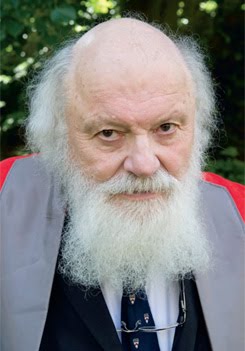 No, it's not Santa Claus, but Geoffrey Hill, as pictured in this Oxford Today feature on his entry as Oxford Professor of Poetry. Not much in the way of news here, but some nice stanzas from a work in progress.
I'm feeling the usual semester's-end weariness; the last grades were turned in this morning after a frantic few days of grading & number-teasing, & now I face the horrors of our department's moving to a new building over the holiday break. My office is probably 60% packed; another day's cursing and throwing books in the general direction of cartons should do it. But whether the new office has enough space for the old office's books, now that's another issue altogether.
To celebrate the end of semester, and to take my mind off of Milton final exams, I went thru a splurge of poetry-reading over the last few days. Quite a number of books, in fact, in no particular order. First, a run of Keith Waldrop chapbooks from all over the last 40 years:
•my nodebook for december (Burning Deck, 1971)I've always been fond of Waldrop's work, which has struck me as falling usually into the category of the spare and precise, a sort of post-Objectivist work that I associate with Cid Corman (most prolifically); but KW is inevitably a far more careful and thoughtful craftsperson – and his work has a muted sense of humor that I enjoy immensely.
•Intervals (Awede, 1981)
•Water Marks (Underwhich, 1987)
•Two-Part Invention (Meeting Eyes Bindery/Poetry New York, 1999)
Then Phyllis Rosenzweig's more substantial (page-wise) chapbook Reasonable Accomodation (Potes & Poets, 1998). I knew PR glancingly when I was a lurker on the fringes of the DC scene a couple of decades ago, but had never really read her work. It's quite good: disjunctive on the order of much Language writing, name-dropping in the best New York School manner (tho the names dropped are usually of DC folks I know), & showing a sometimes surprising sense of closure – ie the poems actually end, rather than simply trail off.
Kenneth Fearing's Selected Poems (Library of America, 2004) isn't as good as its editor Robert Polito would like you to believe. That is, Fearing really isn't the great American hard-boiled poet, the fellow who actually marries the grittiness of James Cain to the social conscience of Muriel Rukeyser. Rather, he's a kind of lefty Whitman which a strong dash of second-hand surrealism. A congenial combination, to be sure, but the catalogues & the socio-political hectoring get old after awhile.
Donald Wellman's A North Atlantic Wall (Dos Madres, 2010) is a welcome new piece from a poet who's more than content to work in the footsteps of Pound and Olson – a "late modernist," that it. Wellman's deep in the culture of contemporary and historical Spain here, drawing from the works of medieval thru contemporary Spanish poets and writers, musing over the ruins both concrete and metaphysical of the Third Reich's "Fortress Europe."
Two from Laura Sims, Practice, Restraint (Fence, 2005) and Stranger (Fence, 2009), exemplify contemporary "elliptical" poetry in its purest form. I'm enraptured by the spareness of Sims's writing, and she has a wonderful lyric ear. I wonder, however, whether the poems' very evanescence won't have them floating off the page entirely at some point. (Even as I write that, I find myself admitting that Stranger, an extended elegy to Sims's mother, has a kind of emotional gravitas that keep the wee stanzas pretty well anchored indeed.)
The great discovery, however, is Linda Russo's Mirth (Chax, 2007). Of all of these books, Mirth is the one I most wish I'd written – and the one I find myself most admitting is beyond my abilities. A first section of excellent, cutting political poems – then extended fantasias on Ovid (among others) exploring, in a theoretically sophisticated & often deeply funny manner, what it means to be a politically engaged female poet in what alas is still too often a man's man's man's world. By the time you're thru with Mirth, however, you've forgotten that the dour Mr Hill is arbiter of poetry & morals at Oxford, & are enthusiastically following Russo into the twenty-first century.
[105-114]
Thursday, December 02, 2010
Peter O'Leary: Luminous Epinoia
 [Peter O'Leary, February 2008]
We were talking at the pub last night about the sensation of reaching a certain age – a certain point at one's life – where one can see the overall "curve" of the careers of one's culture-heroes – musicians, writers, etc. As usual, I took it as an opportunity to lament impending senility etc. But truth to tell, I don't feel particularly old, or even particularly middle-aged. In some senses, I feel that my poetry has only within the past 5 years or so emerged into what I think of as a "mature" voice; & suspect that a decade from now I might dismiss what I'm writing right now as juvenilia.
I'm comfortable watching poets a few years older than me, folks like my friend Norman Finkelstein, emerge from being pretty damned good poets to being really breathtaking, big poets – poets I'd mention in the same breath as the great poets of the 1920s or 1930s generation – as Norman's done with his last two books, Scribe (blogged here) and Inside the Ghost Factory.
It's a little more unsettling – but simultaneously exhilarating – when I see one of my coevals breaking forth into something like "major" status. I've known Peter O'Leary for something over a decade. I suspect we hooked up by means of Ronald Johnson's work: I've been writing on Johnson as long as I can remember, and Peter, after corresponding with him for several years, was named Johnson's literary executor upon his death in 1998. (Since then he's lovingly shepherded thru the press a number of Johnson projects: The Shrubberies, To Do As Adam Did: Selected Poems, and a reissue of Radi Os.
I've followed O'Leary's poetry, both in his first two full-length collections, Watchfulness (Spuyten Duyvil, 2001) and Depth Theology (2006), his chapbooks, and his periodical appearances. I was even, I'm proud to say, a press reviewer for his excellent critical study Gnostic Contagion: Robert Duncan and the Poetry of Illness. But nothing has prepared me for the impact of his brand new collection from the Cultural Society, Luminous Epinoia.
I haven't even tried to reproduce the cover, as I've yet to see a photo that does justice to this book's visual presentation. It's a Quemadura (Jeff Clark) design, but bears no resemblance to Quemadura's typical combination of slurred visuals and hard-edged, sans-serif lettering. Instead, the book's a jacketless hardcover in blinding silver, etched white repeated designs (snakes, crosses, & stars) surrounding a Gothic "L. E." (The insides, equally scrumptuous, are more recognizably Quemaduran: sans-serif running heads, Gothic epigraphs.) It's a book to be immediately struck by – but the real beauties are inside.
I'll admit that I fall back on comparisons when my critical/descriptive skills falter. What's this book like? Well, imagine a poet whose worldview, and whose visionary tendencies, are akin to those of Dante (in the Paradiso) or Henry Vaughan; whose vocabulary is as ornate (tho nowhere near as pretentious) as Edward Dahlberg's; and whose sense of form, of diction, and of general poetic movement is near kin to Charles Olson, Ronald Johnson, and Nathaniel Mackey. Throw in a generous dash of Freud (& even Jung), an outraged political sensibility, & a kind of deep, radiant, tender humanitas, & you have something like Peter O'Leary.
Not being a believer, I do not write religious poetry. But I do appreciate religious poetry (if I didn't, let's face it, this past semester teaching Milton would have been more than unpleasant), and so far as Christian poetry goes I find a clear distinction between Protestant and Roman Catholic poetics. Milton is the great Protestant poet; Geoffrey Hill is the best Protestant poet writing now. Dante is of course the preëminent Roman Catholic poet. (Oddly enough, I read Hopkins, despite his holy orders, as more Protestant than Catholic in his poetics.) Raised as I was in fundamentalist, text-based Protestantism, I relish the wrestle with the law's letter, with the philosophical paradoxes of faith; but I find myself more often than not left cold by the literary manifestations of ecstatic, mystical religious states.
Or rather, I find it hard to mix the religious & the aesthetic. I love visiting ornate churches & cathedrals; but I find myself bulldoggishly resistant to the "beauties" of the service or the mass. I am as low church as low church can be.
But O'Leary's work moves me, and moves me deeply – so deeply I'm puzzled. He is, yes, a Roman Catholic poet, one whose work is redolent of incense and wine, is shot thru with the light of both stained glass windows and the sun; his poems are almost a series of icons, dense with human detail but alight with hammered gold. Like his mentor Johnson, he relishes science's untangling of the physical and chemical bases of our existence – and he finds in them powerful metaphors for the relationship of God to humanity, even – at some head-spinning moments – explanations of that relationship.
These poems are more personal in many ways than O'Leary's earlier books, including a longish "Spiritual Autobiography" towards the end. It is something of a Vita Nuova crossed with The Interpretation of Dreams, embedded within the Paradiso of exploration and praise that is the book as a whole. Luminous Epinoia may be one of the stranger titles you're likely to encounter – roughly speaking, it refers to one's creativity, conceived I take it as an emanation or a reflection of the divine creativity – but it shouldn't put off even faithless readers (like this one). It's a terrific, rich, mysterious & moving book. I'm almost moved to devotion; but alas, am quite certainly moved to envy.
[104]
I'm comfortable watching poets a few years older than me, folks like my friend Norman Finkelstein, emerge from being pretty damned good poets to being really breathtaking, big poets – poets I'd mention in the same breath as the great poets of the 1920s or 1930s generation – as Norman's done with his last two books, Scribe (blogged here) and Inside the Ghost Factory.
It's a little more unsettling – but simultaneously exhilarating – when I see one of my coevals breaking forth into something like "major" status. I've known Peter O'Leary for something over a decade. I suspect we hooked up by means of Ronald Johnson's work: I've been writing on Johnson as long as I can remember, and Peter, after corresponding with him for several years, was named Johnson's literary executor upon his death in 1998. (Since then he's lovingly shepherded thru the press a number of Johnson projects: The Shrubberies, To Do As Adam Did: Selected Poems, and a reissue of Radi Os.
I've followed O'Leary's poetry, both in his first two full-length collections, Watchfulness (Spuyten Duyvil, 2001) and Depth Theology (2006), his chapbooks, and his periodical appearances. I was even, I'm proud to say, a press reviewer for his excellent critical study Gnostic Contagion: Robert Duncan and the Poetry of Illness. But nothing has prepared me for the impact of his brand new collection from the Cultural Society, Luminous Epinoia.
I haven't even tried to reproduce the cover, as I've yet to see a photo that does justice to this book's visual presentation. It's a Quemadura (Jeff Clark) design, but bears no resemblance to Quemadura's typical combination of slurred visuals and hard-edged, sans-serif lettering. Instead, the book's a jacketless hardcover in blinding silver, etched white repeated designs (snakes, crosses, & stars) surrounding a Gothic "L. E." (The insides, equally scrumptuous, are more recognizably Quemaduran: sans-serif running heads, Gothic epigraphs.) It's a book to be immediately struck by – but the real beauties are inside.
I'll admit that I fall back on comparisons when my critical/descriptive skills falter. What's this book like? Well, imagine a poet whose worldview, and whose visionary tendencies, are akin to those of Dante (in the Paradiso) or Henry Vaughan; whose vocabulary is as ornate (tho nowhere near as pretentious) as Edward Dahlberg's; and whose sense of form, of diction, and of general poetic movement is near kin to Charles Olson, Ronald Johnson, and Nathaniel Mackey. Throw in a generous dash of Freud (& even Jung), an outraged political sensibility, & a kind of deep, radiant, tender humanitas, & you have something like Peter O'Leary.
Not being a believer, I do not write religious poetry. But I do appreciate religious poetry (if I didn't, let's face it, this past semester teaching Milton would have been more than unpleasant), and so far as Christian poetry goes I find a clear distinction between Protestant and Roman Catholic poetics. Milton is the great Protestant poet; Geoffrey Hill is the best Protestant poet writing now. Dante is of course the preëminent Roman Catholic poet. (Oddly enough, I read Hopkins, despite his holy orders, as more Protestant than Catholic in his poetics.) Raised as I was in fundamentalist, text-based Protestantism, I relish the wrestle with the law's letter, with the philosophical paradoxes of faith; but I find myself more often than not left cold by the literary manifestations of ecstatic, mystical religious states.
Or rather, I find it hard to mix the religious & the aesthetic. I love visiting ornate churches & cathedrals; but I find myself bulldoggishly resistant to the "beauties" of the service or the mass. I am as low church as low church can be.
But O'Leary's work moves me, and moves me deeply – so deeply I'm puzzled. He is, yes, a Roman Catholic poet, one whose work is redolent of incense and wine, is shot thru with the light of both stained glass windows and the sun; his poems are almost a series of icons, dense with human detail but alight with hammered gold. Like his mentor Johnson, he relishes science's untangling of the physical and chemical bases of our existence – and he finds in them powerful metaphors for the relationship of God to humanity, even – at some head-spinning moments – explanations of that relationship.
These poems are more personal in many ways than O'Leary's earlier books, including a longish "Spiritual Autobiography" towards the end. It is something of a Vita Nuova crossed with The Interpretation of Dreams, embedded within the Paradiso of exploration and praise that is the book as a whole. Luminous Epinoia may be one of the stranger titles you're likely to encounter – roughly speaking, it refers to one's creativity, conceived I take it as an emanation or a reflection of the divine creativity – but it shouldn't put off even faithless readers (like this one). It's a terrific, rich, mysterious & moving book. I'm almost moved to devotion; but alas, am quite certainly moved to envy.
[104]
the fénéon book
A couple years back, my most delicious internet reading was the blog Faits Divers de la Poésie Américaine et Brittanique, a series of for the most part brutally funny satirical squibs directed at the poetry "scene" in general, & emanating from the anonymous fénéon collective. Hoo boy did the fénéon folks stir up ire on all sides of American poetry (except perhaps for the trade-press-entrenched hyper-establishment, which doesn't really traffic in internet communication). Eventually, after pissing off just about everyone who is anyone in alt-poetry, the blog's contents disappeared.
I won't go into the history of the "collective," which is laid out in loving detail in "Anonyme"'s introduction to the recently released Works and Days of the fénéon collective (Skanky Possum/Effing Press) (hard to come by at the moment, but you might look here). Suffice it to say they take their name from the art critic and anarchist Félix Fénéon, and are inspired by his Nouvelles in trois lignes, cryptic and anonymous squibs which appeared in the Paris Newspaper Le Matin in 1906. Fénéon's "novels" are capsulized and crystallized social commentary:
The collective's primary targets are on the one hand the tired rhetoric of outsiderhood among post-avant poets –
There is something here for everyone to be offended by, and likewise there is something to solace every resentment. My own favorite:
I won't go into the history of the "collective," which is laid out in loving detail in "Anonyme"'s introduction to the recently released Works and Days of the fénéon collective (Skanky Possum/Effing Press) (hard to come by at the moment, but you might look here). Suffice it to say they take their name from the art critic and anarchist Félix Fénéon, and are inspired by his Nouvelles in trois lignes, cryptic and anonymous squibs which appeared in the Paris Newspaper Le Matin in 1906. Fénéon's "novels" are capsulized and crystallized social commentary:
A dozen hawkers who had been announcing news of a nonexistent anarchist bombing at the Madeleine have been arrested.The 232 "faits divers" of the "fénéon collective" are rather more loquacious, and focus their commentary on the angst- and ambition-riddled microcosm of contemporary poetry. The humor is for the most part broad. We encounter the perpetually needy denizens of MFA programs:
Reverend Andrieux, of Roannes, near Aurillac, whom a pitiless husband perforated Wednesday with two rifle shots, died last night.
Too poor to raise him, Triquet, of Théligny, Sarthe, smothered his son, aged 1 month.
The MFA students of Iowa are on strike! Marching towards the Capitol, post-avant and School of Quietude as one, they brandished cans of Spam, the only aliment they can afford.Conceptual poetry makes an appearance:
In the midst of economic crisis, things proceeded as normal at the AWP: bailouts, bonus packages, back-room deals, aimless loitering of the unemployed.
"Ouch!" cried the cunning oyster-eater, M. Goldsmith. "A pearl!" Someone at the next table bought it for 100 francs. It had cost 10 centimes at the dime store.Time and time again, poets whose surnames assiduous followers of the "scene" will recognize collide head-on in the street.
The collective's primary targets are on the one hand the tired rhetoric of outsiderhood among post-avant poets –
Assistant Professor M. Devaney, of Penn, read a paper at the MLA, attacking Official Verse Culture. Now that it is printed in the Writer's Chronicle and collected in a prize-winning anthology from Wesleyan, the Literary Industry has been dealt another penetrating blow by the avant-garde.– and on the other the failure of real world political engagement among poets who are otherwise assiduous at trumpeting their own heartfelt political beliefs:
Let's protest the war, poets, said M. Hamill! 15,000 did. Messrs. Bernstein, Silliman, and Watten gave speeches, protesting the poets who protested. Irony.This sort of thing will certainly not do (as Samuel Johnson might say). The fénéon collective's squibs are nasty, mean-spirited, and not at all constructive. They are also for the most part wickedly funny & often very pointed indeed. The very anger they aroused on their first publication is an index of how close to the bone some of their satire strikes.
Well, Guernica's come and go... As Gaza burned, Mlle Dark, the self-appointed U.S. poetry medium of Badiou, devoted her blog to a personal "Top-40 Countdown" of pop music hits in 2008.
Yes, and as Gaza burned, the avant with 2,000,000 hits, former editor of the Socialist Review, devoted his blog today to an anecdotal homage for the '70s sitcom hit, Starsky and Hutch.
There is something here for everyone to be offended by, and likewise there is something to solace every resentment. My own favorite:
There is no god even for drunkards. The pugilist-poet M. Kleinzahler, of St. Germain, who had mistaken the window for the door, has left this world.
Sunday, November 28, 2010
the damned 100 books thing
So the "BBC 100 books" meme is going around Facebook again. You've seen it -- it's a list of 100 books, chosen by some arcane process, of which the BBC has found most people have read only 6. And you're supposed to go thru the list, marking the ones you've read, & tagging your friends.
Problem is, of course, that the BBC apparently had no such intention in compiling their original list (which can be found here). That list is a reader-voted list of 100 most popular novels. Somewhere along the line, someone monkeyed around with that list, making a bit more highbrow (maladroitly – they added both Shakespeare's Complete Works and Hamlet, separately). It's in that latter form that it's getting passed around as a test of one's literacy. (For a straightforward comparison of the two lists, & their sources, see this blog post.)
What does the phenomenon say about contemporary reading habits, & habits of thought more generally? Well, first & most obviously: when people think about "books" they've read, they think novels. The BBC was explicit about their list being novels; whoever altered the list to "books" didn't really think it necessary to do more than throw in a couple of Shakespeares – after all, the important reads are still novels. Where're the biographies, the books of history, the nonfiction things that squat atop the bestseller lists for ages?
Secondly, most people apparently haven't read a whole lot since high school, and what they've read rarely goes beyond the front displays of Barnes & Noble (or Waterstone's). The vast majority of the books here fall into roughly three categories: classic children's books (and young people's books – Little Women, The Secret Garden); things that are assigned in secondary school (To Kill a Mockingbird, Grapes of Wrath); and books that have been atop the bestseller lists (Harry Potter, Captain Corelli's Mandolin). There's also a fair number of "classics," especially in the later "altered" list – what I would call "warhorse" classics, books that everyone's heard of & agrees are suitably serious (Jane Austen, Dickens, Melville, Tolstoy).
But most interestingly, everyone still wants to feel themselves somehow "well read" – that they've somehow kept ahead of the curve of their peers, those poor schmucks who've only read 6 books from this list. Frankly, I imagine anyone who reads much at all – anyone, that is, who isn't part of that 95% of the American public who never reads a book* – has probably read at least 15 or 20 of these. But I'm not sure there isn't a category mistake taking place here: can we really call the warm bath of looking back over Winnie the Pooh (#7) or Black Beauty (#58) reading in the same sense that working one's way through Ulysses (#78) or Gormenghast (#84) is reading?
*I just made that statistic up.
Problem is, of course, that the BBC apparently had no such intention in compiling their original list (which can be found here). That list is a reader-voted list of 100 most popular novels. Somewhere along the line, someone monkeyed around with that list, making a bit more highbrow (maladroitly – they added both Shakespeare's Complete Works and Hamlet, separately). It's in that latter form that it's getting passed around as a test of one's literacy. (For a straightforward comparison of the two lists, & their sources, see this blog post.)
What does the phenomenon say about contemporary reading habits, & habits of thought more generally? Well, first & most obviously: when people think about "books" they've read, they think novels. The BBC was explicit about their list being novels; whoever altered the list to "books" didn't really think it necessary to do more than throw in a couple of Shakespeares – after all, the important reads are still novels. Where're the biographies, the books of history, the nonfiction things that squat atop the bestseller lists for ages?
Secondly, most people apparently haven't read a whole lot since high school, and what they've read rarely goes beyond the front displays of Barnes & Noble (or Waterstone's). The vast majority of the books here fall into roughly three categories: classic children's books (and young people's books – Little Women, The Secret Garden); things that are assigned in secondary school (To Kill a Mockingbird, Grapes of Wrath); and books that have been atop the bestseller lists (Harry Potter, Captain Corelli's Mandolin). There's also a fair number of "classics," especially in the later "altered" list – what I would call "warhorse" classics, books that everyone's heard of & agrees are suitably serious (Jane Austen, Dickens, Melville, Tolstoy).
But most interestingly, everyone still wants to feel themselves somehow "well read" – that they've somehow kept ahead of the curve of their peers, those poor schmucks who've only read 6 books from this list. Frankly, I imagine anyone who reads much at all – anyone, that is, who isn't part of that 95% of the American public who never reads a book* – has probably read at least 15 or 20 of these. But I'm not sure there isn't a category mistake taking place here: can we really call the warm bath of looking back over Winnie the Pooh (#7) or Black Beauty (#58) reading in the same sense that working one's way through Ulysses (#78) or Gormenghast (#84) is reading?
*I just made that statistic up.
Saturday, November 27, 2010
most bizarre sentence in a "scholarly" book, episode 237
From K. W. Gransden's Virgil: The Aeneid (Landmarks of Western Literature) (Cambridge UP, 1990).
We all know about Eclogue 4, right? You remember, the one which addresses the Consul Pollio, prophesying the birth of a man child who will bring back the golden age associated with Saturn? The one Virgil wrote in 40 BCE, and in which no-one has any real idea what he's talking about? The one that got taken up by Christian commentators as a prophecy of Christ's birth, & had a great deal to do with Virgil's being enshrined as a "Christian poet" avant la lettre?
Gransden writes, gravely: "It must be emphasized that there is no evidence, and little likelihood, that Virgil was referring in this poem to Christ."
The mind boggles. What precisely would constitute "evidence" that Virgil, writing in 40 BCE, was "referring to" Christ (born ca. 7-3 BCE)? What would make it more or less "likely"?
We all know about Eclogue 4, right? You remember, the one which addresses the Consul Pollio, prophesying the birth of a man child who will bring back the golden age associated with Saturn? The one Virgil wrote in 40 BCE, and in which no-one has any real idea what he's talking about? The one that got taken up by Christian commentators as a prophecy of Christ's birth, & had a great deal to do with Virgil's being enshrined as a "Christian poet" avant la lettre?
Gransden writes, gravely: "It must be emphasized that there is no evidence, and little likelihood, that Virgil was referring in this poem to Christ."
The mind boggles. What precisely would constitute "evidence" that Virgil, writing in 40 BCE, was "referring to" Christ (born ca. 7-3 BCE)? What would make it more or less "likely"?
Friday, November 26, 2010
Addendum to the below (& perhaps a mortal blow for my potential use of Sarah Ruden's version of the Aeneid in next semester's class): These sentences that open her introduction:
But where in the Sam Hill did she get that business about only 12 of 24 books being finished?? Of course, there are indeed around 60 partial lines in the poem. That's explained by Virgil's method of composition: he'd write a prose draft, then versify in blocks; when he got stuck, he'd leave a half-line, which he called tibicines (props), to support the overall structure until he could raise the final columnes (pillars). Virgil had worked on the epic for some 10 years when he died in 19BCE, & he was projecting another three years' work to "finish" it – polish it up, remove inconsistencies like those you find thruout Homer, and finish up those half-lines. But by no means could he have been intending another 12 books.
I'm no classicist, tho I did my stint of Virgil back in high school Latin (books I thru VI, if I remember rightly). But I've got a stack of classicists' books scattered around the house & the office, & nowhere can I find a projected 24-book length to the Aeneid. K. W. Grandsen, in his little Cambridge UP guide (where I also picked up the snazzy factoids about the tibicines & columnes), puts it most forcefully: "It should however be emphasized that the poem, though unrevised, is in no sense incomplete or unfinished (as Spenser's Faerie Queene is unfinished)."
Please, somebody who knows more about this than I do – who's plugged into the most recent Virgil scholarship – prove me wrong. Otherwise I'm going to to irrevocably lose faith in the whole academic publishing industry – or at least in the Yale UP copy editor who let that sentence get onto the first page of this highly-promoted translation.
***
The Thanksgiving celebration, by the way, was lovely. Not least for the fact that we were invited to some dear friends' house, where the food was delicious and the alcohol flowed freely, & I didn't have to cook anything more than a bowl of Gujerati string beans.
I am in awe of scholars who can expertly debate Vergil's political purpose and attitude; I find him difficult just to read. In part, I blame the half-finished state of his epic: only twelve out of the projected twenty-four books exist, and many lines are two- or three-word fragments.First off, it's bad to start out your intro with an "aw-shucks-Miz-Scarlett-ah'm-just-a-translator-&-don't-know-nothin'-'bout-scholarship"; it may establish your poetic bona fides, but it gives no comfort to those who hope to find in your translation a firm grasp not merely of the Latin language but of the poem as a whole, which has been thought about by scholars – sometimes very fruitfully indeed – for some two millennia now.
But where in the Sam Hill did she get that business about only 12 of 24 books being finished?? Of course, there are indeed around 60 partial lines in the poem. That's explained by Virgil's method of composition: he'd write a prose draft, then versify in blocks; when he got stuck, he'd leave a half-line, which he called tibicines (props), to support the overall structure until he could raise the final columnes (pillars). Virgil had worked on the epic for some 10 years when he died in 19BCE, & he was projecting another three years' work to "finish" it – polish it up, remove inconsistencies like those you find thruout Homer, and finish up those half-lines. But by no means could he have been intending another 12 books.
I'm no classicist, tho I did my stint of Virgil back in high school Latin (books I thru VI, if I remember rightly). But I've got a stack of classicists' books scattered around the house & the office, & nowhere can I find a projected 24-book length to the Aeneid. K. W. Grandsen, in his little Cambridge UP guide (where I also picked up the snazzy factoids about the tibicines & columnes), puts it most forcefully: "It should however be emphasized that the poem, though unrevised, is in no sense incomplete or unfinished (as Spenser's Faerie Queene is unfinished)."
Please, somebody who knows more about this than I do – who's plugged into the most recent Virgil scholarship – prove me wrong. Otherwise I'm going to to irrevocably lose faith in the whole academic publishing industry – or at least in the Yale UP copy editor who let that sentence get onto the first page of this highly-promoted translation.
***
The Thanksgiving celebration, by the way, was lovely. Not least for the fact that we were invited to some dear friends' house, where the food was delicious and the alcohol flowed freely, & I didn't have to cook anything more than a bowl of Gujerati string beans.
Subscribe to:
Posts (Atom)