So I've reached a top-ish rung in the academy – I'm full professor; there's nowhere to go, as someone said, but to the grave. (Or to a named chair somewhere, as if that'll happen...) According to popular wisdom, this is the point at which I start recycling my lecture notes and pretty much switch off my scholarship. And I've seen it happen, several times. Usually it happens a bit earlier: someone scrapes together the book or the requisite articles to get tenure, and then we don't see them in print ever again.
Now I'd hasten to assure my conservative friends that this isn't by any means the norm; in fact, when I say I've seen it happen "several times," what I mean is that I see it happen perhaps 10% of the time among my colleagues across the departments; the vast majority of us keep on publishing after getting tenured, even after getting promoted to Full.
Lately, however, I've been feeling a bit adrift. I have all sorts of vague outlines of the next "big" (ie, book-length) project in mind, but nothing that I'm particularly enthusiastic about pursuing. I know I could just sit down and start writing – I've done quite a bit of that – but I feel the pull of the books: I'd rather, quite frankly, just keep reading, making notes, trying to scribble down connections.
I've been feeling guilty about that – the production schedule seems to have broken down. Why aren't I writing? why aren't I producing, like a healthy cog?
This week has been one of reassurance, tho. A few days ago I got the latest copy-edited version of my next Parnassus essay (on Black Mountain); the cuts have been brutal, and will need to be sorted thru and fought over, but this should see print by summer. Today I just got the final copy-edited version of a book chapter that might be out by the end of the year, and I realize that sometime before Christmas, I read proof for another that should be out sometime this spring. And yet another book chapter, I noted as I sifted thru e-mails today, is in the hopper.
And when I look over my commitments calendar, I realize I'm committed to two non-onerous (read: pleasurable) reviews this spring, and yet another book chapter. And editors will be reading this summer my first full-length essay on Ruskin, mirabile dictu (no, it's not written, but it's all there in my talking points for last fall's graduate seminar, waiting to be quarried out).
So maybe I'm not lying quite as fallow as I sometimes fear. Indeed, I wonder if perhaps I'm not doing too much.
Friday, January 25, 2013

Tuesday, January 22, 2013
ye olde modernes
There's one advantage to electing Democrats to the White House; at least every four years they give you something to talk about in a poetry workshop, in the form of an inaugural poem. Richard Blanco's effort yesterday is interesting: not interesting enough to be good poetry, but interesting enough to talk about. It feels as though he were given a list of topics to touch upon, a handful of themes to treat, & was left to make the best of them – in a wholly un-ironical manner. Maybe it's the utter absence of irony that's unsettling.
***
Teaching the modernists this semester. This week it's "Hugh Selwyn Mauberley," a poem which I've been reading for a quarter-century or more, I'd guess. So I re-read it again a half dozen times over the past few days. I suspect it will be a hard sell – so much of it depends on modulations of tone, evocations of cultural landscapes all these young people born in the 1990s can't even imagine. It was hard for me to imagine them when I first read the poem, as well, but then I've been more or less professionally thinking about it & poems like it for years & years now.
Distance. "Hugh Selwyn Mauberley," or for that matter "The Waste Land," is as far away from us in 2013 as those poems were from Keats and Shelley's major works. I have trouble wrapping my mind around that.
***
Teaching the modernists this semester. This week it's "Hugh Selwyn Mauberley," a poem which I've been reading for a quarter-century or more, I'd guess. So I re-read it again a half dozen times over the past few days. I suspect it will be a hard sell – so much of it depends on modulations of tone, evocations of cultural landscapes all these young people born in the 1990s can't even imagine. It was hard for me to imagine them when I first read the poem, as well, but then I've been more or less professionally thinking about it & poems like it for years & years now.
Distance. "Hugh Selwyn Mauberley," or for that matter "The Waste Land," is as far away from us in 2013 as those poems were from Keats and Shelley's major works. I have trouble wrapping my mind around that.
Sunday, January 20, 2013
unfinishing
[James Spates]
One of the few treasures in my Ruskin collection – and it's a working library, not a collector's treasure-trove – is a little vanity-press production from 1966, The Ruskin-Froude Friendship as Represented Through Letters. I picked it up in The Strand the year before last, along with a bunch of other Ruskiniana. It's inscribed by its author/editor, Helen Gill Viljoen "To Dr. Rosenberg – With kind regard and best wishes." Of course, that's John D. Rosenberg, author of The Darkening Glass: A Portrait of Ruskin's Genius (1961), the book that's widely regarded as having kicked off contemporary Ruskin criticism, & a book which would start Rosenberg's career as a distinguished Victorianist. In 1966, Rosenberg was a young scholar; he had joined the Columbia faculty four years earlier; Viljoen was 67, & had retired from Queens College the year before. Since 1929, she had been working on Dark Star, a revolutionary biography of John Ruskin.
I'm most of the way thru James L. Spates's very strange and very absorbing The Imperfect Round: Helen Gill Viljoen's Life of Ruskin. I'll be frank: this is a weird book. It's a smart book, if a bit eccentric. Spates is a professor of sociology, not a literary scholar, and he's sometimes a bit wobbly on the norms of the discipline – how to insert comments and emendations into quoted letters, how to cite cross-references in footnotes, and so forth. And he's not a critic or theorist of biography. Nonetheless, this is one of the most compelling pieces of writing about biography I've encountered in a very long time.
Helen Gill Viljoen (pronounced "Fil-yoon," if you were wondering) was an American Ruskin scholar. She's remembered for three books: a massive and incredibly detailed edition of Ruskin's late Brantwood Diary (Yale UP, 1971); a little book on Ruskin's friendship with Froude (Pageant, 1966); and Ruskin's Scottish Heritage (U of Illinois P, 1956), a large-scale "prelude" to a full-scale biography of Ruskin that she never wrote, or never brought to the point of publication.
Viljoen visited Brantwood in 1929, when Ruskin's library and papers were still in the house, pretty much in the state Ruskin had left them. Well, in the state Cook and Wedderburn had left them, after going thru everything in the course of preparing their 39-volume Library Edition of his works. She wasn't planning on doing much research; she had just finished her PhD at Wisconsin (on Modern Painters) and thought perhaps to follow up on some of her hunches about Ruskin's reading. But in the course of going thru the bookcases, she discovered Ruskin's diaries (which had never been published), and in reading thru them – and pretty much transcribing them whole over the next few weeks – she came to the conclusion that the Library Edition editors had systematically distorted the record of Ruskin's life – repressing the story of his obsession with Rose La Touche, airbrushing out the terrific tension in his relationship with his parents.
What she had in the diaries, Viljoen decided, was the basis for a new, revisionary life of Ruskin, one that would completely eclipse the "standard" lives of WG Collingwood and ET Cook, and would sweep away the handful of Stracheyan productions written in the first decades of the century. So for the rest of her life she was laboring towards a massive, multi-volume biography that would capture the true essence of Ruskin, that would set straight the mistaken record that almost all Ruskin scholars were relying on.
Viljoen's career, as Spates presents it, is a tragedy of an over-scrupulous scholar who could never stop researching, could never sit down and just write the book that she had been working her entire adult life to make real. Decade after decade, Viljoen accumulates more and more notes for her Ruskin biography, comes upon new caches of letters and stacks of documents. Time and again, she gets sidetracked: Before she writes the biography proper, she needs to transcribe and edit all of the sermon notebooks Ruskin kept as a teenager; and then she has to account for all of his ancestors, and remove various myths surrounding his parents' background; and then, disgusted with the way most of his diaries have been edited and published, she has to do her own massive job on his "Brantwood" diary, appending full biographical sketches of every person mentioned, annotating every single reference in his maddening allusive text (that last project seems to have eaten up around a decade of her working life).
Every job takes longer than she's planned; every ancillary project ends up sidetracking her from writing the biography proper. It's almost heartbreaking, really. Part of me admires Viljoen unreservedly: in her desire from absolute accuracy, and complete thoroughness, she's kind of a patron saint of scholars. But even scholarship has to stop somewhere. There's no such thing as total knowledge, & the desire for total knowledge can keep one from offering any of one's knowledge to the world in print.
Spates clearly reads Viljoen as kind of an unsung hero of Ruskin studies, and I'm inclined to agree. But my admiration for her is rather less whole-hearted than his. Yes, she probably knew more about Ruskin than anyone else alive – maybe more than anyone else ever will know. But the inability to know when to stop, to call a more or less temporary halt to the quest for information & to set down what one already knows, is at least as important a faculty of the scholar as the drive for continued research.
And frankly, I'm less than convinced that Viljoen's critical acumen is all that Spates makes it out to be. As he narrates in The Imperfect Round, Viljoen spent a number of years pursuing an allegorical reading of Ruskin's work, in which almost all of his writings, from the early Poetry of Architecture thru Praeterita (& even including his private diaries) are coded allegories of his own family, & later of his pursuit of Rose La Touche. Viljoen never published any of this work – she told everyone she knew about it, and received scant encouragement from the scholarly community – but apparently she clung to this reading to the very end. It distracted her from working on Ruskin's life for a number of years, and heaven knows how it would have affected the biography she never really wrote. The very notion of an extended allegory, running thru and structuring all of Ruskin's works, strikes me as incredibly unlikely; it goes against everything I know about how Ruskin wrote and thought, every intuition I've had about his work over the past decade of reading him. He's simply not that kind of writer. Alas, there's something all too Casaubon-like in this bit of Viljoen's intellectual history.
So I have reservations, both about Helen Gill Viljoen's work and about James Spates's full-throated praise of that work. But The Imperfect Round is a book every Ruskinian needs to own, and indeed every biographer ought to read. It's the most absorbing cautionary tale about the art of life-writing I've encountered, and gives us in scrupulous detail the moving human tragedy of a gifted writer's encounter with, and ultimate absorption in, the endless vortex of the record of the past.
Monday, December 24, 2012
year's end
Yes, as I always say, I hate year-end "best of" lists, whether of books or records or movies or whatever. Especially of books. On the one hand, there's the implicit "check out how much I read factor." Now I read a lot, but I'm not particularly proud of it. Indeed, I feel there's something slightly pathological about how much I read. I get something close to a panic attack when I realize I'm going to be somewhere where I might have a couple of hours on my hands, and I don't have something to read.
And then there's the whole "cool kid" quotient. Astonishingly enough, I was not one of the cool kids back in high school, and things really haven't improved. So no, I probably haven't gotten around to reading the latest super-snazzy book of poetry or theory or whatever. But I feel bad about not having done so every time I see that title pop up on the year-end "best of" lists.
Any way, here's some highlights from this year's reading, sorted roughly by genre. Stuff that's stuck in my mind enough to note or recommend:
Poetry:
And then there's the whole "cool kid" quotient. Astonishingly enough, I was not one of the cool kids back in high school, and things really haven't improved. So no, I probably haven't gotten around to reading the latest super-snazzy book of poetry or theory or whatever. But I feel bad about not having done so every time I see that title pop up on the year-end "best of" lists.
Any way, here's some highlights from this year's reading, sorted roughly by genre. Stuff that's stuck in my mind enough to note or recommend:
Poetry:
•Odi Barbare, by Geoffrey Hill, is a bit of a return to form after the disappointments of Oracles/Oraclau and Clavics; he's still writing too much in the home stretch, if you ask me.
•With Aerodrome Orion & Starry Messenger, Susan Gevirtz continues to demonstrate that she's one of the poets you really ought to read, even if you haven't.
•Terra Lucida, by Joseph Donahue and Gnostic Frequencies, by Patrick Pritchett, are two very different explorations in the fascinating province of "new gnosticism."
•John Peck's I Came, I Saw: Eight Poems is typical Peck – and by "typical" I mean dense, musical, and impactedly beautiful.
•I'd read Jill Magi's earlier books, but with SLOT she seems to really be coming into her own as an important contemporary voice; solid, moving.
•Jena Osman's Public Figures continues her exploration of "documentary" poetics; this outing revolves around statues & monuments in Philadelphia.
•Gravesend, by Cole Swensen, does nifty things with ghosts, graves, and the town of Gravesend in England; I like it because it's so obviously about something, and because Swensen has a really dead-on lyric ear.
•I contributed a blurb sight unseen to Alan Halsey's Even if only out of, saying nice things about his work as a whole; this one doesn't disappoint, either; epigrams like Martial on speed and shrooms.
•Matthew Cooperman's Still: Of the Earth as the Ark which Does Not Move initially impressed me as yet another "here's the unremitting barrage of data we're subjected to every day" books, but as it progressed, it moved me more and more, until it became almost overwhelming.
•Stacy Doris's Knot: Doris was one of the poets we lost recently, and I bitterly regret not getting to know her work, which plays wonderful games with tenses and verbs, earlier.Fiction:
•Cormac McCarthy, Blood Meridian: ouch.
•China Miéville, The City and the City: deserved every prize it got – tho for my taste, it went a little genre-y at the end (noir, rather than sf, though)
Biography:
•And of course, maybe the high point of the year's reading, the umpteenth read-thru of Virginia Woolf's To the Lighthouse; I love that book!
•Joan Evans's 1950s John Ruskin is very good indeed; a good deal less carefully rendered detail than Derrick Leon's magnificent 1949 John Ruskin, The Great Victorian, but perhaps more smartly judgmental. Peter Quennell's John Ruskin: The Portrait of a Prophet was published the same year as Leon's biography, which is unfortunate, as the density of Leon's research overshadows the liveliness and grace of Quennell's style.
•Richard Ellmann, Oscar Wilde: yes, it took me a long time to get around to this one, so long that I suppose it's been largely superseded (but when was I ever up to date?); but it was worth the wait.
•Lisa Jarnot, Robert Duncan, The Ambassador from Venus, which I've already written about a bit; an important book.Sui generis:
•Keith Tuma, On Leave: A Book of Anecdotes: what's to say? great anecdotes, wonderful theorizing about the genre of the anecdotes, and a tremendous emotional wallop to the whole.I read some really splendid books of criticism and correspondence, but most of them were on Ruskin, & I think I'll save a bit of that for my big long-awaited (by me) post on finishing the Library Edition. Which I did, this year, and which puts me in an exclusive club of about 200 members, I'd guess. Almost like winning the shit-eating contest.
Friday, December 14, 2012
hobby time
I meant to paint some soldiers this evening, but time got away; I ended up varnishing some already painted soldiers and gluing them (with rubber cement, so they're easily removable) to bases.
So this is what I'm up to:

They're on the stove-top, so you can get some idea of scale (note burner control to right). At a nominal 1:72 scale, they stand around an inch high. These particular sets aren't great, as these types of soldiers go. On the left are a couple of bases' worth of Romans, from the much-maligned Airfix "Romans" sets; most of the swords didn't survive the injection-molding process, & the sculptor seemed to have no idea of how a pilum (short lance) was actually carried. I must have bought these back in the 1970s sometime; I had to scrape my adolescent self's very bad paint jobs off of some of them. (Luckily, since I was too dumb to varnish back then, much of the paint had already flaked off.)
On the right are Airfix's "Ancient Britons," one of the first sets I bought back in the day, but a set that's still available – this particular formation is from a new box. Eventually I'll get around to repainting my old ones as well. I have in mind a huge diorama of the siege of Alesia, or something like that. I'm looking forward to incorporating some of the newer, far more realistic and dynamically sculpted Gallic Warriors from Italeri:

Here's a few more or less in progress.
So this is what I'm up to:

They're on the stove-top, so you can get some idea of scale (note burner control to right). At a nominal 1:72 scale, they stand around an inch high. These particular sets aren't great, as these types of soldiers go. On the left are a couple of bases' worth of Romans, from the much-maligned Airfix "Romans" sets; most of the swords didn't survive the injection-molding process, & the sculptor seemed to have no idea of how a pilum (short lance) was actually carried. I must have bought these back in the 1970s sometime; I had to scrape my adolescent self's very bad paint jobs off of some of them. (Luckily, since I was too dumb to varnish back then, much of the paint had already flaked off.)
On the right are Airfix's "Ancient Britons," one of the first sets I bought back in the day, but a set that's still available – this particular formation is from a new box. Eventually I'll get around to repainting my old ones as well. I have in mind a huge diorama of the siege of Alesia, or something like that. I'm looking forward to incorporating some of the newer, far more realistic and dynamically sculpted Gallic Warriors from Italeri:

Here's a few more or less in progress.
Thursday, December 13, 2012
jarnot's duncan
Ben asks me to expand a bit on my praise of Lisa Jarnot's Robert Duncan, The Ambassador from Venus: A Biography. Maybe the word "footwork" wasn't the best; maybe I should have said "spadework," or "ground-work." Any way –
What's evident thruout her book is a massive organizational effort, one which I can sympathize with & understand, having done something similar (or parallel) with the LZ biography. When you begin a book like this – that is, a first comprehensive biography of someone about whom much is known, but whose life has never been told at length – there's an enormous amount of sorting and filing to be done. I'll speak to my own methods, since I don't really know precisely what road Jarnot took, but I began by constructing chronological databases, based more or less on what sources were out there (Dictionary of Literary Biography articles, biographical sketches, etc.): one database of writings, sorted first by composition date (when known) and then by publication date; then another database of events (education, jobs, addresses, meetings with important people, readings, illnesses, etc.). Those databases constituted a kind of skeleton for everything – the girders beneath the fabric of the narrative, as it were.
Then the real work began: reading everything possible by, about, and around the subject. Of course LZ's works – I had already read everything several times, but was constantly re-reading. (When it actually came down to writing a given chapter, I'd re-read everything LZ had written during that period, just to have it fresh in my mind.) Perhaps as importantly, from a biographical standpoint, was correspondence: I tried to read every extant letter LZ had written, and every letter he'd received. Contemporaneous letters are the gold standard for biographical evidence, so far as I'm concerned, and I tried to back up every statement of "fact" with a letter written as near as possible the actual event. As I read letters, I entered the gist of their contents into the "events" database, often altering the orders and dates of events as better evidence emerged.
Interviews as well got sifted into the mix; they proved more useful for human "impressions" of events than for actual hard data, it became rapidly clear – people have great memories for their own first impressions of someone, but their memories for dates and places are far less reliable.
At any event, I ended up with several thousands of pages of photocopies and notes before I even began the actual writing of the thing, which was a wholly different challenge: how to pour as much of this material as possible into a readable narrative, one that wouldn't be clogged or overburdened with detail, yet would convey the shape of LZ's life and writing career. Looking back, I think I achieved maybe 60% of what I hoped to do.
Jarnot, I suspect, had a much larger mass of material to work with – after all, Duncan spent a large proportion of his later years on the road doing readings and visiting teaching gigs, and he seemed to be in more or less constant correspondence with Jess during that period: a lot of letters to take account of, a lot of quotidian data. She's had a hell of a lot of stuff to sort through and make into a book, and she's done a very solid job of it indeed.
What's evident thruout her book is a massive organizational effort, one which I can sympathize with & understand, having done something similar (or parallel) with the LZ biography. When you begin a book like this – that is, a first comprehensive biography of someone about whom much is known, but whose life has never been told at length – there's an enormous amount of sorting and filing to be done. I'll speak to my own methods, since I don't really know precisely what road Jarnot took, but I began by constructing chronological databases, based more or less on what sources were out there (Dictionary of Literary Biography articles, biographical sketches, etc.): one database of writings, sorted first by composition date (when known) and then by publication date; then another database of events (education, jobs, addresses, meetings with important people, readings, illnesses, etc.). Those databases constituted a kind of skeleton for everything – the girders beneath the fabric of the narrative, as it were.
Then the real work began: reading everything possible by, about, and around the subject. Of course LZ's works – I had already read everything several times, but was constantly re-reading. (When it actually came down to writing a given chapter, I'd re-read everything LZ had written during that period, just to have it fresh in my mind.) Perhaps as importantly, from a biographical standpoint, was correspondence: I tried to read every extant letter LZ had written, and every letter he'd received. Contemporaneous letters are the gold standard for biographical evidence, so far as I'm concerned, and I tried to back up every statement of "fact" with a letter written as near as possible the actual event. As I read letters, I entered the gist of their contents into the "events" database, often altering the orders and dates of events as better evidence emerged.
Interviews as well got sifted into the mix; they proved more useful for human "impressions" of events than for actual hard data, it became rapidly clear – people have great memories for their own first impressions of someone, but their memories for dates and places are far less reliable.
At any event, I ended up with several thousands of pages of photocopies and notes before I even began the actual writing of the thing, which was a wholly different challenge: how to pour as much of this material as possible into a readable narrative, one that wouldn't be clogged or overburdened with detail, yet would convey the shape of LZ's life and writing career. Looking back, I think I achieved maybe 60% of what I hoped to do.
Jarnot, I suspect, had a much larger mass of material to work with – after all, Duncan spent a large proportion of his later years on the road doing readings and visiting teaching gigs, and he seemed to be in more or less constant correspondence with Jess during that period: a lot of letters to take account of, a lot of quotidian data. She's had a hell of a lot of stuff to sort through and make into a book, and she's done a very solid job of it indeed.
Monday, December 10, 2012
done-ish
I turned in my grades last night, just under the wire as usual. I'd tried something new in my undergraduate course: sick to death of taking roll and trying to enforce attendance policies (please, Professor S, I had to miss class because my car broke down...), I built a huge quiz component into the final grade. I told them I was giving at least 10 quizzes over the course of the semester; that the quizzes would be more or less mindlessly easy if they'd done the reading for the class; that the quiz would always happen first thing, so they needed to be on time; that I would end up dropping at least one or two of the lowest grades; and that this would constitute 20% of their final grade.
I got generous; I ended up giving not 10 or 11, but 12 quizzes – and averaged them all in, even though that gave them the possibility of getting extra points. I gave quizzes that had more than the normal number questions, but averaged them in as if they were the regular. And some of the students still ended up losing a sold 10 or 11 points off the top of their grades.
***
The graduate seminar papers were far more pleasant to read than the undergrad grades had been to calculate. I learned some things, as one is supposed to do in a graduate seminar. I miss my seminar already: what will I do with my Wednesday nights, now there's no-one to talk Ruskin to?
***
Going back and forth between Joan Evans's splendid 1954 biography John Ruskin and Lisa Jarnot's splendid (in very different ways) Robert Duncan: The Ambassador from Venus (2012). Jarnot has done her footwork in ways that I suspect only another biographer can fully appreciate.
I got generous; I ended up giving not 10 or 11, but 12 quizzes – and averaged them all in, even though that gave them the possibility of getting extra points. I gave quizzes that had more than the normal number questions, but averaged them in as if they were the regular. And some of the students still ended up losing a sold 10 or 11 points off the top of their grades.
***
The graduate seminar papers were far more pleasant to read than the undergrad grades had been to calculate. I learned some things, as one is supposed to do in a graduate seminar. I miss my seminar already: what will I do with my Wednesday nights, now there's no-one to talk Ruskin to?
***
Going back and forth between Joan Evans's splendid 1954 biography John Ruskin and Lisa Jarnot's splendid (in very different ways) Robert Duncan: The Ambassador from Venus (2012). Jarnot has done her footwork in ways that I suspect only another biographer can fully appreciate.
Saturday, December 08, 2012
downwinding
Alone in the house today; everybody's else's off at of all things a Swedish Xmas fest, Santa Lucia and a bazaar and so forth. I had a hankering to go myself, but I'm deeply sunk in the slough of finishing up grading. Just read and marked the last of the Ruskin seminar papers (the last on hand, that is – still waiting for a couple of laggards), and am about to plunge into crunching the numbers for my undergraduate "Intro to Literary Studies" course. Looking back at my syllabus, I realize that I've come up with an insanely complex algorithm for determining final grades. This may take hours.
***
Yes, I've finished. Consummatum est. That is, the other day I finished the last substantive volume of the Ruskin Library edition, Vol. 37, part two of the Letters. Right now I'm working my way through the Bibliography volume, which has its own anal-retentive pleasures. Expect a longish blog post on the experience of reading thru all of Ruskin over a two-and-a-half-year stretch. And then another on the wonders of the apparatus volumes (the bibliography, the general index) of this edition.
***
My next few weeks are pretty clearly laid out for me, & it looks busy indeed. A major essay to be given a huge overhaul before Christmas; the holiday; then a jaunt north to NYC for a few days, then to Boston for the MLA (thankfully, my major task will be child care; and there's an enormous hobby shop in the Boston area I have my eye on for visiting); back to Boca just in time to start teaching.
***
Teaching: this Spring there's an undergraduate American modernism course, which I could probably teach in my sleep, but which I'm rather excited about. We're doing Pound, Eliot, WCW, Stein, Barnes, and Faulkner. And then there's a graduate poetry workshop, for which I just got around to ordering the books the other day:
***
Yes, I've finished. Consummatum est. That is, the other day I finished the last substantive volume of the Ruskin Library edition, Vol. 37, part two of the Letters. Right now I'm working my way through the Bibliography volume, which has its own anal-retentive pleasures. Expect a longish blog post on the experience of reading thru all of Ruskin over a two-and-a-half-year stretch. And then another on the wonders of the apparatus volumes (the bibliography, the general index) of this edition.
***
My next few weeks are pretty clearly laid out for me, & it looks busy indeed. A major essay to be given a huge overhaul before Christmas; the holiday; then a jaunt north to NYC for a few days, then to Boston for the MLA (thankfully, my major task will be child care; and there's an enormous hobby shop in the Boston area I have my eye on for visiting); back to Boca just in time to start teaching.
***
Teaching: this Spring there's an undergraduate American modernism course, which I could probably teach in my sleep, but which I'm rather excited about. We're doing Pound, Eliot, WCW, Stein, Barnes, and Faulkner. And then there's a graduate poetry workshop, for which I just got around to ordering the books the other day:
LZ, Selected Poems
Basil Bunting, Complete Poems
JH Prynne, Pearls that Were and Triodes
Michael Palmer, Thread
Jill Magi, SLOT
Cole Swensen, Gravesend
Jena Osman, Public Figures
Friday, November 30, 2012
endgame
I was going to start blogging again, wasn't I? Well, that worked out well...
At any rate, the semester is almost over. I have taught my last undergraduate class (tho precious little "teaching" takes place that last week, I'm afraid), and the Ruskin seminar is largely wound up; we had our last official meeting Wednesday night. We'll meet again next week, but mostly for comestibles and potables, a free-wheeling discussion of Wilde's "Decay of Lying," and perhaps an episode of the sexed-up and hilariously inaccurate Desperate Romantics.
At the moment I'm in that wee breathing space between finishing teaching and having to dive into a sea of final grading. An odd place, where I want to get lots of things done – I've a big Black Mountain essay that needs major revision, for instance – but instead have been just nosing about among my books, happily learning things. I finished The Divine Comedy for the whateverth time the other day (Mandelbaum translation this time around), & feeling a little at sea without a "big" book on the burner, began The Cantos again: five cantos a day the current pace, tho that'll slow down when I hit the long ones.
One of the interesting aspects of the Ruskin seminar was the degree to which it ended up being an exercise in literary and intellectual biography. Looking back over my talking points (by the end, some 30,000 words, maybe 60 pages), I realize there's a pretty thorough short biography all written up in there. Mind you, I absurdly over-prepare for graduate seminars – probably only a third or so of that mass of mostly well-turned prose ever got talked thru. But something should be done with all that; I have a perverse hankering to start proposing a Ruskin life to some of the "brief lives" series out there.
But what about those hobbies, the piquant chutneys of life? Well, I've haven't laid a single brush to a single figurine over the past two weeks (tho I have gazed longingly on many a set reviewed in the Plastic Soldier Review site). But I have been thrashing away on the bouzouki or guitar for about half an hour every day, and even sat down the other day with the hurdy-gurdy, a pair of pliers, rosin, and cotton wool (it's complicated), and tried to coax some semi-musical sounds out of it. Better yet, Pippa and I spent an hour playing hell-for-leather versions of Irish dance tunes one afternoon last week, and started getting together a neat take on Richard Thompson's "The Angels Took My Racehorse Away." At 10, she's ten times the musician I'll ever be; but it's delightful being her accompanist.
At any rate, the semester is almost over. I have taught my last undergraduate class (tho precious little "teaching" takes place that last week, I'm afraid), and the Ruskin seminar is largely wound up; we had our last official meeting Wednesday night. We'll meet again next week, but mostly for comestibles and potables, a free-wheeling discussion of Wilde's "Decay of Lying," and perhaps an episode of the sexed-up and hilariously inaccurate Desperate Romantics.
At the moment I'm in that wee breathing space between finishing teaching and having to dive into a sea of final grading. An odd place, where I want to get lots of things done – I've a big Black Mountain essay that needs major revision, for instance – but instead have been just nosing about among my books, happily learning things. I finished The Divine Comedy for the whateverth time the other day (Mandelbaum translation this time around), & feeling a little at sea without a "big" book on the burner, began The Cantos again: five cantos a day the current pace, tho that'll slow down when I hit the long ones.
One of the interesting aspects of the Ruskin seminar was the degree to which it ended up being an exercise in literary and intellectual biography. Looking back over my talking points (by the end, some 30,000 words, maybe 60 pages), I realize there's a pretty thorough short biography all written up in there. Mind you, I absurdly over-prepare for graduate seminars – probably only a third or so of that mass of mostly well-turned prose ever got talked thru. But something should be done with all that; I have a perverse hankering to start proposing a Ruskin life to some of the "brief lives" series out there.
But what about those hobbies, the piquant chutneys of life? Well, I've haven't laid a single brush to a single figurine over the past two weeks (tho I have gazed longingly on many a set reviewed in the Plastic Soldier Review site). But I have been thrashing away on the bouzouki or guitar for about half an hour every day, and even sat down the other day with the hurdy-gurdy, a pair of pliers, rosin, and cotton wool (it's complicated), and tried to coax some semi-musical sounds out of it. Better yet, Pippa and I spent an hour playing hell-for-leather versions of Irish dance tunes one afternoon last week, and started getting together a neat take on Richard Thompson's "The Angels Took My Racehorse Away." At 10, she's ten times the musician I'll ever be; but it's delightful being her accompanist.
Tuesday, November 13, 2012
hobby time
The semester is winding down, & it's been a doozy. I've cooked up two conference proposals, done three tenure reviews, written a letter of support for a sabbatical, and given a reading in Ohio. I've lived thru the 2012 presidential campaign. The worst of course is yet to come: applications for our MA program are sitting in the file cabinet, waiting to be read and decided on; one more sabbatical letter remains to be written, and several letters of recommendation; and I'm part of the evaluation committee for one of the college's "eminent scholars." Not to mention the usual end-of-term grading and so forth. No wonder I haven't gotten my book orders for the spring in yet.
I've been thinking about "hobbies," those ancillary pursuits we put so much of our hearts into, lately. I'm lucky: if I were working at an insurance agency, I'd probably be trying to snatch waking moments to read and think about poetry; as it is, I get paid (sorta) to think and talk and write about literature (or at least that's part of my job description). When I read Adorno's essay "Free Time" some years ago – the one where he says I have no hobbies; I write and read and think and make music and think about music; hobbies are capital's way of colonizing the little free time left to workers – I felt all virtuous and Frankfurt-schooly.
But more recently I've come to feel that it's good, for me at least, to spend significant time doing thing with my hands and eyes and ears that have nothing to do with the "serious" work I'm committed to. I've made peace with my own trivial pursuits. I haven't bought a new guitar in a couple of years now, and have no plans to buy any more instruments anytime soon: but I do intend to spend a good deal more time making bad music. And yes, I've resurrected my teenaged hobby of collecting and painting toy soldiers ("military miniatures," that is). So look for lots of pictures of 30 Years' War battle formations, and a vast diorama of the Battle of the Teutonberg Wald, or the Battle of Maldon.
And maybe some poems along the way. That, after all, isn't a hobby.
I've been thinking about "hobbies," those ancillary pursuits we put so much of our hearts into, lately. I'm lucky: if I were working at an insurance agency, I'd probably be trying to snatch waking moments to read and think about poetry; as it is, I get paid (sorta) to think and talk and write about literature (or at least that's part of my job description). When I read Adorno's essay "Free Time" some years ago – the one where he says I have no hobbies; I write and read and think and make music and think about music; hobbies are capital's way of colonizing the little free time left to workers – I felt all virtuous and Frankfurt-schooly.
But more recently I've come to feel that it's good, for me at least, to spend significant time doing thing with my hands and eyes and ears that have nothing to do with the "serious" work I'm committed to. I've made peace with my own trivial pursuits. I haven't bought a new guitar in a couple of years now, and have no plans to buy any more instruments anytime soon: but I do intend to spend a good deal more time making bad music. And yes, I've resurrected my teenaged hobby of collecting and painting toy soldiers ("military miniatures," that is). So look for lots of pictures of 30 Years' War battle formations, and a vast diorama of the Battle of the Teutonberg Wald, or the Battle of Maldon.
And maybe some poems along the way. That, after all, isn't a hobby.
Thursday, November 08, 2012
back
Yes, back to blogging, with no fanfare, no trumpets, no FB announcements (maybe). With a welcome cold front, and an even more welcome end to the endless election season, the time seems right to resume posting occasional reminders (perhaps only to myself) of my existence.
Reading, as always. Very near the end of another trundle thru JH Prynne's huge Poems; re-reading Red D Gypsum (1998), Pearls That Were (1999), and Triodes (1999), found myself shocked by how much they had shaped my own idiom in both Torture Garden and in Red Arcadia. Never too old to be influenced, I guess, or too weak-minded.
Much Ruskin. As for the Library Edition, it's all over but the letters, specifically the last half of the second volume of letters. Along the way, as I continue to accumulate ancillary JR materials, I read a book or two a week of criticism or ephemera. J. H. Whitehouse's edition of The Solitary Warrior: New Letters by Ruskin (Houghton Mifflin, 1930) is definitely among the latter. 179 small pages, large type, huge margins – numerous blank pages between sections; I'd guess there's a 50-page ordinary book lurking in here. Perhaps there are a half-dozen letters of real (but only mild) interest in the volume – discussions of JR's relationship with Rose La Touche, socio-political speculations, early intimations of the Guild of St. George. The rest are invitations to tea, apologies for not writing, "staying in touch" notes. One marvels, by the end, that a major publisher bothered to bring this out at all. An index, I suppose of how precious any scrap of Ruskin's writing seemed at one time.
Frans G. Bengtsson's The Long Ships (Röde Orm) is the bomb. My Swedish friend Göran gave me a British (HarperCollins) paperback a year or two ago, but I only started it the other day. Delicious, even guiltily delicious, reading. Flashman meets Dumas meets the Icelandic sagas.
Reading, as always. Very near the end of another trundle thru JH Prynne's huge Poems; re-reading Red D Gypsum (1998), Pearls That Were (1999), and Triodes (1999), found myself shocked by how much they had shaped my own idiom in both Torture Garden and in Red Arcadia. Never too old to be influenced, I guess, or too weak-minded.
Much Ruskin. As for the Library Edition, it's all over but the letters, specifically the last half of the second volume of letters. Along the way, as I continue to accumulate ancillary JR materials, I read a book or two a week of criticism or ephemera. J. H. Whitehouse's edition of The Solitary Warrior: New Letters by Ruskin (Houghton Mifflin, 1930) is definitely among the latter. 179 small pages, large type, huge margins – numerous blank pages between sections; I'd guess there's a 50-page ordinary book lurking in here. Perhaps there are a half-dozen letters of real (but only mild) interest in the volume – discussions of JR's relationship with Rose La Touche, socio-political speculations, early intimations of the Guild of St. George. The rest are invitations to tea, apologies for not writing, "staying in touch" notes. One marvels, by the end, that a major publisher bothered to bring this out at all. An index, I suppose of how precious any scrap of Ruskin's writing seemed at one time.
Frans G. Bengtsson's The Long Ships (Röde Orm) is the bomb. My Swedish friend Göran gave me a British (HarperCollins) paperback a year or two ago, but I only started it the other day. Delicious, even guiltily delicious, reading. Flashman meets Dumas meets the Icelandic sagas.
Friday, September 14, 2012
shameless self-promotion

[Stephen Burt, channeling Brian Eno ca. 1975]
There's a big piece in the New York Times today on Stephen Burt, calling him "Poetry's Cross-Dressing Kingmaker." Well, the cross-dressing was news to me – rather endearing news – but the degree to which Burt's become the go-to voice on contemporary poetry (reviewing for the Boston Review, the London Review, the TLS, and seemingly everywhere) is pretty well-established.
So I'm delighted at Burt took the better part of eight minutes last month to discuss Red Arcadia, which he reads sharply and seems to rather like, on the latest edition of "The Latest," the podcast he does for the Woodberry Poetry Room at Harvard. Nifty stuff – you can hear it here.
Monday, August 20, 2012
bran mak morn & the race of the picts

[Bran Mak Morn, as painted by Jeffery Jones – the cover of Worms of the Earth by Robert E. Howard ]
It's a long story, the windings of my mind lately. When we were in Tennessee, I sought out and found a couple of sets of model soldiers I'd messed about with in my childhood – Airfix ancient Britons, a lovely set including two chariots and a chieftain with a wonderfully winged helmet, and Airfix Romans, a set every bit as poorly sculpted and anachronistically detailed as the review on Plastic Soldier Review (a site where I've been spending way too much time) makes it out to be.
I had determined that I was going to "finish" these soldiers – ie to paint them in realistic colors, and to use them for some sort of diorama (I have the Battle of the Teutonberg Forest in mind, in case you're interested, but it's a while down the road). I'd always been fascinated with ancient military history, & excelled in the "history" category at the Latin Club competitions back in the day. And I have indeed painted a couple dozen of the Romans, and some of the Britons, and a handful of ancient Germans and Picts that I've picked (pict – get it?) up over the past few months.
But while I was home, I also rummaged thru my books, and came away with among many other things a complete set of Robert E. Howard's Bran Mak Morn stories – not merely his own stories, collected in Bran Mak Morn and Worms of the Earth, but a couple of pastiches by other authors. (Karl Edward Wagner's Legion from the Shadows, I seem to recall, is actually far superior to Howard's own Bran stories.) This is all pulp trash, of course, the sort of thing a pimply 15-year-old reads avidly, but it's interesting trash.
Unlike Conan the Cimmerian, Howard's most famous creation, Bran lives in a recognizable historical period – 3rd century Britain, where he's the king of the Picts in northern Scotland, and endlessly engaged in fighting off the encroaching Romans, not to mention the Gaels, the Northmen (Vikings), the Cymrians (Welsh?), and various other tribes who are all sharply differentiated in terms of physical appearance, fighting tactics, weapons, and clothing. The Picts themselves are described as dwarfish, olive-skinned, and vaguely neanderthalish. Bran himself, however, has retained the high forehead and upright stature of his ancient, pre-Atlantean Pictish ancestors (ie, he may be dark-skinned, but he looks white). His people have intermarried with the debased Teutons of north Britain, and thereby lost their handsomeness.
Bran is a typical Howard hero. He's a barbarian, so he hasn't been affected by the softness and effeminacy of civilized life. He's smart and cunning, but brave and straightforward as well. He fights for the honor & the survival of his people, though he knows they've become debased over the centuries. Indeed, decadence of one sort or another is a pretty constant theme in these stories, & in that they're very much akin to Lovecraft (with whom I spent some time this summer). In Lovecraft, half the time the horror of the story involves some kind of racial mixing or evolutionary debasement, as in "The Shadow over Innsmouth," where the villagers intermarry with creepy immortal sea-creatures, or in "The Lurking Fear," where the descendents of the reclusive Jan Martens eventually become dwarfish, apelike killers who nonetheless retain their ancestral mark of differently colored eyes. Both Howard and Lovecraft are one variety or other of racists (lump Edgar Rice Burroughs in there, as well), who see various races as being higher or lower on the evolutionary scale, and moreover are constantly worried about the possibility of decadence or atavism, of retreating back down that scale.
What's this got to do with my toy soldiers, or my fascination with ancient history? Well, when I was studying Roman history, I whizzed thru those various chronicles of Rome's struggles with other cultures – the Carthaginians, the Gauls, the Goths, the Visigoths, the Ostrogoths, etc. – thinking of them largely in Howardian terms: ie, that a given foreign nation must have not merely a given culture, but a given racial identity as well. It never occurred to me – frankly because I haven't even thought of such issues for decades – until I spent some time recently with a big Osprey compilation, Rome and Her Enemies, that most of the armies Rome fought were every bit as multicultural and multiracial as the contemporary US Army. Take the Carthaginians, for instance – there's a core in Hannibal's army of "Carthaginians" – read Semites – but up to 80% of his army consisted of Celts, Iberians, Numidians, and other allied and mercenary groups.
Howard's notion of the conquering Roman army, commanded by "hawk-faced" Italians and consisting mostly of Italians and Teutonic recruits, facing down monoracial enemies, is clearly modeled on an early 20th-century American mythology of the Wild West, in which white cowboys and bluecoated soldiers battle it out with monoracial Native Americans. (And Howard's sympathies, interestingly enough, are always with the noble "barbarian" group.) What's even more interesting to me is the extent to which Howard, in a strikingly Herderesque move, pretty much equates race with culture. That is, to be a Viking may be to wear a horned helmet, to fight behind a shield wall, to carry a particular sword or axe, but it's always to be big and blonde or red-haired. (Similarly, in Conan's Hyborian Age the Stygians are all dark-skinned, the Kushites are black, the Cimmerians are pale but dark-haired...) And Howard's Picts are the purest example of this equation. Reading thru all the Bran stories, we learn almost nothing about the Picts' social organization, their folkways, their clothing, their traditions; even the distinguishing feature that gave them their Latin name – "pictus," painted – their tattooing or painting themselves with woad – is pretty much elided. Instead, we learn that they're olive-skinned, small of stature, and gnarled, almost apish. The racial degeneration of the Picts, in Howard's account, trumps anything else that might define their culture; because for Howard, race equals culture.
Alas, it's a pretty familiar theme, if you've read much Victorian adventure fiction. And ashes on my head that nothing about this rank boys'-own mix set off any alarm bells in my own adolescent head, when I was reading reams of this stuff back in Tennessee.
Friday, August 17, 2012
the other blog
I should have posted a link here already, since I mentioned it last week: the new Ruskin-related blog, The Ruskin Seminar, is up and running now. Just posted the syllabus for this fall's graduate seminar, which masochists are welcome to follow along with.
Tuesday, August 14, 2012
paper
I spent one of the latter weeks of July in my parents' home in Tennessee, grimly sifting thru papers & boxes, drawers, shelves full of things they accumulated during their decades together. I never thought of my folks as hoarders, as pack-rats even, but I was amazed at what they had managed to keep.
My father didn't retire from the military until 1974, I think. He had done tours in Austria, the Philippines, Germany (three times), California, upstate New York, and I imagine places I don't know of. The house is full of furniture and tchotchkes from Germany; many of them I'll want to keep, I suppose, others will go.
I finally gritted my teeth and loaded the trunk of the rental car with Dad's beloved wardrobe-full of tweed blazers. He loved nothing so much as buying a new blazer, and must have rewarded himself at least twice a year. (I'm not sure if I've bought a dress jacket in the last decade.) I saved one suit: a nice woolen job in charcoal grey, a German suit from the mid-1960s. It fits me pretty well, and has a great Austin Powers vibe. The ties – scores and scores of them, all too conservative for my taste – went with the blazers to Goodwill.
In exploring the attic, which I'd thought was simply the resting place of every toy I ever accumulated in my childhood (more on that later, perhaps), I found box after box after box, each of them full of old copies of The New York Review of Books, The Times Literary Supplement, and the London Review of Books. Imagine that! – at least ten years' worth of newsprint, hundreds of pounds' worth, most of which he had carted around with him from house to house, from post to post (for many of them dated from well before his retirement).
I thumbed thru a few copies, looked longingly on the covers of a few TLSes – look, Terry Eagleton back when he had hair!, a new essay from Susan Sontag! – and proceeded to organize a carrier brigade: I would carry armfuls of magazines out of the attic; Daphne would carry them down the stairs; Pippa would dump them into the trunk of the car.
I don't know how many trips Daphne made up and down the stairs to the attic – she didn't complain much – but it took two trips to the recycling center to dispose of the whole mass. It's given me pause: do I want to inflict this paper scourge on my own children? And we've still barely begun dealing with his books.
My father didn't retire from the military until 1974, I think. He had done tours in Austria, the Philippines, Germany (three times), California, upstate New York, and I imagine places I don't know of. The house is full of furniture and tchotchkes from Germany; many of them I'll want to keep, I suppose, others will go.
I finally gritted my teeth and loaded the trunk of the rental car with Dad's beloved wardrobe-full of tweed blazers. He loved nothing so much as buying a new blazer, and must have rewarded himself at least twice a year. (I'm not sure if I've bought a dress jacket in the last decade.) I saved one suit: a nice woolen job in charcoal grey, a German suit from the mid-1960s. It fits me pretty well, and has a great Austin Powers vibe. The ties – scores and scores of them, all too conservative for my taste – went with the blazers to Goodwill.
In exploring the attic, which I'd thought was simply the resting place of every toy I ever accumulated in my childhood (more on that later, perhaps), I found box after box after box, each of them full of old copies of The New York Review of Books, The Times Literary Supplement, and the London Review of Books. Imagine that! – at least ten years' worth of newsprint, hundreds of pounds' worth, most of which he had carted around with him from house to house, from post to post (for many of them dated from well before his retirement).
I thumbed thru a few copies, looked longingly on the covers of a few TLSes – look, Terry Eagleton back when he had hair!, a new essay from Susan Sontag! – and proceeded to organize a carrier brigade: I would carry armfuls of magazines out of the attic; Daphne would carry them down the stairs; Pippa would dump them into the trunk of the car.
I don't know how many trips Daphne made up and down the stairs to the attic – she didn't complain much – but it took two trips to the recycling center to dispose of the whole mass. It's given me pause: do I want to inflict this paper scourge on my own children? And we've still barely begun dealing with his books.
Monday, August 13, 2012
slavoj zizek on writing
I'm totally behind the curve on most things, so it's not surprising that I only got around to watching the Zizek! documentary the other day. It wasn't great; it was okay, diverting. I like Zizek – more for his shambly self-presentation than anything else. But I very much like what he has to say about the perennial torture of writing:
It's psychologically impossible for me to sit down [and write]... So I trick myself. I put down ideas, in a relatively sophisticated form, a line of thought, full sentences and so on. So up to a certain point, I'm telling myself, "no, I'm not yet writing, I'm just putting down ideas." Then at a certain point, I tell myself, "everything is already there – I just have to edit it." So that's it – I split it into two: I put down notes, I edit it. "Writing" disappears.
Friday, August 10, 2012
summer reading
Things of interest I've read this summer:
I downloaded from the internet someone's coding (for the Kindle) of the Complete Works of H.P. Lovecraft, and finished reading the entire corpus (!) over this past summer. I'd read almost everything, mind you, by the time I was 12, and spent many hours in wide-eyed terror at night, worrying over colours from space and multiply-tentacles elder demons. I must have revisited Lovecraft a decade ago or so, & found him unreadable – the prose too purple, the horrors too "eldritch." This time around, however, surprisingly compelling. Even a few shivers, and glances over my shoulder to make sure nothing was behind me in the darkness.
China Miéville's The City and the City, which won every SF and fantasy award available, it seems, pretty much deserved them, if you ask me. Somebody describes it as Raymond Chandler meets Kafka meets Borges, which is about right; but I suspect Miéville's been reading Eyal Weizman (Hollow Land: Israel's Architecture of Occupation), which describes how the IDF makes use of Deleuzian theory in their carving up of the West Bank. (This is probably already a commonplace of Miéville criticism; if it isn't, let me know – there's an article to be written.)
Much, too much perhaps, of Ruskin & Ruskin-criticism. It's hard not to tip a hat to Bernard Shaw's blistering Ruskin's Politics, however.
Christopher Benfey's Red Brick, Black Mountain, White Clay is about pottery and clay, mostly, but it's also about art-making and family (his mother is related to Anni Albers, whose husband Josef headed Black Mountain College for most of its existence). Written in that spare, laid-back manner that characterizes lots of the nonfiction I encounter these days (few New Yorker adjectival flourishes, thank God); lyrical nonetheless.
The winner of the books of contemporary poetry – which have in truth been rather thin on the ground since I burned through over two dozen back in April, and well-nigh burned myself out on the genre – is – by a mile – John Peck's I Came, I Saw: Eight Poems. Is it enough to say that Peck is at once the most learned and the most lyrical of contemporary American poets? Is that a hyperbolic enough claim to make you buy the book and read it for yourself? Do it anyway, even if you don't believe me. Peck is an extraordinary poet.
I downloaded from the internet someone's coding (for the Kindle) of the Complete Works of H.P. Lovecraft, and finished reading the entire corpus (!) over this past summer. I'd read almost everything, mind you, by the time I was 12, and spent many hours in wide-eyed terror at night, worrying over colours from space and multiply-tentacles elder demons. I must have revisited Lovecraft a decade ago or so, & found him unreadable – the prose too purple, the horrors too "eldritch." This time around, however, surprisingly compelling. Even a few shivers, and glances over my shoulder to make sure nothing was behind me in the darkness.
China Miéville's The City and the City, which won every SF and fantasy award available, it seems, pretty much deserved them, if you ask me. Somebody describes it as Raymond Chandler meets Kafka meets Borges, which is about right; but I suspect Miéville's been reading Eyal Weizman (Hollow Land: Israel's Architecture of Occupation), which describes how the IDF makes use of Deleuzian theory in their carving up of the West Bank. (This is probably already a commonplace of Miéville criticism; if it isn't, let me know – there's an article to be written.)
Much, too much perhaps, of Ruskin & Ruskin-criticism. It's hard not to tip a hat to Bernard Shaw's blistering Ruskin's Politics, however.
Christopher Benfey's Red Brick, Black Mountain, White Clay is about pottery and clay, mostly, but it's also about art-making and family (his mother is related to Anni Albers, whose husband Josef headed Black Mountain College for most of its existence). Written in that spare, laid-back manner that characterizes lots of the nonfiction I encounter these days (few New Yorker adjectival flourishes, thank God); lyrical nonetheless.
The winner of the books of contemporary poetry – which have in truth been rather thin on the ground since I burned through over two dozen back in April, and well-nigh burned myself out on the genre – is – by a mile – John Peck's I Came, I Saw: Eight Poems. Is it enough to say that Peck is at once the most learned and the most lyrical of contemporary American poets? Is that a hyperbolic enough claim to make you buy the book and read it for yourself? Do it anyway, even if you don't believe me. Peck is an extraordinary poet.
Tuesday, August 07, 2012
last ruskin
Once again I've reached a crossroads point in my Ruskin reading, & it's time to take a deep breath. I have, for all intents & purposes, finished the Library Edition. That is, I've finished the first 34 volumes. All that remains are Vol. 35, Praeterita and Dilecta (which I've already read a few times in other editions), vols. 36 & 37, which are a small sample (but hefty in themselves – well over 1000 pages) of Ruskin's letters, and vols. 38 & 39, a bibliography and index. Maybe in days to come I'll post a few notes on the last few volumes I've read (but not here – see note at end of post); right now I'm wondering about Praeterita.
You see, I'm teaching a graduate seminar devoted to JR this fall (beginning in a bit over two weeks – eek!), and of course Praeterita is on the reading list. And this summer I read well into the book in the edition I'll be using, a nice Oxford World's Classics edited by Francis O'Gorman. It's gotten pretty marked up, as any teaching text should be. But I'm wondering: I've got just about enough time, given the various projects on my desk – a major essay to finish by next week, a couple of tenure review files, the usual beginning-of-semester mishugas – to reread the book before classes begin. Should I a) forge ahead in O'Gorman, leaving the Library Edition volume untouched, or b) begin again with the Library Edition, and then read the rest of O'Gorman along with my students over the course of the semester (which, truth to tell, I'd do anyway), or c) do a "parallel" reading, working mainly in (and marking) O'Gorman, while consulting each page of the LE for useful footnotes and snazzy illustrations?
This "quandary," I'm afraid, does little more than illustrate my mild OCD, which gets more & more obvious as the years go by.
Cook & Wedderburn's introduction to this volume, however, is quite interesting. As usual (every volume in the LE has an introduction that clocks in somewhere over 50 pages), they give a narrative of Ruskin's life during the years in question, then a compositional history of the works contained in the volume proper. Here, there's very much a valedictory feel to the whole thing. They know it's really the last volume, so they provide a touching but not over-thorough account of Ruskin's last years, along with a summary of all the memorials given him. The latest, they point out, is this very edition: "Last among the memorials to Ruskin comes the present edition of his Life, Letters, and Works."
I'm struck by this formulation, how much it sets the LE within a very Victorian context (think Strachey's preface to Eminent Victorians, where he slams the Victorian commemorative biography:
As I recall, Auden is the most recent author for which we have a volume devoted wholly to "table talk." I can't say I wouldn't welcome such collections for any number of contemporaries. But then, I'm turning into a Victorian as I speak.
You see, I'm teaching a graduate seminar devoted to JR this fall (beginning in a bit over two weeks – eek!), and of course Praeterita is on the reading list. And this summer I read well into the book in the edition I'll be using, a nice Oxford World's Classics edited by Francis O'Gorman. It's gotten pretty marked up, as any teaching text should be. But I'm wondering: I've got just about enough time, given the various projects on my desk – a major essay to finish by next week, a couple of tenure review files, the usual beginning-of-semester mishugas – to reread the book before classes begin. Should I a) forge ahead in O'Gorman, leaving the Library Edition volume untouched, or b) begin again with the Library Edition, and then read the rest of O'Gorman along with my students over the course of the semester (which, truth to tell, I'd do anyway), or c) do a "parallel" reading, working mainly in (and marking) O'Gorman, while consulting each page of the LE for useful footnotes and snazzy illustrations?
This "quandary," I'm afraid, does little more than illustrate my mild OCD, which gets more & more obvious as the years go by.
Cook & Wedderburn's introduction to this volume, however, is quite interesting. As usual (every volume in the LE has an introduction that clocks in somewhere over 50 pages), they give a narrative of Ruskin's life during the years in question, then a compositional history of the works contained in the volume proper. Here, there's very much a valedictory feel to the whole thing. They know it's really the last volume, so they provide a touching but not over-thorough account of Ruskin's last years, along with a summary of all the memorials given him. The latest, they point out, is this very edition: "Last among the memorials to Ruskin comes the present edition of his Life, Letters, and Works."
I'm struck by this formulation, how much it sets the LE within a very Victorian context (think Strachey's preface to Eminent Victorians, where he slams the Victorian commemorative biography:
Those two fat volumes, with which it is our custom to commemorate the dead – who does not know them, with their ill-digested masses of material, their slipshop style, their tone of tedious panegyric, their lamentable lack of selection, of detachment, of design? They are as familiar as the cortége of the undertaker, and wear the same air of slow, funereal barbarism. One is tempted to suppose, of some of them, that they were composed by that functionary, as the final item of his job.Cook would later digest the biographical portions of his volume introductions into a single two-volume biography of JR.) The LE, unlike most modern editions of an author – think the Oxford Shakespeare, or the Oxford Middleton, or the California Duncan – aims to give us the whole of Ruskin. Not just the works, but the life, the letters, every possible interesting scrap. In the volume I've just finished (#33), there's a substantial section of "Ruskiniana," which consists of descriptions of Ruskin's writing habits, his thoughts on typography, reported conversations with him, etc. etc. ("Ruskin on Cats in Heaven," for instance.)
As I recall, Auden is the most recent author for which we have a volume devoted wholly to "table talk." I can't say I wouldn't welcome such collections for any number of contemporaries. But then, I'm turning into a Victorian as I speak.
***
For those of my 7 readers who've borne patiently with my Ruskin-obsession over the past few years – you'll be glad to know that I'm farming off further Ruskin commentary onto another blog, which will run parallel with the Ruskin seminar I'm teaching this fall semester. So Culture Industry will be devoted, as I always meant it to be, to poetry & music & other matters of kulchural interest, & this irritating Ruskiniana will be thankfully sequestered to its own little space on the blogosphere. But I'll let you know when that's up & running, in case you're interested.
Friday, May 25, 2012
like that anymore
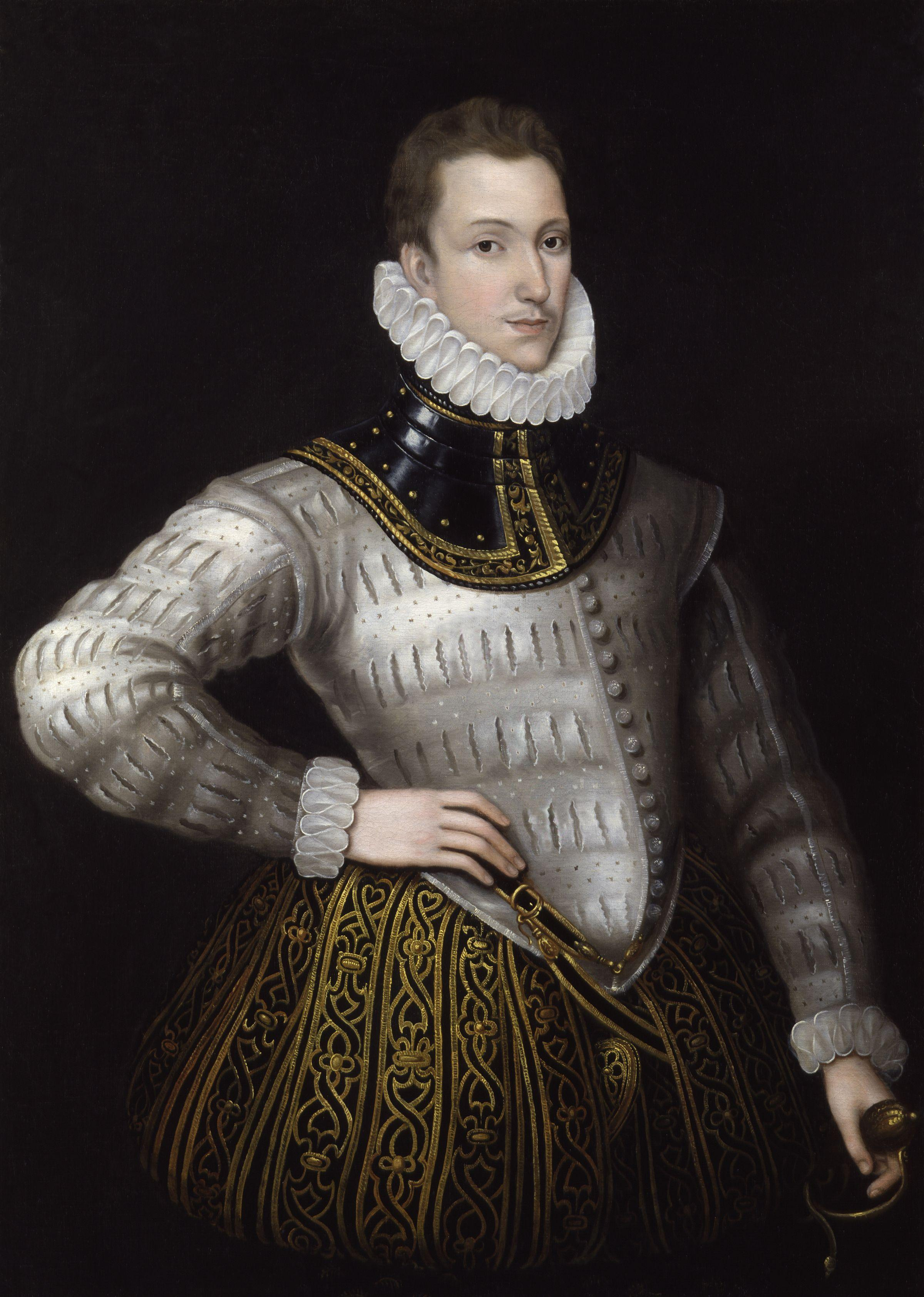
[Sir Philip Sidney, an 18th-century copy of a 1578 original]
I realize that my blogging has been largely Ruskin-related for a while now, which is more than apt to put off some readers (like the old friend from grad school I've reconnected with on Facebook, whose most printable names for JR are a "pompous asshole" and "neurotic pedophile"). But one has to follow one's obsessions.
So I'm well into Bibliotheca Pastorum, Ruskin's "shepherd's library" for the home. The first volume was a translation of Xenophon's Economist, which mostly proved to me that (a) there's a reason we read Plato's Socratic dialogues, and not Xenophon's, and (b) if I want classical agricultural instruction, I'll go to Hesiod or Virgil, thank you very much. Volume 2 is titled (by Ruskin) "Rock Honeycomb," and consists of an edited version of Sir Philip Sidney's translations of the Psalms. (Mostly Sir Philip's – many of the latter, and better, specimens are by his sister, Mary Herbert, Countess of Pembroke.
Ruskin's edited these poems, not because he feels the KJV Psalms are somehow inadequate, but because he feels the various metrical psalters available are inadequate. The Psalms are after all songs, meant to be sung, and therefore should be presented in a form fit for musical setting. The Sidneys' Psalms are in Ruskin's account both fine poetry, accurate translation, and eminently singable. I dunno – as translations, they seem to be as full of verbal padding and syntactic inversion as any metrical psalter I've met. But they are, many of them, exquisite examples of Elizabethan verse, and very interesting and varied metrically. If I must have my Psalms in meter, however, I think I'll stick with Milton. ("Milt does more than Philip can / To justify God's ways to man...")
***
It's way too often that I find myself reading a book of criticism or biography from 60 or 70 years ago & thinking to myself, they just don't produce them like this anymore. And of course there's writers out there who do, whether it's a matter of "big picture" reconceptualization or painstaking close reading. But two very old Ruskin books have been striking me repeatedly with their smarts. One is Derek Leon's posthumously published Ruskin: The Great Victorian (RKP, 1949). While Tim Hilton's big two-volume Yale life is going to be the biography of record for decades to come, and while I can't count the number of Ruskin biographies I've read up to this point, several of them very good indeed, nobody comes close to Leon's package of graceful writing, psychological insight, and abundant, incisive detail. A tremendous read, even if in its pacing it sometimes feels a bit Victorian itself.
Real Ruskin criticism didn't really get off the ground, despite a continuous flow of books, articles and monographs from the the 1880s thru the 1920s, until R. H. Wilenski's John Ruskin: An Introduction to Further Study of His Life and Work (Faber, 1933). Most of those earlier works were pieces of explanation or hagiography (or hagiographical biography), and despite some valiant efforts like Frederic Harrison's little book in the English Men of Letters series, no-one had made the full-scale effort of untangling what had become the Ruskin "myth," sorting out the bullshit from the brilliance, and figuring out how the one was related to the other. Wilenski was an art historian of some note; he explains in his preface how he'd gotten a copy of the Library Edition at some point, & was in the habit of turning its pages over regularly, wondering at how a single man could say such penetrating and silly things from book to book.
Wilenski's premise is simple but powerful: One must key any statement of Ruskin's to its personal and historical context; once one plots out the details and overall curve of JR's emotional, intellectual, and social life, the imagery and ideas of the books and lectures become entirely explicable. As I say, it's a powerful premise, and the first half of Wilenski's book is devoted to an admittedly amateur, but entirely persuasive, critical psychobiography of Ruskin, one which makes sense of his shifts of attention, his changing obsessions, and his varying voices. (I've just plunged into the second half of the book, which is marked "critical" – I'll keep you posted on how persuasive this part is.)
Perhaps most fascinating is Wilenski's relentless deflation of the Ruskin myths. Ruskin, he shows, learned everything he knew about art more or less before he was 30, and spent the rest of his life either refining those lessons or turning away from art altogether – but most definitely not making any new discoveries, or revising earlier positions. The "overwork" Ruskin so complained of in later years? Mostly imaginary – he had armies of secretaries and copyists to deal with piddling correspondence and to make the artistic "records" he had once pursued himself; Ruskin was plagued, not by overwork, but by his own inability to focus on one thing at a time. And most importantly – Wilenski shows to my mind unanswerably that Ruskin's public reputation in the 1850s and '60s was actually rather circumscribed, that very few people outside of art circles (where he was widely hated) had ever heard his name. It was only with his assumption of the Oxford Professorship in 1870 that Ruskin began his ascent to Victorian sagedom. (Helped along by the earlier publication of a "selection" of purple passages from Modern Painters, which became a bestseller, and Sesame and Lilies, which for some reason became the prize book of choice for girls' schools.)
The view of Ruskin as an "art-dictator" in the '50s and '60s, ruling the aesthetic world from the bastion of Modern Painters, Seven Lamps of Architecture, and Stones of Venice, is sheerest myth (sorry, fans of the BBC's Desperate Romantics, a wonderful romp but about as historically accurate as Shakespeare in Love), a myth produced by Ruskinians and Ruskin-readers of the 1880s, '90s, and first decades of the 20th century, reading Ruskin's later Fors-era prominence back into his past. That insight alone is worth the price of admission, whatever the value of the stretches of Wilenski I've yet to read.
Thursday, May 24, 2012
reading Ruskin: endgame
In his luminous autobiography, Praeterita, Ruskin recalls how he read the Bible with his mother, from the time he was able to make out the words to the time he went up to Oxford. They went thru 2 to 3 chapters a day, each one reading alternate verses aloud: "she began with the first verse of Genesis, and went straight through, to the last verse of the Apocalypse; hard names, numbers, Levitical law, and all; and began again at Genesis the next day." Margaret Ruskin corrected her son's pronunciation and intonation, quizzed him on the meaning of hard passages, and set him verses to memorize each day. Unsurprisingly, he came out of it with an unparalleled familiarity with the language and ideas of the King James Bible. (Apparently, they made a brief foray into learning Hebrew as well, which didn't stick; in later years Ruskin would correct habitually correct KJV renderings with his own translations from the Vulgate or the Septuagint, but never from the Hebrew text.)
I feel a bit like the child Ruskin with my own Ruskin reading. Every morning, after getting the girls off to school (or driving them myself), I settle down with my coffee and a volume of the Library Edition for an hour or so. Typically, I've been covering around 50 pages a day, reading at a moderate pace, marking passages (in pencil, Tom!), making notes. When I finish a volume, I immediately pull out the next and begin the Editors' Introduction.
This sort of wholesale & roughly chronological reading, as I found when working my way thru LZ, is essential to getting a firm grasp of the shape & details of an author's career. But it's also dreadfully wearing. I've already mentioned how trying Deucalion, Ruskin's mineralogical "treatise" was. His books on ornithology and botany (Love's Meinie and Proserpina) were similarly tough trudges, for different reasons. Indeed, the Library Edition is so complete that there're whole volumes of what amount to laundry lists – Vol. XIII on Turner, for instance, is largely composed of Ruskin's catalogues of Turner drawings, and Vol. XXI, The Ruskin Art Collection at Oxford, enumerates all of the specimen works he donated for his drawing school, in hundreds of pages. I confess to doing a bit of skimming when I come across a page which consists of nothing but the numbered names of drawings I've never seen, & whose subjects I can't imagine – but there's not a page I haven't cast my eye over carefully, looking for some interesting passage of description or commentary.
The day before yesterday – my mother's yahrzeit, a melancholy (and rainy) day – I finished the last letters (and appendices) of Fors Clavigera (Vol. XXIX) and a volume I'd been reading concurrently, The Guild and Museum of St. George (XXX), a collection mostly of notes, statements, correspondence, and catalogues relating to Ruskin's quixotic project to reclaim waste agricultural land in Britain and set up model cooperative (but rigidly hierarchical) farm communities, and to stock a museum for the edification of the workers. I fear from now on it's all downhill, however. The last two volumes of the Library Edition are a bibliography and an index. Volumes XXXVI and XXXVII are letters, which I intend to read, but at my own pace, piecemeal. And Volume XXXV is Praeterita itself, which I've already been thru several times.
Which leaves the odds & sods of Volumes XXXI thru XXXIV: a couple of volumes of other people's writing which Ruskin edited for the use of the Guild of St. George (right now I'm in the midst of XXXI, Biblioteca Pastorum, the beginnings of a kind of eccentric "household library" for Guild members); a number of very late Oxford lectures; a collection of public letters on various subjects; and various & sundry other sweepings (presented by the editors under the title "Ruskiniana"). I'm sure there will be some jewels – or at least some interesting bits – here. I do indeed look forward to The Storm-Cloud of the Nineteenth Century, Ruskin's own version of Silent Spring, and to Fiction Fair and Foul, his assessment of the English novel. But I'm pretty sure that nothing's going to measure up to the work of the '60s and '70s, from Unto this Last thru the fiery middle letters of Fors.
To put it simply: After his first major mental breakdown in early 1878, Ruskin never really gets his mojo back. It makes for sad reading, to say the least. The last nine numbers of Fors, written after his convalescence, are wan imitations of the earlier ones. Where the best letters of Fors read like muscular, proto-modernist ideograms of juxtaposed materials, iced off at the end with scrappy chunks of correspondence (think Paterson, in prose), the late ones feel like Ruskin desperately trying to focus his attention, trying time and again to sum up what's he's been about over the past 20 years. And he can't stop thinking about Rose La Touche, the Irish girl he fell in love with when she was 9 or 10, who died insane (at 27) in 1875, and whose name and specter (as St. Ursula) keep haunting all his writings. Praeterita manages to be his last masterpiece because it's an exercise in autobiography as therapy, Ruskin looking back at all the things in his life that make him happy, scrupulously avoiding everything that would upset him or send him back over the edge.
Reading the last run of Fors in conjunction with a few other Ruskin-related items – his correspondence with Thomas Carlyle, his letters to Lady Mount-Temple (his great confidant on the Rose La Touche affair), a little monograph by Van Akin Burd on JR's flirtation with the spiritualists (yes, Rose communicated with him from the other world), JL Bradley's Ruskin chronology (what, you don't read chronologies?) – has given me a deeper sense of Ruskin's longstanding mental problems, the degree to which he struggled with depression for pretty much his whole life. But it's sad to see the man succumbing in the end, sad to watch the five-volume extinguishing of the lamp. Of all of the literary careers I've worked my way thru, Ruskin's is the most precipitous in its dropping-off. Well, maybe there's one comparable – from Praeterita, again:
I feel a bit like the child Ruskin with my own Ruskin reading. Every morning, after getting the girls off to school (or driving them myself), I settle down with my coffee and a volume of the Library Edition for an hour or so. Typically, I've been covering around 50 pages a day, reading at a moderate pace, marking passages (in pencil, Tom!), making notes. When I finish a volume, I immediately pull out the next and begin the Editors' Introduction.
This sort of wholesale & roughly chronological reading, as I found when working my way thru LZ, is essential to getting a firm grasp of the shape & details of an author's career. But it's also dreadfully wearing. I've already mentioned how trying Deucalion, Ruskin's mineralogical "treatise" was. His books on ornithology and botany (Love's Meinie and Proserpina) were similarly tough trudges, for different reasons. Indeed, the Library Edition is so complete that there're whole volumes of what amount to laundry lists – Vol. XIII on Turner, for instance, is largely composed of Ruskin's catalogues of Turner drawings, and Vol. XXI, The Ruskin Art Collection at Oxford, enumerates all of the specimen works he donated for his drawing school, in hundreds of pages. I confess to doing a bit of skimming when I come across a page which consists of nothing but the numbered names of drawings I've never seen, & whose subjects I can't imagine – but there's not a page I haven't cast my eye over carefully, looking for some interesting passage of description or commentary.
The day before yesterday – my mother's yahrzeit, a melancholy (and rainy) day – I finished the last letters (and appendices) of Fors Clavigera (Vol. XXIX) and a volume I'd been reading concurrently, The Guild and Museum of St. George (XXX), a collection mostly of notes, statements, correspondence, and catalogues relating to Ruskin's quixotic project to reclaim waste agricultural land in Britain and set up model cooperative (but rigidly hierarchical) farm communities, and to stock a museum for the edification of the workers. I fear from now on it's all downhill, however. The last two volumes of the Library Edition are a bibliography and an index. Volumes XXXVI and XXXVII are letters, which I intend to read, but at my own pace, piecemeal. And Volume XXXV is Praeterita itself, which I've already been thru several times.
Which leaves the odds & sods of Volumes XXXI thru XXXIV: a couple of volumes of other people's writing which Ruskin edited for the use of the Guild of St. George (right now I'm in the midst of XXXI, Biblioteca Pastorum, the beginnings of a kind of eccentric "household library" for Guild members); a number of very late Oxford lectures; a collection of public letters on various subjects; and various & sundry other sweepings (presented by the editors under the title "Ruskiniana"). I'm sure there will be some jewels – or at least some interesting bits – here. I do indeed look forward to The Storm-Cloud of the Nineteenth Century, Ruskin's own version of Silent Spring, and to Fiction Fair and Foul, his assessment of the English novel. But I'm pretty sure that nothing's going to measure up to the work of the '60s and '70s, from Unto this Last thru the fiery middle letters of Fors.
To put it simply: After his first major mental breakdown in early 1878, Ruskin never really gets his mojo back. It makes for sad reading, to say the least. The last nine numbers of Fors, written after his convalescence, are wan imitations of the earlier ones. Where the best letters of Fors read like muscular, proto-modernist ideograms of juxtaposed materials, iced off at the end with scrappy chunks of correspondence (think Paterson, in prose), the late ones feel like Ruskin desperately trying to focus his attention, trying time and again to sum up what's he's been about over the past 20 years. And he can't stop thinking about Rose La Touche, the Irish girl he fell in love with when she was 9 or 10, who died insane (at 27) in 1875, and whose name and specter (as St. Ursula) keep haunting all his writings. Praeterita manages to be his last masterpiece because it's an exercise in autobiography as therapy, Ruskin looking back at all the things in his life that make him happy, scrupulously avoiding everything that would upset him or send him back over the edge.
Reading the last run of Fors in conjunction with a few other Ruskin-related items – his correspondence with Thomas Carlyle, his letters to Lady Mount-Temple (his great confidant on the Rose La Touche affair), a little monograph by Van Akin Burd on JR's flirtation with the spiritualists (yes, Rose communicated with him from the other world), JL Bradley's Ruskin chronology (what, you don't read chronologies?) – has given me a deeper sense of Ruskin's longstanding mental problems, the degree to which he struggled with depression for pretty much his whole life. But it's sad to see the man succumbing in the end, sad to watch the five-volume extinguishing of the lamp. Of all of the literary careers I've worked my way thru, Ruskin's is the most precipitous in its dropping-off. Well, maybe there's one comparable – from Praeterita, again:
The series of Waverley novels, then drawing towards its close, was still the chief source of delight in all households caring for literature; and I can no more recollect the time when I did not know them than when I did not know the Bible; but I still have a vivid remembrance of my father's intense expression of sorrow mixed with scorn, as he threw down Count Robert of Paris, after reading three or four pages; and knew that the life of Scott was ended: the scorn being a very complex and bitter feeling in him, – partly, indeed, of the book itself, but chiefly of the wretches who were tormenting and selling the wrecked intellect, and not a little, deep down, of the subtle dishonour which had essentially caused the ruin. My father never could forgive Scott his concealment of the Ballantyne partnership.**Scott was a silent partner in the firm of his publisher, James Ballantyne; when Ballantyne went belly-up in the banking crisis of 1826, Scott refused to declare himself bankrupt, & determined to write his way out of his enormous debts. Over the next six years he essentially ruined his health and his mind by overwork, producing some seven volumes of fiction, a six-volume life of Napoleon, a two-volume history of Scotland, and various other books.
Subscribe to:
Posts (Atom)