I'm off on something resembling "vacation" tomorrow, with no prospect of internet access beyond the occasional email checking, if that. So Culture Industry will be going on vacation as well for a while.
***
A valedictory random 10:
1) "You & Me," John Cale, The Island Years
2) "Tanah," Masada, Live at Mittelheim
3) "Who Is That," Ralph Stanley, Mountain Gospel
4) "The Sins of a Family," Oysterband, Ride
5) "Etude 28," John Zorn/Marc Ribot, The Book of Heads
6) "Master-Dik," Sonic Youth, Sister
7) "Interlude," Miles Davis, Agharta
8) "Pink," John Zorn, Elegy
9) "For the Beauty of Wynona," Daniel Lanois, For the Beauty of Wynona
10) "Blackwaterside," Oysterband, Rise Above
Friday, May 26, 2006

Monday, May 22, 2006
mechanical production
Two bits of data crossing the screen lately. On the one hand, this rather cool compositional tool – "Erasures" – brought to you by the folks at Wave Books (incorporating what was Verse Press): I was being conservative, it turns out, when I speculated some months ago that the compositional process Ronald Johnson used to produce Radi Os – erasing most of a previous text (in his case Paradise Lost) in order to "reveal" the minimalist poem within – might become a workshop tool. No, it's gone beyond that: it's become a hip, handy, & above all easy method, now codified as a computer program. I guess the next step will be a version of "Erasures" that lets you pour whatever source text you want into the program, which then dishes it up to you for erasing.
I don't regret so much the dissemination of Johnson's (or Lucas Foss's, or Tom Phillips's, whoever you want to name the "originator") method – tho there's always the inevitable slope of interest (when the Sex Pistols have blazed a trail, can Fear and the Anti-Nowhere League be far behind?) – as I do the loss of the sheer labor involved in Johnson's and Phillips's practice: those hundreds of hours pencilling out and erasing options in RJ's chance-acquired copy of Milton, followed by the hundreds more of typing up mock-up pages of spare, scattered words, testing how they look; for TP's Humument, the many more thousands of hours spent painting over the original pages – hours that will soon be abridged by some nifty combination of Erasures and Photoshop.
***
On the other hand, there's this, from the new Chicago Review:
Turns out this poem is the product of Eric P. Elshtain (proprietor of the excellent Beard of Bees ePress) feeding some passages from A. Maude Royden's Sex and Common Sense (1922) into Jon Trowbridge's Gnoetry 0.2, a program that generates poetry in much the same way the Laputan's word-loom of Gulliver's Travels III did.
CR editor Joshua Kotin raises questions in a "note" on the poems:
•Dunno about you folks out there, but Gnoetry doesn't at all satisfy my appetite for "surprising syntax and brilliant word combinations"; there are some neat turns in the handful of Gnoems in CR, & if I had the software on my computer I bet I'd be using it to generate some "seed" texts, but on the whole these strike me as rather limp bits of imitation LangPo.
•Therefore, one still labors over poems because it hasn't been demonstrated to one's satisfaction that the computer is yet able to generate anything that pleases one as much as what one comes up with oneself, even in terms of the disjunctions and surprises that Gnoetry does indeed seem to produce.
•While I don't think I want to spend the rest of my life reading nothing but Gnoems, I very much admire the project itself, insofar as it serves the same purpose that Warhol and Kostabi did for easel painting: it questions the relationship between traditionally formulated product and means of production; the product of such projects is nugatory – everyone knows that everything Warhol did from that late 70s on was mechanical, & that Kostabi was crap from the start.
Perhaps most importantly, as Josh K rightly implies, the existence of Gnoetry – aside from the amusing and sometimes interesting texts it produces – means that one can no longer take striking disjunction as the mark of experimentation (or, in that hoary old military metaphor, the "avant-garde"), or as the mark of anything in particular. Alt-poetry reading habits, already as slack as the ones IA Richards castigated in Practical Criticism, will have to tighten up. A "return to meaning"? Depends on what you mean by "meaning," I guess; but this post has gone on long enough already.
****
Gilbert Sorrentino, 1927 – 2006. Ron Silliman comments on GS's Something Said, which includes one of the most hilariously vicious essays I've read since Mark Twain on Fenimore Cooper, "John Gardner: Rhinestone in the Rough."
I don't regret so much the dissemination of Johnson's (or Lucas Foss's, or Tom Phillips's, whoever you want to name the "originator") method – tho there's always the inevitable slope of interest (when the Sex Pistols have blazed a trail, can Fear and the Anti-Nowhere League be far behind?) – as I do the loss of the sheer labor involved in Johnson's and Phillips's practice: those hundreds of hours pencilling out and erasing options in RJ's chance-acquired copy of Milton, followed by the hundreds more of typing up mock-up pages of spare, scattered words, testing how they look; for TP's Humument, the many more thousands of hours spent painting over the original pages – hours that will soon be abridged by some nifty combination of Erasures and Photoshop.
***
On the other hand, there's this, from the new Chicago Review:
18:54:16Not bad, you're thinking – tho not too great, either. The beginning has a whiff of J.H. Prynne, while the syntax of the middle almost strides into Geoffrey Hill territory, until that cheeky Jeff Clark reference ("the little door") in the final stanza. What does it mean? Who knows, but that's a pretty passé question to be asking of much contemporary verse.
I am able to, and
carried on at great
speed. Marriage is broken.
They break the ice at these two
creatures, united by the
way in which you must take it for
me to be overcome before the
meeting. That people who
come to take leave of him to put
it in his breast the little
door, where they do not regret the
equilibrium.
Turns out this poem is the product of Eric P. Elshtain (proprietor of the excellent Beard of Bees ePress) feeding some passages from A. Maude Royden's Sex and Common Sense (1922) into Jon Trowbridge's Gnoetry 0.2, a program that generates poetry in much the same way the Laputan's word-loom of Gulliver's Travels III did.
CR editor Joshua Kotin raises questions in a "note" on the poems:
Because Gnoetry replicates and refines a period style, instantly, ad infinitum, it threatens to render that style obsolete. For why write poems a computer can generate more efficiently? Why labor over unsolicited submissions when you can fill a journal over lunch? Gnoetry evacuates craft of meaning. When every MFA graduate has Gnoetry on his or her desktop, verbal pyrotechnics will no longer indicate a creative, skilled mind at the end of the poem. By flooding the market with linguistically innovative poetry, Gnoetry asks us to reconsider what we value in the period style, in poetry. And as it satisfies our appetite for surprising syntax and brilliant word combinations, it challenges poets to invent a new style that means, a style that cannot be replicated by a computer.Hmmmm. I wonder. Elshtain's experiments, it seems to me, must be placed in the Duchamp/Warhol camp – bits of language that challenge the ontology of the poem as traditionally conceived, ie the production of a single creative intelligence. But does Gnoetry really do so in any way beyond that of such modernist experiments as "automatic" writing, or Burroughsian cut-ups, or the collaborative writings of the Surrealists? I'm tempted to respond in bullet points:
•Dunno about you folks out there, but Gnoetry doesn't at all satisfy my appetite for "surprising syntax and brilliant word combinations"; there are some neat turns in the handful of Gnoems in CR, & if I had the software on my computer I bet I'd be using it to generate some "seed" texts, but on the whole these strike me as rather limp bits of imitation LangPo.
•Therefore, one still labors over poems because it hasn't been demonstrated to one's satisfaction that the computer is yet able to generate anything that pleases one as much as what one comes up with oneself, even in terms of the disjunctions and surprises that Gnoetry does indeed seem to produce.
•While I don't think I want to spend the rest of my life reading nothing but Gnoems, I very much admire the project itself, insofar as it serves the same purpose that Warhol and Kostabi did for easel painting: it questions the relationship between traditionally formulated product and means of production; the product of such projects is nugatory – everyone knows that everything Warhol did from that late 70s on was mechanical, & that Kostabi was crap from the start.
Perhaps most importantly, as Josh K rightly implies, the existence of Gnoetry – aside from the amusing and sometimes interesting texts it produces – means that one can no longer take striking disjunction as the mark of experimentation (or, in that hoary old military metaphor, the "avant-garde"), or as the mark of anything in particular. Alt-poetry reading habits, already as slack as the ones IA Richards castigated in Practical Criticism, will have to tighten up. A "return to meaning"? Depends on what you mean by "meaning," I guess; but this post has gone on long enough already.
****
Gilbert Sorrentino, 1927 – 2006. Ron Silliman comments on GS's Something Said, which includes one of the most hilariously vicious essays I've read since Mark Twain on Fenimore Cooper, "John Gardner: Rhinestone in the Rough."
Friday, May 19, 2006
In haste...
In-laws are in town with attendant demands on time, as is a dear friend who's packing and liquidating his stuff in preparation for moving to Seattle. The weather, after a day of depressingly incessant rain, has veered towards Florida summer. And everybody's talking about the hurricane season. So there are lots of reasons to be depressed.
***
Random 10:
1) "Distance Equals Rate Times Time," Pixies, Trompe Le Monde
2) "First Riddle," Fred Frith/Ensemble Moderne, Traffic Continues
3) "The Saint," John Zorn, Locus Solus
4) "Mahshav," Masada Chamber Ensemble, Bar Kokhba
5) "Blackleg Miner," Richard Thompson, 1000 Years of Popular Music
6) "Etude 17," John Zorn/Marc Ribot, The Book of Heads
7) "Baby Don't Know What to Do With Herself," Richard Thompson, You?Me?Us?
8) "Wheels," Fred Frith, Art Bears (remix record)
9) "You Don't Know What Love Is," Anthony Coleman, Selfhaters
10) "Never Real," Waco Brothers, Electric Waco Chair
(I'm beginning to wonder how truly random the "Party Shuffle" function on iTunes actually is; I mean, jeez, three Zorn-related and three-Frith related tracks in a single 10-song shuffle? But then again, I never took statistics...)
***
Random 10:
1) "Distance Equals Rate Times Time," Pixies, Trompe Le Monde
2) "First Riddle," Fred Frith/Ensemble Moderne, Traffic Continues
3) "The Saint," John Zorn, Locus Solus
4) "Mahshav," Masada Chamber Ensemble, Bar Kokhba
5) "Blackleg Miner," Richard Thompson, 1000 Years of Popular Music
6) "Etude 17," John Zorn/Marc Ribot, The Book of Heads
7) "Baby Don't Know What to Do With Herself," Richard Thompson, You?Me?Us?
8) "Wheels," Fred Frith, Art Bears (remix record)
9) "You Don't Know What Love Is," Anthony Coleman, Selfhaters
10) "Never Real," Waco Brothers, Electric Waco Chair
(I'm beginning to wonder how truly random the "Party Shuffle" function on iTunes actually is; I mean, jeez, three Zorn-related and three-Frith related tracks in a single 10-song shuffle? But then again, I never took statistics...)
Wednesday, May 17, 2006
Monastic Modernisms
Bob Archambeau fantasizes that my life in South Florida consists of long sessions of "jamming out like a crazed sasquatch on obscure stringed instruments " – would that it were so! – and reproduces a droll photo of me from of all places my wedding reception, when I sat in with the band ("The Big Shillelaghs") on Irish bouzouki for a couple of numbers.
It's nice to be able to look back on one's wedding with warm memories. It took place in a site down in North Miami called the Ancient Spanish Monastery, a set of actual 12th-century cloisters that William Randolph Hearst had imported from Spain to serve as a pool surround or some damn thing for San Simeon. The cloisters – disassembled into individual stones and bits of statuary & packed in crates with straw padding – got held up when they arrived in New York due to an outbreak of foot & mouth disease in Segovia (the customs people destroyed all the straw packing, & with it the assembly instructions!), Hearst fell into financial troubles and sold the lot, & the whole thing languished in a Brooklyn warehouse for a quarter-century until somebody bought it with the bright idea of putting it together as a tourist attraction in Miami.
Really quite a magical place, like The Cloisters in NYC transported into the midst of Mowgli's jungle (vines, creepers, big tropical trees), & a perfect place for a (rather heterodox) Jewish wedding. Serves the Inquistion right, if you ask me.
***
Turns out I misspelled Michael Horovitz's name (that's Horovitz with a "v," not Horowitz) when I cited his 1969 Penguin anthology Children of Albion. Tho I wasn't trying to be exhaustive, I ought to have mentioned Adrian Clarke & Robert Sheppard's excellent Floating Capital: New Poets from London (Potes & Poets, 1991), something of a "London" counterpoint to the "Cambridge" A Various Art. Helpful readers Alex Davis and Edmund Hardy point me to Nicholas Johnson's anthology Foil: Defining Poetry 1985-2000 (Etruscan, 2000) and, for those who want some pointers in contemporary Irish writing, Alex's article "The Irish Modernists and Their Legacy" in Matthew Campbell's Cambridge Companion to Contemporary Irish Poetry.
I can't help mulling over the differences between contemporary British/Irish & American alt-poetry, however much my mulling serves simply to expose my ignorance. One thing that strikes me is how often one finds contemporary British poets/anthologists/critics referring to such work as "modernist" – for example in the title of Rod Mengham & John Kinsella's anthology, Vanishing Points: New Modernist Poems (Salt, 2004), a collection that includes John Ashbery, Lyn Hejinian, Peter Gizzi, Susan Howe, Marjorie Welish, & a bunch of other people that most American critics would be labelling "post-" at the drop of a hat. (I'll confess that I haven't seen the anthology, either, so I don't know how much – if any – time Mengham & Kinsella spend justifying that adjective "modernist.") Or in Anthony Mellors's Late Modernist Poetics: From Pound to Prynne (Manchester UP, 2005), which treats not merely Prynne but Charles Olson himself, Mister Post-Modernism.
On the one hand, I suspect what's going on is a variation of the argument Marjorie Perloff makes in Twenty-First Century Modernisms, that there is a deep stylistic and conceptual continuity between early 20th-century modernisms & contemporary alt-poetry (an argument with which I have a great deal of sympathy – why not leave the "postmodernist" tag to the social theorists, the philosophers, & the popular pundits, since it's such a squishy signifier anyway?).
But on the other hand – and here I'm speculating – I wonder if there isn't a difference between the literary experiences of Britain/Ireland & of the US that leads poets of the former lands to put rather more stock in "modernist" as a term: That is, perhaps the suppression of modernism that took place over the 1940s & 50s – the Movement, the lemming-like following of the late, tame TS Eliot – was rather more successful either than similar tendencies in US poetry, leading innovative British/Irish poets of the 1970s on to spend rather more energy asserting their continuity with the ruptures of early 20th-c. modernism: As opposed to the successive waves of American experimentalists, from the "groups" in Donald Allen's New American Poetry to the Language Poets, each of which sought in various ways to distance themselves from aspects of a modernist heritage which, while it may have been in disrepute in New Yorker circles, still seemed very much alive and dangerously alluring to younger poets. Maybe. I really do have to read Robert Sheppard's The Poetry of Saying, and a buttload of new things coming out from Salt and Manchester. Too effing many books out there.
It's nice to be able to look back on one's wedding with warm memories. It took place in a site down in North Miami called the Ancient Spanish Monastery, a set of actual 12th-century cloisters that William Randolph Hearst had imported from Spain to serve as a pool surround or some damn thing for San Simeon. The cloisters – disassembled into individual stones and bits of statuary & packed in crates with straw padding – got held up when they arrived in New York due to an outbreak of foot & mouth disease in Segovia (the customs people destroyed all the straw packing, & with it the assembly instructions!), Hearst fell into financial troubles and sold the lot, & the whole thing languished in a Brooklyn warehouse for a quarter-century until somebody bought it with the bright idea of putting it together as a tourist attraction in Miami.
Really quite a magical place, like The Cloisters in NYC transported into the midst of Mowgli's jungle (vines, creepers, big tropical trees), & a perfect place for a (rather heterodox) Jewish wedding. Serves the Inquistion right, if you ask me.
***
Turns out I misspelled Michael Horovitz's name (that's Horovitz with a "v," not Horowitz) when I cited his 1969 Penguin anthology Children of Albion. Tho I wasn't trying to be exhaustive, I ought to have mentioned Adrian Clarke & Robert Sheppard's excellent Floating Capital: New Poets from London (Potes & Poets, 1991), something of a "London" counterpoint to the "Cambridge" A Various Art. Helpful readers Alex Davis and Edmund Hardy point me to Nicholas Johnson's anthology Foil: Defining Poetry 1985-2000 (Etruscan, 2000) and, for those who want some pointers in contemporary Irish writing, Alex's article "The Irish Modernists and Their Legacy" in Matthew Campbell's Cambridge Companion to Contemporary Irish Poetry.
I can't help mulling over the differences between contemporary British/Irish & American alt-poetry, however much my mulling serves simply to expose my ignorance. One thing that strikes me is how often one finds contemporary British poets/anthologists/critics referring to such work as "modernist" – for example in the title of Rod Mengham & John Kinsella's anthology, Vanishing Points: New Modernist Poems (Salt, 2004), a collection that includes John Ashbery, Lyn Hejinian, Peter Gizzi, Susan Howe, Marjorie Welish, & a bunch of other people that most American critics would be labelling "post-" at the drop of a hat. (I'll confess that I haven't seen the anthology, either, so I don't know how much – if any – time Mengham & Kinsella spend justifying that adjective "modernist.") Or in Anthony Mellors's Late Modernist Poetics: From Pound to Prynne (Manchester UP, 2005), which treats not merely Prynne but Charles Olson himself, Mister Post-Modernism.
On the one hand, I suspect what's going on is a variation of the argument Marjorie Perloff makes in Twenty-First Century Modernisms, that there is a deep stylistic and conceptual continuity between early 20th-century modernisms & contemporary alt-poetry (an argument with which I have a great deal of sympathy – why not leave the "postmodernist" tag to the social theorists, the philosophers, & the popular pundits, since it's such a squishy signifier anyway?).
But on the other hand – and here I'm speculating – I wonder if there isn't a difference between the literary experiences of Britain/Ireland & of the US that leads poets of the former lands to put rather more stock in "modernist" as a term: That is, perhaps the suppression of modernism that took place over the 1940s & 50s – the Movement, the lemming-like following of the late, tame TS Eliot – was rather more successful either than similar tendencies in US poetry, leading innovative British/Irish poets of the 1970s on to spend rather more energy asserting their continuity with the ruptures of early 20th-c. modernism: As opposed to the successive waves of American experimentalists, from the "groups" in Donald Allen's New American Poetry to the Language Poets, each of which sought in various ways to distance themselves from aspects of a modernist heritage which, while it may have been in disrepute in New Yorker circles, still seemed very much alive and dangerously alluring to younger poets. Maybe. I really do have to read Robert Sheppard's The Poetry of Saying, and a buttload of new things coming out from Salt and Manchester. Too effing many books out there.
Sunday, May 14, 2006
High Lonesome
Mother's Day, of course, & part of the "celebration" consisted of driving down to Hollywood Beach to take in, of all things, a bluegrass festival. The high lonesome sound is not the single most popular musical genre in South Florida – in fact, I'd rank it somewhere near the very bottom of the music scene down here, along with Celtic, polka, German oompah band, and traditional "classical." A far cry from when I lived in Northern Virginia / suburban DC, where one of the best public radio stations programmed about five hours of bluegrass/old-timey every weekday and it was a rare weekend when there wasn't a "roots" music festival within easy driving distance or an excellent band appearing at the Birchmere in Alexandria.
Bluegrass in South Florida was a weird thing. All of these pasty-white, slightly tubby folks with the accents of my childhood, playing in front of a (smallish) crowd distinguished largely by their leathery tans, tasteful tattoos, & bemused expressions. I didn't have high hopes for the show, either, since the first ensemble we heard (a local group, I gather) had lots of enthusiasm but a paucity of chops, especially in the vocal department. Bluegrass, like bebop or contemporary metal, is a genre that puts a great premium on virtuosity, and a bluegrass band that can't quite keep up with their own beat is a spectacle about as leaden & embarassing as a violinist playing a Bach partita with shaky intonation.
So we opted out of the last bit of that set & the whole of the second set in order to get dinner – which, with the kids, is an undertaking that ought only to be entrusted to NASA or some other highly organized group. But we got back in time for the headliners, the Lonesome River Band, a group that I'd heard a bit of back in the day but whom I'd largely forgotten. They reminded me a just how exhilarating well-played bluegrass can be, with one driving, rattling tune following hard on the heels of another – the percussive sound of an overdriven banjo, the piercing whine of a Southern tenor, joined by his bandmates on the choruses in a sound that put me back into the Church of Christ pew of my early days.
Of course – at the risk of alienating some diehard fans – bluegrass can be the most boring music on earth, as any genre that trades on the same tempos and chord progressions can begin to seem pretty samey after a while: how many Telemann pieces can you listen to in a row? One dear friend of my grad school days used to call it "sewing machine music" on account of the degree to which bluegrass solos rely on running lightning-fast scales, over and over – first the banjo, then the guitar, then the mandolin: repeat in a different order on the next song, etc. She played old-timey guitar, old-time music being essentially the "roots" version of bluegrass, with a greater emphasis on archival tunes and songs, a deëmphasis of virtuosity, and a concomitant valorization of "feel." Sort of John Clare to bluegrass's Crabbe, but good stuff on the whole.
(For my money, the "house band" of Ithaca during my time there was the very wonderful Horseflies, an old-timey band with a bent sense of humor and a strong propensity to turn post-punk. They wrote the ultimate anthem to Ithaca, New York: "I Live Where It's Grey." During my time there, they signed with MCI and had a short-lived "pop" career, before drifting back to Ithaca and soldiering on. Check 'em out.)
Lately I've been watching from a distance & with some amusement the rise of Old Crow Medicine Show, a group of young old-timers who seem to have grown up listening to Nirvana and Public Enemy. They've become regulars on "Prairie Home Companion," without losing their ragged edges. I saw them once, when J. & I – probably a half-dozen years ago – were visiting Nashville & went to a huge bluegrass festival on the grounds of the Grand Ole Opry. There was a phalanx of bluegrass stars playing that festival (Doc Watson, most notably, still in fine voice), but what struck us most about the whole thing was the chaotic energy of five none-too-well-washed, extremely young, extremely scruffy skinny guys whaling away at various old-timey tunes, busker-style, in the interstices between the big stages. I wondered whether security was going to come & cart them away, fiddle, banjo, double bass and all, at any minute. And that was Old Crow Medicine Show.
Bluegrass in South Florida was a weird thing. All of these pasty-white, slightly tubby folks with the accents of my childhood, playing in front of a (smallish) crowd distinguished largely by their leathery tans, tasteful tattoos, & bemused expressions. I didn't have high hopes for the show, either, since the first ensemble we heard (a local group, I gather) had lots of enthusiasm but a paucity of chops, especially in the vocal department. Bluegrass, like bebop or contemporary metal, is a genre that puts a great premium on virtuosity, and a bluegrass band that can't quite keep up with their own beat is a spectacle about as leaden & embarassing as a violinist playing a Bach partita with shaky intonation.
So we opted out of the last bit of that set & the whole of the second set in order to get dinner – which, with the kids, is an undertaking that ought only to be entrusted to NASA or some other highly organized group. But we got back in time for the headliners, the Lonesome River Band, a group that I'd heard a bit of back in the day but whom I'd largely forgotten. They reminded me a just how exhilarating well-played bluegrass can be, with one driving, rattling tune following hard on the heels of another – the percussive sound of an overdriven banjo, the piercing whine of a Southern tenor, joined by his bandmates on the choruses in a sound that put me back into the Church of Christ pew of my early days.
Of course – at the risk of alienating some diehard fans – bluegrass can be the most boring music on earth, as any genre that trades on the same tempos and chord progressions can begin to seem pretty samey after a while: how many Telemann pieces can you listen to in a row? One dear friend of my grad school days used to call it "sewing machine music" on account of the degree to which bluegrass solos rely on running lightning-fast scales, over and over – first the banjo, then the guitar, then the mandolin: repeat in a different order on the next song, etc. She played old-timey guitar, old-time music being essentially the "roots" version of bluegrass, with a greater emphasis on archival tunes and songs, a deëmphasis of virtuosity, and a concomitant valorization of "feel." Sort of John Clare to bluegrass's Crabbe, but good stuff on the whole.
(For my money, the "house band" of Ithaca during my time there was the very wonderful Horseflies, an old-timey band with a bent sense of humor and a strong propensity to turn post-punk. They wrote the ultimate anthem to Ithaca, New York: "I Live Where It's Grey." During my time there, they signed with MCI and had a short-lived "pop" career, before drifting back to Ithaca and soldiering on. Check 'em out.)
Lately I've been watching from a distance & with some amusement the rise of Old Crow Medicine Show, a group of young old-timers who seem to have grown up listening to Nirvana and Public Enemy. They've become regulars on "Prairie Home Companion," without losing their ragged edges. I saw them once, when J. & I – probably a half-dozen years ago – were visiting Nashville & went to a huge bluegrass festival on the grounds of the Grand Ole Opry. There was a phalanx of bluegrass stars playing that festival (Doc Watson, most notably, still in fine voice), but what struck us most about the whole thing was the chaotic energy of five none-too-well-washed, extremely young, extremely scruffy skinny guys whaling away at various old-timey tunes, busker-style, in the interstices between the big stages. I wondered whether security was going to come & cart them away, fiddle, banjo, double bass and all, at any minute. And that was Old Crow Medicine Show.
Friday, May 12, 2006
British Matters
Well, what promised to be a relaxed & productive 1st week of summer break has turned out to be nothing of the sort, thanks to one child's mystery virus / succession of traumatic boo-boos, the other's decision that this particular month was the most propitious time to start trying out the "terrible" part of being two, & a minor catastrophe in an air conditioning outflow line. Not dull at all.
***
Bob Archambeau, similarly dug out from under the semester's wreckage, has a must-read "open letter" in response to Stephen Burt's recent review of Scottish & Northern Irish poetry in the Times. Bob makes the very accurate point – certainly not a new one to the 6 readers of this blog, but news to the readers of the Times and various other mass circulation periodicals – that British & Irish poetry is a far more variegated & rambunctious realm than one might anticipate if one's only points of reference are Seamus Heaney and the various lost-wax-process replicas of Philip Larkin who publish in the TLS.
Indeed, there's a lively alt-poetry scene in Great Britain & Ireland, & one that's been documented pretty well in a series of big anthologies: Michael Horowitz's Children of Albion (1969), John Matthias's 23 Modern British Poets (1971), Andrew Crozier & Tim Longville's A Various Art (1987), Eric Mottram et al.'s The New British Poetry (1988, and its spinoff volume, Future Exiles: 3 London Poets, 1992), Iain Sinclair's Conductors of Chaos (1996), Ric Caddel & Peter Quartermain's Other: British and Irish Poetry Since 1970 (1999), & Keith Tuma's Oxford Anthology of Twentieth-Century British and Irish Poetry (2001).
Interestingly enough, all of these later anthologies (save Tuma's, which takes a kind of Oxonian high ground) employ much the same rhetoric as the roughly contemporaneous American alt-poetry anthologies – Silliman's American Tree, Weinberger's Innovators and Outsiders, Messerli's From the Other Side of the Century, etc.: a simultaneous valuing of the innovation represented in the works of the poets included & vigorous assertion of their institutional (public, academic, etc.) marginalization. What's interesting is that these British anthologies, quite unlike their American counterparts, were published by fairly mass-market presses: Penguin, Paladin, Picador and the poetry press Carcanet. I suppose the US equivalent might be seeing In the American Tree published by Vintage, rather than by the University of Maine's National Poetry Foundation.
That's one thought. Another thought – and this perhaps to explain the general impression that British & Irish contemporary poetry is somehow more formally & conceptually conservative than American poetry, or that it lacks the vigorous alt-poetry component: Often it's just a matter of what's available on the other side of the ocean. Up until very recently indeed, the only UK or Irish poets the average American reader was likely to encounter were either a) published in American magazines or b) published by American publishers. Bloodaxe Books have only started making inroads into American bookstores in the last 10 years or so, & their distribution is still lousy; Carcanet, so far as I know, sells nothing over here; small presses like Reality Street and Shearsman can be found at the better small press bookstores (Bridge Street in DC, Talking Leaves in Buffalo), but not at even the very best independent bookstores in (say) Austin or Miami. Which leaves one reading the British & Irish poets who have American publishing contracts, folks like Larkin, Muldoon, Heaney, Hughes, etc. In some ways this has always been the case: though we share (more or less) a common language with the British, that's no reason to expect that there should be any significant overlaps in the institutional structures of our literary production.
(The problems of "translating" literary "scenes" across national borders are of course exacerbated when there's a language difference. I know a half-dozen contemporary French poets' work pretty well, but I have no idea whether my sense of contemporary French poetry is any more accurate than Baudelaire's, who thought Poe was a divine genius. Conversely, I'm told on good authority that the Italians consider John Ciardi and Gregory Corso to be the top rank of American poets.)
I have to confess a bunch of ignorance here: I've probably only read 50 or 60 books of British & Irish poetry published in the past 20 years, & I have only a vague notion of the issues at state when speaking of the "experimental" or "innovative" or "postmodernist" wing of those poetries (for convenience, shall we say "Brit-alt-poetry"?). For instance:
•This whole "modernist/postmodernist" business; I get the sense the Brits would rather use the term "modernist" rather than positing some ill-defined "post" – which seems to me eminently sensible. Perhaps it comes out of the experience of a modernism which was more thoroughly repressed (by the Movement, the neo-late-Eliotians, whomever) & is now being reinvigorated – as opposed to the New American Poets, who in some sense are trying to work their way out from under what they see as an oppressive modernism?
•The various regional groupings: who's a "Cambridge" poet (apart from the obvious suspects – Pope Prynne and the Various Art folks), and who's loosely connected with some other group?
Methinks I should be reading Andrew Duncan's and Robert Sheppard's books, & soon. What I'd really like would be an old-fashioned literary history of post-war British poetry, the sort of thing promised but not realized in Perkins's History of Modern Poetry & Michael Schmidt's Lives of the Poets.
***
Just finished John Xiros Cooper's Modernism and the Culture of Market Society, & struck by this exchange from Wyndham Lewis's Tarr:
Week's random 10:
1) "The Slave," Art Bears, Winter Songs
2) "The World Turned Upside Down," Oysterband, The Shouting End of Life
3) "Valerie," Richard Thompson & Danny Thompson, Live at Crawley
4) "Imperial Thorn," Death Ambient (Hideki/Mori/Frith), Death Ambient
5) "Piram," John Zorn/Masada, First Live 1993
6) "Frownland," Captain Beefheart and the Magic Band, Trout Mask Replica
7) "I Know Why the River Runs," Julie Miller, Broken Things
8) "Here He Comes," Brian Eno, Before and After Science
9) "Portent," Painkiller, Guts of a Virgin
10) "Funk in Deep Freeze," John Zorn/George Lewis/Bill Frisell, News for Lulu
***
Bob Archambeau, similarly dug out from under the semester's wreckage, has a must-read "open letter" in response to Stephen Burt's recent review of Scottish & Northern Irish poetry in the Times. Bob makes the very accurate point – certainly not a new one to the 6 readers of this blog, but news to the readers of the Times and various other mass circulation periodicals – that British & Irish poetry is a far more variegated & rambunctious realm than one might anticipate if one's only points of reference are Seamus Heaney and the various lost-wax-process replicas of Philip Larkin who publish in the TLS.
Indeed, there's a lively alt-poetry scene in Great Britain & Ireland, & one that's been documented pretty well in a series of big anthologies: Michael Horowitz's Children of Albion (1969), John Matthias's 23 Modern British Poets (1971), Andrew Crozier & Tim Longville's A Various Art (1987), Eric Mottram et al.'s The New British Poetry (1988, and its spinoff volume, Future Exiles: 3 London Poets, 1992), Iain Sinclair's Conductors of Chaos (1996), Ric Caddel & Peter Quartermain's Other: British and Irish Poetry Since 1970 (1999), & Keith Tuma's Oxford Anthology of Twentieth-Century British and Irish Poetry (2001).
Interestingly enough, all of these later anthologies (save Tuma's, which takes a kind of Oxonian high ground) employ much the same rhetoric as the roughly contemporaneous American alt-poetry anthologies – Silliman's American Tree, Weinberger's Innovators and Outsiders, Messerli's From the Other Side of the Century, etc.: a simultaneous valuing of the innovation represented in the works of the poets included & vigorous assertion of their institutional (public, academic, etc.) marginalization. What's interesting is that these British anthologies, quite unlike their American counterparts, were published by fairly mass-market presses: Penguin, Paladin, Picador and the poetry press Carcanet. I suppose the US equivalent might be seeing In the American Tree published by Vintage, rather than by the University of Maine's National Poetry Foundation.
That's one thought. Another thought – and this perhaps to explain the general impression that British & Irish contemporary poetry is somehow more formally & conceptually conservative than American poetry, or that it lacks the vigorous alt-poetry component: Often it's just a matter of what's available on the other side of the ocean. Up until very recently indeed, the only UK or Irish poets the average American reader was likely to encounter were either a) published in American magazines or b) published by American publishers. Bloodaxe Books have only started making inroads into American bookstores in the last 10 years or so, & their distribution is still lousy; Carcanet, so far as I know, sells nothing over here; small presses like Reality Street and Shearsman can be found at the better small press bookstores (Bridge Street in DC, Talking Leaves in Buffalo), but not at even the very best independent bookstores in (say) Austin or Miami. Which leaves one reading the British & Irish poets who have American publishing contracts, folks like Larkin, Muldoon, Heaney, Hughes, etc. In some ways this has always been the case: though we share (more or less) a common language with the British, that's no reason to expect that there should be any significant overlaps in the institutional structures of our literary production.
(The problems of "translating" literary "scenes" across national borders are of course exacerbated when there's a language difference. I know a half-dozen contemporary French poets' work pretty well, but I have no idea whether my sense of contemporary French poetry is any more accurate than Baudelaire's, who thought Poe was a divine genius. Conversely, I'm told on good authority that the Italians consider John Ciardi and Gregory Corso to be the top rank of American poets.)
I have to confess a bunch of ignorance here: I've probably only read 50 or 60 books of British & Irish poetry published in the past 20 years, & I have only a vague notion of the issues at state when speaking of the "experimental" or "innovative" or "postmodernist" wing of those poetries (for convenience, shall we say "Brit-alt-poetry"?). For instance:
•This whole "modernist/postmodernist" business; I get the sense the Brits would rather use the term "modernist" rather than positing some ill-defined "post" – which seems to me eminently sensible. Perhaps it comes out of the experience of a modernism which was more thoroughly repressed (by the Movement, the neo-late-Eliotians, whomever) & is now being reinvigorated – as opposed to the New American Poets, who in some sense are trying to work their way out from under what they see as an oppressive modernism?
•The various regional groupings: who's a "Cambridge" poet (apart from the obvious suspects – Pope Prynne and the Various Art folks), and who's loosely connected with some other group?
Methinks I should be reading Andrew Duncan's and Robert Sheppard's books, & soon. What I'd really like would be an old-fashioned literary history of post-war British poetry, the sort of thing promised but not realized in Perkins's History of Modern Poetry & Michael Schmidt's Lives of the Poets.
***
Just finished John Xiros Cooper's Modernism and the Culture of Market Society, & struck by this exchange from Wyndham Lewis's Tarr:
"Art is merely the dead, then?"***
"No, but deadness is the first condition of art... The second is the absence of soul, in the sentimental human sense. The lines and masses of the statue are its soul. No restless, quick flame-like ego is imagined for the inside of it. It has no inside. This is another condition of art; to have no inside, nothing you cannot see. Instead, then, of being something impelled like an independent machine by a little egoistic fire inside, it lives soullessly and deadly by its frontal lines and masses."
Week's random 10:
1) "The Slave," Art Bears, Winter Songs
2) "The World Turned Upside Down," Oysterband, The Shouting End of Life
3) "Valerie," Richard Thompson & Danny Thompson, Live at Crawley
4) "Imperial Thorn," Death Ambient (Hideki/Mori/Frith), Death Ambient
5) "Piram," John Zorn/Masada, First Live 1993
6) "Frownland," Captain Beefheart and the Magic Band, Trout Mask Replica
7) "I Know Why the River Runs," Julie Miller, Broken Things
8) "Here He Comes," Brian Eno, Before and After Science
9) "Portent," Painkiller, Guts of a Virgin
10) "Funk in Deep Freeze," John Zorn/George Lewis/Bill Frisell, News for Lulu
Wednesday, May 10, 2006
Noah Eli Gordon: The Frequencies: A Poem
Noah Eli Gordon's The Frequencies (Tougher Disguises, 2003) is a long sequence of prose poems, each them titled with a radio frequency – 106.3, 104.1, 98.7, and so forth. Familiar enough territory, especially if you've spent as much of your life on the road as I have, memorizing distances by when one station fades out and another starts coming in clearly, associating particular places with particular sets of numbers on the radio dial. (Tho a particularly contemporary experience – when I was a little kid, in the antedeluvian days before digital tuners became standard equipment in cars, you only knew approximately where the radio was tuned.) The root metaphor is I think Jack Spicer's notion of the poet as "radio receiver," passing on the signals he receives from the "Martians" or whomever.
The sources of the signals in Gordon's poem vary widely, tho surprisingly enough there's not as much as one might expect of overtly musical material in The Frequencies: Doc Watson & Waylon Jennings make appearances, as does "California Dreaming," but by the long, last virtuosic stretch of the book it had become clear to me (a slow learner at best) that what the radio primarily represents in the poem is the pressure of outside voices & idioms upon the poet: the pressure, that is, of intertextuality, of tradition. Spicer & Robert Duncan can be heard, fo course, but also those warhorses of "high" modernism, William Carlos Williams, T.S. Eliot, & Ezra Pound – which rather surprised me, popping up in a book published in 2003. I'd thought myself an anomaly for still – ten years older than Gordon – feeling the influence of the folks of 1914 as a heavy hand, both facilitating & hampering new directions. But apparently, unless I'm misreading The Frequencies, this splendid & varied book, I'm not at all alone.
The sources of the signals in Gordon's poem vary widely, tho surprisingly enough there's not as much as one might expect of overtly musical material in The Frequencies: Doc Watson & Waylon Jennings make appearances, as does "California Dreaming," but by the long, last virtuosic stretch of the book it had become clear to me (a slow learner at best) that what the radio primarily represents in the poem is the pressure of outside voices & idioms upon the poet: the pressure, that is, of intertextuality, of tradition. Spicer & Robert Duncan can be heard, fo course, but also those warhorses of "high" modernism, William Carlos Williams, T.S. Eliot, & Ezra Pound – which rather surprised me, popping up in a book published in 2003. I'd thought myself an anomaly for still – ten years older than Gordon – feeling the influence of the folks of 1914 as a heavy hand, both facilitating & hampering new directions. But apparently, unless I'm misreading The Frequencies, this splendid & varied book, I'm not at all alone.
87.7
"I'm hitting a brick wall here," the producer said, handing me the playlist. "ON the one hand, we've got to make it new," he went on, "on the other, we don't want to alienate our audience – they expect certain things from radio, you know." The way everything he said seemed to be an allegory was a bit unnerving, not to mention the fact that he continued to call me Kenneth no matter how often I corrected him. "A little autonomy would be nice," I said, forcing a half-smile. "Look, this isn't an art gallery," he answered. "It doesn't matter what you like; there's big money driving the music." I couldn't help thinking this is where the strings come in, where the plot starts to swell, but the only applause sign I'd respond to would be one that goes off at random, without rhythm – the blinking light burning up an expectation of an irreducible outcome, the American idiom like a new penny wrapper, meaningless & empty & somehow more than itself.
Sunday, May 07, 2006
Louis Zukofsky: "A"
Grades are in.
***
 So I'm fairly well launched on one of the summer's big reading projects, Hegel's Phenomenology of Spirit, taking as guides a small stack of (randomly-happened-upon) secondary works & the syllabus for Steve Evans's Hegel seminar this past semester. I have to admit that one of the things that intrigued me most about Steve's little encomium to Robert Pippin, his former teacher (here; scroll down a bit), was the shot of (what I take to be) Steve's own Hegel shelf, with its disintegrating copy of the Phenomenology. It reminded me a book that I'm again in the middle of reading – Zukofsky's "A".

I don't know how many times I've read "A". The very condition of my working copy of the book testifies to that. I can still recall unpacking it out of a big box from the University of California Press in my dorm room in Barringer Hall at Virginia Tech, a box containing a hardcover of The Maximus Poems, George Butterick's Guide to same, Prepositions, & Barry Ahearn's Zukofsky's "A". (U of C was having a really big sale...) That was 20 years ago, almost half my life, & I had no idea that I'd be devoting so much of it to LZ.
I've picked up several copies of "A" since then: a hardcover of the U of C edition, similar to the powder-blue paperback except for the fact that its cover is in pink & includes the quotation marks around A that LZ insisted upon; library discards of the Doubleday/Paris Review "A" 1-12 and "A" 13-21; the Grossman "A"-24; both American (Viking/Compass) & English (Trigram) editions of "A" 22 & 23; and a jacketless copy of the signed, limited edition Turret "A"-14. Not to mention a second printing of the Johns Hopkins republication of the complete "A", in a slightly larger format but with identical contents to the U of California edition.
I have a deep fondness for my paperback California "A", despite – or probably in part because of – its dilapidated condition. The notch at the bottom comes from the time in Ithaca I grew so frustrated with the book that I threw it across the room. There are of course my own marginalia – pencil marks so worn that they've become illegible, fountain pen underlinings that have bled thru to the next page, three or four different colors of ballpoint. It's not that I find much wisdom or insight in those markings: indeed, many of them are the conventionally puzzled, dopey scribblings of an ignorant 25-year-old (or an ignorant 30-year-old, or...): in short, pretty embarassing.
But I suppose I find this ratty book comforting in that it's evidence that there's at least one book in the world that I've read almost to pieces, even if I make no great claims as to how well I understand it or how much of it I can quote off the top of my head. Somewhere in Ways of Seeing, Berger comments on how frequently 19th-century boardrooms were decorated with lavish paintings of nude women, so that when a man of state or business was outwitted, he might look up "for consolation. What he saw reminded him that he was a man." When I've met defeat on my third attempt to make sense of a paragraph of Hegel's, I can cast my eye on my bookcase and think, "at least I've read 'A'."
***
 So I'm fairly well launched on one of the summer's big reading projects, Hegel's Phenomenology of Spirit, taking as guides a small stack of (randomly-happened-upon) secondary works & the syllabus for Steve Evans's Hegel seminar this past semester. I have to admit that one of the things that intrigued me most about Steve's little encomium to Robert Pippin, his former teacher (here; scroll down a bit), was the shot of (what I take to be) Steve's own Hegel shelf, with its disintegrating copy of the Phenomenology. It reminded me a book that I'm again in the middle of reading – Zukofsky's "A".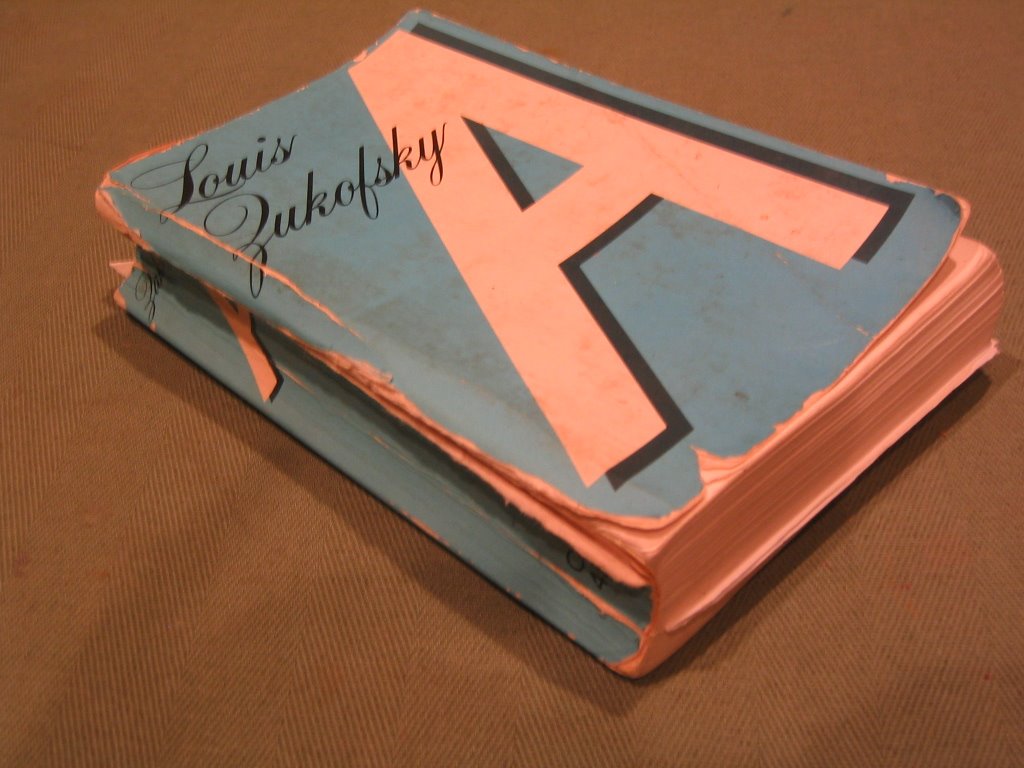
I don't know how many times I've read "A". The very condition of my working copy of the book testifies to that. I can still recall unpacking it out of a big box from the University of California Press in my dorm room in Barringer Hall at Virginia Tech, a box containing a hardcover of The Maximus Poems, George Butterick's Guide to same, Prepositions, & Barry Ahearn's Zukofsky's "A". (U of C was having a really big sale...) That was 20 years ago, almost half my life, & I had no idea that I'd be devoting so much of it to LZ.
I've picked up several copies of "A" since then: a hardcover of the U of C edition, similar to the powder-blue paperback except for the fact that its cover is in pink & includes the quotation marks around A that LZ insisted upon; library discards of the Doubleday/Paris Review "A" 1-12 and "A" 13-21; the Grossman "A"-24; both American (Viking/Compass) & English (Trigram) editions of "A" 22 & 23; and a jacketless copy of the signed, limited edition Turret "A"-14. Not to mention a second printing of the Johns Hopkins republication of the complete "A", in a slightly larger format but with identical contents to the U of California edition.
I have a deep fondness for my paperback California "A", despite – or probably in part because of – its dilapidated condition. The notch at the bottom comes from the time in Ithaca I grew so frustrated with the book that I threw it across the room. There are of course my own marginalia – pencil marks so worn that they've become illegible, fountain pen underlinings that have bled thru to the next page, three or four different colors of ballpoint. It's not that I find much wisdom or insight in those markings: indeed, many of them are the conventionally puzzled, dopey scribblings of an ignorant 25-year-old (or an ignorant 30-year-old, or...): in short, pretty embarassing.
But I suppose I find this ratty book comforting in that it's evidence that there's at least one book in the world that I've read almost to pieces, even if I make no great claims as to how well I understand it or how much of it I can quote off the top of my head. Somewhere in Ways of Seeing, Berger comments on how frequently 19th-century boardrooms were decorated with lavish paintings of nude women, so that when a man of state or business was outwitted, he might look up "for consolation. What he saw reminded him that he was a man." When I've met defeat on my third attempt to make sense of a paragraph of Hegel's, I can cast my eye on my bookcase and think, "at least I've read 'A'."
Saturday, May 06, 2006
Thises & thats
A brief note before the weekend – which is gonna be way gnarly, what with the stack of papers still to be graded & the final marks to be crunched. Largely heartened, however, by the final seminar papers from "Poetry & Theory," some of which were little short of dazzling.
***
Read Gillian Conoley's Profane Halo (Verse, 2005), & found it very, very good. Why haven't I heard of this poet before? I don't get out enough. Still welcoming suggestions for recent (last 3 years or so) absolutely dazzling books of poetry for my fall course.
***
Random 10:
1) "Cold Light," Yeah Yeah Yeahs, Fever to Tell
2) "Loisaida," Elliott Sharp, Nots
3) "Lantern Marsh," Brian Eno, Ambient 4/On Land
4) "Lonely Are the Dumb," John Zorn, Filmworks XIII: Invitation to a Suicide
5) "Deusa do Amor," Moreno Veloso +2
6) "Hair Pie: Bake 1," Captain Beefheart and the Magic Band, Trout Mask Replica
7) "Chusen Kale Mazel Tov," David Krakauer's Klezmer Madness!, The Twelve Tribes
8) "Beatrice," Daniel Lanois, For the Beauty of Winona
9) "I Will Be a Good Boy," Gang of Four, Songs of the Free
10) "There Will Never Be Another You," Alex Chilton, Set
***
Read Gillian Conoley's Profane Halo (Verse, 2005), & found it very, very good. Why haven't I heard of this poet before? I don't get out enough. Still welcoming suggestions for recent (last 3 years or so) absolutely dazzling books of poetry for my fall course.
***
Random 10:
1) "Cold Light," Yeah Yeah Yeahs, Fever to Tell
2) "Loisaida," Elliott Sharp, Nots
3) "Lantern Marsh," Brian Eno, Ambient 4/On Land
4) "Lonely Are the Dumb," John Zorn, Filmworks XIII: Invitation to a Suicide
5) "Deusa do Amor," Moreno Veloso +2
6) "Hair Pie: Bake 1," Captain Beefheart and the Magic Band, Trout Mask Replica
7) "Chusen Kale Mazel Tov," David Krakauer's Klezmer Madness!, The Twelve Tribes
8) "Beatrice," Daniel Lanois, For the Beauty of Winona
9) "I Will Be a Good Boy," Gang of Four, Songs of the Free
10) "There Will Never Be Another You," Alex Chilton, Set
Friday, May 05, 2006
Eric's back!...
so hie thyselves over to Say Something Wonderful and give him tips about how to teach Tender Buttons and Lifting Belly – and make 'em like it!
Thursday, May 04, 2006
Various
Quote of the month (so far) – Donald Rumsfeld: "I'm not in the intelligence business." You don't say.
***
All of you folks in the 40-and-under demographic should be submitting to Jessica Smith & John Sakkis's Anthology; you know who you are. I fear I just miss the cutoff, & am feeling too grey & tired (exam week, right?) to make the "young at heart" argument.
***
I'm beginning the slow process of cooking my fall syllabi, & have my antennae up for outstanding books of poetry published over the past 3 years or so. Anybody got any favorites that they think ought to be kicked around a seminar room by a bunch of hungry young poetry writing students?
***
All of you folks in the 40-and-under demographic should be submitting to Jessica Smith & John Sakkis's Anthology; you know who you are. I fear I just miss the cutoff, & am feeling too grey & tired (exam week, right?) to make the "young at heart" argument.
***
I'm beginning the slow process of cooking my fall syllabi, & have my antennae up for outstanding books of poetry published over the past 3 years or so. Anybody got any favorites that they think ought to be kicked around a seminar room by a bunch of hungry young poetry writing students?
Zukofsky abroad...
in Botswana, of all places (thanks to Croissantfactory). Interestingly enough, Tshireletso Motlogelwa, the article's author, quotes from the early, unrevised version of "A"-8, rather than the versions which appeared from 1959 onward (compare pp. 48-9 of the U California/Johns Hopkins editions). So either he found the poem in a late-1930s New Masses (where this "workers' song" first appeared), or he's stumbled upon New Directions in Poetry and Prose 1938 (which printed all of "A"-8), or he's seen my LZ and the Poetry of Knowledge. For my part, I like to imagine contemporary Botswanan progressives finding sustenance in the back files of New Masses.
Tuesday, May 02, 2006
Sleeping Arrangements

Long bedtimes at the Scroggins-Low household these days. We're trying, that is, to move both of the girls into a single room, thereby freeing up the larger of their bedrooms to serve as a playroom/ toy-storage-area/ guestroom. Luck has been sporadic thus far. Daphne (to the left, in full pirate/ hula girl outfit) is all for the idea, since she admires her sister to nothing less than idolatry. Getting to sleep in a pack 'n' play (that's a portable crib, for those of you who haven't been totally indoctrinated in the product industry associated with American infancy) – and eventually, in her own permanent crib – in the same room with Pippa is for her the equivalent of your average Young Republican getting to sit at the high table with Karl Rove.

Pippa (brunching with her friend Maddie, on left), on the other hand, approaches the whole matter with far more circumspection. Okay, so it's nice to have my sister in my room, especially since she's confined & can't get at any of my stuff. And it's kind of fun to swap giggles for a while after bedtime, and to make our talking Teletubbies talk to one another across the room. But do I really want to bunk down with a party animal who just doesn't know when to stop? I've got to get up for preschool in the morning, but my sister's happy to keep laughing, squawking, and playing fort-da with stuffed animals till the moon is high in the sky. What's in this for me?
The big answer: A Bunk Bed. A Bunk Bed With A Slide. Mind you, I think we're asking for trouble – aside from the whole issue of broken collarbones etc., I have a sneaking suspicion that importing playground equipment to the bedroom is going to push actual sleeping time all the way into the ante meridian. It's all an adventure.
Monday, May 01, 2006
Take yr stinkin' May Day...
May Day, of course, has for a long time been associated with unsavory and unAmerican Leftism, movements to liberate workers, to provide equal rights, to improve working conditions, and to do other nefarious things that go against everything that our current Congress and administration stand for. Thank heavens, this truly unChristian, unAmerican, and (most importantly) unCapitalist celebration has been replaced by what the Dauphin and his Capitol Hill supporters have named "Loyalty Day." All together now, let's take the oath...

(With thanks to Jesus' General.)

(With thanks to Jesus' General.)
Saturday, April 29, 2006
Noted, received, audited
With amusement: Michael Blumenthal's farewell letter to his poetry writing students, which puts paid to much of the mushiness all too prevalent in creative writing programs.
And Stephen Budiansky's Times op-ed piece on the branding of American higher education.
***
An influx of bookage: from Jeff Twitchell (proprietor of the absolutely essential Z-Site for Zukofsky research) a bundle of recencies by J. H. Prynne, including the pamphlets (that's English for chapbooks) Acrylic Tips and Biting the Air, and a copy of the hard-to-find lectures Stars, Tigers and the Shapes of Words. I can't wait to read, once I get through this stack of papers.
Perhaps most surprisingly, the local used bookstore divulged a copy of the 1967 Pennant Key-Indexed Study Guide to Homer's The Odyssey, by Guy Davenport, Ph.D. I won't tell you what I paid; look it up on abe.books, and rest assured that what it cost me would make a bookseller weep. (That's okay – these good folks have gotten enough of my money in the past, & will get enough in the future.) I'm always fascinated by the spectacle of a really interesting writer taking on scutwork – LZ's Index of American Design writing, for instance, or Pound's music reviews. And this one even has the advantage of Guy's own drawings of Achaian armor & suchlike.
***
& the weekly random 10:
1) "Lathe of God," Painkiller, Guts of a Virgin
2) "Lanterns," Killing Joke, Democracy
3) "Hal-an-Tow," Oysterband, Trawler
4) "St. Valentine's Day," Mekons, I Love Mekons
5) "The River," Brian Eno
6) "Tincans," Oysterband, Ride
7) "Sixteen Dances X," John Cage
8) "Coney Island Baby," Tom Waits, Blood Money
9) "My Lady Careys Dompe," Philip Pickett with Richard Thompson, The Bones of All Men
10) "One of These Days," Velvet Underground, Gold
And Stephen Budiansky's Times op-ed piece on the branding of American higher education.
***
An influx of bookage: from Jeff Twitchell (proprietor of the absolutely essential Z-Site for Zukofsky research) a bundle of recencies by J. H. Prynne, including the pamphlets (that's English for chapbooks) Acrylic Tips and Biting the Air, and a copy of the hard-to-find lectures Stars, Tigers and the Shapes of Words. I can't wait to read, once I get through this stack of papers.
Perhaps most surprisingly, the local used bookstore divulged a copy of the 1967 Pennant Key-Indexed Study Guide to Homer's The Odyssey, by Guy Davenport, Ph.D. I won't tell you what I paid; look it up on abe.books, and rest assured that what it cost me would make a bookseller weep. (That's okay – these good folks have gotten enough of my money in the past, & will get enough in the future.) I'm always fascinated by the spectacle of a really interesting writer taking on scutwork – LZ's Index of American Design writing, for instance, or Pound's music reviews. And this one even has the advantage of Guy's own drawings of Achaian armor & suchlike.
***
& the weekly random 10:
1) "Lathe of God," Painkiller, Guts of a Virgin
2) "Lanterns," Killing Joke, Democracy
3) "Hal-an-Tow," Oysterband, Trawler
4) "St. Valentine's Day," Mekons, I Love Mekons
5) "The River," Brian Eno
6) "Tincans," Oysterband, Ride
7) "Sixteen Dances X," John Cage
8) "Coney Island Baby," Tom Waits, Blood Money
9) "My Lady Careys Dompe," Philip Pickett with Richard Thompson, The Bones of All Men
10) "One of These Days," Velvet Underground, Gold
Thursday, April 27, 2006
The home stretch
Okay, so now it's all over but the grading, which I was puttering at today as I nursed a hangover from last night's last meeting of my "Poetry & Theory" seminar. Now that was fun: I nattered on for a while trying futilely to tie together some of the ideas in play during the last few weeks of class, then we kicked back to watch the second half of The Ister, all well-lubricated by many bottles of wine, some choice Belgian cherry beer, and Pernod with Perrier. Very decadent. And then off to the local "English" pub, where we bemused various antipodean rugby-playing regulars by talking at great length about Celan and Heidegger.
The course, which I'd been contemplating for some time, didn't quite come off as I'd planned (tho of course they never do). I'd foreseen the whole thing pivoting as it were around the materialist readings I'd programmed towards the middle – Antony Easthope, Adorno, Bernstein – but it turned out that the Celan unit at the end (Celan, Szondi, Gadamer, Derrida, Lacoue-Labarthe) captured my own imagination (and evidently the imaginations of some of the seminar members) even more than I'd expected. "Primary" texts: "The Meridian," "Du liegst," "Todtnauberg," and a handful of other Celan poems and talks, read thru the progressive prisms of Szondi's "Eden" essay fragment, the afterword to Gadamer's Who Am I and Who Are You?, bits of Derrida's "Shibboleth," and Lacoue-Labarthe's Poetry as Experience. Key themes: the poem's occasion; the "date" inscribed in the poem; the poem as "dialogue," "message in a bottle"; the status of extratextual reference (in a poetry PC himself always insisted was "ganz und gar nicht hermetisch" – yeah, right).
As if we didn't have enough balls in play over the past few weeks, midway thru the semester I got a brand new book which threatened to play the "archival research trumps speculative theory" card: James K. Lyon's Paul Celan and Martin Heidegger: An Unresolved Conversation, 1951-1970 (Johns Hopkins UP, 2006).* I'm looking forward to the reviews and responses to this one, which goes a really long way towards undermining a reading of the poem "Todtnauberg" as a record of Celan's bitter disappointment with his 1967 meeting with Heidegger at the philosopher's Black Forest cabin at Todtnauberg. It's a record of the meeting, all right, but Lyon shows – in a manner which looks pretty damned scrupulous – that when the poem was written, six days after that meeting, Celan by all reports was on a Heidegger high: he wasn't disappointed at all by what MH had told him about his (MH's) involvement with the Nazis, nor was he bitter about MH's silence concerning the Holocaust; on the contrary, he appeared to be well pleased with what he'd gotten out of his face-time with Heidegger.
All this, of course, contra the received reading of "Todtnauberg" (cf. Lacoue-Labarthe, and Pierre Joris in various places, & lots of other people). It all appears to be a matter of various readers reading Celan's disappointment and bitterness – oh yes, he changed his mind about Heidegger, tho he never stopped reading him, and even met him a couple more times before his death – back into a poem which was written before that reaction set in, and which – on its face – seems to bear few marks of anything other than a dispassionate note-jotting about a serious and much-anticipated meeting.
But I'm convinced, even tho one might have to scrap a reading of "Todtnauberg" that attributes bitterness and disappointment to its original occasion – to find that "date" inscribed in that particular manner – that there's still a good deal of truth in Lacoue-Labarthe's assessment of the poem as "an extenuated poem, or, to put it better, a disappointed one. It is the poem of a disappointment; as such, it is, and it says, the disappointment of poetry." Somewhere percolating in the depths of my mind, and sparking among these various texts, is the material for a proleptic theory of poetry, in which the poem rises up to meet the conditions for its future reception. But it'll have to wait until I get thru all these papers.
*This is not a book I'd recommend either for its stylistic flourishes – none, on the contrary a kind of dogged, repetitive presentation of facts and documents – nor for its theoretical sophistication; but it is an example of the sort of strenuous (almost "Germanic"?) archival scholarship that's perhaps a bit too rare today.
The course, which I'd been contemplating for some time, didn't quite come off as I'd planned (tho of course they never do). I'd foreseen the whole thing pivoting as it were around the materialist readings I'd programmed towards the middle – Antony Easthope, Adorno, Bernstein – but it turned out that the Celan unit at the end (Celan, Szondi, Gadamer, Derrida, Lacoue-Labarthe) captured my own imagination (and evidently the imaginations of some of the seminar members) even more than I'd expected. "Primary" texts: "The Meridian," "Du liegst," "Todtnauberg," and a handful of other Celan poems and talks, read thru the progressive prisms of Szondi's "Eden" essay fragment, the afterword to Gadamer's Who Am I and Who Are You?, bits of Derrida's "Shibboleth," and Lacoue-Labarthe's Poetry as Experience. Key themes: the poem's occasion; the "date" inscribed in the poem; the poem as "dialogue," "message in a bottle"; the status of extratextual reference (in a poetry PC himself always insisted was "ganz und gar nicht hermetisch" – yeah, right).
As if we didn't have enough balls in play over the past few weeks, midway thru the semester I got a brand new book which threatened to play the "archival research trumps speculative theory" card: James K. Lyon's Paul Celan and Martin Heidegger: An Unresolved Conversation, 1951-1970 (Johns Hopkins UP, 2006).* I'm looking forward to the reviews and responses to this one, which goes a really long way towards undermining a reading of the poem "Todtnauberg" as a record of Celan's bitter disappointment with his 1967 meeting with Heidegger at the philosopher's Black Forest cabin at Todtnauberg. It's a record of the meeting, all right, but Lyon shows – in a manner which looks pretty damned scrupulous – that when the poem was written, six days after that meeting, Celan by all reports was on a Heidegger high: he wasn't disappointed at all by what MH had told him about his (MH's) involvement with the Nazis, nor was he bitter about MH's silence concerning the Holocaust; on the contrary, he appeared to be well pleased with what he'd gotten out of his face-time with Heidegger.
All this, of course, contra the received reading of "Todtnauberg" (cf. Lacoue-Labarthe, and Pierre Joris in various places, & lots of other people). It all appears to be a matter of various readers reading Celan's disappointment and bitterness – oh yes, he changed his mind about Heidegger, tho he never stopped reading him, and even met him a couple more times before his death – back into a poem which was written before that reaction set in, and which – on its face – seems to bear few marks of anything other than a dispassionate note-jotting about a serious and much-anticipated meeting.
But I'm convinced, even tho one might have to scrap a reading of "Todtnauberg" that attributes bitterness and disappointment to its original occasion – to find that "date" inscribed in that particular manner – that there's still a good deal of truth in Lacoue-Labarthe's assessment of the poem as "an extenuated poem, or, to put it better, a disappointed one. It is the poem of a disappointment; as such, it is, and it says, the disappointment of poetry." Somewhere percolating in the depths of my mind, and sparking among these various texts, is the material for a proleptic theory of poetry, in which the poem rises up to meet the conditions for its future reception. But it'll have to wait until I get thru all these papers.
*This is not a book I'd recommend either for its stylistic flourishes – none, on the contrary a kind of dogged, repetitive presentation of facts and documents – nor for its theoretical sophistication; but it is an example of the sort of strenuous (almost "Germanic"?) archival scholarship that's perhaps a bit too rare today.
Tuesday, April 25, 2006
Noted
Jane/Joshua's "Cut 'n' Paste Poetics Blogwar," which is almost too accurate to be funny.
***
Lori Jareo, a big Star Wars fan, has advertised her "non-canonical" print-on-demand SW novel, Another Hope, on Amazon.com; unfortunately, she never got around to asking the Lucas people for permission to write about their "universe." Cease and Desist orders have gone out.
I would say "ho-hum," with a bit of the raised eyebrow at the genre of "fan fiction," about which I knew precisely nothing before this crossed the radar screen, except for the fact that Jareo, it turns out, is also one of the proprietors of the WordTech Communications poetry publishing outfit, a POD unit that on its face seems to be making a good faith effort to provide a book outlet for poets who are entirely unplugged from the "scene." And she's published her Stars Wars thing, it seems, under the same imprint. Oh dear. Kids, remember the old school punk adage? If the labels won't bite, then DIY.
***
[Of interest only to academics – and those who don't want American universities entirely subcontracted out to WalMart and Halliburton:] An "issue paper" from the Department of Education on why college costs so much: it's the faculty, of course. Only room for a few choice morsels of this business-school produced piece o' crap:
Comments on this abomination on Inside Higher Ed and Michael Bérubé.
***
Lori Jareo, a big Star Wars fan, has advertised her "non-canonical" print-on-demand SW novel, Another Hope, on Amazon.com; unfortunately, she never got around to asking the Lucas people for permission to write about their "universe." Cease and Desist orders have gone out.
I would say "ho-hum," with a bit of the raised eyebrow at the genre of "fan fiction," about which I knew precisely nothing before this crossed the radar screen, except for the fact that Jareo, it turns out, is also one of the proprietors of the WordTech Communications poetry publishing outfit, a POD unit that on its face seems to be making a good faith effort to provide a book outlet for poets who are entirely unplugged from the "scene." And she's published her Stars Wars thing, it seems, under the same imprint. Oh dear. Kids, remember the old school punk adage? If the labels won't bite, then DIY.
***
[Of interest only to academics – and those who don't want American universities entirely subcontracted out to WalMart and Halliburton:] An "issue paper" from the Department of Education on why college costs so much: it's the faculty, of course. Only room for a few choice morsels of this business-school produced piece o' crap:
The time-honored practice of tenure is costly. Tenure was originally conceived as a means to protect “academic freedom.” [dig those scare quotes] It has evolved into a system to protect job security. A combination of institutional practice and emerging case law has resulted in a situation where institutional flexibility is reduced in two key ways. First, if student demand for academic programs shifts [of course, the life of the mind has always been demand-driven], faculty capacity to deliver it cannot. Tenured faculty members are not interchangeable parts (a physics professor can’t usually teach journalism, and vice versa). [duh]The ultimate solution? Scale universities back to internet-based vocational programs serving only the skills students demand the most in order to become happy, profit-making parts in the great industrial machine. No more tenure – those online courses can be taught entirely by adjuncts; no more physical libraries – after all, they can get any data they need on the internet; no more wasteful "research" "releases" for the folks chained to their keyboards grading exams.
Colleges are not managed with efficiency as the primary value. [where in God's name did this fellow get the idea that they should be?]
a. Colleges maintain large physical infrastructures that often include libraries, computing centers, academic and student-oriented buildings, power plants, research facilities, theatres and stadiums. This infrastructure is rarely used to capacity.
To understand the management of a college one must understand the unique culture and extraordinary power of the faculty. [Where does this guy teach? I want a job there!] To many faculty, they are the university. [I don't believe this, entirely: in my mind, the university is first its students; then its faculty; then the staff who support the teaching and research that goes on in the institution; I imagine I disagree with Robert Dickeson (the report's author) in seeing administration – what he calls "management" – as little more than a necessary evil. "That government governs best that governs least," said somebody wiser than either of us.] This tenet explains a number of practices that distinguish college management from most other forms of management. Among these practices are: the keen importance of process in undertaking decision-making on campus, a factor that explains the slow-moving pace of change that characterizes most institutions; the assumption that the faculty “own” all curricular decisions, and the concomitant reluctance to challenge that authority when meaningful reform is indicated
Comments on this abomination on Inside Higher Ed and Michael Bérubé.
Boxing Duchamp
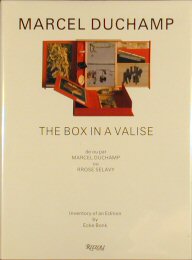
In all my excitement over The Ister, I forgot to mention a new arrival in the household that will probably hold my attention much longer: an anniversary present, the big book Marcel Duchamp: The Box in a Valise (de ou par Marcel Duchamp ou Rrose Selavy): Inventory of an Edition, by Ecke Bonk (Rizzoli, 1989). I've always been fascinated by Duchamp, & convinced that his ideas about art probably have a lot of bearing on contemporary poetry. (For instance, his early and repeated rejection of "retinal art" – art that provides immediate sensual pleasure to the eye – in favor of an art of ideas, an art that appeals to the mind rather than the senses, is probably of some relevance to the discussion of the relationship between intellectuality and immediate apprehensibility in alt-poetry going on over on Josh Corey's blog these days.)
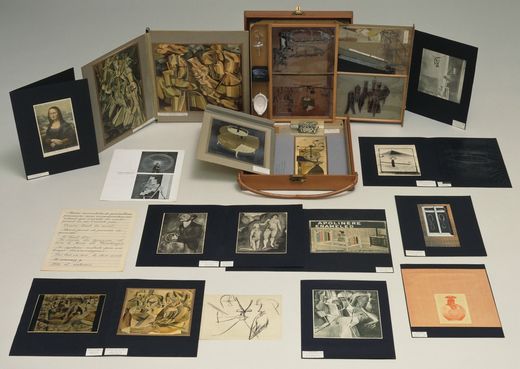
The Box in a Valise is an exhaustive and loving chronicle, with pictures and diagrams of every detail, of Duchamp's monumental-miniature "late" work, the Boîte-en-valise, a handy wooden carrying case containing reproductions – most of them made thru painstaking and enormously time-consuming handicraft methods – of all of his major works, and most of his minors. There's a wee clay model of "Fountain," the signed urinal; there are hand-colored reproductions of all of the paintings; there are precise simulacra of his odder projects (the fake checks, the Monte Carlo investment "bonds" Duchamp had made for his own attempt to break the bank at roulette; there are photos of most of the ready-mades).
It's an amazing, and amazingly obsessive project. It took Duchamp over five years of full-time labor to produce the reproductions of his works for the approximately 350 copies of the Box, and he would release the finished products in "homeopathic doses" of maybe 20 to 30 over the last 27 years of his life.
It's a gesture I really love: a pocket "canon," as it were, an artist assembling – on his own idiosyncratic terms – the sort of catalogue raissoné that most artists have to wait a lifetime to see published. Or perhaps I'm just drawn to it by my own longstanding obsession with miniaturization, with shrinking the big down into the little. Zukofsky claims somewhere that 80 Flowers – a book that totals 648 lines of verse – was the compact version of his entire life's work. Something to be said for shriking it all down into something you can tuck under an arm and walk away with. Thoreau would approve.
Saturday, April 22, 2006
But what do you compare it to?
Couple days ago I told Jessica Smith that I wasn’t kidding when I said (of Annie Finch) “I love it when people talk of poetry as a dance”: “I always remember – tho I can't lay my finger on it” (said I) “that passage where WCW kicks Pound's butt over the ‘condition of music’ business, and tells him that if poetry has to be compared to anything, it ought to be compared to dancing.” So Michael Zbigley replies:
I don't deny the historical linkage of music & poetry, & EP, Zukofsky, and Bunting among others certainly got a lot of mileage out of the entertwined roots of the two arts. But for all the maddening & wonderful inconsistencies of WCW's statements about poetics, I think he's onto something: that the Paterian notion of art aspiring to a "condition of music" – a content-free, non-referential, purely formal shape – is only one of the options open to the poet in the 20th century & beyond.
Admittedly, there is a very basic pleasure to be obtained from the poet with a conventionally or unconventionally musical ear. And one can't gainsay the achievements of poets who've been attracted by the model of music – Pound and Zukofsky, to name 2 who really didn't know jack about music in any substantial sense, and Bunting, who seems to have known quite a bit. But there's no meaningful, foundational link between the two arts – maybe never, and not anymore if there ever was.
I find, as I get older and even dorkier on the dance floor than I was when I was young & thin, that I find the metaphor of dance – and metaphors're all they are, these "musics" and "dances" and "paintings," after all? – more attractive when I sit down to write. Celan's "Todesfuge" got analyzed in German high school classes all thru the '70s for its "fugal form," but it's worth remembering that the poem started life as "Todestango."
***
Oh yes, the weekly random 10:
1) “Den of Sins,” Naked City, Naked City
2) “Born to Run,” Emmylou Harris, Spyboy
3) “Down Where the Drunkards Roll,” Richard Thompson, the big box set
4) “Bottle of Smoke,” The Pogues, If I Should Fall from Grace with God
5) “I Don’t Know,” Mekons, I Love Mekons
6) “Friendly Ghosts,” Mark Ribot, Rootless Cosmopolitans
7) “Archimedes,” John Cale, Hobo Sapiens
8) “Garage d’Or,” Mekons, Original Sin
9) “Long Dark Street,” Oysterband, The Shouting End of Life
10) “Ashes to Ashes,” David Bowie, Scary Monsters
Pound also said "Music rots when it gets too far from the dance. Poetry atrophies when it gets too far from music."Well, I found the WCW passage I had in mind, from towards the end of Spring and All:
I don't recall that WCW line, but I suppose the salient point is that both dance and poetry arose as responses to music, supplements, you might say.
The Derridean logic of the supplement certainly plays out in poetry's history, i.e. poetry as augmentation to music becomes poetry as replacement for music, but this seems less apt for dance. I suppose purveyors of modern dance see their work as separable from music just as poets since at least the 13th century have been happy to speak their poems sans melody.
Pound again: "There are three kinds of melopoeia, that is, verse made to sing; to chant or intone; & to speak. The older one gets the more one believes in the first."
Writing is likened to music. The object would be it seems to make poetry a pure art, like music. Painting too. Writing, as with certain of the modern Russians whose work I have seen, would use unoriented sounds in place of conventional words. The poem would then be completely liberated when there is identity of sound with something – perhaps the emotion.Nothing about dance there, tho my memory isn't playing me entirely false, since Wms a few lines before writes of how poetry "creates a new object, a play, a dance which is not a mirror up to nature but –"
I do not believe that writing is music. I do not believe writing would gain in quality or force by seeking to attain to the conditions of music. (Imaginations 150)
I don't deny the historical linkage of music & poetry, & EP, Zukofsky, and Bunting among others certainly got a lot of mileage out of the entertwined roots of the two arts. But for all the maddening & wonderful inconsistencies of WCW's statements about poetics, I think he's onto something: that the Paterian notion of art aspiring to a "condition of music" – a content-free, non-referential, purely formal shape – is only one of the options open to the poet in the 20th century & beyond.
Admittedly, there is a very basic pleasure to be obtained from the poet with a conventionally or unconventionally musical ear. And one can't gainsay the achievements of poets who've been attracted by the model of music – Pound and Zukofsky, to name 2 who really didn't know jack about music in any substantial sense, and Bunting, who seems to have known quite a bit. But there's no meaningful, foundational link between the two arts – maybe never, and not anymore if there ever was.
I find, as I get older and even dorkier on the dance floor than I was when I was young & thin, that I find the metaphor of dance – and metaphors're all they are, these "musics" and "dances" and "paintings," after all? – more attractive when I sit down to write. Celan's "Todesfuge" got analyzed in German high school classes all thru the '70s for its "fugal form," but it's worth remembering that the poem started life as "Todestango."
***
Oh yes, the weekly random 10:
1) “Den of Sins,” Naked City, Naked City
2) “Born to Run,” Emmylou Harris, Spyboy
3) “Down Where the Drunkards Roll,” Richard Thompson, the big box set
4) “Bottle of Smoke,” The Pogues, If I Should Fall from Grace with God
5) “I Don’t Know,” Mekons, I Love Mekons
6) “Friendly Ghosts,” Mark Ribot, Rootless Cosmopolitans
7) “Archimedes,” John Cale, Hobo Sapiens
8) “Garage d’Or,” Mekons, Original Sin
9) “Long Dark Street,” Oysterband, The Shouting End of Life
10) “Ashes to Ashes,” David Bowie, Scary Monsters
Thursday, April 20, 2006
Honey, get the kids out of the house...now!
And this sighted in Friday's Washington Post:
Learning the Wrong Things From Poetry
Fill your house with books if you want little Billy or Beth to grow up to be an academic all-star. Shakespeare is good. But stay away from poetry -- books of poesy on your shelves may dumb down your child.
A research team headed by demographer Jonathan Kelley, of Brown University and the University of Melbourne, analyzed data from a study of scholastic ability in 43 countries, including the United States. The data included scores on a standardized achievement test in 2000 and detailed information that parents provided about the family. The average student scored 500 on this test.
The researchers found that a child from a family having 500 books at home scored, on average, 112 points higher on the achievement test than one from an otherwise identical family having only one book -- and that's after they factored in parents' education, occupation, income and other things typically associated with a child's academic performance. The findings were presented last month at the annual meeting of the Population Association of America in Los Angeles.
Of course, it's not the number of books in the home that boosts student performance -- it's what they represent. The researchers say a big home library reflects the parents' dedication to the life of the mind, which probably nurtures scholastic accomplishment in their offspring.
They also found that not all books are created equal. "Having Shakespeare or similar highbrow books about bodes well for children's achievement," they wrote. "Having poetry books around is actively harmful by about the same amount," perhaps because it signals a "Bohemian" lifestyle that may encourage kids to become guitar-strumming, poetry-reading dreamers.
Learning the Wrong Things From Poetry
Fill your house with books if you want little Billy or Beth to grow up to be an academic all-star. Shakespeare is good. But stay away from poetry -- books of poesy on your shelves may dumb down your child.
A research team headed by demographer Jonathan Kelley, of Brown University and the University of Melbourne, analyzed data from a study of scholastic ability in 43 countries, including the United States. The data included scores on a standardized achievement test in 2000 and detailed information that parents provided about the family. The average student scored 500 on this test.
The researchers found that a child from a family having 500 books at home scored, on average, 112 points higher on the achievement test than one from an otherwise identical family having only one book -- and that's after they factored in parents' education, occupation, income and other things typically associated with a child's academic performance. The findings were presented last month at the annual meeting of the Population Association of America in Los Angeles.
Of course, it's not the number of books in the home that boosts student performance -- it's what they represent. The researchers say a big home library reflects the parents' dedication to the life of the mind, which probably nurtures scholastic accomplishment in their offspring.
They also found that not all books are created equal. "Having Shakespeare or similar highbrow books about bodes well for children's achievement," they wrote. "Having poetry books around is actively harmful by about the same amount," perhaps because it signals a "Bohemian" lifestyle that may encourage kids to become guitar-strumming, poetry-reading dreamers.
Subscribe to:
Posts (Atom)