Showing posts with label richard thompson. Show all posts

Thursday, June 24, 2010

the great English songbook

[Richard Thompson, with an unspeakably cool guitar]

Nothing to blog about, and blogging it:

It is officially summer, tho summer weather set in here weeks & weeks ago. Terrifically muggy, sticky, generally uncomfortable. The air conditioner in my little Cabrio died the other week (this is the second time it's done this over the car's lifetime), so getting from place to place is an exercise in temporary sauna-immersion. I'd take the top down, but the sun is unbearably oppressive, & the daytime weather here is terrifically unpredictable: if you leave for the office on a cloudless morning, there's decent chance of getting caught in a cloudburst before you get to the parking lot.

We leave for New York next week, to be away for something like 6 weeks. Am I looking forward to the trip? Well, as much as I usually do – I'm frankly a homebody, deeply inertial. I like being among my books, my guitars, my stuff. But I'll manage. I'll get things read, and get things written. I've already gotten a few little things done since the end of the semester (tho that six weeks has felt more like a week & a half).

Father's Day was nice; I'd spent much of the week before visiting my mother in God's Country (middle Tennessee), a deeply depressing, sad experience, so it was nice to come home to the girls. They gifted me with something I'd been anticipating for years: the big set of 3 Richard Thompson songbooks. Now anyone who knows me well knows that I've had a well-nigh obsessive relationship with RT's music for maybe 30 years now. Yes, I've got all the albums; yes, I know all the words (or most of them).

The songbooks were at first, frankly, a bit of a disappointment. RT's website has been anticipating them for several years now. They'd hired the Fairport Convention guitarist/multi-instrumentalist Maartin Alcock to do the transcribing, & apparently (former descriptions have vanished from the site) the plan was to present the entire RT song corpus – every single song – in detailed tablature. [Tablature, for those non-guitarist-geeks out there, is a kind of pidgin musical notation that shows the guitarist which fret & string a note should fall on: for real musicians who read music, it's a supplement, showing unusual fingerings and tunings; for musical idiots like me, who can read music about as well as I read Greek, it's a wonderful bridge to actually being able to play something.]

At any rate, the 3 volumes of the RT songbook as published don't by any means include all of his songs. It's true, the 150-odd songs here are practically everything one would want to know, but anal-compulsive completists like me are bound to miss a few things. And the promised tablature is only there for maybe 30 or 40 of the songs. Like, it's great to have the tabs for "1952 Black Vincent," but let's face it, I'll never have the technique to play that song anyway; I'd much rather have the tabs for the psychotic guitar solos on "Gethsemene" or "Dad's Gonna Kill Me."

On the plus side? (and truth to tell, the pluses far outweigh the disappointments of this set): The books are spiral-bound, so they lie flat on a table or music stand when you're trying to learn a piece. And even more importantly, while way too many of the songs have nothing more than a vocal melody line & a set of chord symbols, this is very much a guitarist's collection, in sharp contrast to the mass-produced music books of the 1970s or 80s, where the transcribers would figure out chords & then automatically punch in standard chord symbols. Here the transcriber (Alcock's still got a credit in the books, but his contribution has been massively downplayed on the website – what gives?) has scrupulously noted which tunings Richard uses on each song (lots of dropped-D, a good deal of DADGAD), what chord shapes RT plays (some of them exceedingly strange at first glance, but always eventually logical), & whether a given song is capoed. It makes all the difference in the world. Call me slow, but songs I'd worked out in standard tuning in E, & found unplayably difficult, suddenly become cool & luminous when played in dropped-D with the capo at 2.

So it seems suddenly tough to have to leave all guitars behind for the rest of the summer. And – did I mention this? – the newish acquisition. Yes, I broke down & bought a shiny black Turkish baglama (or "saz," the more generic term for stringed instrument) the other month. It's a strange piece of work, a combination of high-tech (pickups, control dials, etc.) & the primitive (the single-piece neck & headstock, the maddeningly inaccurate friction tuning pegs). It makes a lovely sound. I have its three courses tuned in "buzuk" tuning – D-G-A – so I can muddle thru with much of what I've learned on the mandolin & bouzouki. But it's still hard to get used to 18 frets to the octave, & figure out what to do with all of those extra notes. "Kashmir" sounds great, as do the Mekons' "Old Trip to Jerusalem" and PiL's "This Is Not a Love Song."

[is "baglamist" a word? yr humble blogger, flipped courtesy of Photobooth]

Sunday, December 23, 2007

new shoes!; good guitar


Damn the hiatus; I feel like blogging. Ed Baker kindly suggests that the malaise implied in my last post is the result of – you got it – the holidays themselves: "all holidays are too divisive and are cause of your current sicknesses/angst... they are all about buying things and murdering "them infidels" or about celebrating some invented 'happenstance' (phantasy)." To which I can only reply, yeah, I think you're right.

We were – horrors – in the local hi-tone mall the other night, & the spectacle of massed consumerism was rather like the shark-feeding scene in Moby-Dick; me, I turned into the shark who gets so enthusiastic that he starts swallowing his own entrails. In short, I bought new shoes [see above]. Pretty boss, no? A pair of New Balance trainers whose design – according to the press release –
pays homage to 70’s Grindhouse Cinema through a hard-hitting collage of the era’s slickest iconography. From the streets of Harlem to the skyscrapers of Hong Kong, [Sean] D’Anconia’s fusion of 70’s funk, yakuza and kung-fu imagery brings his unique pop-fusion universe to life in this limited-edition New Balance Creation.
I dunno. I just think they're cool. I'd draw your attention to the fact that the very hip gentleman on the inside of each shoe [see image to the right] has an actual crushed velvet afro.
***
Last week I wrote about bad guitar playing (ie, my own). This week I've been thinking about good guitar playing. It's time of course for that dreaded year-end phenomenon, people's lists of "best books of 2007," "best albums of 2007," etc. [The Poem of a Life, it seems, was released too late in the year to make anyone's list, tho it does happily appear on Pierre Joris's year-end list of "books I should have sent in to Steve Evans's Attention Span project," where he's kind enough to comment, "Still in the process of reading it, and so far completely delighted. A must for anyone interested in the most secret of the great American poets of the past century." And Su, bless her heart, says nice things here.]

Any way, while I can't claim to have anything like an encyclopedic knowledge – or even a cursory knowledge – of the records released over the past year, I'd hasten to put in a plug for my old flame Richard Thompson's latest electric release, Sweet Warrior. Every time RT comes out with a new band album, I'm inclined to think "this is the best thing since Rumour & Sigh" (1991) – & then, after listening for a couple months, decide that it's a good album but perhaps not quite up to R&S, which is after all pretty close to a perfect record. But Sweet Warrior (which I'll blog at length sometime soon, perhaps) is the real thing.

But I'm struck at the moment by a little note on the front page of RT's spiffy official website, letting us know that oor man made the top 20 of Rolling Stone magazine's 2003 list of the "100 greatest guitarists of all time" (number 19, in fact). I'm abnormally fascinated by such lists, which seem to mime the process of classic literary canon formation. Unfortunately, RS doesn't provide any information on how they came up with their pantheon of guitar heroes: did they just throw out names around the office? is it the result of an online or print readers' poll (as I suspect)?

And what makes a "great guitarist"? Here, for your perusal, are the top 20:
1 Jimi Hendrix
2 Duane Allman of the Allman Brothers Band
3 B.B. King
4 Eric Clapton
5 Robert Johnson
6 Chuck Berry
7 Stevie Ray Vaughan
8 Ry Cooder
9 Jimmy Page of Led Zeppelin
10 Keith Richards of the Rolling Stones
11Kirk Hammett of Metallica
12 Kurt Cobain of Nirvana
13 Jerry Garcia of the Grateful Dead
14 Jeff Beck
15 Carlos Santana
16 Johnny Ramone of the Ramones
17 Jack White of the White Stripes
18 John Frusciante of the Red Hot Chili Peppers
19 Richard Thompson
20 James Burton
It's pretty hard to argue with some of these: Hendrix, B. B. King, Duane Allmann, James Burton, Robert Johnson are all pioneers of their idioms, breakers of new ground (as Pound might have it); Santana, Jerry Garcia, Ry Cooder, & Kirk Hammett are very very fine players, impeccable technicians as it were. But what does Stevie Ray Vaughan have to offer that isn't already in Hendrix? And what in the world are Jack White & Kurt Cobain – iconic figures, & decent players but no more – doing in this top 20, many strata above such marvelous musicians as Ali Farka Toure (#76), Tom Verlaine (#56), & Vernon Reid (#66)? Are the rudimentary stylings of Lou Reed (#52) & Ron Asheton (of the Stooges, #29) really "greater" than the impeccable madness of Lightin' Hopkins (#71) & Robert Quine (#80)?

Rock music, however, has always been about more than just music itself, which goes some way towards explaining why Jimmy Page outscores the late, great, & much lamented Robert Quine by 71 positions. After all, who wouldn't vote for the romantically hairy, bare-chested Page, who in the eyes of his fellow guitarists wore the bloody guitar too low to bang out a decent solo in concert (ever wondered why the solos are so much better on Led Zeppelin's studio albums than on their live releases? wonder no more), over the bald, bespectacled Quine – Mr. Magoo with an electric guitar?

I'm an unabashed fan: I love all his work, from his stuff on Lou Reed's best albums of the 1980s to his solos on Matthew Sweet's records to his work on various John Zorn & Tom Waits releases. But if I had the choice of which tour bus I get to ride along on, I'm pretty certain that I'd choose Zeppelin's floating orgy over whatever studious accomodations the ex-legal student Quine might have to offer.

Out-on-a-limb statement of the day: Eric Clapton is the single most overrated popular musician of the last quarter of the 20th century.

[Robert Quine, 1942-2004]

Saturday, December 23, 2006

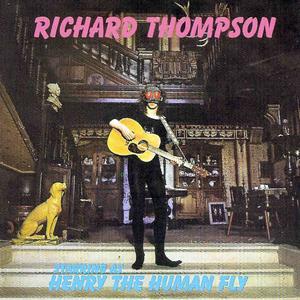
Richard Thompson Starring as Henry the Human Fly

One of the great watersheds of late 20th-century pop music, so far as I’m concerned, came in 1970 or so, when Richard Thompson sold his goldtop Gibson Les Paul (1955? 1956?) to John Martyn and switched to playing a Fender Stratocaster more or less exclusively.

Thompson’s first band, Fairport Convention, had begun as a quasi-folkish outfit playing covers of Dylan and Joni Mitchell and doing nice Hollies-esque harmonies. Under the influence of their trad-obsessed bassist Ashley (Tyger) Hutchings, Fairport had taken a decisive turn towards indigenous British folk – Child Ballads, morris dances, etc. Thompson had set himself down and learned his way thru books & books of jigs, reels, strathspeys, etc. – all on that goldtop Les Paul.

The Les Paul, however, even the single-coil pickup version RT was playing, is a rather blunt instrument for traditional dance tunes, as you can hear on Fairport’s otherwise sublime Liege & Lief (1969). I’d compare RT’s switching to the Strat to the moment when the medieval/renaissance revivalist Phil Pickett laid down his modern oboe and picked up his first crumhorn. Finally: the right tool for the job.

RT had been two years out of Fairport, living on session work, before he released his 1st solo record, Henry the Human Fly (1972), and a strange and wonderful record it is. Oft-repeated legend has it that Henry is the worst-selling album Warner-Reprise ever released in the United States. The dire cover design – RT, in all his gangly mid-20s-ness, a halo of flyaway curls projecting from behind a half-face fly mask, posed with his guitar in quintessentially English, über-panelled Jacobean interior – certainly seems designed to drive away casual browsers.

But Henry, 34 years after its release, and maybe 2 decades since I bought my first vinyl copy, remains one of my favorite records: in part perhaps because of its sheer awkwardness. There’s only one song in here that “rocks” in anything like a conventional manner: “The Angels Took My Racehorse Away,” which begins with utterly sublime sounds of an English country dance on accordian & fiddle, over which RT proceeds to play a note-perfect Chuck Berry solo. (The album’s opening track is another Berry allusion: “Roll Over Vaughn Williams.”)

The other songs are for the most part experiments in what RT was calling “British rock music,” electro-acoustic music that would marry the energy of American rock ‘n’ roll with the melodic and lyrical traditions of the British Isles. Thompson’s BRM isn’t just a matter of electrifying traditional songs & tunes, as Fairport had done & as Hutchings was doing with his new bands Steeleye Span and the Albion Country Band, but a matter of writing original songs that melded the contemporary & the traditional, that would reinvigorate the emotion & forms of centuries-old “folk” music with new instrumentation and the savvy songwriting that Dylan had set as a benchmark in popular music.

What “British rock music” amounts to on Henry the Human Fly is a series of mordant, witty, highly literate, and generally quite depressing songs which seem to hover somewhere between the 17th & 19th centuries. “Roll Over Vaughn Williams” and “The New St. George” feel like marching songs for a new Levellers movement, tho without the millennial optimism of those early proto-communists. “Twisted,” “Nobody’s Wedding,” & “Cold Feet” are drinking songs whose Python-like humor conceals a pathos as dark as that of any George Jones tune.

Most memorable of all, perhaps, are a quartet of ballads: “The Poor Ditching Boy” is echt 19th-century self-pity, while “Shaky Nancy” – as TS Eliot said of Guido the younger in Djuna Barnes’s Nightwood – haunts one’s imagination. “Painted Ladies” is one of the great sex songs of RT’s considerable sex song repertoire: “Those film stars and beauties may please you tonight / If you go to bed with a book / But they can’t hold a candle to something that trembles / When you need to do more than look.” Best of all is “The Old Changing Way,” its stair-stepping trad chord progression dusted with an incongruously lovely harp; it’s the first (& for my money the best) of Thompson’s string of narrative ballads (cf. “Beeswing” & the crowdpleasing “1952 Vincent Black Lightning”). It’s the story of the itinerant Darby the tinker & his brother Tam, whose fraternal partnership – described in terms that would place them anywhere between the 17th and 19th century (“We’ll fix up your kettles / Please dear Missus / We’ll sharpen your knives”) – is broken by the forces of economic change, precipitating them into the “spikes and brothels” of the 20th century.

RT’s Strat is at times scarcely audible on Henry the Human Fly – the only points where he really stretches out are the traditional tunes in “Roll Over Vaughn Williams” & the stinging solo of “The Angels Took My Racehorse Away.” The big workouts like the modal intro to “Calvary Cross” and the long ending of “Night Comes In” would come later. But in Henry, one sees all the elements in place that would distinguish Thompson as the single greatest figure on the folk-rock scene for at least the next 3 decades.
***
The doctor gave me a cleanish bill of health yesterday, so I suppose I’m recovered just in time for the maelstrom of activity that surrounds the holidays. We’re Florida-bound this time around – bound to stay in Florida, not bound for Florida – except for a flying visit on my part to Philadelphia for the MLA. Not a prospect I’m looking forward to.