[This one from earlier this evening, when RW read before a standing-room-only crowd at the "Board of Trustees Room" of Our University's Administration Building. A lovely event.]
I have it from my friend the poet C. S. Giscombe, usually a quite reliable source, that the ideal introduction for a poet should run no more one minute.* For the poet being introduced, waiting nervously to see whether the introducer will mispronounce a name, get a book’s title wrong, or spiral off into the mindless repetition of vague encomia, the one-minute rule might seem quite the godsend. But Rosmarie Waldrop, this year’s Lawrence A. Sanders visiting writer-in-residence, has only herself to blame – herself, and her ceaseless, energetic activity – if her introduction seems less a punchy one-minute warning than the overture to Parsifal. Introduce Rosmarie Waldrop in one minute? Give me an easy one, like summarizing Proust in thirty seconds!
When I introduced Rosmarie Waldrop two days ago, I felt as though I had exhausted my breath in enumerating her honors and accomplishments – that the Republic of France has named her a Chevalier des Arts et des Lettres, that she is a member of the American Academy of Arts & Sciences, that she is the recipient of awards and grants from the NEA, the Fund for Poetry, the Howard Foundation, and the DAAD Berlin artists’ program; that Burning Deck, the “small” press she runs with her husband Keith, has been one of our primary outlets for innovative poetry & prose over the past three decades; that her many translations – of Emmanuel Hocquard, Anne-Marie Albiach, Jacques Roubaud, Paul Celan, and especially Edmond Jabès – have made her one of the principal mediators of contemporary European poetry for an Anglophone audience; that her prose works, Lavish Absence: Recalling and Rereading Edmond Jabès and Dissonance (if you are interested) set her squarely in the ranks of the most interesting contemporary poet-critics.
But the prospect of hearing Waldrop reading her own poetry has for better or worse given me a second wind. The handiest overview of Waldrop’s poetic career, the 1997 Another Language: Selected Poems, includes a blurb which I initially found rather curious: “A thinker and a poet is an extraordinary combination. Waldrop is both.” What, I wondered, is so “extraordinary” about the combination of thinker and poet? haven’t poets, from Lucretius to Dante to Eliot, been among the foremost thinkers of their eras? The etymological roots of “poet,” however, mean not thinker but maker – the poet is someone who makes things: she fashions speech, she crafts words into resonant shapes, she weaves language into tensile baskets that carry burdens of narrative, of emotion, of sensation – only occasionally is she a thinker as well. Waldrop is indeed both thinker and poet. From the early, spare free verse of 1972’s The Aggressive Ways of the Casual Stranger, through the remarkable historical and linguistic meditations of A Key Into the Language of America (1994) to the extraordinary trilogy of prose poem sequences collected in last year’s Curves to the Apple, Waldrop’s poetry has grown into a durable and keen instrument to explore and probe the gendered social body of our language, the social language of our embodied gender. A poet born into one tongue and adopting another in which to write, a translator dedicated to melting down and recasting texts into other languages, Waldrop’s chosen field of play is the “between,” the “Lawn of Excluded Middle” – between languages, between genders, between poetry and fiction, between verse and prose. And while she navigates these various conceptual “betweens,” Waldrop never loses sight of the primordial pleasures of poetry – the resonant shapes of words on the tongue, the surprise of unfamiliar verbal combinations, the energy of torqued syntax and counterpointed etymology. The “lavish dissonance” of her work – if I may be permitted to recast two of her titles – emerges into the resolution of an exquisite polyphony of thought and music. As we are about to hear. Let’s welcome Rosmarie Waldrop.
*This by way of Aldon Lynn Nielsen.
Showing posts with label rosmarie waldrop. Show all posts
Showing posts with label rosmarie waldrop. Show all posts
Thursday, March 15, 2007

Wednesday, March 14, 2007
Rosmarie Waldrop I
[A new feature: the texts of introductions to visiting speakers/poets. Rosmarie Waldrop is spending the week at Our University as a visiting writer, and this evening delivered a lecture on poetry & poetics, "'The Language of the Gods'" (note quotation marks).]
It would be pleasant to introduce this year’s Lawrence A. Sanders writer-in-residence, Rosmarie Waldrop, merely by her honors – that she is a Chevalier des Arts et des Lettres, a member of the American Academy of Arts and Sciences, the recipient of awards and grants from the NEA, the Fund for Poetry, the Howard Foundation, and the DAAD Berlin artists’ program. It would be pleasant to introduce her under a single literary function: as a poet, or as a translator, or as an editor. That one must introduce her as all three, however, is a trifle overwhelming. Burning Deck books, the press she edits with her husband Keith Waldrop, has for over four decades been one of the most consistently rewarding sources of new poetry on the American “small press” scene, publishing books & chapbooks by some three or four generations of innovative poets & writers – American, British, French, & German. As a translator, Waldrop has established herself as a central mediator of contemporary European poetry for an Anglophone audience: she has translated Jacques Roubaud, Emmanuel Hocquard, Anne Marie Albiach, Paul Celan, and others, but will no doubt be irreversibly identified with the French Jewish master Edmond Jabès; the 17 books of Jabès’s work she has translated have had a profound effect on American innovative writing of the past two decades. Most of the major modernist writers were translators – Proust translating Ruskin, Eliot translating St.-John Perse, Benjamin translating Proust, Beckett translating Apollinaire, Rimbaud, Mexican poetry, & himself, Pound translating, well, everything – and Waldrop’s work as a translator is far more than a mediating or ancillary activity, but has profoundly informed her own 18 volumes of poetry, from her first collection in 1972, The Aggressive Ways of the Casual Stranger, to the trilogy of prose poem sequences collected in last year’s Curves to the Apple. Her writing, that is, constantly moves in the space of “between”: between languages, between verse and prose, between poetry and fiction; it is constantly at play on what she has called the “lawn of [the] excluded middle.” I would perhaps overstep the bounds of propriety to mention that in her recent nonfiction volumes – Lavish Absence: Recalling and Rereading Edmond Jabès and Dissonance (if you are interested) – Waldrop proves herself a sensitive and sophisticated theorist of poetry and poetics: but this I think she will prove herself in the next hour. Let’s please welcome Rosmarie Waldrop.
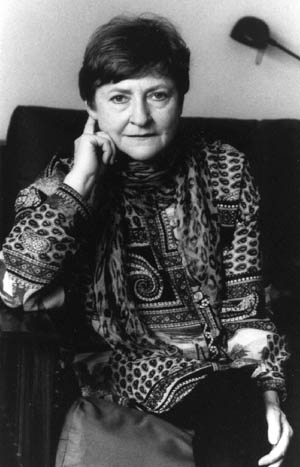
It would be pleasant to introduce this year’s Lawrence A. Sanders writer-in-residence, Rosmarie Waldrop, merely by her honors – that she is a Chevalier des Arts et des Lettres, a member of the American Academy of Arts and Sciences, the recipient of awards and grants from the NEA, the Fund for Poetry, the Howard Foundation, and the DAAD Berlin artists’ program. It would be pleasant to introduce her under a single literary function: as a poet, or as a translator, or as an editor. That one must introduce her as all three, however, is a trifle overwhelming. Burning Deck books, the press she edits with her husband Keith Waldrop, has for over four decades been one of the most consistently rewarding sources of new poetry on the American “small press” scene, publishing books & chapbooks by some three or four generations of innovative poets & writers – American, British, French, & German. As a translator, Waldrop has established herself as a central mediator of contemporary European poetry for an Anglophone audience: she has translated Jacques Roubaud, Emmanuel Hocquard, Anne Marie Albiach, Paul Celan, and others, but will no doubt be irreversibly identified with the French Jewish master Edmond Jabès; the 17 books of Jabès’s work she has translated have had a profound effect on American innovative writing of the past two decades. Most of the major modernist writers were translators – Proust translating Ruskin, Eliot translating St.-John Perse, Benjamin translating Proust, Beckett translating Apollinaire, Rimbaud, Mexican poetry, & himself, Pound translating, well, everything – and Waldrop’s work as a translator is far more than a mediating or ancillary activity, but has profoundly informed her own 18 volumes of poetry, from her first collection in 1972, The Aggressive Ways of the Casual Stranger, to the trilogy of prose poem sequences collected in last year’s Curves to the Apple. Her writing, that is, constantly moves in the space of “between”: between languages, between verse and prose, between poetry and fiction; it is constantly at play on what she has called the “lawn of [the] excluded middle.” I would perhaps overstep the bounds of propriety to mention that in her recent nonfiction volumes – Lavish Absence: Recalling and Rereading Edmond Jabès and Dissonance (if you are interested) – Waldrop proves herself a sensitive and sophisticated theorist of poetry and poetics: but this I think she will prove herself in the next hour. Let’s please welcome Rosmarie Waldrop.
Subscribe to:
Posts (Atom)