Showing posts with label samuel beckett. Show all posts

Wednesday, December 24, 2008

more Beckett

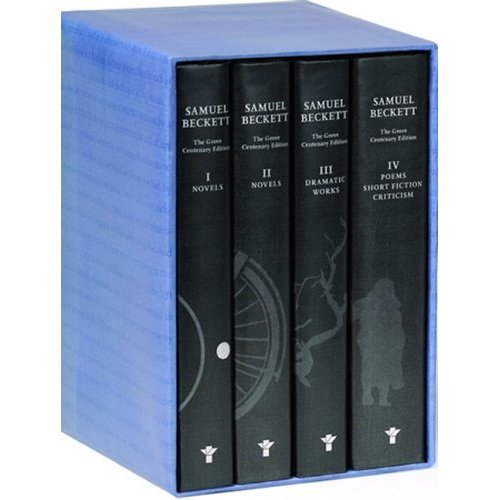
Some time ago I wrote about Grove Press's sumptuous four-volume collected Beckett, the "Grove Centenary Edition" released two years ago to coincide with SB's 100th birthday. I've been enjoying it, savoring it, for almost two years now – and I've almost read my way thru every last page.

Of course, the Centenary Edition wasn't all that Grove did to celebrate their author's 100th birthday. Mr UPS brought this around the other day: Beckett's most famous play, Waiting for Godot, in a handsome, unjacketed hardcover whose dimensions are uniform with those of the GCE and whose design is close enough (without being identical) to make it clear that this volume is also part of the centenary celebrations. Best of all, this is a bilingual edition, with the original French text on the left page & Beckett's English translation on the right; no more flipping from one's English text to one's tattered old Minuit paperback.

The cynic in me, I fear, smells marketing here. Why only Godot? Why not Godot and Endgame, Beckett's other dramatic masterpiece originally written in French? (And for that matter, since Beckett's English-t0-French translations are as much creative acts as his French-to-English efforts, why not throw in Happy Days and Krapp's Last Tape?) There's certainly space here: the 2006 Grove bilingual Waiting for / En attendant Godot clocks in at 357 pages; that in comparison to only 509 pages in the complete Dramatic Works of the GCE.

I guess it's a matter, in terms of typography, of feast or famine. In the GCE, Waiting for Godot occupies only 87 pages, but they're rather packed pages: fairly narrow margins, stage directions pressed right up against speeches, speakers' names hived off into the left margin. Turning to the 2006 Godot (where the English text takes up 174 pages) is like going from the cramped Oxford World's Classics edition of the King James Bible to a big, airy presentation volume. Margins are vast; speakers' names (in all caps) rest atop speeches; stage directions have paragraphs all to themselves. Really, I can't help feeling, there's too much space. Even as I revel Ronald Johnsonianly or Susan Howeishly in the tracts of white space, I gotta suspect that Grove is stretching things out to make a substantial volume of this.

And as welcome as the bilingual edition is, I'm also a trifle exasperated with what I've called (in reference to the GCE) the "'black box' nature of the textual editing." The 2006 Godot has a teasing introduction by Beckett scholar & textual editor S. E. Gontarski that makes much of the text of this new issue, without ever really showing what's been changed. Gontarski goes over the play's textual history from the first Grove edition of 1954; he spends a good deal of time excoriating Faber & Faber for publishing a "mutilated" version of the play in 1956, and reprinting that text (censored at the behest of the Lord Chamberlain) in 1986, even tho they had access to a 1965 Grove edition that Beckett considered "definitive"; & he draws attention to 2 further revised versions of 1975 and 1955. 

In the 2006 Godot, Gontarski, gloats somewhat anticlimactically, "Grove Press has not only reunited the long separated fraternal twins, the English and French Godot, but has brought British and American texts closer to harmony." Er –– meaning what precisely? Show me the textual notes, guys. You've got over 350 pages to play with here; 15 or 20 pages of texual notes and variants at the end would have been far more welcome than a lot of that beautiful white space in which Didi & Gogo's back-&-forthings echo like Laurel & Hardy in the Sahara. No Shakespeare editor could get away with this.

Tuesday, December 02, 2008

On the edge...

of the end of the semester. A storm of papers will arrive later today, to be followed later this week by a stack of final exams. And then I can get to work on what I ought to be writing. But for now a brief breather.
***
Snatching some time to read in the interstices: Ron Silliman's The Age of Huts (compleat); I've known Age for yonks, thru the old yellow Roof edition. "Sunset Debris" and "The Chinese Notebook" are old friends. And I've become very fond of "Ketjak" now. (The recursive structure assures it that by the time you finish the poem, you're either very fond of it, or driven to active loathing.) I have the typically anal project of working thru Ron's big poem Ketjak (not the short "Ketjak"), as outlined in the preface to Age of Huts, in order of its parts: Age of Huts, then Tjanting, then The Alphabet. That's what, maybe 1500 pages of elegantly processed quotidianity? Should keep me off the streets for awhile.

Mostly thru Beckett's How It Is. One of those books that when you lay it down, you can't pick it up again, if you know what I mean. Oh, it's brilliant all right – I wouldn't want at all to sell the thing short of brilliance. But it's frankly the  single most painful read I've ever essayed. The unpunctuated paragraphs are one thing, forcing you to read at pretty much speaking pace, pausing to internally punctuate & repunctuate at every turn, looking for where the pauses ought to (or might) fall. But while that's a painstaking process (a painful process?) not unfamiliar to the reader of contemporary poetry, it's the bleakness of the "action" that really does it for (to?) me. In a few words: Conveyance: standard Beckett blind mud-crawling; Diet: canned good of dubious provenance & sell-by date; Communication media: fingernails in back, digit in arsehole, can-opener to buttocks, sharp knocks to the skull. And other nastinesses, not least of which is the intrusion of "Love" into this hellish scenario. Kathy Acker, by comparison, is sunshine & lollipops.
***
Observations on the state of modernist studies, having read thru almost 200 job applications:
•James Joyce stock remaining high, with no perceptible dips; still King of Hill

•historicism the order of the day; even the crustiest formalists apt to swath their readings in a decent chiton of historical context or anecdote

•William Faulkner holding steady – who woulda thought?

•Langdon Hammer of Yale the busiest dissertation director in the land; how does he find time to chair the department and write James Merrill's biography?

•the Edwin Rolfe renaissance still failing to materialize, despite all of Cary Nelson's best efforts

•poetry, alas, the big loser: by my admittedly unscientific estimate (ie, I don't have the notes in front of me), something like 15% of dissertations

Saturday, May 31, 2008

endgames

Coming to the end of a biography is always a sad prospect, given that one is fairly confident of how the narrative will conclude. We each of us come into the world in much the same way, & while there are lots of different manners in which a life can conclude, conclusion itself is pretty much inevitable.

The last 20 pages or so of Anthony Cronin's Samuel Beckett: The Last Modernist make melancholy reading, but Cronin does a delicate job of balancing between presenting Beckett's last days – mostly debilitated, in a spartan nursing home, most of the friends & companions of his youth & middle years dead – as the grim endgame of perhaps the majority of us in the post-industrial west – in short, a commonplace scenario, remarkable here only for the artistic identity of the protagonist – &, on the other hand, as a kind of blackly ironical playing-out of the plots of so many of Beckett's writings: Molloy, Malone Dies, the ashbin parents of Endgame, the buried Winnie of Happy Days

Saturday, March 08, 2008

back

I suppose a plurality of the folks who've moved to south Florida for the more-or-less constant warmth would consider us masochists, but we like to take in a little real winter once in a while. Got back yesterday from a rather frigid New York to be greeted by some of Florida's weirder weather – torrential rains & high winds last night, followed by a blissfully sunny (but rather humid) day today with the prospect of what they call a "cold front" moving in tomorrow.

The 4 of us squatted for 5 days in an apartment that could fit into the master bedroom closet of many of the macmansions down here, tripping over toys & books & small children at every turn. It would have been claustrophobic if it weren't New York, where there's something to do & somewhere to go all the time – & even then, it got pretty claustrophobic. The only bit of real culture – the one family outing to the Metropolitan Museum was J. & P., leaving me to take D. to the Children's Museum for the 3rd bloody time – was an evening at City Opera, where we caught Mark Morris's adaptation (reduction?) of Purcell's King Arthur. A splendidly silly early baroque musical really, with text by Dryden & really luminous music. (Michael Nyman has spun about 8 hours of music out of the "frost" scene, last time I counted.) Morris – he's more a dance guy than a conventional opera guy, I gather – opted to cut a few things: all the (spoken) dialogue, the characters, & the plot, leaving King Arthur as something of a dance revue, where dancers performed in whimsical modern costumes to beautifully performed Purcell "numbers." Great fun – for a while. But after a couple of acts, it began to feel like postmodernism lite, & I found myself hankering for the different kind of silliness that Dryden & Purcell themselves had cooked up – fairies & goblins & Saxons & all.

Stuck in an apartment full of an educated New Yorker's books, my own bag bulging with recent dense volumes of criticism I'm supposed to be reviewing, of course I ended up hauling down a copy of The Fellowship of the Ring & trawling thru it in something less than 4 days.

I snuck away one evening to The Strand, where I came away with the usual ragbag of slim volumes of poetry, volumes of criticism, & thises & thats. The real find was a recent translation of Flemish philosopher Arnold Geulincx's Ethics. Geulincx was a Cartesian & a close contemporary of Spinoza's, tho nowhere near as interesting as Zukofsky's "blessed" one. I suspect the only reason this rather weird tome got itself translated into English is the influence Geulincx had on Samuel Beckett, who found the philosopher's most famous quotations – Ita est, ergo ita sit ("it exists, therefore it is so") & Ubi nihil vales, ibi nihil velis (roughly, "Where you are worth nothing, there you should want nothing") – very congenial to his own grumpy pessimism. Cf. Murphy.

Sunday, September 16, 2007

All of Beckett (almost)


So far as I can tell, there's no European equivalent to Grove Press's 4-volume Centenary Edition of Samuel Beckett's works (published last year, & which I have been carrying about, reading thru, & generally caressing ever since I received my copy for Christmas). No Pleiade Beckett in French, as one might expect, nor has Calder, his English publisher, issued a set analogous or identical to Grove's American enterprise.

Mind you, this is a lovely edition. It brings together almost everything (I'll get back to that "almost") that Beckett ever published in English, or translated into English himself. (A very few of his translations, early on, were done in collaboration with other translators, I assume before Beckett realized the aesthetic potential in the act of self-translation.) The omission of works existing only in French is quite deliberate, according to Paul Auster, the Grove Centenary Edition's (henceforward GCE's) series editor, & he concedes that this means that, however definitive it may be in presenting the works upon which Beckett's vast reputation rests, the edition "does not constitute a Collected Works."

Auster has for the most part chosen wisely in assigning superstar writers to introduce each volume: Colm Tóibín's introduction to the 1st volume of "Irish" novels is excellent; Salman Rushdie's introduction to the 2nd volume of novels – the Trilogy and How It Is – is luminous; & JM Coetze's introduction to the final volume of poetry, short fiction, & criticism is wonderfully hard-nosed & critically uncompromising. (Only Edward Albee's introduction to the Dramatic Works falls short, amounting to a page & a half of noting how really cool Beckett's plays are. Was Harold Pinter, Wole Soyinka, or Tom Stoppard otherwise occupied?)

But I fear, with my own obsessive anality coming to the fore, that I'm still dissatisfied with this edition, despite its lovely design & really wonderful typography – such an improvement over the hodge-podge of mostly dreadfully designed Grove paperbacks in my office. It's about the text, in part. The Grove website claims that "Typographical errors that remained uncorrected in the various prior Grove editions of Beckett's work have been corrected in consultation with Beckett scholars C.J. Ackerley and S E. Gontarski," but the books themselves make no note of textual matters save for the following: "Design and textual supervision by Laura Lindgren." She's done a lovely job of the design, for sure: but I'd feel much better about the texts – Watt is almost legendary for its longstanding corruption – if I'd been at least assured somewhere in the books themselves that real textual editors were on the job. (Ideally, of course, there'd be 20 or 30 pages of textual notes at the end of each volume detailing corrections & variations, but perhaps that's asking too much.)

And then there's the contents themselves: I can entirely understand the GCE's leaving out Beckett's posthumously published works, the novel Dream of Fair to Middling Women & the play Eleuthéria (which was written in French, & which SB himself didn't translate). But Auster is a trifle disingenuous when he claims that all that has been omitted from the 4 volumes are "a number of untranslated French poems and short critical essays." "Those with a knowledge of French," he continues helpfully, "can find them in Collected Poems in English and French and Disjecta, both available from Grove Press." (My inner copyeditor adds that those without a knowledge of French can find them there as well, tho they won't be able to read them.)

A glance at the contents of Disjecta, however, shows one that more than just a few French-language essays have been omitted from the GCE. (For the record, the GCE's "criticism" section consists of precisely 3 items: the Finnegans Wake essay "Dante...Bruno.Vico..Joyce," the book Proust, & the "Three Dialogues" with Georges Duthuit.) Leaving aside the Disjecta pieces in French & German, & leaving aside the various excerpts from letters, there remain almost 20 reviews & notes on writers, poets, & painters – all in English – that for some reason passed thru the GCE's editorial sieve. Reviews & notes on Mörike, on Rilke, on Ezra Pound; on such Irish modernists as Denis Devlin & Thomas McGreevy; on painters Jack B. Yeats & Avigdor Arikha. And finally, a 12-page fragment of Human Wishes, SB's play about Samuel Johnson.

I'm all in favor of honoring authors' posthumous desires about what to publish & what to leave unpublished (tho I suspect Grove's decision not to include Dream of Fair to Middling Women and Eleuthéria had more to do with the fact that they're in print from other publishers than with Beckett's wishes). But these pieces in Disjecta – written in English or translated into English by SB, published in his lifetime with his (grudging) permission – seem to meet all possible criteria for inclusion in the big 4-volume set. It would be silly to claim they're essential bits of the Beckett oeuvre, but I for one would like their exclusion to be explained a bit more clearly.

But enough grousing. Despite its teeny omissions, & despite the "black box" nature of its textual editing, this is my working Beckett from here on out: an extraordinary collection, beautifully produced & wonderfully readable to boot. Nothing like being brought face to face with the emptiness & inanity of human existence thru a nice piece of bibliographic art.

Friday, September 14, 2007

unlikely source

Happened upon this bit of sub-Kipling schoolboy good cheer, as writen in an autograph book:
When a bit of sunshine hits you
After passing of a cloud,
And a bit of laughter gets you
And your spine is feeling proud,
Don't forget to up and fling it
At a soul that's feeling blue,
For the moment that you sling it
It's a boomerang to you.
The author? Samuel Beckett. As biographer Anthony Cronin comments, the boy in whose book Beckett inscribed these lines "thought that they were an accurate reflection of his attitude. It is fairly safe to say that no one would ever think so again."
Hamm: Go and see is she dead.
[Clov goes to bins, raises the lid of Nell's, stoops, looks into it. Pause.]
Clov: Looks like it.
[He closes the lid, straightens up. Hamm raises his toque. Pause. He puts it on again.]
Hamm: [with his hand to his toque] And Nagg?
[Clov raises lid of Nagg's bin, stoops, looks into it. Pause.]
Clov: Doesn't look like it.
[He closes the lid, straightens up.]
Hamm: [letting go his toque] What's he doing?
[Clov raises lid of Nagg's bin, stoops, looks into it. Pause.]
Clov: He's crying.
[He closes lid, straightens up.]
Hamm: Then he's living.
Poetics of the pause.