I’m still alive, tho last week came close to killing me. (NB: If you send in a manuscript with either calculus equations or Greek quotations, they will, oh yes they will, get chewed up somewhere along the way.) The jobsearch madness winds down this week. We (J & I, that is) are as it were still between tumults. The girls share the same birthday (2 years apart – don’t even ask…), which falls in the midst of next week. So in lieu of one vast rampage of preschoolers, we’re having separate birthday parties – one yesterday, and one this coming weekend. These things tend to run to excess down here: the last one we attended had a clown blowing up balloons, a face-painter, a bounce house (one of those inflatable contraptions in to which small children can climb and jostle themselves silly), and a guy from an animal shelter offering pythons and tarantulas for the kids to pet. I think the party itself was catered; the open bar was certainly nice. (All this, mind you, for a fifth birthday – I believe bat mitzvahs down here tend to require a second mortgage.) Since we’re modest folks, Pippa’s celebration will be considerably more restrained.
***
Aside from rereading (& wincing at) my own prose, I’ve been working my way thru Beckett’s trilogy with much wonder, & getting my toes wet in Neal Stephenson’s Crytonomicon. Our job candidates have reminded me of a long-deferred project that might actually happen this year – reading my way thru Virginia Woolf’s novels. Poetry titles that have caught my attention include Kate Greenstreet’s case sensitive and Paul Naylor’s Arranging Nature. I’ll try to give them a little close attention when I’m a little more blog-motivated. And a big shout out to Paul, who’s welcoming aboard the new arrival Siena Kilb Naylor. Congratulations! Welcome to the world of catered birthday parties!
***
An embarrassing proportion of the traffic this humble blog’s gotten in the past couple of months has happened because of some kind soul’s linking my little screed on Fernando Botero’s Abu Ghraib pictures to the Wikipedia Botero entry. Heaven knows how many Boterophiles out there are sharpening their knives for me. Indeed, I’ve even gotten some communications from a BBC team working on a documentary on the man – something about wanting a “dissenting voice” on Botero’s wonderfulness: I didn’t have the heart to say Hey, walk into any art history department, or ask your nearest art critic. (Anybody, that is, but Arthur Danto…)
Sunday, January 28, 2007

Saturday, January 20, 2007
AWOL
Culture Industry has been more or less dark for a while now, & may remain that way for a bit longer. A lot on our plate here in the space station: 1) Our department is hiring no fewer than three positions this year, so we have no fewer than nine prospective colleagues visiting over the three weeks; and since I’m chairing one of the search committees, I need to be on board for at least three of those visits. 2) Of course it’s the first couple weeks of classes with attendant panic, dysfunction, & frantic rereading of texts on the instructor’s (read my) part. 3) And I’m in the midst of reviewing copy-editing changes – and making bunches of my own – on a 600-page manuscript which I thought I knew by heart, having written it myself & worked it over in detail at least four times, but now I find full of major & minor infelicities, grammatical solecisms, idiomatic gaffes, and outright idiocies. And this due back to the publisher in less time than it takes Homer Simpson to fulfill his conjugal duties.
So I haven’t been blogging, or even reading blogs much. I’d love to chime in with Josh Corey on “postmodern baroque,” am enjoying discovering how Reginald Shepard’s mind works, especially when he’s thinking about “difficulty” in poetry, and wish that someday someone would do to a book of mine what Ron Silliman is doing to Bob Perelman’s latest – but there just aren’t enough hours in the day right now.
So back to page 253, and a query that will send me on what I hope isn’t a wild goose chase into the tottering stack of papers & folders that I call my “files.” DV, will emerge someday.
So I haven’t been blogging, or even reading blogs much. I’d love to chime in with Josh Corey on “postmodern baroque,” am enjoying discovering how Reginald Shepard’s mind works, especially when he’s thinking about “difficulty” in poetry, and wish that someday someone would do to a book of mine what Ron Silliman is doing to Bob Perelman’s latest – but there just aren’t enough hours in the day right now.
So back to page 253, and a query that will send me on what I hope isn’t a wild goose chase into the tottering stack of papers & folders that I call my “files.” DV, will emerge someday.
Tuesday, January 09, 2007
Size Matters
I’m still in the trenches of preparing syllabi (D-Day is tomorrow – er, later today, I guess) & therefore not at all available for extended blogging. Thank Goddess there’re so many distractions from paying work. Right now I’m finding it hard to line up dates & page numbers because the cranium’s abuzz with the idea of a longish essay/shortish monograph on part-to-whole relationships in modernist/late modernist long poems. Really a meditation on length, the length of the small things that make up the big thing. Sparked by noting how while The Cantos stretch out from 3-5 pages early on to 20 or more in the late bits, there’s a general homogeneity in duration – only rarely the blip of a canto longer or shorter than anything around it. (Relecting back on the books into which Homer & Virgil divided their epics – who’s responsible for the book divisions in Homer? are you out there, David W? – the very regular canto lengths in Dante, Milton’s decision to revise Paradise Lost from 10 to 12 by the simple expedient of chopping 2 long books in half…) Chapter & volume divisions in the Victorian novel, more often than not influenced by the exigencies of periodical publication & circulating library demands – a tradition blown to hell by the metastasizing chapters of Ulysses – which I read in turn as the key influence on Zukofsky’s decision to organize “A” as a series of heterogeneous formal experiments, rather than – as it began – a Marxist-inflected new world version of The Cantos. Then on to what – The Alphabet? Drafts? the solid text blocks of McCaffery’s Black Debt? the labyrinths of Sheppard’s Twentieth Century Blues? But for now back to the syllabi…
***
Michael Bérubé has closed up shop. I’m glummish, even tho rejoycing at the 4-5 weekly hours that have been freed up…
***
Hey, Bob, what if – and the syntax allows – Ron only meant Gjertrud S’s poetics were fascist, & not Geoffrey Hill’s? Just wondering…
***
The night of the walking ellipses… (LZ habitually used only two dots for ellipses, one of the weirder orthographical things I’ve encountered since Ron Johnson’s habitual “Euridice.”)
***
Michael Bérubé has closed up shop. I’m glummish, even tho rejoycing at the 4-5 weekly hours that have been freed up…
***
Hey, Bob, what if – and the syntax allows – Ron only meant Gjertrud S’s poetics were fascist, & not Geoffrey Hill’s? Just wondering…
***
The night of the walking ellipses… (LZ habitually used only two dots for ellipses, one of the weirder orthographical things I’ve encountered since Ron Johnson’s habitual “Euridice.”)
Thursday, January 04, 2007
self-promotional department
There's a whacking large update of Zach Barocas's always lively Cultural Society, with new work from Norman Finkelstein, Peter O'Leary, Pam Rehm, Stacy Szymaszek, Tyrone Williams, and others: including two new poems of mine – "Boo-boo" and "Contrafactual." Do check it all out.
Busy busy busy
is what I've been, what with licking a poetry manuscript into send-outable shape, trying to put together syllabi for next week & to read those last-minute readings, & anticipating the oncoming semester like a bullet train hurtling at me down a tunnel. Anyway, busyness probably goes to explain why the blog has been so torpid these last few days (weeks? months?): one sign of which is the fact that there's been far more happening in the comments box than on the actual blog. Case in point – this wonderful summation from old chum Paul Naylor of the excellent Singing Horse press:
***
This arresting factoid from the Silli-blog: apparently there were all of 69 whole academic positions in Creative Writing advertised in this years MLA Job List, in contrast to 400 – yes, four hundred – creative writing programs busily minting MFAs & CW PhDs to fill those positions. Ron estimates that this means a production level of 4000 MFAs per year (I think that's high; the MFA program I attended usually generated 8 per year, & the program at Our University is turning out rather fewer, thankfully). He doesn't consider, however, that the AWP (Associated Writing Programs, I believe) runs its own conference & joblist – but I can't believe that they're advertising 3931 jobs this year. However you slice it, that's an astonishing overproduction: somebody's getting ripped off here, folks.
***
The Archambeau/Park axis continues to blog Adorno's Aesthetic Theory, & I've been roughly interpellated to respond; but it'll take a few days. (Note to Bob: we like Greil Marcus better than Lester Bangs 'cuz he lived & was able to write past his early stuff: but have you ever heard Bangs's records? As someone once said of my poetry, "not bad for a critic.") (And speaking of Lipstick Traces, those of you with fond memories of Marcus's magnum opus might want to check out my own Anarchy, which in some moments I think of as a set of variations on Marcusian themes.)
I have to say I’ve never found Adorno’s critique of Heidegger very persuasive, and I think that has to do with something Norman said in passing, that “you couldn’t have the latter w/out the former,” meaning Adorno’s essay “Lyric Poetry and Society” isn’t possible without Heidegger’s essays on poetry. That’s absolutely right, but it’s something Adorno would be loathe to admit. Adorno was either blind to the fact that he and Heidegger had an immense amount in common philosophically, or he refused to admit it. They both take their lead from Weber’s contention that modernity is characterized by the disenchantment of nature at the hands of instrumental rationality. They both offer a critique of instrumental rationality by drawing attention to that which resists instrumental rationality in particular and conceptuality in general; for Heidegger it’s the “earth” that can’t be totalized in conceptual knowledge, while for Adorno it’s the “non-identical” that resists conceptuality. And both turn to art as the primary instance of that which is non-identical to instrumental rationality. The fact that Adorno either can’t or won’t recognize that common ground and/or influence prevents him from waging a fully “immanent” critique of Heidegger; as a result, what I find in The Jargon of Authenticity and Negative Dialectics are mostly glancing blows that don’t really get at the core of what’s problematic in Heidegger.See what I mean? Beautifully put, & way smart. (Interesting how in the strange slightly overlapping worlds of poetry & academia, one comes to think of someone as an "old chum" on the basis of maybe a half-dozen actual hours of shared facetime over a decade or more...)
***
This arresting factoid from the Silli-blog: apparently there were all of 69 whole academic positions in Creative Writing advertised in this years MLA Job List, in contrast to 400 – yes, four hundred – creative writing programs busily minting MFAs & CW PhDs to fill those positions. Ron estimates that this means a production level of 4000 MFAs per year (I think that's high; the MFA program I attended usually generated 8 per year, & the program at Our University is turning out rather fewer, thankfully). He doesn't consider, however, that the AWP (Associated Writing Programs, I believe) runs its own conference & joblist – but I can't believe that they're advertising 3931 jobs this year. However you slice it, that's an astonishing overproduction: somebody's getting ripped off here, folks.
***
The Archambeau/Park axis continues to blog Adorno's Aesthetic Theory, & I've been roughly interpellated to respond; but it'll take a few days. (Note to Bob: we like Greil Marcus better than Lester Bangs 'cuz he lived & was able to write past his early stuff: but have you ever heard Bangs's records? As someone once said of my poetry, "not bad for a critic.") (And speaking of Lipstick Traces, those of you with fond memories of Marcus's magnum opus might want to check out my own Anarchy, which in some moments I think of as a set of variations on Marcusian themes.)
Tuesday, January 02, 2007
Ruskin-Silliman-Adorno
Ruskin, writing of the ornamentation of concave & convex pillar capitals in Stones of Venice (volume I, chapter XXVII), anticipates Ron Silliman’s manicheanism:
***
In re/ my last post, Norman finds Heidegger speaking to him more than I find Heidegger speaking to me – but that just might be the malaised mood I’ve been in for a while now: the “dictations” just aren’t coming thru like they should be.
On the other hand, Bob quite rightly reminds me of a passage where Adorno claims that the German language has what he calls "a special elective affinity to philosophy and indeed to its speculative moment." Indeed – but it’s worth considering the passage as a whole, just to note how TA scrupulously takes the opportunity to distinguish what he’s saying from Heidegger’s stance towards German as the language of Being, and to argue (yet again) against paraphrase. Here from “On the Question ‘What is German?” with my comments interspersed – Adorno writes, in this 1965 radio talk, specifically about his decision to return to Germany after the war:
Huzzah! USAirways found my bag, & delivered it to the door about 8.00 pm on New Year's Eve. So I won't have to replace all those toiletries, and find a new hairbrush (not that that's such an essential item anymore...).
And now the reader shall judge whether I had not reason to cast aside the so-called Five orders of the Renaissance architects, with their volutes and fillets, and to tell him that there were only two real orders, and that there could never be more. For now we find that these two great and real orders are representative of the two great influences which must for ever divide the heart of man: the one of Lawful Discipline, with its perfection and order, but its danger of degeneracy into Formalism; the other of Lawful Freedom, with its vigor and variety, but its danger of degeneracy into Licentiousness.
***
In re/ my last post, Norman finds Heidegger speaking to him more than I find Heidegger speaking to me – but that just might be the malaised mood I’ve been in for a while now: the “dictations” just aren’t coming thru like they should be.
On the other hand, Bob quite rightly reminds me of a passage where Adorno claims that the German language has what he calls "a special elective affinity to philosophy and indeed to its speculative moment." Indeed – but it’s worth considering the passage as a whole, just to note how TA scrupulously takes the opportunity to distinguish what he’s saying from Heidegger’s stance towards German as the language of Being, and to argue (yet again) against paraphrase. Here from “On the Question ‘What is German?” with my comments interspersed – Adorno writes, in this 1965 radio talk, specifically about his decision to return to Germany after the war:
The decision to return to Germany was hardly motivated simply by a subjective need, or homesickness, as little as I deny having had such sentiments. An objective factor also made itself felt. It is the language. Not only because one can never express one’s intention so exactly, with all the nuances and the rhythm of the train of thought in the newly acquired as in one’s own. Rather, the German language also apparently [note qualification] has a special elective affinity with philosophy and particularly with its speculative element that in the West is so easily suspected of being dangerously unclear, and by no means completey without justification [so, even as he asserts the “elective affinity” between German & the idealist tradition, TA allows that a good deal of that tradition might indeed be “nonsense on stilts”]. Historically, in a process that finally needs to be seriously analyzed, the German language has become capable of expressing something in the phenomena that is not exhausted in their mere thus-ness, their positivity, and givenness. This specific quality of the German language can be most graphically demonstrated in the nearly prohibitive difficulty of translating into another language philosophical texts of supreme difficulty such as Hegel’s Phenomenology of Spirit or his Science of Logic. German is not merely the signification of fixed meanings; rather, it has retained more of the power of expression – more in any case than would be perceived in the Western languages by someone who had not grown up in them and for whom they are not second nature. However, whoever remains convinced that, in contrast to the individual disciplines, the mode of presentation is essential to philosophy – as Ulrich Sonnemann recently put it very succinctly, there has never been a great philosopher who was not also a great writer – will be disposed to the German language. At least the native German will feel that he cannot fully acquire the essential aspect of presentation or expression in the foreign language [a fallback – even if what TA’s said about metaphysics & German is wrong, it’s at least true for the “native German”]. If one writes in a foreign language, then whether it is acknowledged or not, one falls under the captivating spell to communicate, to say it in a way such that others can understand. In one’s own language, however, if one says the matter as exactly and uncompromisingly as possible, one may hope through such unyielding efforts to become understandable as well [Adorno’s first allegiance, then, is to the contours of thought, which he can only accurately trace in German; if he were to write in, say, English (as he did a significant amount of), he’d be tempted to actually “communicate,” and thereby possibly traduce the thought itself]. In the domain of one’s own language, it is this very language itself that stands as a guarantee for one’s fellow human beings. I will not venture to decide whether this circumstance is specific to German or whether it affects far more generally the relationship between each person’s native language and a foreign language. yet the impossibility of conveying without violence not only high-reaching speculative thoughts but even particular, quite precise concepts such as those of Geist, Moment, and Erfahrung, including everything with which they resonate in German, speaks for a specific, objective quality of the German language. Unquestionably the German language also has a price to pay for this quality in the omnipresent temptation that the writer will imagine that the immanent tendencies of German words to say more than they actually say makes things easily and releases him from the obligation of thinking and, where possible, of critically qualifying this ‘more’, instead of playfully indulging it. The returning émigré, who has lost the naïve relationship to what is his own, must unite the most intimate relationship to his native language with unflagging vigilance against any fraud it promotes; against the belief that what I should like to call the metaphysical excess of the German language in itself guarantees the truth of the metaphysics it suggests, or of metaphysics in general. I should perhaps admit in this context that I also for this reason wrote the Jargon of Authenticity [TA’s 1964 attack on Heidegger & Heideggerianism].***
Huzzah! USAirways found my bag, & delivered it to the door about 8.00 pm on New Year's Eve. So I won't have to replace all those toiletries, and find a new hairbrush (not that that's such an essential item anymore...).
Sunday, December 31, 2006
Back
Philadelphia was nice, if a bit cold. A shame, given that this was one MLA – with Marjorie Perloff as president, much of the big show was geared specifically to poetry – where I would’ve actually liked to have attended things, that I spent most of my time in a hotel room in endless interviews.
USAirways seems to have lost my suitcase, which contained (along with a lot of sentimentally-valuable clothes) copies of Josh Corey’s Compos(t)ition Marble, Michael Heller’s A Look at the Door with the Hinges Off, Lawrence Upton’s Wire Sculptures, and Peter Riley’s Passing Measures. That’s what I get for trying to save weight in the shoulder bag by packing the already-read books in the checked luggage.
***
Somebody seems to have been giving Bob Archambeau trouble about his Adorno posts, to which Bob responds feistily. My experience is that hardcore Adornauts can indeed be a bit on the Spanish Inquisitorial side (which is why I read a lot of Adorno but don’t write a lot about him, until I’m double-dog sure I’m right) – probably a side effect of having invested so much psychic energy into making out what the Bald & Oracular One’s saying.
But I think Bob’s a trifle off-key in his responses. First, while I see the value of paraphrase, I think I’d be happier comparing it to translation (as Bob does) than to performance, eg of a musical score. Paraphrase is to text not as Michael Tilson Thomas’s conducting of (say) Mahler is to Mahler’s score of the 8th Symphony, but as a piano redaction of the 8th Symphony is to the original score; or as a Muzak adaptation of an Iggy Pop tune is to the original recording. Yes, you can learn something from the redaction & the Muzak, but it’s not the original, no not at all. Richard Thompson’s cover of Britney Spears’s “Oops I Did It Again” teaches us that it’s a pretty damned good pop song – but we could have learned that as readily by reading the sheet music & thereby bypassing the aural and visual distraction of the blonde one.
So it’s a bit unfair to slam Adorno for preferring the sheet music, considering he’s in pretty good company – Beethoven (perforce), George Antheil, Paul Zukofsky – a list of fellows not at all averse to performance, but finding that they grasp the immanent structure of the music much better without the distraction of actual musicians flubbing notes and concert-goers coughing etc.
I don’t remember a passage where Adorno asserts the primacy of German as “a special language, with unique affinities for philosophy” (tho Bob might remind me of one). He did claim the necessity of thinking and moving in a German linguistic environment as one of his reasons for returning to the BRD after the war. And I suspect that he did believe in some ways German was the language in which to do the sort of philosophy he did. An argument can be made that just as English is the language of pragmatism, & French the language of deconstruction, German is the language of Kantian and post-Kantian idealism – that the concepts and key ideas of idealist philosophy (the Kant – Hegel – Marx tradition in which Adorno moves) are absolutely embedded in the German language, & that when we try to translate them to another tongue – with whatever good intentions – they undergo an inevitable transformation, even violence. German is, in that sense, the only language in which to do (the particular) philosophy (that follows from Kant & Hegel). In one sense, it’s no more debateable than arguing that it’s easier to write a canzone in Italian than English, because the former language has lots & lots more rhyming words.
Heidegger, on the other hand, asserts something rather different & rather creepier: that German (along with classical Greek, which he saw as conceptually cognate with German) has some obscure and fundamental connection to the roots of Being (Seyn, as he archaically spelled it). That’s a far more foundationalist argument about language & philosophy.
Just for fun, Adorno on Heidegger, from “The Essay as Form”:
***
I have no New Year's resolutions (tho I'll be trying to live up to my blue china); a happy one to you all.
USAirways seems to have lost my suitcase, which contained (along with a lot of sentimentally-valuable clothes) copies of Josh Corey’s Compos(t)ition Marble, Michael Heller’s A Look at the Door with the Hinges Off, Lawrence Upton’s Wire Sculptures, and Peter Riley’s Passing Measures. That’s what I get for trying to save weight in the shoulder bag by packing the already-read books in the checked luggage.
***
Somebody seems to have been giving Bob Archambeau trouble about his Adorno posts, to which Bob responds feistily. My experience is that hardcore Adornauts can indeed be a bit on the Spanish Inquisitorial side (which is why I read a lot of Adorno but don’t write a lot about him, until I’m double-dog sure I’m right) – probably a side effect of having invested so much psychic energy into making out what the Bald & Oracular One’s saying.
But I think Bob’s a trifle off-key in his responses. First, while I see the value of paraphrase, I think I’d be happier comparing it to translation (as Bob does) than to performance, eg of a musical score. Paraphrase is to text not as Michael Tilson Thomas’s conducting of (say) Mahler is to Mahler’s score of the 8th Symphony, but as a piano redaction of the 8th Symphony is to the original score; or as a Muzak adaptation of an Iggy Pop tune is to the original recording. Yes, you can learn something from the redaction & the Muzak, but it’s not the original, no not at all. Richard Thompson’s cover of Britney Spears’s “Oops I Did It Again” teaches us that it’s a pretty damned good pop song – but we could have learned that as readily by reading the sheet music & thereby bypassing the aural and visual distraction of the blonde one.
So it’s a bit unfair to slam Adorno for preferring the sheet music, considering he’s in pretty good company – Beethoven (perforce), George Antheil, Paul Zukofsky – a list of fellows not at all averse to performance, but finding that they grasp the immanent structure of the music much better without the distraction of actual musicians flubbing notes and concert-goers coughing etc.
I don’t remember a passage where Adorno asserts the primacy of German as “a special language, with unique affinities for philosophy” (tho Bob might remind me of one). He did claim the necessity of thinking and moving in a German linguistic environment as one of his reasons for returning to the BRD after the war. And I suspect that he did believe in some ways German was the language in which to do the sort of philosophy he did. An argument can be made that just as English is the language of pragmatism, & French the language of deconstruction, German is the language of Kantian and post-Kantian idealism – that the concepts and key ideas of idealist philosophy (the Kant – Hegel – Marx tradition in which Adorno moves) are absolutely embedded in the German language, & that when we try to translate them to another tongue – with whatever good intentions – they undergo an inevitable transformation, even violence. German is, in that sense, the only language in which to do (the particular) philosophy (that follows from Kant & Hegel). In one sense, it’s no more debateable than arguing that it’s easier to write a canzone in Italian than English, because the former language has lots & lots more rhyming words.
Heidegger, on the other hand, asserts something rather different & rather creepier: that German (along with classical Greek, which he saw as conceptually cognate with German) has some obscure and fundamental connection to the roots of Being (Seyn, as he archaically spelled it). That’s a far more foundationalist argument about language & philosophy.
Just for fun, Adorno on Heidegger, from “The Essay as Form”:
Whenever philosophy imagines that by borrowing from literature it can abolish objectified thought and its history – what is commonly termed the antithesis of subject and object – and even hopes that Being itself will speak, in a poésie concocted of Parmenides and Jungnickel, it starts to turn into a washed-out cultural babble.
***
I have no New Year's resolutions (tho I'll be trying to live up to my blue china); a happy one to you all.
Wednesday, December 27, 2006
out to lunch
I'm off the Philadelphia later today, where I'll be spending most of my time in an overcrowded hotel room talking to people who're doing work more interesting than mine, & trying to decide which one to hire. But it would be nice to run into any of you there – I'm in the Sheraton. Let's have a drink.
Tuesday, December 26, 2006
Xmas Cheer (?)
One of the welcome gifts to cross my threshold this holiday was this, the 4-volume Grove Press Centenary edition of Samuel Beckett. I've been thinking some about Beckett lately, & over the past couple of years reading some of the works I hadn't yet ventured on. It's been hard to avoid SB this year, of course, given that it's the centenary of his birth year & so forth – a new story in the Times every few weeks, the TLS running an ongoing "translate Beckett's untranslatable French poems" contest. Not to mention Marjorie Perloff, whom every time I've seen her (in print or in person) the last few years has been grousing about some group of young people or other: "They haven't even read Beckett!"
Well, dammit, I've read Beckett – or a decent chunk of him: 4 of the 7 novels, maybe 2/3 of the plays, all the poems, & a substantial portion of the short fiction. It's awfully satisfying to have pretty much all of it together in the 4 solid volumes of the Centenary edition, tho at the same time it's kind of shocking to realize how compact the corpus actually is, given SB's larger-than-life reputation. I suspect that's the effect of having read so much of it over the years in 12 or 15 slim separate collections.
Textual Note: This really is the place to start with Beckett, & for most of us the place to end as well. Watt, most importantly, is presented in a significantly cleaned-up text. There's very little missing: the suppressed early novel Dream of Fair to Middling Women & B's first French play Eleutheria (both in print from other publishers than Grove, or I imagine they'd be here as well), a few short prose pieces, & the French poems. The box retails for $100, but you can save about a third of that at amazon.com; it'll probably be hitting half.com for less than its current $75 soon.
I'm most struck re-reading the poems, which made a huge impact on me when I was a grimly self-pitying undergraduate aesthete. I haven't picked them up in 15 years or so, but looking over them today I found them strikingly familiar, even companionate.
Well, dammit, I've read Beckett – or a decent chunk of him: 4 of the 7 novels, maybe 2/3 of the plays, all the poems, & a substantial portion of the short fiction. It's awfully satisfying to have pretty much all of it together in the 4 solid volumes of the Centenary edition, tho at the same time it's kind of shocking to realize how compact the corpus actually is, given SB's larger-than-life reputation. I suspect that's the effect of having read so much of it over the years in 12 or 15 slim separate collections.
Textual Note: This really is the place to start with Beckett, & for most of us the place to end as well. Watt, most importantly, is presented in a significantly cleaned-up text. There's very little missing: the suppressed early novel Dream of Fair to Middling Women & B's first French play Eleutheria (both in print from other publishers than Grove, or I imagine they'd be here as well), a few short prose pieces, & the French poems. The box retails for $100, but you can save about a third of that at amazon.com; it'll probably be hitting half.com for less than its current $75 soon.
I'm most struck re-reading the poems, which made a huge impact on me when I was a grimly self-pitying undergraduate aesthete. I haven't picked them up in 15 years or so, but looking over them today I found them strikingly familiar, even companionate.
Roundelay
on all that strand
at end of day
steps sole sound
long sole sound
until unbidden stay
then no sound
on all that strand
long no sound
until unbidden go
steps sole sound
long sole sound
on all that strand
at end of day
Saturday, December 23, 2006
Richard Thompson Starring as Henry the Human Fly
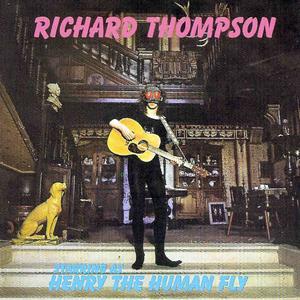 One of the great watersheds of late 20th-century pop music, so far as I’m concerned, came in 1970 or so, when Richard Thompson sold his goldtop Gibson Les Paul (1955? 1956?) to John Martyn and switched to playing a Fender Stratocaster more or less exclusively.
Thompson’s first band, Fairport Convention, had begun as a quasi-folkish outfit playing covers of Dylan and Joni Mitchell and doing nice Hollies-esque harmonies. Under the influence of their trad-obsessed bassist Ashley (Tyger) Hutchings, Fairport had taken a decisive turn towards indigenous British folk – Child Ballads, morris dances, etc. Thompson had set himself down and learned his way thru books & books of jigs, reels, strathspeys, etc. – all on that goldtop Les Paul.
The Les Paul, however, even the single-coil pickup version RT was playing, is a rather blunt instrument for traditional dance tunes, as you can hear on Fairport’s otherwise sublime Liege & Lief (1969). I’d compare RT’s switching to the Strat to the moment when the medieval/renaissance revivalist Phil Pickett laid down his modern oboe and picked up his first crumhorn. Finally: the right tool for the job.
RT had been two years out of Fairport, living on session work, before he released his 1st solo record, Henry the Human Fly (1972), and a strange and wonderful record it is. Oft-repeated legend has it that Henry is the worst-selling album Warner-Reprise ever released in the United States. The dire cover design – RT, in all his gangly mid-20s-ness, a halo of flyaway curls projecting from behind a half-face fly mask, posed with his guitar in quintessentially English, über-panelled Jacobean interior – certainly seems designed to drive away casual browsers.
But Henry, 34 years after its release, and maybe 2 decades since I bought my first vinyl copy, remains one of my favorite records: in part perhaps because of its sheer awkwardness. There’s only one song in here that “rocks” in anything like a conventional manner: “The Angels Took My Racehorse Away,” which begins with utterly sublime sounds of an English country dance on accordian & fiddle, over which RT proceeds to play a note-perfect Chuck Berry solo. (The album’s opening track is another Berry allusion: “Roll Over Vaughn Williams.”)
The other songs are for the most part experiments in what RT was calling “British rock music,” electro-acoustic music that would marry the energy of American rock ‘n’ roll with the melodic and lyrical traditions of the British Isles. Thompson’s BRM isn’t just a matter of electrifying traditional songs & tunes, as Fairport had done & as Hutchings was doing with his new bands Steeleye Span and the Albion Country Band, but a matter of writing original songs that melded the contemporary & the traditional, that would reinvigorate the emotion & forms of centuries-old “folk” music with new instrumentation and the savvy songwriting that Dylan had set as a benchmark in popular music.
What “British rock music” amounts to on Henry the Human Fly is a series of mordant, witty, highly literate, and generally quite depressing songs which seem to hover somewhere between the 17th & 19th centuries. “Roll Over Vaughn Williams” and “The New St. George” feel like marching songs for a new Levellers movement, tho without the millennial optimism of those early proto-communists. “Twisted,” “Nobody’s Wedding,” & “Cold Feet” are drinking songs whose Python-like humor conceals a pathos as dark as that of any George Jones tune.
Most memorable of all, perhaps, are a quartet of ballads: “The Poor Ditching Boy” is echt 19th-century self-pity, while “Shaky Nancy” – as TS Eliot said of Guido the younger in Djuna Barnes’s Nightwood – haunts one’s imagination. “Painted Ladies” is one of the great sex songs of RT’s considerable sex song repertoire: “Those film stars and beauties may please you tonight / If you go to bed with a book / But they can’t hold a candle to something that trembles / When you need to do more than look.” Best of all is “The Old Changing Way,” its stair-stepping trad chord progression dusted with an incongruously lovely harp; it’s the first (& for my money the best) of Thompson’s string of narrative ballads (cf. “Beeswing” & the crowdpleasing “1952 Vincent Black Lightning”). It’s the story of the itinerant Darby the tinker & his brother Tam, whose fraternal partnership – described in terms that would place them anywhere between the 17th and 19th century (“We’ll fix up your kettles / Please dear Missus / We’ll sharpen your knives”) – is broken by the forces of economic change, precipitating them into the “spikes and brothels” of the 20th century.
RT’s Strat is at times scarcely audible on Henry the Human Fly – the only points where he really stretches out are the traditional tunes in “Roll Over Vaughn Williams” & the stinging solo of “The Angels Took My Racehorse Away.” The big workouts like the modal intro to “Calvary Cross” and the long ending of “Night Comes In” would come later. But in Henry, one sees all the elements in place that would distinguish Thompson as the single greatest figure on the folk-rock scene for at least the next 3 decades.
***
The doctor gave me a cleanish bill of health yesterday, so I suppose I’m recovered just in time for the maelstrom of activity that surrounds the holidays. We’re Florida-bound this time around – bound to stay in Florida, not bound for Florida – except for a flying visit on my part to Philadelphia for the MLA. Not a prospect I’m looking forward to.
Saturday, December 16, 2006
Light Reading
I’m by no means on my deathbed, but I’ve been operating at a lot less than 100%, that’s for sure. Reading, as I noted, has become somewhat spotty, less directed: while I had in mind a goodly chunk of Milton & Joyce criticism to down over the past week, instead I lazed my way thru pages of Ron Johnson, Alan Halsey, WS Graham, Dhalgren, Claire Tomalin’s Pepys, & a big sheaf of children’s (“young person’s”) books. J, mind you, is something of a connoisseur of the stuff, & even if we didn’t have kids she’d still own every single book she ever acquired during her childhood, & be adding to her collection continually. (Having kids just gives her the excuse to get it all out of boxes & up on shelves.)
[I have to put in a plug here: we all know that Maurice Sendak is a major American artist & that Richard Scarry is a genius – tho I’m inclined to view Dr. Seuss as somewhat overrated, the Max Ernst of children’s draughtsmen – wonderful ideas, but never executed with quite enough care to make them convincing. But what about PD Eastman? I’m not sure I’ve ever met an Eastman book that I didn’t love – Go, Dog, Go!, Are You My Mother?, Sam and the Firefly, Fish Out of Water. Anyway – enough of the stuff that one reads to please the under-5 crowd…]
PL Travers’s Mary Poppins, I can report, is so much better than the Disney film (& this coming from someone who’s only in the last decade gotten over a certifiable Julie Andrews crush) that it’s not funny. Ms P herself is sterner, stranger – less a nanny that a force of nature, an elemental. Much overlap in some of the episodes here with the “Piper at the Gates of Dawn” chapter in Wind in the Willows.
The 3 Natalie Babbitt books I read – The Search for Delicious, Kneeknock Rise, & Tuck Everlasting – are all beautifully written, fitting subjects for some non-Derridean project on “hauntology” – that is, I find them very hard to get out of my head now that they’ve worked their way in. Not so much the characters, which seem little more than sturdy stock figures, but the situations: the family confronted with the equivocal gift of immortality in Tuck; the village with the secret in Kneeknock; the kingdom disintegrating over semantics in Delicious.
Travers & Babbitt are able, within the compass of books that are at least ostensibly pitched at young readers, to get at some of the deepest things that trouble the reflections of middle-aged readers: aging, death, the ultimate evanescence of human life; the foundations of human community and love; faith and its grounds or lack thereof. They’re doing the sorts of things Phillip Pullman does in His Dark Materials, & which JK Rowling fails so miserably at in Harry Potter.
Absolutely immersive books, tho, that gave me that classic old experience of reading straight thru, losing all track of time, being irritated when I got to the end. Which casts my mind back to that 3- or 4-way discussion bouncing among blogs last week – what seems the dim, pre-penicillin past – over the strenuous pleasures of anti-absorptive poetry. What’s so misguided about setting the energetic pleasure of reading Lyn Hejinian against the rather “easier” pleasure of reading classic fiction – Travers, Babbitt, Pullman, Dickens, Austen, whoever – is that is really is comparing two very different experiences. And without trying to rewrite Wayne Booth & a zillion other fiction critics on how some of the most interesting fiction puts us thru moral & ethical paces in the very process of immersing us in a “vivid, continuous dream,” I’d submit that poetry, by its very formality, by the fact that it’s written in lines (or ostentatiously written not in lines) or in even more complex forms, has already renounced the “suck you in” immersivity that prose fiction can command. So the discussion on pleasure & difficulty we might want to have – & which I might want to contribute to, if I ever reclaim enough lung capacity to think straight – ought to take place on the ground of poetry alone. Fiction (thanks heavens for it!) only muddies the water.
***
Next time: Deathbed Reading: What to Read in Denver When You’re Almost Dead.
[I have to put in a plug here: we all know that Maurice Sendak is a major American artist & that Richard Scarry is a genius – tho I’m inclined to view Dr. Seuss as somewhat overrated, the Max Ernst of children’s draughtsmen – wonderful ideas, but never executed with quite enough care to make them convincing. But what about PD Eastman? I’m not sure I’ve ever met an Eastman book that I didn’t love – Go, Dog, Go!, Are You My Mother?, Sam and the Firefly, Fish Out of Water. Anyway – enough of the stuff that one reads to please the under-5 crowd…]
PL Travers’s Mary Poppins, I can report, is so much better than the Disney film (& this coming from someone who’s only in the last decade gotten over a certifiable Julie Andrews crush) that it’s not funny. Ms P herself is sterner, stranger – less a nanny that a force of nature, an elemental. Much overlap in some of the episodes here with the “Piper at the Gates of Dawn” chapter in Wind in the Willows.
The 3 Natalie Babbitt books I read – The Search for Delicious, Kneeknock Rise, & Tuck Everlasting – are all beautifully written, fitting subjects for some non-Derridean project on “hauntology” – that is, I find them very hard to get out of my head now that they’ve worked their way in. Not so much the characters, which seem little more than sturdy stock figures, but the situations: the family confronted with the equivocal gift of immortality in Tuck; the village with the secret in Kneeknock; the kingdom disintegrating over semantics in Delicious.
Travers & Babbitt are able, within the compass of books that are at least ostensibly pitched at young readers, to get at some of the deepest things that trouble the reflections of middle-aged readers: aging, death, the ultimate evanescence of human life; the foundations of human community and love; faith and its grounds or lack thereof. They’re doing the sorts of things Phillip Pullman does in His Dark Materials, & which JK Rowling fails so miserably at in Harry Potter.
Absolutely immersive books, tho, that gave me that classic old experience of reading straight thru, losing all track of time, being irritated when I got to the end. Which casts my mind back to that 3- or 4-way discussion bouncing among blogs last week – what seems the dim, pre-penicillin past – over the strenuous pleasures of anti-absorptive poetry. What’s so misguided about setting the energetic pleasure of reading Lyn Hejinian against the rather “easier” pleasure of reading classic fiction – Travers, Babbitt, Pullman, Dickens, Austen, whoever – is that is really is comparing two very different experiences. And without trying to rewrite Wayne Booth & a zillion other fiction critics on how some of the most interesting fiction puts us thru moral & ethical paces in the very process of immersing us in a “vivid, continuous dream,” I’d submit that poetry, by its very formality, by the fact that it’s written in lines (or ostentatiously written not in lines) or in even more complex forms, has already renounced the “suck you in” immersivity that prose fiction can command. So the discussion on pleasure & difficulty we might want to have – & which I might want to contribute to, if I ever reclaim enough lung capacity to think straight – ought to take place on the ground of poetry alone. Fiction (thanks heavens for it!) only muddies the water.
***
Next time: Deathbed Reading: What to Read in Denver When You’re Almost Dead.
Thursday, December 14, 2006
& the diagnosis is
(drumroll...) the Illness Formerly Known As Walking [or in this case pretty much lying down all the time & shuffling around a little bit] Pneumonia.
Getting lots of unfocussed reading done betweeen bouts of coughing and bouts of napping: Claire Tomalin's splendid Pepys biography; Delany's Dhalgren; everything by Ron Johnson.
Getting lots of unfocussed reading done betweeen bouts of coughing and bouts of napping: Claire Tomalin's splendid Pepys biography; Delany's Dhalgren; everything by Ron Johnson.
Monday, December 11, 2006
And here's
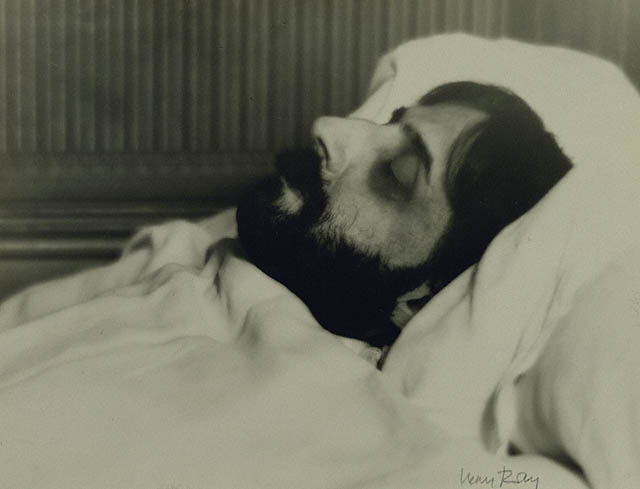 [Man Ray, Marcel Proust on his Deathbed]
how I'm feeling right now, in the grips of some flu-like something or other.
Friday, December 08, 2006
but wait...
Okay, I really should be finishing grading a stack of finals on the synoptic gospels & John – but I can't resist drawing the interested thousands' (or the interested five's) attention to two contributions to this pleasure/difficultly discussion. First, a beautifully-turned paragraph from Eric in re/ the notion of an "ethical" element to anti-absorptive writing:
Do we really mean, perhaps, that certain kinds of literature invite the exercise of certain moral qualities or habits of character, as though we were acting towards something or in a context that really mattered, morally speaking? They allow or invite us to cultivate patience, curiosity, a taste for ambiguity, all the values of what used to be called a "liberal" education? They beseech us, in the bowels of Christ, to think it possible we may be mistaken? (To quote the butcher Cromwell, whose cannon, Joyce reminds me, were embellished with the slogan "God Is Love.") Mark, Josh, is that what you're getting at, finally?Then from Robert at a groovy collaborative blog called "Of Looking at a Blackbird":
I can’t help feeling that criticism of immersion conceals a fear of immersing oneself in life itself, a fear of commitment. Not to mention fear of sexuality, fear of eros, fear of romance, Harlequin or not. Sure, when you take your kids to the park to play on the swings, it’s good to be meta-aware of all the sociological and class implications of what you’re doing. On the other hand, at a certain point doesn’t all that awareness become an excuse to maintain a safe and ironic distance from your own children?If Eric doesn't make something of this I'll eat my rive-gauche-issue avant-garde beret.
........
Mark et al. talk about Roland Barthes’ distinction between the “readerly” and the “writerly,” and that seems exactly to the point: immersive literature is readerly and anti-absorptive is writerly. I wish I could remember what poet I was reading recently who talked about the crucial turning point in his writing that came when he realized he was not even writing the sort of poems he wanted to read. Isn't there something very curious about this fear of the terrible bourgeois corruption that will result if the writer ever dares to get into bed with the reader and share some pleasure? It seems to hide a writer’s contempt for the reader within himself, or within herself, as well as for the readers in the world.
Thursday, December 07, 2006
Finally, some pleasure
So as I kinda expected, Bob Archambeau has weighed in on pleasure & difficulty, with a rather detailed (& illustrated) “story thus far” post. Only niggling corrections I’d add would be that the business about anti-absorptive work enabling us better to see the “Other” is Josh, not me – me, I stuck with the “feeling in the bones” business without putting any chips down – yet – on a particular politico-ethical mechanism. And I’m not exactly full-throttledly endorsing the “Difficult = Anti-Absorptive [Chas Bernstein / Veronica Forrest-Thomson’s term, by the way, not Silliman’s] = Ethical.” And while I entirely agree with Bob’s call for “data” – something like the “thick description” I hankered for last post – I think one of the crucial disagreements we might have is over this the business of “difficult for whom.” Bob sez, in response to Eric’s point about his students’ struggles with what seem to us like “immersive” texts, that
2ndly, in re the longer passage: I think this's true of much modernist writing as well – yes, two generations later. It's just that we've gotten used to the demands of modernist writing, not that it's gotten any simpler or any less "difficult." Try this on your own pulses: Do you honestly feel that "Anglo-Mongrels and the Rose" or The Anathemata have become easy poems? We know a lot more about how to read them, thanks to people like Keith Tuma, Maeera Shreiber, & Thomas Dilworth, but they still require an expenditure of effort that marks them as – well – difficult.
***
Eric is also back at bat, throwing out ideas like Stephen Hawking with an injection of monkey glands. And I'd respond, but I've got a big stack o' tests a-gradin' like everybody else; what I really wanted to do today was to draw your attention to something that gave me a big burst of pleasure last night – my first dip (ashes on my head!) into W.S. Graham. I have no idea, given my own semi-sentimental-semi-scholarly interest in Scottish lit, and given Tony Lopez (from whom I'd buy a used car any day)'s enthusiastic endorsement, why I haven't gotten around to reading Graham before. This, for instance:
What Is The Language Using Us For? (first poem)
What is the language using us for?
Said Malcom Mooney moving away
Slowly over the white language.
Where am I going said Malcolm Mooney.
Certain experiences seem to not
Want to go in to language maybe
Because of shame or the reader's shame.
Let us observe Malcolm Mooney.
Let us get through the suburbs and drive
Out further just for fun to see
What he will do. Reader, it does
Not matter. He is only going to be
Myself and for you slightly you
Wanting to be another. He fell
He falls (tenses are everywhere.)
Deep down into a glass jail.
I am in a telephoneless, blue
Green crevasse and I can't get out.
I pay well for my messages
Being hoisted up when you are about.
I suppose you open them under the light
Of midnight of The Dancing Men.
The point is would you ever want
To be down here on the freezing line
Reading the words that steam out
Against the ice? Anyhow draw
This folded message up between
The leaning prisms from me below.
Slowly over the white language
Comes Malcolm Mooney the saviour.
My left leg has no feeling.
What is the language using us for?
something like Language Poetry isn't necessarily "difficult" to its primary readership: other language poets and the profs who swarm around them.And again, in response to something of Eric’s:
there's the point (implicit, I think, in Eric's piece) that difficulty is something experienced by the reading subject, rather than inherent in the textual object. What's difficult for me may be easy for you, and vice-versa. This goes for all schools of "difficult" poetry. I mean, the formidably difficult works of Modernism have become pretty straightforward to thousands and thousands of readers over time, as we (I fear that is the professorial "we") have internalized the linguistic conventions with which they were written.I think we're dealing with another slippage in terms here. In re the 1st quotation: Sure, Langpo isn't "difficult" to its primary readership in one sense – that is, we (speaking as someone who's taught Barrett Watten, Lyn Hejinian, John Wilkinson, & Tony Lopez to just deliriously enthusiastic students over the past couple years [irony alert]) may have a few more readerly tricks up our sleeves than readers more accustomed to straightforwardly "immersive" texts, but really the big difference is that LangPo's primary readership just isn't as concerned with issues of coherence & meaning – that it has a certain "negative capability" about the kinds of thematic, narrative, argumentative closure that one encounters in the average New Yorker lyric. We've learned to stop worrying and love the bomb of disjunctive polysemic indeterminacy – but that doesn't make the work itself less disjunctively polysemically indeterminate.
2ndly, in re the longer passage: I think this's true of much modernist writing as well – yes, two generations later. It's just that we've gotten used to the demands of modernist writing, not that it's gotten any simpler or any less "difficult." Try this on your own pulses: Do you honestly feel that "Anglo-Mongrels and the Rose" or The Anathemata have become easy poems? We know a lot more about how to read them, thanks to people like Keith Tuma, Maeera Shreiber, & Thomas Dilworth, but they still require an expenditure of effort that marks them as – well – difficult.
***
Eric is also back at bat, throwing out ideas like Stephen Hawking with an injection of monkey glands. And I'd respond, but I've got a big stack o' tests a-gradin' like everybody else; what I really wanted to do today was to draw your attention to something that gave me a big burst of pleasure last night – my first dip (ashes on my head!) into W.S. Graham. I have no idea, given my own semi-sentimental-semi-scholarly interest in Scottish lit, and given Tony Lopez (from whom I'd buy a used car any day)'s enthusiastic endorsement, why I haven't gotten around to reading Graham before. This, for instance:
What Is The Language Using Us For? (first poem)
What is the language using us for?
Said Malcom Mooney moving away
Slowly over the white language.
Where am I going said Malcolm Mooney.
Certain experiences seem to not
Want to go in to language maybe
Because of shame or the reader's shame.
Let us observe Malcolm Mooney.
Let us get through the suburbs and drive
Out further just for fun to see
What he will do. Reader, it does
Not matter. He is only going to be
Myself and for you slightly you
Wanting to be another. He fell
He falls (tenses are everywhere.)
Deep down into a glass jail.
I am in a telephoneless, blue
Green crevasse and I can't get out.
I pay well for my messages
Being hoisted up when you are about.
I suppose you open them under the light
Of midnight of The Dancing Men.
The point is would you ever want
To be down here on the freezing line
Reading the words that steam out
Against the ice? Anyhow draw
This folded message up between
The leaning prisms from me below.
Slowly over the white language
Comes Malcolm Mooney the saviour.
My left leg has no feeling.
What is the language using us for?
Wednesday, December 06, 2006
Adam’s McRib
I can help feeling there’s been a certain slippage in the recent discussion of pleasure among Josh Corey, Eric Selinger, & YVT, attributable perhaps to a too rigid dichotomy (damn those Manicheans!) between the “immersive” experience of popular/genre/middlebrow fiction and the “anti-absorptive” rigors of contemporary alt-poetry. A couple of thoughts, mostly in response to Eric’s recent posts:
1) Josh is right when he reads Eric as saying, in essence, that “all pleasure is equally valid and anyone who says otherwise is deluded or a snob” – in arguing for the equal validity of all readerly pleasure. But I suspect he’s just as irritated as I am when Eric starts playing the old anti-elitist class card – “culinary” or “cultural-positioning” responses “don't let you feel smug or self-approving in your scorn for NASCAR and McRib sandwiches” – accusing us of being somehow insensitive to the pleasures of watching powerful cars go in circles or savoring boneless gestures towards American vernacular cuisine. Yes indeed, M. Bourdieu is right when he shows that a preference for Beckett plays & pad thai over NASCAR & the McRib is pretty inevitably aligned with a particular class distinction – but so what? If one values cultural productions – & I’d like to think that as poets & university teachers of poetry we do – that we’ve got to make some choices about what we pay attention to, what we take pleasure from. I know how much pleasure you take in deflating the pretensions of your friends & colleagues, Eric (& G-d knows that I don’t wanna deprive anyone of pleasure), but until you send me the poetry syllabus that focuses entirely on amateur slams, hip-hop records, prison workshops, and Hallmark greeting cards, I wish you’d stop pretending to be Mike Gold. More heat than light. (“That shirt cost more than my mother makes in a year.”)
2) When Eric talks about the “moral” pleasure of tackling difficult poetry as being a kind of ex post facto figleaf we lay over the naughty bits of our more basic pleasures – & this bears more discussion – I think he’s rightly pointing to what Bob Archambeau has written about on a number of occasions as the “aesthetic anxiety” of late Victorian to contemporary poets. But – & this is the crucial point – it still begs the question of whether those ethical effects actually exist. EG: I love arugula for its bitter taste and wonderful texture; I rationalize to myself that I eat arugula because it’s good for me, tho I don’t have any hard evidence one way or another; but it’s good for me anyway, objectively. (This is a counterfactual supposition – me, I hate arugula.)
Josh & I say the ethical element of “hard” poetry is there: we feel it in our bones, tho we can’t argue it in a universally convincing fashion. (We need to try harder…) Eric says “show me the money, & until then I’ll just consider the pleasures of ‘hard’ poetry as one choice on the menu, not necessarily to be preferred to the McTaco.” (Yummy poem, by the way.)
***
But those were preliminaries: What I really meant to write about was the “slippages” in discourse that seems to be happening here. This will sound like a laundry list:
•I think we need a more nuanced, more “thick” description of the experience & the pleasures of anti-absorptive texts than just a foregrounding of language or “speed bumps” in the way of immersion. Those things indeed happen, but a great deal else – varying widely from text to text – happens as well. Josh gestures towards this – & I image he’s doing a lot more than gesturing in his dissertation – but before we can talk intelligently about anti-absorptional writings as being somehow more valuable than something else, we need some sort of encyclopedic tracing of the pleasures of bafflement, allusion both external and internal, dictional shifts, fragmentation, indeterminacy, polysemy, and so forth. (This has probably been written, but hey, I’ve been in a cave writing a biography for last 7 years.)
•No, it’s not just a contrast between ways of reading: there are fundamental differences between mass market immersive fiction and “difficult” poetry. Yes, we can bring to bear on the former some of the tools useful for the latter, and to interesting effect. But that’s a matter I think of more general literary-critical methodology, rather than things specifically crafted for the sort of poetry Josh is talking about. There are skill sets and there are skill sets, & some of them overlap, & some of them don’t. I may read a romance novel thru the lens of Northrop Frye & Patricia Parker on the classic romance, thru Mulveyan notions of the gaze, & thru various post-Freudian theorizations of the “other” – all ways of resisting “immersion” – but how do those skill sets help me with Susan Howe’s “Bibliography of the King’s Book”?
•I don’t think the pleasure Josh & I (& you too, EMS) take in an anti-absorptive poem really bears much resemblance, aside from the fact that it’s work rewarded – which applies just as well to a crossword puzzle, building a sukkah, or washing the car – to what undergrads in an intro to poetry class feel in working thru the “‘immersive’ first person lyric.” Some of the same elements are there (pleasure in the sound of language, pleasure in “decoding” what seems initially unclear, etc.), but there are other faculties being drawn upon, other muscles exercised. (Maybe we should shift governing metaphors from cuisine to exercise: immersive work as a morning jog; anti-absorptive work as yoga?) And here one needs to go two bullets back up, which takes us back to the big unwritten – the Geertzean description of alt-poetry reading that will in turn perhaps (?) facilitate the convincing ethical description that will convert the reprobate Selinger to the True Church of Painful Difficulty.
1) Josh is right when he reads Eric as saying, in essence, that “all pleasure is equally valid and anyone who says otherwise is deluded or a snob” – in arguing for the equal validity of all readerly pleasure. But I suspect he’s just as irritated as I am when Eric starts playing the old anti-elitist class card – “culinary” or “cultural-positioning” responses “don't let you feel smug or self-approving in your scorn for NASCAR and McRib sandwiches” – accusing us of being somehow insensitive to the pleasures of watching powerful cars go in circles or savoring boneless gestures towards American vernacular cuisine. Yes indeed, M. Bourdieu is right when he shows that a preference for Beckett plays & pad thai over NASCAR & the McRib is pretty inevitably aligned with a particular class distinction – but so what? If one values cultural productions – & I’d like to think that as poets & university teachers of poetry we do – that we’ve got to make some choices about what we pay attention to, what we take pleasure from. I know how much pleasure you take in deflating the pretensions of your friends & colleagues, Eric (& G-d knows that I don’t wanna deprive anyone of pleasure), but until you send me the poetry syllabus that focuses entirely on amateur slams, hip-hop records, prison workshops, and Hallmark greeting cards, I wish you’d stop pretending to be Mike Gold. More heat than light. (“That shirt cost more than my mother makes in a year.”)
2) When Eric talks about the “moral” pleasure of tackling difficult poetry as being a kind of ex post facto figleaf we lay over the naughty bits of our more basic pleasures – & this bears more discussion – I think he’s rightly pointing to what Bob Archambeau has written about on a number of occasions as the “aesthetic anxiety” of late Victorian to contemporary poets. But – & this is the crucial point – it still begs the question of whether those ethical effects actually exist. EG: I love arugula for its bitter taste and wonderful texture; I rationalize to myself that I eat arugula because it’s good for me, tho I don’t have any hard evidence one way or another; but it’s good for me anyway, objectively. (This is a counterfactual supposition – me, I hate arugula.)
Josh & I say the ethical element of “hard” poetry is there: we feel it in our bones, tho we can’t argue it in a universally convincing fashion. (We need to try harder…) Eric says “show me the money, & until then I’ll just consider the pleasures of ‘hard’ poetry as one choice on the menu, not necessarily to be preferred to the McTaco.” (Yummy poem, by the way.)
***
But those were preliminaries: What I really meant to write about was the “slippages” in discourse that seems to be happening here. This will sound like a laundry list:
•I think we need a more nuanced, more “thick” description of the experience & the pleasures of anti-absorptive texts than just a foregrounding of language or “speed bumps” in the way of immersion. Those things indeed happen, but a great deal else – varying widely from text to text – happens as well. Josh gestures towards this – & I image he’s doing a lot more than gesturing in his dissertation – but before we can talk intelligently about anti-absorptional writings as being somehow more valuable than something else, we need some sort of encyclopedic tracing of the pleasures of bafflement, allusion both external and internal, dictional shifts, fragmentation, indeterminacy, polysemy, and so forth. (This has probably been written, but hey, I’ve been in a cave writing a biography for last 7 years.)
•No, it’s not just a contrast between ways of reading: there are fundamental differences between mass market immersive fiction and “difficult” poetry. Yes, we can bring to bear on the former some of the tools useful for the latter, and to interesting effect. But that’s a matter I think of more general literary-critical methodology, rather than things specifically crafted for the sort of poetry Josh is talking about. There are skill sets and there are skill sets, & some of them overlap, & some of them don’t. I may read a romance novel thru the lens of Northrop Frye & Patricia Parker on the classic romance, thru Mulveyan notions of the gaze, & thru various post-Freudian theorizations of the “other” – all ways of resisting “immersion” – but how do those skill sets help me with Susan Howe’s “Bibliography of the King’s Book”?
•I don’t think the pleasure Josh & I (& you too, EMS) take in an anti-absorptive poem really bears much resemblance, aside from the fact that it’s work rewarded – which applies just as well to a crossword puzzle, building a sukkah, or washing the car – to what undergrads in an intro to poetry class feel in working thru the “‘immersive’ first person lyric.” Some of the same elements are there (pleasure in the sound of language, pleasure in “decoding” what seems initially unclear, etc.), but there are other faculties being drawn upon, other muscles exercised. (Maybe we should shift governing metaphors from cuisine to exercise: immersive work as a morning jog; anti-absorptive work as yoga?) And here one needs to go two bullets back up, which takes us back to the big unwritten – the Geertzean description of alt-poetry reading that will in turn perhaps (?) facilitate the convincing ethical description that will convert the reprobate Selinger to the True Church of Painful Difficulty.
Monday, December 04, 2006
Make Mine Spicy, Please
Two of my favorite blogspherians, Josh Corey & Eric Selinger, have started a discussion on an old subject – pleasure & difficulty in one’s reading material. (So open a new browser window here and here.) Josh contrasts the “absorptive” or “immersive” pleasure of your average well-written novel (the “vivid continuous dream” evoked by John Gardner) with the more thorny pleasures offered by “anti-absorptive” poetry – writing in which the language does not “disappear” from the page, to be replaced by an evoked or described world – writing, in short, that foregrounds its own materiality as language, that won’t let us forget that we’re after all reading. Josh:
This all seems like an old argument to me, if only because I feel like I’ve been batting around some version of it with Eric for 15 years or so now, ever since we were in junior high together (er, well, maybe we were a bit older than that…). It all comes back around to pleasure, it seems, & pleasure gets figured in no more than a couple of ways: as sex (vide Josh’s active/passive & “masochism” business) or as eating (“Immersive fiction as trans-fats, innovative writing as leafy greens”). Of course, according to Freud, the latter resolves into the former as one sort of arrested sexual development. But I very much want, following Eric, to call at least a temporary halt to the Freudianizing of readerly pleasure “in order to draw the sort of precise, useful distinctions Josh (and I) are looking for. Any other vocabularies out there for us to draw on?”
Josh, it seems to me, is preaching from the same set of sacred texts that have been batted around in the alt-poetry world for three decades now: the Russian Formalists on poetic language as “defamiliarizing”; Roland Barthes on the distinction between the “readerly” and the “writerly”; Veronica Forrest-Thomson on poetic artifice; and the various LangPo redactions of these scriptures, most notably Ron Silliman’s “Disappearance of the Word, Appearance of the World” and various essays by Chas: Bernstein. Interestingly enough, all of these texts are written by figures who have a state in the success of particular avant-garde literary formations (which is also true of Alban Berg’s student Adorno; why, as a dissenting voice, don’t we hear from Georg Lukacs on realism?).
But what I love about Josh’s post is his sensitivity to the “moral content” of his distinction between the immersive and the anti-absorptive, what I like to think of as the “scold factor” in alt-poetics (cf. “School of Quietude,” passim). It’s understandable why Silliman mercilessly flogs the reader of Peter Benchley in “Disappearance of the Word” – after all, he’s got his own anti-absorptive poetic movement to promote. Now, 30 years after the lean years of LangPo, it’s hard to hear the same rhetoric being deployed – in a poetic landscape where Michael Palmer’s just won a 100K prize and Nate Mackey’s gotten the National Book Award – without sensing some puritanical defensiveness – of which Josh is keenly aware.
The question, that is, is why ought I to prefer "anti-absorptive" texts to "immersive" ones? It's in the "ought" that the rub resides, no? for the question of why do I prefer such texts to other sorts of texts ends up boiling down to either a question of biographical taste (Adorno's dreaded "culinary" approach to art) (eg I like late modernist poetry because I have a disposition, nurtured on bales of densely detailed Richard Scarry books and crossword puzzles and so forth, towards the complex and open-ended), or to a Bourdieuesquely-mapped position within the field of production, consumption, & distinction (which, if you're deeply committed to poetry, is a pretty depressing perspective from which to view matters).
The deus ex machina here is to invoke a political or (which often boils down to the same thing) moral argument: that anti-absorptive work is somehow better for you, or that it somehow works to change the world (not immediately, not directly, not vulgar-Marxistly) by altering the way you or your readers conceive the world.
In my bones I believe that these arguments are more or less right, tho I have yet to see them stated in a way that I find more than temporarily convincing. I want to believe wholeheartedly, but I'm still skeptical. And it does ultimately come around to the issue of pleasure: what I want is a convincing account of the pleasure of what's difficult – perhaps analogous to the pleasure I take in a 100-proof habañero sauce on top of a plate of black beans & rice, a pleasure that involves two minutes of searing pain & buckets of sweat – an account that won't (disregard that last analogy) fall back upon the culinary, try to convince me that reading My Life is like a good bout of S/M, or preach to me about the virtues of asceticism like the aged Scottish Covenanter penguin in Happy Feet.
All this is antithetical to the pleasures I seek from poetry, or from fiction that foregrounds the language through the beauty or ugliness of its sentences. Most readers (on airplanes or elsewhere) are after the infantilizing dream-state, and yet I can't blame others or myself for wanting to be nurtured by certain reading experiences rather than pricked into greater consciousness. A healthy diet, so to speak, probably requires both. But isn't the moral content that creeps into my language here interesting? Immersive fiction as trans-fats, innovative writing as leafy greens. I am loath to become a scold, urging children to read Language poetry because it's good for you. Is the pleasure of anti-absorptive writing simply the masochistic pleasure of self-denial, of anorexia? Is it a "higher" pleasure because further from the pleasures of the flesh? And yet the anti-absorptive is closer to the body of language than immersive fiction is: we savor the materiality of phonemes and syntax and sentences, provoked into the kind of apperception that requires us to look up from the book now and then and figure. One type of reading is active and closer to writing; the other is passive and demands our submission—there's a masochism for you.Now Eric has much to say in response to this, only some of it scoldy, but all of it sharp. For one thing, he’s anxious to argue (rightly I think) that an “immersive” reading experience by no means precludes being aware of, & paying careful attention to, the texture of the language one’s reading. Maybe one’s toggling back & forth between thinking of Stephen Dedalus as an incorrigible ass & marv’ling at the balance of the periods in which his asininity is presented, but both of those moments are present for me in the same reading experience. And Eric’s also concerned about the notion – which I hear all too often as well – that “immersive” reading is somehow “passive”: “it only feels that way because the skills it takes come so easily to you, have been so naturalized, that you no longer notice you're deploying them!”
This all seems like an old argument to me, if only because I feel like I’ve been batting around some version of it with Eric for 15 years or so now, ever since we were in junior high together (er, well, maybe we were a bit older than that…). It all comes back around to pleasure, it seems, & pleasure gets figured in no more than a couple of ways: as sex (vide Josh’s active/passive & “masochism” business) or as eating (“Immersive fiction as trans-fats, innovative writing as leafy greens”). Of course, according to Freud, the latter resolves into the former as one sort of arrested sexual development. But I very much want, following Eric, to call at least a temporary halt to the Freudianizing of readerly pleasure “in order to draw the sort of precise, useful distinctions Josh (and I) are looking for. Any other vocabularies out there for us to draw on?”
Josh, it seems to me, is preaching from the same set of sacred texts that have been batted around in the alt-poetry world for three decades now: the Russian Formalists on poetic language as “defamiliarizing”; Roland Barthes on the distinction between the “readerly” and the “writerly”; Veronica Forrest-Thomson on poetic artifice; and the various LangPo redactions of these scriptures, most notably Ron Silliman’s “Disappearance of the Word, Appearance of the World” and various essays by Chas: Bernstein. Interestingly enough, all of these texts are written by figures who have a state in the success of particular avant-garde literary formations (which is also true of Alban Berg’s student Adorno; why, as a dissenting voice, don’t we hear from Georg Lukacs on realism?).
But what I love about Josh’s post is his sensitivity to the “moral content” of his distinction between the immersive and the anti-absorptive, what I like to think of as the “scold factor” in alt-poetics (cf. “School of Quietude,” passim). It’s understandable why Silliman mercilessly flogs the reader of Peter Benchley in “Disappearance of the Word” – after all, he’s got his own anti-absorptive poetic movement to promote. Now, 30 years after the lean years of LangPo, it’s hard to hear the same rhetoric being deployed – in a poetic landscape where Michael Palmer’s just won a 100K prize and Nate Mackey’s gotten the National Book Award – without sensing some puritanical defensiveness – of which Josh is keenly aware.
The question, that is, is why ought I to prefer "anti-absorptive" texts to "immersive" ones? It's in the "ought" that the rub resides, no? for the question of why do I prefer such texts to other sorts of texts ends up boiling down to either a question of biographical taste (Adorno's dreaded "culinary" approach to art) (eg I like late modernist poetry because I have a disposition, nurtured on bales of densely detailed Richard Scarry books and crossword puzzles and so forth, towards the complex and open-ended), or to a Bourdieuesquely-mapped position within the field of production, consumption, & distinction (which, if you're deeply committed to poetry, is a pretty depressing perspective from which to view matters).
The deus ex machina here is to invoke a political or (which often boils down to the same thing) moral argument: that anti-absorptive work is somehow better for you, or that it somehow works to change the world (not immediately, not directly, not vulgar-Marxistly) by altering the way you or your readers conceive the world.
In my bones I believe that these arguments are more or less right, tho I have yet to see them stated in a way that I find more than temporarily convincing. I want to believe wholeheartedly, but I'm still skeptical. And it does ultimately come around to the issue of pleasure: what I want is a convincing account of the pleasure of what's difficult – perhaps analogous to the pleasure I take in a 100-proof habañero sauce on top of a plate of black beans & rice, a pleasure that involves two minutes of searing pain & buckets of sweat – an account that won't (disregard that last analogy) fall back upon the culinary, try to convince me that reading My Life is like a good bout of S/M, or preach to me about the virtues of asceticism like the aged Scottish Covenanter penguin in Happy Feet.
Wednesday, November 29, 2006
Placeholder
It's been a pretty frantic week – the holiday, family in town, grading essays, watching as the wee little cough I'd had for a week morphed into a real live hacking pre-bronchitis... Sleep deprivation, which has plagued me all semester – dozing off as J. reads the girls their bedtime story, or falling asleep in their room after replying to their catechismal "Tell me about my day" and "Tell us who loves us"... No breathing space for the (if I only had time & energy to be) wicked: department meeting tomorrow, & one final meeting of the poetry workshop in the evening.
***
If you were wondering whether Wikipedia was ever reliable – I'm not a numbers queen, but I noticed an unaccountable jump lately in my Sitemeter numbers, accounted for (once I figured out how) by a link to my half-cock'd musings on Botero's Abu Ghraib pictures some kind soul inserted into the Wikipedia entry for "Fernando Botero."
On the other hand, while I've given uncounted school-marmish scoldy lectures on the unreliability of Wikipedia for serious research (all of which have passed in one set of undergraduate ear-'oles and out the other), I couldn't resist the allure of the ultimate "users' encyclopaedia," & have been trolling thru the entries and fixing little wee bits of verbal & ideational flash (you remember it from the model airplane kits, the excess plastic forced between the facing surfaces of the mold, & having to trim it off with the exacto knife). After I cleaned up the account of Zukofsky's political career, his Wikipedia entry is actually a pretty damned decent overview.
***
And writing (ie something other than letters of recommendation): a longish poem en train, projected 150 lines in 3-line stanzas.
***
If you were wondering whether Wikipedia was ever reliable – I'm not a numbers queen, but I noticed an unaccountable jump lately in my Sitemeter numbers, accounted for (once I figured out how) by a link to my half-cock'd musings on Botero's Abu Ghraib pictures some kind soul inserted into the Wikipedia entry for "Fernando Botero."
On the other hand, while I've given uncounted school-marmish scoldy lectures on the unreliability of Wikipedia for serious research (all of which have passed in one set of undergraduate ear-'oles and out the other), I couldn't resist the allure of the ultimate "users' encyclopaedia," & have been trolling thru the entries and fixing little wee bits of verbal & ideational flash (you remember it from the model airplane kits, the excess plastic forced between the facing surfaces of the mold, & having to trim it off with the exacto knife). After I cleaned up the account of Zukofsky's political career, his Wikipedia entry is actually a pretty damned decent overview.
***
And writing (ie something other than letters of recommendation): a longish poem en train, projected 150 lines in 3-line stanzas.
Sunday, November 26, 2006
Bad Joyce
 Ray Davis comments of Ulysses’s 18 stylistic menu-choices, “I wonder if fear of stylistic tinnitus is why goofy "Eumaeus" and "Ithaca" have been my favorite episodes for so many years…” Having just ploughed thru ‘em both, I can only sympathize. There’s something beautiful about watching a writer who seems to be able to do anything turning his hand to actively bad writing: the first half of “Nausicaa” is pretty breathtaking in that way, with its spot-on pastiche of 1904 Redbook, Cosmo, & Reader’s Digest, but “Eumaeus” is just plain sublime, a cliché in every line:
Prepatory to anything else [cliché] Mr Bloom brushed off the greater bulk [cliché] of the shavings and handed Stephen the hat and ashplant and bucked him up generally [cliché + limp adverb] in orthodox Samaritan fashion [cliché, but oh how deliciously wrong-headed – if there’s anything the Gospel Good Samaritan isn’t it’s “orthodox” – remember the priest & the Levite] which he very badly needed [limp, limp ending].This first sentence of Section III of the novel ought to bring to mind the first sentence of Section I: ”Stately, plump Buck Mulligan came from the stairhead, bearing a bowl of lather on which a mirror and a razor lay crossed.” There’s the “Buck” of “bucked him up generally,” and of course Mulligan is about to shave (“the greater bulk of the shavings”). Not to mention the more distant echoes between “plump” and “bulk.” One great joy of obsessively re-reading Ulysses lies in hearing those echoes propagate themselves in one’s echo-chamber mind, but another – in “Eumaeus” – is simply marvelling at how the bad prose unfurls itself. Or watching Joyce’s more familiar lyricism break thru the wall of tone-deafness, as in the antepenultimate paragraph:
The horse having reached the end of his tether, so to speak [indeed], halted and, rearing high a proud feathering tail, added his quota [ouch! yes, it’s a street-sweeping cart] by letting fall on the floor which the brush would soon brush up and polish [cliché], three smoking globes of turds. [and here’s the real thing:] Slowly three times, one after another, from a full crupper he mired. And humanely his driver waited till he (or she) had ended, patient in his scythed car.Except for that tell-tale "he (or she)," those last two sentences are as beautiful as anything JJ ever wrote.
***
Thanks be Thanksgiving is over. Not that I mind national holidays, especially ones which call for large-scale cooking – but I just don’t like anything on the menu, turkey most of all. This year’s substitution was a big-ass Smithfield salt-cured ham, the sort of thing you have to soak for two days ahead of time to get enough of the salt out to make it edible. It came out beautifully, in case you’re wondering, but I’m afraid I’m the only one in the household enthusiastic about this particular comestible, so I have a great deal of salty swineflesh in my future.
***
For those of you still on tenterhooks as to my selection of course texts for this Spring’s Milton, I’ve decided to go with the half-century old Merritt Hughes over the Flannagan Riverside. Okay, so Hughes doesn’t annotate “Hermes” or “Virgin mother” or much of the basic stuff Flannagan does – but isn’t that what Wikipedia and the online Brittanica are for? And Hughes doesn’t, as Flannagan does, manage to confuse “Philistine” and “Pharisee,” or claim that in “Avenge O Lord thy slaughter’d Saints” Milton is somehow “perverting” the Roman Catholic notion of sainthood. (Is there a Protestant in the house, please?)
Wednesday, November 22, 2006
Crucified Smurfs
 It's hard to avoid Fernando Botero's paintings down here in South Florida. The Colombian artist's pudgy figures are enormously popular – every poster shop has reproductions, and most galleries either have real Boteros or second-rate imitations. For my part, I've never been able to tell the difference between an imitation Botero and the real thing, just as I find little to separate Stephen King parodies from echt Stephen King – I've always found Botero's puffy figures, rendered in a kind of (faux?) naive realism, the height of contemporary kitsch: not merely the sort of art that people who don't like art like – Norman Rockwell, whatever you might say about the implicit politics of his images, was an incredible draughtsman, as was Grant Wood – but the sort of art that people who don't really like art but think they like art, or want you to think they like art, like.
This isn't a kind of apotropaic response on my part to figurative art in general - I'm a great fan of Wood, of RB Kitaj, Eva Hesse, and Balthus. Perhaps it's just that Botero's figures, vast, puffy, cherubic, and even when butt-naked absolutely sexless, seem to have been sieved of all human interest, leaving nothing but a kind of piggish contentment. These aren't George Grosz's fatties, who seem to be the human equivalents of rather savage wild boars, but a endless stream of humanized gelded cats.
So I was rather surprised when a family member alerted me that her old philosophy prof Arthur Danto was reviewing Botero in a recent issue of The Nation – and that the works he was reviewing were a series of paintings about the prisoner abuse in Abu Ghraib – frankly the last thing I would imagine Botero painting. It's like imagining Thomas Kinkade painting Guernica, or Norman Rockwell illustrating the Bataan Death March.
But it's true: Botero has done a very long series of canvases & drawings based on the reports of prisoner abuse in Abu Ghraib, tho not based, he insists, on the widely circulated photographs of that abuse. Danto makes a nice point about that distinction:
We knew that Abu Ghraib's prisoners were suffering, but we did not feel that suffering as ours. When the photographs were released, the moral indignation of the West was focused on the grinning soldiers, for whom this appalling spectacle was a form of entertainment. But the photographs did not bring us closer to the agonies of the victims.In contrast – according to Danto – Botero's paintings
are masterpieces of what I have called disturbatory art--art whose point and purpose is to make vivid and objective our most frightening subjective thoughts.... Botero's images, by contrast, establish a visceral sense of identification with the victims, whose suffering we are compelled to internalize and make vicariously our own. As Botero once remarked: "A painter can do things a photographer can't do, because a painter can make the invisible visible." What is invisible is the felt anguish of humiliation, and of pain. Photographs can only show what is visible; what Susan Sontag memorably called the "pain of others" lies outside their reach. But it can be conveyed in painting, as Botero's Abu Ghraib series reminds us, for the limits of photography are not the limits of art. The mystery of painting, almost forgotten since the Counter-Reformation, lies in its power to generate a kind of illusion that has less to do with pictorial perception than it does with feeling.Leaving aside for a moment whether or not Botero's paintings "establish a visceral sense of identification with the victims, whose suffering we are compelled to internalize and make vicariously our own," I am appalled by Danto's initial assumption that when the Abu Ghraib photos were first disseminated "the moral indignation of the West was focused on the grinning soldiers, for whom this appalling spectacle was a form of entertainment" to the exclusion of any sympathy with "the agonies of the victims." What West does he refer to? Donald Rumsfeld's? Time magazine's?
My own outraged reaction to the photographs stemmed from a combination of disgust at the touristic, sadistic poses & expressions of the American soldiers posing for the photographs and precisely an immediate sympathy for the men being abused – a sympathy that I can't imagine any viewer outside of the present American administration wouldn't feel: yes, Professor Danto, we shrank from that snarling dog, we felt the degradation of being piled into a naked pyramid, of being forced to grovel at the end of a leash.
It's the very verisimilitude of the photographs, in my own experience, that elicited immediate sympathy, the fact that the naked and degraded men in them had individual bodies and faces – they looked like my friends, my students, the guys I used to see in the communal showers in my dorm. And that's why the Botero paintings, while they have a certain weird postmodern fascination, ultimately fail to move me. It's strange indeed, and somewhat disturbing, to see Botero-figures put through Abu Ghraib tortures – but it's a weirdness that's akin to seeing Smurfs crucified, or seeing Mickey Mouse shooting up & having sex. These are not human beings being tortured: they're Boteros being put thru unfamiliar paces. Botero's very success at making his friendly chubbies into a world-recognized brand-emblem, it would seem, has deprived him of the ability to do anything more than continue to sell the brand.

Perhaps it's the very middle-brow allure of the standard Botero that makes these horror-Boteros so strangely unmoving to me. In contrast, I find the iPod/iRaq graphic – which was surreptitiously inserted into a number of Apple street advertisements in New York two years ago – to be far more emotionally compelling, & to pack a far more intellectually incisive punch.
Subscribe to:
Posts (Atom)