Tuesday, December 27, 2005

Thursday, December 22, 2005
Hiatus?
Having lived more than five years in Ithaca (New York), I know the difference between "bitterly cold" and "kinda cold," but even with that knowledge under my belt, this vacationing (non-native) Floridian is finding the kinda cold weather in New York City pretty damned bitter. The blog's not exactly hiatusing, but you won't see much of me until the new year.
***
Lots of folks bitching a blue streak about the MTA strike (frankly, more of them back in Florida than here in NYC, so far as I've heard -- I don't think they actually have unions down there). Joshua Clover talks sense:
***
Bob has gotten back at me for my "bullcrap" comment by disseminating a photo of some bookish dork he's pulled off the internet and implying that it's me. A low blow indeed, Robert, a low blow indeed. A more accurate image:
***
Happy Holidays to everyone out there!
***
Lots of folks bitching a blue streak about the MTA strike (frankly, more of them back in Florida than here in NYC, so far as I've heard -- I don't think they actually have unions down there). Joshua Clover talks sense:
Whatever poor matter the laborer or client nation can bring to market must be exchanged for basic physical protection which is always under threat of being removed or indeed turned on the protectees, should they fail to perform as commanded: Pinkertons, embargoes, bombers. There is no corporate language that is not the language of threat, something Mayor Bloomberg knows perfectly well when he dares to call the striking transit workers "thuggish" and "selfish." He should perhaps make investigations with the dictionary.
***
Bob has gotten back at me for my "bullcrap" comment by disseminating a photo of some bookish dork he's pulled off the internet and implying that it's me. A low blow indeed, Robert, a low blow indeed. A more accurate image:

***
Happy Holidays to everyone out there!
Tuesday, December 20, 2005
Zach Barocas: Among Other Things
 Some time ago Kasey Mohammad posted a list of “clichés” about contemporary poetry, one of which went something like “Clark Coolidge, who is also a bebop drummer, writes remarkably percussive poetry.” I suppose it’s fair enough to mark the resemblance – Coolidge has often enough made the connection between his own work and jazz forms – tho one doesn’t often find physics writers talking about how Einstein’s papers have “violin-like” melodies to them, or literary critics talking about how Wayne Booth’s paragraphs have a “cello-like” sonority (or how Pound’s lines often sound like a slightly out-of-tune bassoon).
All this as prelude to noting that despite what his blurbists have to say – Norman Finkelstein calls the poems “off-beat, pitch perfect,” and Peter O’Leary speaks of a “percussive instinct” in “these lyrics whose rhythm is honesty” – I don’t really find the poems of Zach Barocas’s Among Other Things: Poems & Proposals to be particularly “drummish.” Maybe Zach himself is: he spent a good chunk of the 1990s as drummer of Jawbox, by all accounts one of the more melodically intelligent post-punk bands. These days he lives in Minneapolis, and runs the wonderfully spare poetry/visual art website Cultural Society. The aesthetic of Cultural Society – clean, sans-serif, updated only when there’s work its editor feels worth presenting – is evident as well in Among Other Things. The poems are mostly short; Barocas’s most common form is a two-line stanza (tho there are a number of exceptions); thruout there’s a sense of thoughtfulness & deliberation. I don’t feel the raging energy of punk (“old school” or “new”) or post-punk, but the clean and close deliberation of a kind of post-Eno minimalism.
The collection is punctuated with a series of numbered “proposals,” a form that O’Leary calls “a hybrid elegy/epigram,” which to my ears leans more towards epigram than elegy. But that title, “proposal,” suggests how these little poems are more than squared-off statement; they lean into the future, propose what ought to or might take form in the realm of thought and personal relations. One proposes to the person with whom one hopes to spend one’s life; one proposes a work to be pursued. Even the poems here not designated “proposals” have a sense of proposition, as “Things To Do Today” or “For the Rest of Our Lives”:
I propose pretty marriage:
orchids to wrists, garters to thighs,
satin
to seatbacks.
Dark glasses to sunup,
the mesh & thrust of motor-
parts to the knock of piston
rings;
the tongue to
the eye.
On the other hand, the “proposals” themselves are sometimes devoted to a kind of phenomenology of poetry, a rumination on the physical and sensory bases of the poem, as in the 9th and 11th proposals:
What flashes silver
& quickens the eye?
Diamonds or minnows,
fiberglass slivers,
stainless steel (in its
own dull way), & ice.
Silver, then, is just
a kind of white light,
a glint of white &
the way we name it.
***
It is not merely
the incandescence,
the radiance, one
barely, if at all,
contains; it is the
illuminated
witness, too, warmed &
facing the light’s source
alone, basking with-
out fear, that matters.
I don't want to give the impression – as these quotations might – that all of Among Other Things is in this quiet and ruminative mode. There're a fair number of love poems here, barroom pickup poems, morning after poems, and a really knockout set of "Notes on Music" (where, if anywhere, Barocas's percussive sensibility to comes to the fore). The book as a whole is a focused and lovely group of poems, & – as Barocas’s first – a remarkably self-assured collection, promising more pleasures to come.
Monday, December 19, 2005
marking time on the web
It's a slow weekend for blogging, but nuggets keep turning up on the internet, here & there:
In the Guardian yesterday, Harold Bloom with a typically weary & mournful analysis of the contemporary American political scene, thru the lens of the writers of the American Renaissance. Money quote: "Though he possesses a Yale BA and honorary doctorate, our president is semi-literate at best. He once boasted of never having read a book through, even at Yale. Henry James was affronted when he met President Theodore Roosevelt; what could he have made of George W Bush?"
***
World O' Crap continues a indefatigable Augean stable-cleaning job of keeping up with what the loonies are saying about just about everything, including most recently Brokeback Mountain.
***
Rue Hazard remains dark; perhaps John is off writing some more poems (which I ought to be doing).
***
John Matthias's "Automystifstical Plaice," a fine and zany poem on Hedy Lamarr, George Antheil, Ezra Pound, Francis Picabia, the internet, wireless telephones, etc. etc. is now online. Go and read, and know modernism is alive and kicking. (Thanks to Bob for the tip.)
***
Josh Corey has read and is enthusiastic over Michael Coffey's CMYK. I concur, wholeheartedly. Josh describes the book admirably, but I can't resist another snippet, this from the journal-poem "Datebook 2002":
sa/1/5: Today, partly cloudy and warmer, high 40; tonight, turning cloudy, low 32.
Today, abundant sunshine, high 37. Tonight, clear and chilly, low 29; a weak jet stream disturbance passing overhead.
Andy Warhol drew a picture of Frank O'Hara's penis. O'Hara crumpled it up.
Painting was slow for a mind that fast; shopping, however, was quick.
Her legs scissored, open and closed, like Hélène Cixous.
Friday, December 16, 2005
how you weather division
I think I was probably a bit too abrupt with Bob Archambeau the other day – at least that “bullcrap” comment was the fruit of too many late-night “South Park” episodes, too little sleep, & too many cups, not of some refined Sumatra bean concoction, but of good old-fashioned Fol-zhay. Bob is absolutely right in reading Enlightenment disinterestedness as a “double-edged sword,” a stance enabling both an admirable even-handedness in political and ethical decisions (the judge who sets aside her own personal convictions in order to ruled equitably on a case) and a set of divided social roles that often manifest very different ethical priorities (how we behave with our friends, with our family, at our jobs) in the same person.
The notion of a disinterested aesthetic sense, one capable of “appreciating” works of art whose ideological content & effect one might find otherwise repellant, is indeed part & parcel of this disinterestedness, but it was far from clear to me, as I read Bob’s learned post, that the moment of the theorization of a disinterested aesthetics is somehow the “tipping point” or the foundational moment of a more generalized disinterest. (There's certainly a historically specifiable shift, which we can roughly name “Kant,” and one of whose indices is the reading of Milton: compare Coleridge’s Milton – which Bob quotes – a disinterested aesthete, aware of the ideological “wrongness” of the cathedral, yet still convinced of its aesthetic value, to Samuel Johnson’s: in Lives of the Poets, Milton runs a very close second to Homer as the greatest “Epick” poet – he’s not the best, but perhaps only because he’s not the first – but he does so despite his “surly Republicanism,” the traces of which in his poetry are not some ideological “content” that the disinterested reader can discount, but real live blemishes that are outweighed by the beauties & strengths elsewhere evident.) Happily, however, the interest of Bob’s ruminations – & how many other contemporary poets have actually gotten around to reading Shaftesbury? (my copy of Characteristicks glares mournfully down at me…) – doesn’t really depend on this causal relationship between aesthetic disinterest & the split self of the post-Enlightenment west.
But… but nonetheless… Those of us invested in talking about cultural artifacts, and especially those of us interested in the sorts of pleasure generated by artifacts traditionally categorized as “aesthetic” (or generated by regarding artifacts of whatever sort thru an aesthetic lens), are likely to be pretty interested in the origins of the category of the aesthetic & its relationship to modern subjectivity, especially at that foundational moment three centuries back. Terry Eagleton makes a pretty provocative case in his Ideology of the Aesthetic, where he argues that the emergence of an autotelic aesthetic realm is contemporary with, & deeply linked to, the emergence of the bourgeois subject & the “public sphere.” And that new bourgeois subject and public sphere, a grouping of autonomous individuals maintained not by overt coercion but by ideals of harmony & self-realization, is directly underwritten by the new ideology of the aesthetic: “What is at stake here is nothing less than the production of an entirely new kind of human subject – one which, like the work of art itself, discovers the law in the depths of its own free identity, rather than in some oppressive external power.” (19)
If the aesthetic comes in the eighteenth century to assume the significance it does, it is because the word is shorthand for a whole project of hegemony, the massive introjection of abstract reason by the life of the senses. What matters is not in the first place art, but this project of refashioning the human subject from the inside, informing its subtlest affections and bodily responses with this law which is not a law. It could then be as inconceivable for the subject to violate the injunctions of power as it would be to find a putrid odor enchanting. The understanding knows well enough that we live in conformity to impersonal laws; but in the aesthetic it is as though we can forget about all that – as though it is we who freely fashion the laws to which we subject ourselves. (42-3)That’s Eagleton, I’m afraid, at his most totalizing. I’m still working my way thru the book – the 2nd chapter, on Shaftesbury, Hume, & Burke, & the 3rd on Kant are quite dazzling – but I’m afraid that there’s no real happy ending in sight, only a deeper and deeper realization of how profoundly our aesthetic pleasures – guilty or otherwise – are entangled in our social being, which is divided, split, bourgeoisified, sliced ‘n’ diced to the core.
Thursday, December 15, 2005
Divide THIS!
I’ve been meaning to respond to Bob Archambeau’s big post on aesthetic disinterestedness for some time now, but I find that Eric Selinger, now happily (for us) back online, has said many of the things that were rumbling inarticulately in my own mind. “Modernity is disinterest,” Bob sums himself up with relish (& risotto on the side), drawing parallels between a gesellschaftlich division of roles in the contemporary western subject (we’re loving parents at home who go to work in SUVs and pollute the environment our children will have to inhabit, we believe in all sorts of socially responsible goals, including a “freedom of speech” which allows various right-wing loonies to spread doctrines that would end up silencing everybody except right-wing loonies and putting an end to everything we hope for) and a “disinterestedness” in our aesthetic responses, where we can appreciate the fine points of Pound's spondaic line while still being good philosemitic lefties. (By the way, there’s an interesting take on this issue in the latest APR, of all places: Robert Hass’s meditation Zukofsky’s elegy for Lenin, a slightly touched-up version of the talk he gave at last year’s University of Chicago Zuk-fest – suffice it to say that Hass doesn’t allow the political naïveté of LZ’s Lenin-worship to go entirely uninterrogated.)
But I’m with Eric: I don’t buy that a theorizing of aesthetic “disinterest” – the segregation of aesthetic judgments from ethical or political judgments – started by Shaftsbury & others is the beginning of a slippery slope to ethical relativism, or self-division. As Bob puts it,
It’s unconvincing (don’t take that “bullcrap” the wrong way, Bob) because the splitting-up of the Enlightenment and post-Enlightenment Western subject is entirely overdetermined, entertwined and inter-influenced in so many directions that it seems patently reductive to point to this one aspect of division of psychic labor (yes, it all does come down to capitalism, somewhere) and premise another aspect upon it. A disinterested aesthetics is no doubt part and parcel of the ambivalent project of enlightenment (cf. here Fredric Jameson’s wonderful parsing of the “Odysseus and the Sirens” section of Adorno/Horkheimer’s Dialectic of Enlightenment, where – roughly – the rowers with their ears blocked correspond to the proletariat, while Odysseus is the bourgeoisie who allows himself to attend to the experience of beauty, but only by imposing upon himself the disinterest of the “aesthetic” – the cords which tie him to the mast, & prevent him from physically responding to it), but I can’t buy it as somehow a “triggering” element.
Eric somehow restrains himself at the end from quoting Winston Churchill on democracy (“the worst of all possible systems, the only problem is that none of the others is better”). It’s worth for the moment quoting Zizek on elections, if only in glancing acknowledgment of what’s going on in Iraq:
***
Now where will I find the time to start thinking about Bob's "I"s?
But I’m with Eric: I don’t buy that a theorizing of aesthetic “disinterest” – the segregation of aesthetic judgments from ethical or political judgments – started by Shaftsbury & others is the beginning of a slippery slope to ethical relativism, or self-division. As Bob puts it,
once we become divided from parts of ourselves at the level of aesthetics (where the stakes seem so low to so many people), we’re ready to become divided from other parts of ourselves, like ethics. We’re ready to treat people with the same disinterest Coleridge’s Milton treated the Cathedral, without bias regarding our personal prejudices. We’re ready to treat our own actions that way, too, without reference our own ethics (“business is business,” we tautologically opine, while doing things we wouldn’t countenance if we weren’t enabled in the divorcing of individual ethics from professional ethics).I’ll be blunter than Reb Selinger: I’m not just “deeply skeptical” about this slippery slope (as my old philosophy professor taught me to be skeptical about every slippery slope argument) – I think it’s (as Cartman would say) Bullcrap.
It’s unconvincing (don’t take that “bullcrap” the wrong way, Bob) because the splitting-up of the Enlightenment and post-Enlightenment Western subject is entirely overdetermined, entertwined and inter-influenced in so many directions that it seems patently reductive to point to this one aspect of division of psychic labor (yes, it all does come down to capitalism, somewhere) and premise another aspect upon it. A disinterested aesthetics is no doubt part and parcel of the ambivalent project of enlightenment (cf. here Fredric Jameson’s wonderful parsing of the “Odysseus and the Sirens” section of Adorno/Horkheimer’s Dialectic of Enlightenment, where – roughly – the rowers with their ears blocked correspond to the proletariat, while Odysseus is the bourgeoisie who allows himself to attend to the experience of beauty, but only by imposing upon himself the disinterest of the “aesthetic” – the cords which tie him to the mast, & prevent him from physically responding to it), but I can’t buy it as somehow a “triggering” element.
Eric somehow restrains himself at the end from quoting Winston Churchill on democracy (“the worst of all possible systems, the only problem is that none of the others is better”). It’s worth for the moment quoting Zizek on elections, if only in glancing acknowledgment of what’s going on in Iraq:
At the moment of elections, the whole hierarchical network of social relations is in a way suspended, put in parentheses; ‘society’ as an organized unity ceases to exist, it changed into a contingent collection of atomized individuals, of abstract units, and the result depends on a purely quantitative mechanism of counting, ultimately on a stochastic process…. In vain do we conceal this thoroughly ‘irrational’ character of what we call ‘formal democracy’: at the moment of an election, the society is delivered to a stochastic process. Only the acceptance of such a risk, only such a readiness to hand over one’s fate to ‘irrational’ hazard, renders ‘democracy’ possible…. It is true that democracy makes possible all sorts of manipulation, corruption, the rule of demagogy, and so on, but as soon as we eliminate the possibility of such deformations, we lose democracy itself – a net example of the Hegelian Universal which can realize itself only in impure, deformed, corrupted forms; if we want to remove these deformities and to grasp the Universal in its intact purity, we obtain its very opposite. So-called ‘real democracy’ is just another name for non-democracy… (The Sublime Object of Ideology 148)
***
Now where will I find the time to start thinking about Bob's "I"s?
Technocrap & Christian Allegory
I’ve done it! I’ve managed to recover the something like 400,000 emails from my old, defunct machine which I thought I’d lost forever, or which had been reduced to some kind of pixellated sludge. Here’s how it works: [WARNING: the following is only of any possible interest to Macintosh geeks, to those of my enemies who are seeking to topple me from my exalted position by detailing my minor obsessions, and – judging by the message boards out there – to about 50,000 people who have exactly the same problem I did] The “old” Macintosh Mail – hereafter known as “Pink Panther,” or PP – stored mail in much the same way every other email program did; in these folder thingies called “mbox”es, where the entire contents of a mailbox would be bunged together into a single document, which when you opened it with Textedit or something looked remarkably like a page from the late Cantos. The “new” Mail – hereafter known as “Paper Tiger,” or TP – stores email messages in mbox folders, BUT stores them as separate “emlx” files; that’s so the “Searchlight” function (hereafter known as SLF) can read each & every single one of them (gosh, now I sound like a college president) and tell you when you used the word “desuetude” in an email to someone you haven’t seen or thought of in 5 years. Seems like there’d be a problem translating those PP mboxes into TP emlxes, right? Bet even Ezra Pound couldn’t do it!
Well, wrong. The problem had nothing to do with that. Turns out that all of the mailbox folders except for your inbox, your “sent” box (hereafter known as SB), and your “trash” (hereafter known as “trash”) are stored in a folder known as “Mailboxes,” which is in the “Mail” folder, in the “Library” folder, in your user directory. [Carruthers! – You in the back! WAKE UP!] Said folder was missing, & I had to create it from scratch, a delicate procedure which I believe can be used to demonstrate the fundamental truths of intelligent design. (I hit Apple-shift-N, and then named the thing.) That did the trick.
***
Joshua Clover posts a cool parody of right wingnuttery from The Colbert Report:
Funny thing is that I’ve just been thinking about the Narnia books as Xtian allegory. (By the way, I am not a Narnia fan; I confess to being a pretty deeply sick Tolkien fan, but the Lewis books just never did it for me. For the record, Tolkien thought they were pretty weak, too.) I think Adam Gopnick, in his 21 November New Yorker review of Alan Jacobs’s biography of Lewis, The Narnian, nails what's wrong with Narnia as allegory:
Well, wrong. The problem had nothing to do with that. Turns out that all of the mailbox folders except for your inbox, your “sent” box (hereafter known as SB), and your “trash” (hereafter known as “trash”) are stored in a folder known as “Mailboxes,” which is in the “Mail” folder, in the “Library” folder, in your user directory. [Carruthers! – You in the back! WAKE UP!] Said folder was missing, & I had to create it from scratch, a delicate procedure which I believe can be used to demonstrate the fundamental truths of intelligent design. (I hit Apple-shift-N, and then named the thing.) That did the trick.
***
Joshua Clover posts a cool parody of right wingnuttery from The Colbert Report:
This movie’s been labeled a Christian allegory, just because its hero, “Aslan the lion,” sacrifies his life on a hilltop to save the world, and through the power of love rises from the grave to defeat evil. Sorry, doesn’t work as an allegory. Last time I checked, Jesus wasn’t a lion. This is worse than taking the Christ out of Christmas; this is taking the Christ out of Jesus...[The Passion of Christ], now that was a great Christian allegory. I’m pretty sure Jim Caviezel symbolized Jesus.
Funny thing is that I’ve just been thinking about the Narnia books as Xtian allegory. (By the way, I am not a Narnia fan; I confess to being a pretty deeply sick Tolkien fan, but the Lewis books just never did it for me. For the record, Tolkien thought they were pretty weak, too.) I think Adam Gopnick, in his 21 November New Yorker review of Alan Jacobs’s biography of Lewis, The Narnian, nails what's wrong with Narnia as allegory:
a central point of the Gospel story is that Jesus is not the lion of the faith but the lamb of God, while his other symbolic animal is, specifically, the lowly and bedraggled donkey. The moral force of the Christian story is that the lions are all on the other side. If we had, say, a donkey, a seemingly uninspiring animal from an obscure corner of Narnia, raised as an uncouth and low-caste beast of burden, rallying the mice and rats and weasels and vultures and all the other unclean animals, and then being killed by the lions in as humiliating a manner as possible – a donkey who reemerges, to the shock even of his disciples and devotees,a s the king of all creation – now, that would be a Christian allegory. A powerful lion, starting life at the top of the food chain, adored by all his subjects and filled with temporal power, killed by a despised evil witch for his power and then reborn to rule, is a Mithraic, not a Christian, myth.
Monday, December 12, 2005
War Poetry/Lit Crit
I’ve been interested in Robert Archambeau’s discussion of war poetry (with contributions from the inestimable John Peck). I don’t find the Kevin Prufer poem he quotes particularly compelling (at least on third & fourth readings), but I did have some thoughts about the “anonymity” he discusses. First of all, I don’t particularly read what’s going on in David Jones’s In Parenthesis – the superposition of previous wars over the Great War – so much to be a matter of the contemporary soldier’s “anonymity” (after all, Jones carefully and emblematically names his contemporary Tommies) as simply a matter of precisely superposition. That is, the Anglo-Welsh Great War soldier does not lose his contemporary identity when he recognizes that he’s standing in the same shoes as one of King Harry’s invaders of France, but rather finds his contemporary situation enriched (a dreadful word, given the horrors described in the poem, but I can’t come up with a better at the moment) and deepened. Which to me at least is something far more interesting (and one sees it as well in Bunting’s “The Spoils”) than a mere loss of contemporary identity, contemporary name. Yes, as Archambeau puts it it’s a matter of “getting at the shared life beyond the individual life,” but I don’t think it necessarily involves the loss of individual identity, as in the anonymity imposed by the state apparatuses of Jarrell and Auden.
For my money, Prufer isn’t so much making use of Jones/Bunting modernist tropes as he is adopting the icy unnaming of Tim O’Brien’s “The Things They Carried” – a short story effective not for so much for showing the universality of the war experience as for making it come alive through specific and telling individual detail. And isn’t the Unknown Soldier synechdoche rather than metonymy for all the unknown dead? [wink]
***
Michael Peverett pointed out last week, in connection with my note on Rosmarie Waldrop’s Reluctant Gravities, that an extract from that book can be found online; he also reminds us that Waldrop’s book of critical essays, Dissonance (if you are interested) is out from the University of Alabama Press, by far the most prestigious venue for new studies on modern & contemporary poetics (nudge nudge, wink wink!). He also responds to my brief note on Margaret Talbott in the New Yorker, where she claims that “in science – as opposed to, say, literary criticism – interpretations can be wrong” (my italics). I responded with an instance of a howling misreading in a performance of Midsummer Night’s Dream. Michael comments:
I am not so sure about your example from MND. This is a misunderstanding of 16th-century English and yes it is wrong. MT obviously doesn't have this in mind when she talks of "interpretations"... My own view is that value placed on an artefact cannot be wrong (or right), but leaving value aside there is many a true and false statement that may be made about an artefact - the leaves in the painting are really green not blue, for example, or Christ's rib-cage is short of a rib.Okay, yes, Talbot doesn’t mean the sort of “interpretation” that involves knowing what a word or sentence means, or how it ought to be inflected in performance – in fact she doesn’t mean “interpretation” at all when she talks about literary criticism, she means evaluative judgement, as Michael alludes to a bit later. What she’s saying in short is “science deals with stuff that can be right or wrong, but literary criticism is all a matter of taste, de gustibus & so forth.” Now I think think that there’s more than just a coincidence of names between “interpreting” a work of literature by writing an essay or commentary on it and “interpreting” it on stage (for a play) or in a public reading (for a poem or story). (We see the distinction much more clearly in music, where “interpretation” almost always means performance, while what musical scholars do is “analysis” or “commentary.”) But whether one takes what Talbot says as a vague remark about what literary critics in the New Yorker generally do, or as a general impression of interpreting literature is all about, her words have the effect of setting literary studies back a century or more – which is where I suppose most New Yorker readers would like it to be.
Sunday, December 11, 2005
A Technical Hiatus
It's been one of those weeks – not just the profound joy of exam week & exam grading, but Tuesday night the hard drive of the computer just up & died – rather spectacularly, with a sound like (as my mother would say) a "dying calf in a thunderstorm." I'd been hearing that sound intermittently for a few days, so I had every last damned thing backed up.
So the short version is that I've got myself a brand new computer, and have moved up to the next generation of the Macintosh OSX – Tiger, I think it is, replacing Panther or Jaguar or Tabby or some damn thing. And it's pretty cool (been using it in the office for a few months now already). Just one glitch: The Mac email program (called, rather flamboyantly, "Mail") has apparently changed their method of saving messages over this last update; useta be they would save a mailbox as a single ".mbox" file; now they save every single message as a separate ".emlx" file. What difference does this make? (After all, as far as I know computers run by sorcery anyway – cf. Fredric Jameson on our inability to understand our technology paralleling our inability to grasp the global economy...) Well, in short the new, Tigerish "Mail" seems unable to understand the old Manx Cat "Mail" – it just won't import those damned mailboxes – and at least for the nonce I seem to have lost about seven years worth of email files.
So, if you've ever sent me an email in your life, I'd much appreciate it if you'd send me another one so I can start building that address book back up again. (Especially you, John, since now I've lost your snailmail address...)
Monday, December 05, 2005
Rosmarie Waldrop: Reluctant Gravities
Rosmarie Waldrop’s Reluctant Gravities (New Directions, 1999) is a lovely, modest, and insinuating book. In her earlier volumes The Reproduction of Profiles and Lawn of Excluded Middle, Waldrop deployed a rhetorical “you,” a second person wholly different from the storm-trooper “you” of the workshop poem, whose only significance is to mildly defamiliarize the same old “I.” (When the workshop poet writes “you,” we all know that she or he’s winking at us: “Don’t worry, folks, it’s really all about me!”) Reluctant Gravities takes the silent addressees of Reproduction & Lawn & gives them (as the blurb puts it) “a voice and a response.” These 24 prose poems are each 4-paragraph dialogues between a “he” and a “she,” reuminating over issues of memory, gender, language, poetry, the passage of time. My own reading imagines them as an aging couple talking in bed (much reference here to “sheets”) long after lights out, thinking together over two long, separate & shared adventures in writing and representation.
The poem’s voices are wry but literate, shot thru with allusion – not as educational showing-off, but in the easy manner of someone deeply familiar & comfortable with the most memorable forms into which human thought has been cast. I read this book in a headlong rush, enchanted with its calm, beautiful, but sometimes disturbing and desperate music. She: “You walk as through a formal garden, an inner music cadencing your steps, and all paths intersect. Whereas I shlepp on swollen feet, arms scratched by perhaps imagined brambles, through a wilderness where roads disappear, where even riverbeds wander. And the point vanishes.” He: “You think you are taking a clean sheet of paper, and it’s already covered with signs, illegible, as by a child’s hand.” She: “I always want to hear the sirens, albeit tied to the mast, but I fear becoming the sailor with ears plugged, just plugging away at the oar.”
The poem’s voices are wry but literate, shot thru with allusion – not as educational showing-off, but in the easy manner of someone deeply familiar & comfortable with the most memorable forms into which human thought has been cast. I read this book in a headlong rush, enchanted with its calm, beautiful, but sometimes disturbing and desperate music. She: “You walk as through a formal garden, an inner music cadencing your steps, and all paths intersect. Whereas I shlepp on swollen feet, arms scratched by perhaps imagined brambles, through a wilderness where roads disappear, where even riverbeds wander. And the point vanishes.” He: “You think you are taking a clean sheet of paper, and it’s already covered with signs, illegible, as by a child’s hand.” She: “I always want to hear the sirens, albeit tied to the mast, but I fear becoming the sailor with ears plugged, just plugging away at the oar.”
What if all our thinking, she says, were a search through underbrush and mud. Trying to decipher the forest without artificial light. The rustlings of language give us the illusion of a deeper dimension. But our equations don’t net the unknown quantity. We’re only as good as our words.
And what can writing not be compared to? she asks. Having a ball? A child growing from your long-tailed sperm? A boatload of foreigners climbing the Statue of Liberty, waving flags? The price of deciphering seems to be transparency, also called fainting. The wings of the dragonfly are beautiful, but the body is not itself. I want the missing meat, bone, metabolisms and ratios of heat and hunger. At the price of windows muddied with fingerprints.
Friday, December 02, 2005
Yes, fuzzy humanists can be wrong too
A nifty, vivid article by Margaret Talbot in the 5 December New Yorker on the Dover “intelligent design” trial. Kenneth Miller, a Brown University biologist, testifies that 99.9% of all the organisms that have ever lived on earth are now extinct: “an intelligent designer who designed things, 99.9 per cent of which didn’t last, certainly wouldn’t be very intelligent.” One moment ruffled my hackles in Talbot’s discussion of the pro-ID Discovery Insitute’s “teach the conflicts” approach:
The “teach the conflicts” rationale for working intelligent design into public-school science classes has a certain appeal. It sounds to most people like a healthy aversion to orthodoxy. Of course, most scientists don’t like it, because in science – as opposed to, say, literary criticism – interpretations can be wrong. (my italics)Clearly Margaret Talbot hasn’t spent much time reading literary-critical journals lately, or marking undergraduate papers. Or for that matter attending student productions of Shakespeare plays. At a production of Midsummer Night’s Dream a couple-three years back at Our University, the fellow playing Lysander read the wonderfully sarcastic line, “do you marry him” (if you, Demetrius, are so beloved by Hermia’s father, maybe you should marry him rather than Hermia; ie, "do" as an imperative) – as a question: “do you marry him?” If that ain’t a wrong piece of literary interpretation, I can’t imagine what is.
Hegel’s Haircut
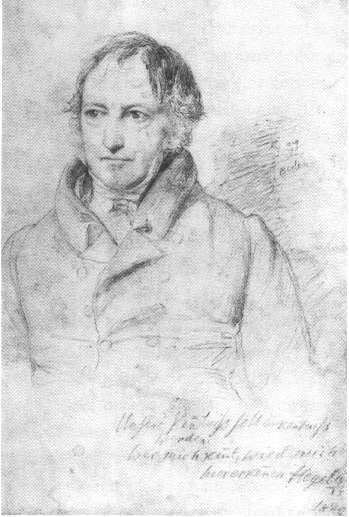
On January 21, 1801, Hegel arrived [in Jena] and took up residence at Schelling’s place at “Kipsteinishchen Garten.” The only likely picture of him at this time (a silhouette) shows him sporting the very fashionable “Titus” haircut (probably best known as Napoleon’s haircut), a style identified with “modernity” (and sometimes with the Revolution), which he was to keep all his life. (A silhouette of him during his university period shows that he probably never sported the more traditional, long-haired, braided look of the generation immediately preceding his own; indeed, he seemed to have had an unkept, rather spiky, “revolutionary” haircut during his university years.)
–Terry Pinkard, Hegel: A Biography (Cambridge UP, 2000) 106
***
Nietzsche writes somewhere that even the best poets and thinkers have written stuff that is mediocre and bad, but have separated off the good material. But it is not quite like that. It’s true that a gardener, along with his roses, keeps manure and rubbish and straw in his garden, but what distinguishes them is not just their value, but mainly their function in the garden.
Something that looks like a bad sentence can be the germ of a good one.
–Wittgenstein, Culture and Value 59e
***
I hate anything that asks me to participate in being a sensitive person
And I don’t want to read thoughts that are markers of that package which is some writer’s sense of his or her own specialness
–Lyn Hejinian, A Border Comedy (Granary Books, 2001) 38
Wednesday, November 30, 2005
Disciplinarities
A difference between philosophy and literary studies: in philosophy, the distinction between a piece of “commentary” or “secondary literature” & a piece of new philosophizing is far less clear-cut than the distinction between a piece of literary criticism & a new work of literature. In the latter field, the commentary almost never gets read as a literary text in its own right (with some very rare exceptions – Lawrence on American literature, Olson on Melville, Zukofsky on Shakespeare – but even then, such books are often put in a special category of “poets’ criticism”). On the other hand, Kripke on Wittgenstein, Heidegger on Hölderlin, Derrida on Heidegger, Cavel on Thoreau and Emerson, all of these seem every bit as important as other works by the same philosophers less directly moored to previous texts.
***
Wittgenstein: “People nowadays think that scientists exist to instruct them, poets, musicians, etc. to give them pleasure. The idea that these have something to teach them – that does not occur to them.” (Culture and Value, 36e)
***
An undergraduate philosophy professor of mine, newly arrived in southwestern Virginia, meets his backwoods girlfriend’s father and introduces himself as a philosopher. “A philosopher? So, what’re some o’ yer sayins?”
***
Zukofsky on Shakespeare in prose (Bottom: on Shakespeare) every bit as “poetic” as Zukofsky on Mallarmé in verse (“A”-19).
***
Wittgenstein: “People nowadays think that scientists exist to instruct them, poets, musicians, etc. to give them pleasure. The idea that these have something to teach them – that does not occur to them.” (Culture and Value, 36e)
***
An undergraduate philosophy professor of mine, newly arrived in southwestern Virginia, meets his backwoods girlfriend’s father and introduces himself as a philosopher. “A philosopher? So, what’re some o’ yer sayins?”
***
Zukofsky on Shakespeare in prose (Bottom: on Shakespeare) every bit as “poetic” as Zukofsky on Mallarmé in verse (“A”-19).
Tuesday, November 29, 2005
Bad Writing in High Places, pt. ii
 A photo snapped over this long holiday weekend at the base of the grand phallic Yorktown monument, commemorating the 1781 siege of Yorktown which ended with the surrender of Cornwallis’s army to a combined Franco-American force under George Washington & the Comte de Grassi – and thereby pretty much ending the Revolutionary War. Now don’t get the idea that I spend my holidays visiting battle sites: on the contrary – I’ve driven thru central Pennsylvania a hundred times, and never come closer than twenty miles to Gettysburg. Okay, I once stopped in Scotland to snap photos of the site of Drumclog (Scott, Old Mortality), but that’s about it. Let’s just say we happened upon this whacking great erection blocking out a lovely view of the York River, & with my constitutional inability to see an inscription without reading it, I had to linger and read not merely the inscriptions on the four sides of the base, but all the plaques the Daughters of the American Revolution had laid round about. One of them – reproduced above – strikes me as a neat epitome of the degradation of public discourse in these United States over the past 200 or so years:
We are now friends with England and with all Mankind.
Benjamin Franklin, 1783
American Peace Commissioner
Now that’s lovely – as fine a balanced period as one could ask for from le philosophe Franklin, transatlantic representative of the age of reason.
This great peace monument is a symbol of the sacrifices in lives and property in the Revolutionary War, which ended at Yorktown and which brought us our independence. It symbolizes, too, the peace between the mother country and America – a peace not seriously interrupted since 1781.
Horace M. Albright, 1931
Director, National Park Service
Oh dear. Public stolidness not unrelieved with turgidity. Without questioning Mr Albright’s history (perhaps the War of 1812 was a “serious interruption,” or those tense years when Henry Adams, junior legate to the embassy in London, was waiting for the UK to cast in with the Confederacy), one notes how a Hooveresque concern for “lives and property” manages to make the Revolution, once figured in terms of Roman virtue, a matter of capital investment.
The Treaty of Paris was the first step toward an alliance with Great Britain which has grown stronger through two centuries to become one of our most important alliance relationships. Political, cultural, economic, and defense ties between our two nations are firm and lasting.
Ronald Reagan, 1983
President, United States of America
I suspect Reagan wrote this bit himself – at least it’s hard to imagine one of his speechwriters guilty of these two sentences of unremitting, bland boilerplate. Would Lincoln, would Pitt, would Burke, for God’s sake would that toad-eater Tony Blair have allowed those two solecisms – “alliance relationships” and “defense ties” – to appear over his name? If the Gipper’s shade is listening, an “alliance” is by definition a “relationship”; and “defense ties” is merely a lazy, bureaucratically crippled way of saying “miliitary ties.” I’ll content myself with addressing the dead; there’s no-one in the White House now who reads or listens to anything.
Wednesday, November 23, 2005
Ad Interim
Off tomorrow morning to spend some quality time waiting in airport lines – er, that is, off for a wee Thanksgiving break, to give my students a respite from my increasingly incoherent teaching, to get a breath of the autumn in latitudes with actual seasons.
And not a moment too soon. I find myself (as the charismatics say) "convicted" by John Latta's burst of blog-loathing (prompted by his reading Virgil Thomson's letters):
And not a moment too soon. I find myself (as the charismatics say) "convicted" by John Latta's burst of blog-loathing (prompted by his reading Virgil Thomson's letters):
Do it ever come down that—full of bullion and bumptious—one of you prints out a passle of such bloggery talk, essential “stuff” come down out of the zone blogique, harry’d by its muchness, “happy at the thought,” though gummed out taut on tenterhooks to read it all, and you—oh, The World itself gets its gumption up to demand something of you and that revery-look you wear so affably, and, well, you don’t get back to them pages blogeoises for, oh, a few days? It does me, and it undoes me. I find myself full of kittle and contempt, bilious at the perusal, fanning through the pages like a sneer-wind, worse it is than yesterday’s news in yesterday’s newspapers. (For those, the common consent is, can at least serve for the wrapping up of the post-repast fish bones . . . or the pre-prandial fish guts . . . or the lousy book by Stanley Fish you.) Is it sensible to write junk day after day? Or pour over the books of wayward saints for pre-chewables, quotes and queries for th’international short attention span? Maybe it’s not.Haven't met a harangue like that since the last time I cracked an Edward Dahlberg book. Glad Stan Brakhage comes to the rescue & saves our reading pleasure. "BEAM 4," ARK, nicht wahr?
Tuesday, November 22, 2005
Tom Raworth: Tottering State
 Bliss! another cold front has descended, which down here means that one is almost tempted to put on a sweater at night (longtime Florida residents can be seen venturing out of their condos in parkas and mittens…).
***
After many dippings-in, and almost a decade & a half of having the book glare down at me with slighted hurt from the shelf, I finally read thru Tom Raworth’s Tottering State: Selected and New Poems 1963-1983 (The Figures, 1984). (And this after having read a half dozen of his single volumes, as well.) The selection’s been superceded at least twice now, I believe, but in cases like this I’m inclined to think of books of poetry as rather like fine wines; the pages might yellow and get spotted, but the contents are just as satisfying as when they were first bottled.
I saw Raworth read at least twice back in the day, when I was living in the DC area and found myself at least on the margins of a very lively “scene.” The nerve center of that scene of course was Rod Smith, working at Bick’s Books in Adams-Morgan (where I got Tottering State) before he shifted over to Bridge Street Books in Georgetown. I remember Raworth, a big shaggy hulk of unreconstructed Englishness, lighting up a cigarette between readers at Bick’s upstairs reading space, then, finding no ashtrays, flicking his ash into the Tibetan bowl gong that Rod used to summon the audience to quiet down and prepare for poesy. Raworth reads like no-one I’ve ever heard: a dense, rapid spray of words, poems over before they seem to have begun, the performance almost as lively as the mercurically shifting words on the page.
There’re a lot of books of poetry asking me to read them, but I regret having put off Tottering State for so long. For one thing, aside from the sly precisions of Raworth’s musical ear, the constant bitter ironies, and the poised sense of line, the poetry is really a great deal of sheer fun. Take, for instance, “Love and Pieces,” whose title seems to play games with early Creeley, but whose last lines place us smack-dab in the neighborhood of Raworth’s own rapid-fire delivery:
met language static
on the street
thinks he’s one
of a new elite
*
you have to learn
you can not teach
*
“there goes the town of spanish boot”
“only the buildings”
*
julius reuter
service de pigeons
*
i can not prove a second ago
to my own satisfaction
Sunday, November 20, 2005
Stupid Days
Busy, busy days, barrelling towards the end of the term, trying to make up time lost to Wilma (tho no longer anticipating “Gamma”), “looking forward” to finals. I try to avoid doing what I ought to be doing – some of it perfectly respectable, to be avoided simply on Oblomovian principle, other bits just plain stupid. Reading around. The schizophrenia of re-reading Antony Easthope’s Poetry as Discourse and Philippe Lacoue-Labarthe’s Poetry as Experience at the same time. (My own magnum opus: Poetry as Rhinoplasty.) Steven Helmling (who’s written a – quite good – LZ biographical essay), The Success and Failure of Fredric Jameson (SUNY, 2001), quotes a passage of FJ that is either of a ravishing, beautiful difficulty, or the most purple thing since Stephen Dedalus’s dreadful villanelle (are those last two words redundant?):
James Buchan, Capital of the Mind: How Edinburgh Changed the World (John Murray, 2003) – and that, uncomfortably, is the British title; the US edition, where vulgarizations usually occur, is Crowded with Genius – brings alive the 18th-century Scottish Enlightenment, Em’bro, that “precipitous city” thru which hurry (dodging the wind) the portly Hume, the capacious Adam Smith, the whoremonger Boswell, and the beleaguered James MacPherson, whose “Ossian” poems remain (as of two days ago, when I tried them once again) entirely unreadable. Dr Johnson read them, pronounced them fakes, and took none of MacPherson’s bluster:
***
Somebody was having a party earlier this evening; a mariachi band echoed through the neighborhood for three hours, but now no noise besides the constant, depressing rain.
Barthes thought certain kinds of writing – perhaps we should say, certain kinds of sentences – to be scriptible, because they made you wish to write further yourself; they stimulated imitation, and promised a pleasure in combining language that had little enough to do with the notation of new ideas. But I think he thought this because he took an attitude towards those sentences which was not essentially linguistic, and had little to do with reading: what is scriptible indeed is the visual or the musical, what corresponds to the two outside senses that tug at language between themselves and dispute its peculiarly unphysical attention, its short circuit of the sentences for the mind itself that makes of the mysterious thing reading some superstitious and adult power, which the lowlier arts imagine uncomprehendingly, as animals might dream of the strangeness of human thinking. We do not in that sense read painting nor do we hear music with any of the attention reserved for oral recitation; but this is why the more advanced and rational activity can also have its dream of the other, and regress to a longing for the more immediately visual, or be sublimated into the spiritual body of pure sound.***
[but no, this isn’t Pater – or EP, or LZ –]
Scriptible is not however the poetry that actually tries to do that (and which is then itself condemned to the technical mediation of a relationship to language not much more “poetic” than the doctrine of the coloration of orchestral instruments and the specialized, painfully acquired knowledge of their technologies); it is the prose stimulated by the idea of sound, or the sentences that something visual – unfortunately, our only word for it is the image – calls into being by suggestion and by a kind of contamination. We don’t write about these things, it is not a metaphorical representation that the sensory pretext summons but rather something related by affinity, that prolongs the content of the object in another, more tenuous form, as though to prolong a last touch with the very fingertips. (Signatures of the Visible 2-3)
James Buchan, Capital of the Mind: How Edinburgh Changed the World (John Murray, 2003) – and that, uncomfortably, is the British title; the US edition, where vulgarizations usually occur, is Crowded with Genius – brings alive the 18th-century Scottish Enlightenment, Em’bro, that “precipitous city” thru which hurry (dodging the wind) the portly Hume, the capacious Adam Smith, the whoremonger Boswell, and the beleaguered James MacPherson, whose “Ossian” poems remain (as of two days ago, when I tried them once again) entirely unreadable. Dr Johnson read them, pronounced them fakes, and took none of MacPherson’s bluster:
MR JAMES MACPHERSON – I received your foolish and impudent letter. Any violence offered me I shall do my best to repel; and what I cannot do for myself, the law shall do for me. I hope I shall never be deterred from detecting what I think to be a cheat, by the menaces of a ruffian.Hume glumly apologized to his friend Gibbon for what by 1776 seemed like a Scottish national imposture: “Men run with great Avidity to give their Evidence in favour of what flatters their Passions, and their national Prejudices.”
What would you have me retract? I thought your book an imposture; I think it an imposture still. For this opinion I have given my reason to the publick, which I here dare you to refute. Your rage I defy. Your abilities, since your Homer, are not so formidable; and what I hear of your morals, inclines me to pay regard not to what you shall say, but to what you shall prove. You may print this if you will. SAM. JOHNSON
***
Somebody was having a party earlier this evening; a mariachi band echoed through the neighborhood for three hours, but now no noise besides the constant, depressing rain.
Monday, November 14, 2005
Curmudgeonliness, British and Cynic
Bob Archambeau remembers Donald Davie. I too remember DD, from an hour spent in his office at Vanderbilt University (they were trying to lure me there for graduate school), where he footered constantly with his pipe (unable it seems to keep it alight for more than three minutes), grumbled in a curmudgeonly fashion, told me to read Bunting, NOW, and scoffed at my enthusiasm for Robert Duncan’s “eclecticism” of influences: “indeed – an eclectic fudge.” A year or so later he mailed me a copy of the syllabus for his swansong graduate seminar at VU, on the Objectivists; the seminar came to appreciate Rakosi and Niedecker very much, he noted, but decided that Oppen’s obliquities were often not worth the effort (!). (Zukofsky, I observed, was entirely omitted from the syllabus, as untangling him – according to Davie – would have dominated the semester – hmmm.)
My favorite of Davie’s critical forays? A Gathered Church: The Literature of the English Dissenting Interest 1700-1930 (RKP, 1978).
***
Diogenes of Sinope (404 – 323 or 314 BCE):
(trans. Guy Davenport)
My favorite of Davie’s critical forays? A Gathered Church: The Literature of the English Dissenting Interest 1700-1930 (RKP, 1978).
***
Diogenes of Sinope (404 – 323 or 314 BCE):
Of what use is a philosopher who doesn’t hurt anybody’s feelings?
•
A. I am Alexander the Great.
B. I am Diogenes, the dog.
A. The dog?
B. I nuzzle the kind, bark at the greedy, and bite louts.
A. What can I do for you?
B. Stand out of my light.
•
In the rich man’s house there is no place to spit but in his face.
•
I’ve seen Plato’s cups and table, but not his cupness and tableness.
•
I pissed on the man who called me a dog. Why was he so surprised?
•
Beggars get handouts before philosophers because people have some idea of what it’s like to be blind and lame.
•
I threw my cup away when I saw a child drinking from his hands at the trough.
(trans. Guy Davenport)
Saturday, November 12, 2005
Ruskin at the Theatre, Adorno in Love, Burgess in His Cups
“We, of the so-called ‘educated’ classes, who take it upon us to be the better and upper part of the world, cannot possibly understand our relations to the rest better than we may where actual life may be seen in front of its Shakespearean image, from the stalls of a theatre. I never stand up to rest myself, and look around the house, without renewal of wonder how the crowd in the pit, and shilling gallery, allow us of the boxes and stalls to keep our places!” –Fors Clavigera, Letter LXI
***
Has no-one ever compiled a list of Adorno’s best one-liners?:
And is there an essay out there on Adorno as philosopher of love?:
***
When I was a pup I must have read forty or fifty Anthony Burgess novels, and always wondered what fuelled his ceaseless productivity. Now, thanks to the "NB" column of the 28 October TLS, I know: a cocktail of his own invention, known as “Hangman’s Blood”:
***
Has no-one ever compiled a list of Adorno’s best one-liners?:
•Intelligence is a moral category.
•No emancipation without that of society.
•True thoughts are those alone which do not understand themselves.
And is there an essay out there on Adorno as philosopher of love?:
•Love is the power to see similarity in the dissimilar.(all from Minima Moralia)
•Love you will find only where you may show yourself weak without provoking strength.
•If love in society is to represent a better one, it cannot do so as a peaceful enclave, but only by conscious opposition. This, however, demands precisely the element of voluntariness that the bourgeois, for whom love can never be natural enough, forbid it. Loving means not letting immediacy wither under the omnipresent weight of mediation and economics, and in such fidelity it becomes itself mediated, as a stubborn counterpressure. He alone loves who has the strength to hold fast to love…
The love, however, which in the guise of unreflected spontaneity and proud of its alleged integrity, relies exclusively on what it takes to be the voice of the heart, and runs away as soon as it no longer thinks it can hear that voice, is in this supreme independence precisely the tool of society. Passive without knowing it, it registers whatever numbers come out in the roulette of interests. In betraying the loved one it betrays itself. The fidelity exacted by society is a means to unfreedom, but only through fidelity can freedom achieve insubordination to society’s command.
***
When I was a pup I must have read forty or fifty Anthony Burgess novels, and always wondered what fuelled his ceaseless productivity. Now, thanks to the "NB" column of the 28 October TLS, I know: a cocktail of his own invention, known as “Hangman’s Blood”:
Into a pint beer-glass doubles of the following are poured: gin, whisky, rum, port, and brandy. A small bottle of stout is added, and the whole topped up with champagne. It induces a somehow metaphysical elation, and rarely leaves a hangover.If you’re in South Florida, join me for one; I’ll find the designated driver.
Wednesday, November 09, 2005
Helpless in the Face of Bureaucracy
I've not read much Jürgen Habermas, having stuck in my mind somehow one friend's parody of him as a middling trimmer – [in ridiculous Dr Strangelove accent] "ah, yes, but vun must neffer be too extreme is zeez matters..." – but Steve Evans's musings last month on Third Factory have sent me to Philosophical Discourse of Modernity anew. I'm delighted by the big bit Steve quotes of an interview with Habermas, which deserves quoting again:
Adorno was a genius, I say that without a hint of ambiguity. In the case of Horkheimer or Marcuse, with whom, by the way, I had a less complicated and, if you like, more intimate relationship, no one would have ever thought of saying such a thing. Adorno had an immediacy of awareness, a spontaneity of thought, and a power of formulation which I have never encountered before or since. One could not observe the process of development of Adorno's thoughts: they issued from him complete—he was a virtuoso in that respect. Also, he was simply not able to drop below his own level; he could not escape the strain of his own thinking for a moment. Adorno did not have the common touch, it was impossible for him, in an altogether painful way, to be commonplace. But at the same time, in his case the elevated demands and the avant-garde claims were without the purely stilted and auratic features which are familiar from the school of Stefan George. If there was a pathos, it was the pathos of negativism—and this need not stand in contradiction to fundamentally egalitarian convictions. Adorno remained anti-elitist despite all his striking refinement. Furthermore, he was also a genius in the sense that he had preserved certain childlike characteristics—both the precocity and the dependency of those who have not yet grown up; when faced with institutions and bureaucratic procedures he was peculiarly helpless.
Subscribe to:
Posts (Atom)
