Showing posts with label geoffrey hill. Show all posts

Saturday, December 11, 2010

year's end

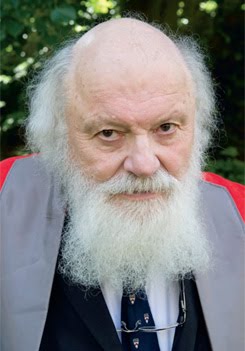
No, it's not Santa Claus, but Geoffrey Hill, as pictured in this Oxford Today feature on his entry as Oxford Professor of Poetry. Not much in the way of news here, but some nice stanzas from a work in progress.

I'm feeling the usual semester's-end weariness; the last grades were turned in this morning after a frantic few days of grading & number-teasing, & now I face the horrors of our department's moving to a new building over the holiday break. My office is probably 60% packed; another day's cursing and throwing books in the general direction of cartons should do it. But whether the new office has enough space for the old office's books, now that's another issue altogether.

To celebrate the end of semester, and to take my mind off of Milton final exams, I went thru a splurge of poetry-reading over the last few days. Quite a number of books, in fact, in no particular order. First, a run of Keith Waldrop chapbooks from all over the last 40 years:
my nodebook for december (Burning Deck, 1971)
Intervals (Awede, 1981)
Water Marks (Underwhich, 1987)
Two-Part Invention (Meeting Eyes Bindery/Poetry New York, 1999)
I've always been fond of Waldrop's work, which has struck me as falling usually into the category of the spare and precise, a sort of post-Objectivist work that I associate with Cid Corman (most prolifically); but KW is inevitably a far more careful and thoughtful craftsperson – and his work has a muted sense of humor that I enjoy immensely.

Then Phyllis Rosenzweig's more substantial (page-wise) chapbook Reasonable Accomodation (Potes & Poets, 1998). I knew PR glancingly when I was a lurker on the fringes of the DC scene a couple of decades ago, but had never really read her work. It's quite good: disjunctive on the order of much Language writing, name-dropping in the best New York School manner (tho the names dropped are usually of DC folks I know), & showing a sometimes surprising sense of closure – ie the poems actually end, rather than simply trail off.

Kenneth Fearing's Selected Poems (Library of America, 2004) isn't as good as its editor Robert Polito would like you to believe. That is, Fearing really isn't the great American hard-boiled poet, the fellow who actually marries the grittiness of James Cain to the social conscience of Muriel Rukeyser. Rather, he's a kind of lefty Whitman which a strong dash of second-hand surrealism. A congenial combination, to be sure, but the catalogues & the socio-political hectoring get old after awhile.

Donald Wellman's A North Atlantic Wall (Dos Madres, 2010) is a welcome new piece from a poet who's more than content to work in the footsteps of Pound and Olson – a "late modernist," that it. Wellman's deep in the culture of contemporary and historical Spain here, drawing from the works of medieval thru contemporary Spanish poets and writers, musing over the ruins both concrete and metaphysical of the Third Reich's "Fortress Europe."

Two from Laura Sims, Practice, Restraint (Fence, 2005) and Stranger (Fence, 2009), exemplify contemporary "elliptical" poetry in its purest form. I'm enraptured by the spareness of Sims's writing, and she has a wonderful lyric ear. I wonder, however, whether the poems' very evanescence won't have them floating off the page entirely at some point. (Even as I write that, I find myself admitting that Stranger, an extended elegy to Sims's mother, has a kind of emotional gravitas that keep the wee stanzas pretty well anchored indeed.)

The great discovery, however, is Linda Russo's Mirth (Chax, 2007). Of all of these books, Mirth is the one I most wish I'd written – and the one I find myself most admitting is beyond my abilities. A first section of excellent, cutting political poems – then extended fantasias on Ovid (among others) exploring, in a theoretically sophisticated & often deeply funny manner, what it means to be a politically engaged female poet in what alas is still too often a man's man's man's world. By the time you're thru with Mirth, however, you've forgotten that the dour Mr Hill is arbiter of poetry & morals at Oxford, & are enthusiastically following Russo into the twenty-first century.

[105-114]

Thursday, October 21, 2010

Geoffrey Hill's production pace


[Geoffrey Hill on the left, Archbishop of Canterbury Rowan Williams center – try imagining Ron Silliman with Pat Robertson – oh, never mind.]

Someone should write a book on poets' rate of production. I once began a Parnassus essay on Ted Enslin with the following snarky anecdote:
Two friends of mine were waiting at the maître d's desk in a posh New York restaurant, when one of them whispered urgently, "Look over at that table – there's Joyce Carol Oates! She's having dinner with a guy – and he's holding her hand. He must be telling her he loves her." "Naw," the other said, "he's just trying to keep her from writing during the meal."
I went on to compare Enslin – who's published a veritable blizzard of books over his long and immensely prolific career – with Cid Corman & Robert Kelly, & gave some thought (& rather too much snark) to the effects of overpublication, overproduction.

I think I had in mind, as counterexample, a poet like Basil Bunting, who popped off at 85, leaving behind – what? – 250 pages of work, only a handful of lines of which I'd be willing to sacrifice on that desert island. Or Geoffrey Hill, whose slim volumes – at least thru the mid-90s – emerged with such irregularity and constipated, impacted grace that one couldn't imagine His Giant Dourness becoming a publishing machine like John Ashbery or T. C. Boyle.

Well, there's a new Geoffrey Hill book out: Oraclau | Oracles, just published by Clutag Press in Thame, Oxfordshire. As it comes closely on the heels of A Treatise of Civil Power (Penguin, 2007 – an earlier chapbook version by Clutag in 2005), it's worth casting an eye over Hill's publishing pace, as he nears 80.

I met Hill once in I think it was 1987, at Campus on the Hill, where I was impressed by his savage comb-over (he'd just gotten what seems a very bad haircut, so the combed-over portion failed to meet the hair on the other side of his bald spot, as tho he'd been imperfectly scalped), limp handshake, & implacable seriousness. I was already deeply impressed by his poems – I had his first Collected Poems (Oxford UP, 1986; Penguin, 1985), which brought together 5 books & one longish poem published over 25 years:
For the Unfallen (1959)
King Log (1968)
Mercian Hymns (1971)
Tenebrae (1978)
The Mystery of the Charity of Charles Péguy (1983)
Hymns to Our Lady of Chartres (1984)
For those who're counting, that's something like a book every 4 years. There was a lapse between the Collected Poems & Hill's next volume, but when that one came out, it was as if someone had turned on a spigot:
Canaan (1997)
The Triumph of Love (1998)
Speech! Speech! (2000)
The Orchards of Syon (2002)
Scenes from Comus (2005)
Without Title (2006)
A Treatise of Civil Power (2005/2007)
Oraclau | Oracles (2010)
What's more, the jacket copy for Oraclau | Oracles announces that this book is actually only one of five collections Hill has completed since A Treatise, one of which will appear in 2012, and all five of which will constitute the "final section" of Hill's Collected Poems 1952-2012, "scheduled for publication by Oxford University Press in 2013."

My word. 12 collections, then, in 16 years. The man has picked up the pace a bit. What's most surprising is that Hill's post-1990 work is to my mind his best, retaining the gnarly intensity of the early work but transposing it to a decorous (& sometimes flippant) vernacular, plumbing the moral issues with which he's always been obsessed more deeply than ever. I haven't read Oraclau | Oracles yet, but I'm itching to; at this point in Hill's career, more collections are just more of a good thing.

Maybe I should reconsider that Joyce Carol Oates joke. Or maybe read some more of her books. Naw.

Tuesday, September 01, 2009

brevity & guilt

[A recent snap of Geoffrey Hill, channelling the elderly Ruskin]

Once in a while a blog post comes along that "convicts" me, as they used to say in my church's youth group – that both convinces & personally accuses: thou art the man (as the prophet says to David). Don Share's Dr Johnson-illustrated post on long books & brief meanderings did it last week, & practically disabled me from blogging for the time being. I can concur wholeheartedly with Don's
I'm increasingly tired of reading and trying to get anything out of all the spurts and blurts and mini-reflections I take in, online in general and in contemporary poems in particular that I look at. Worse, I'm definitely & unapologetically a big book guy.
So I've pretty much stopped tweeting for the time being: a genre – at least for the nonce, in my eyes – more to be followed than participated in. And I'm rethinking "100 poem-books," at least for its last stretch, which seems to have descended into blurbage, precisely what I was hoping to avoid when I kicked it off.

In general, it seems to me there's little sense, particularly for a bear of little brain such as I who continually struggles to connect one thought to another, in issuing wee disconnected thoughts on a daily or weekly basis. It bespeaks the sort of solipsism that the impatient, long winded-world is continually accusing Twitter of.* I don't want Culture Industry to become a collection of tweets: its inspiration, after all, was Adorno's Minima Moralia, in which the form of the micro-essay becomes the concentrated isotopic bearer of incredible density of reflection.
***
And then those long books: I too love them. This summer I finally finished Fors Clavigera; I hastened through David Copperfield in a single ecstatic week; and I read, in 10- or 12-canto hauls, Alan Mandelbaum's version of the Divine Comedy. Right now I'm well on my into yet another reading of Moby-Dick. When I'm reading Moby-Dick I'm convinced that the entire world is arranged – 19th-c. American lit courses & all – so that I can guiltlessly immerse myself in Melville every year or two.

When I'd read Don's post, tho, I realized a hankering for a big book of deep substance, of real density – a steep mountain, not the easy Fuji-walk of Melville's narrative. So I hauled down a 700-odd page volume that had taken pride of place on the shelf since Amazon delivered it, but which had only been cursorily leafed thru: Geoffrey Hill's Collected Critical Writings. I'd long since read the first three books included here – The Lords of Limit, The Enemy's Country, & Style and Faith – so at the moment I'm finishing up the penultimate of two uncollected collections, "Inventions of Value."

What strikes me immediately, if peripherally, is what one might call the "Guide to Kulchur-" or the "Bottom: on Shakespeare-effect" – that the critical writings act as an immediate gloss on the poetry, so that the oblique references of Hill's poems can very often be glossed by the subjects & references he treats in the prose in a rather more straightforward manner. (There is simmering, somewhere among the multiple stovetops of my attention, an essay on Ruskin & Hill...)

Not that the "rather more straightforward manner"of Hill's critical prose amounts to anything like reader-friendliness, on the level, say, of Terry Eagleton. Hill's prose bristles with circumlocution, is burnished with a kind of density of reflection that reminds me of how a job candidate here once described the experience of reading Hegel: "You read each sentence twice before going on to the next, then at the end of each paragraph you stop & try to figure out if you know what's going on; more often than not, you don't, so you start over."

I'm happy to report that by the point of "Inventions of Value" (lectures delivered mostly around 2000), Hill's prose is rather more straightforward than in his 1st 2 collections. And his overall arguments, tho developed in an enormously subtle manner, are both graspable by a bear o. v. l. b. & immediately relevant to the making of poems – and to civic discourse in general. I think the problem most academic readers will have here is the vast shift of perspective necessary to sympathize with Hill's dour & uncompromising analysis of language, probity, and "inherent value." For Hill, that is, most fashionable contemporary discourse of relativism (linguistic, cultural, etc.) is so much cant, frittering away the attention that ought to be devoted to a close analysis of the relationship of morality and language. For Hill, the definitions of "intrinsic value" (or "inhaerent value") found in Hobbes, Locke, Ruskin, & Newman (i. a.) are not historical fossils, but prisms by which the contemporary poet must judge his own work.

It's dense stuff, but exhilarating with a kind of moral authority that one doesn't encounter very often in contemporary criticism. A taste of Hill at his grouchiest (is he writing here of Basil Bunting, a poet for whom – alas – he has zero sympathy?):
One is put in mind [when comparing Locke & Ruskin on, roughly, "intrinsic value" and a "labour theory" of value] of the fate of certain elderly authors who, rescued from oblivion by côteries and the editors of small-circulation journals, are invariably described as having been hitherto 'strangely' or 'unaccountably' neglected. The 'neglect' by some kind of imaginative fiat is simultaneously held to be both their 'documentary claim' to present notice and an intrinsic part of the 'neglected' author's newly proclaimed value. A vicarious solipsism is also a demeaning charity.
***
Oh yeah – momentarily forgetting Bob Archambeau's recent tragic encounter with the car door (how's that wheelchair working out, Bob?), I went out & bought a new bicycle. Look for me around the streets of south Florida (or perhaps in the emergency rooms).

*There are too many exceptions out there not to note at least one: Nick Piombino, for instance, who seems to be seriously thinking thru the formal implications of the 140-character constraints.