One Hundred Etudes, Benjamin Friedlander (Edge Books, 2012)
The overall form is simple. As the book's opening page notes, the etudes pay homage to LZ's word-count prosody. Each page has three 3-lined stanzas, each line of 3 words. The etudes' numbers (eg "Thirty-seven") and titles (eg "DICTATION") count as well, tho an etude may begin or end anywhere with a three-word line. The poems are of variable length, but the book is exactly 300 pages long – so an average of 3 pages to an etude. (All those threes – I can't help thinking of course of Dante, and beyond him of Ron Johnson...)
The form enforces constant enjambment, & Friedlander is one of the most canny players of the line-break around. The etudes themselves are by turns hilarious, slyly witty, guilelessly frank, and transparently beautiful. The form tends, it's true, towards the epigrammatic, the gnomic – and that's fine, because I'd as lief have Friedlander's epigrams as anyone's since Martial – but they also open up into longer, more expansive structures. An amusing, moving, really splendid book, whose depths belie its unassuming title.
[121]
Showing posts with label more poem-books. Show all posts
Showing posts with label more poem-books. Show all posts
Sunday, May 19, 2013

Sunday, March 31, 2013
Jena Osman: Public Figures
Public Figures, Jena Osman (Wesleyan UP, 2012)
Is it an essay? (even a "lyric" essay?) or is it a longish poem? Who cares; it's writing, smart and engaging, impassioned. Public Figures begins as a conceptual-art kinda thang – check out the statues in the public spaces of Philadelphia, rig up a camera to snap images of precisely what their stoney/bronzey eyes are gazing upon, then meditate upon those gazes. So far so good: there's lots to think about there – the tradition of memorial statuary in the New World and the Old, urban development growth and decay, the ironies of history. But something else emerges over the course of this meditation. The poem-essay-commentary, which begins in a plainspoken this is what my idea was and this is how I started doing it register, shifts into the ultra-contemporary now, as transcribed drone observations – from the Iraq theater of operations, one assumes – start running along the bottom of the page like the "crawl" on the CNN screen; and the poem becomes not just a meditation on statuary (paging Dr. Ozymandias) but a larger consideration of the decline of the "heroic" "ideal" in the age of remote-controlled war.
[120]
Is it an essay? (even a "lyric" essay?) or is it a longish poem? Who cares; it's writing, smart and engaging, impassioned. Public Figures begins as a conceptual-art kinda thang – check out the statues in the public spaces of Philadelphia, rig up a camera to snap images of precisely what their stoney/bronzey eyes are gazing upon, then meditate upon those gazes. So far so good: there's lots to think about there – the tradition of memorial statuary in the New World and the Old, urban development growth and decay, the ironies of history. But something else emerges over the course of this meditation. The poem-essay-commentary, which begins in a plainspoken this is what my idea was and this is how I started doing it register, shifts into the ultra-contemporary now, as transcribed drone observations – from the Iraq theater of operations, one assumes – start running along the bottom of the page like the "crawl" on the CNN screen; and the poem becomes not just a meditation on statuary (paging Dr. Ozymandias) but a larger consideration of the decline of the "heroic" "ideal" in the age of remote-controlled war.
[120]
Friday, March 30, 2012
Hillary Gravendyk: Harm

Harm, Hillary Gravendyk (Omnidawn, 2011)
One feels old. The letter carrier today brought Michael Heller's huge and beautifully designed This Constellation Is a Name: Collected Poems 1965-2010 (Nightboat), and all I could think was, this isn't right – Mike's a guy with a handful of exquisite collections, not a brick of a book like this. But then I realized, I was stuck in the late 1980s, when Heller published In the Builded Place; and he's been publishing a new, strong collection every few years since; and before you know it, yes all those slim volumes add up to an almost 600-page volume. Need I add that I can't wait to dive into This Constellation, to re-meet all those old acquaintances among his poems, & savor the new work?
***
I suppose we've been witnessing the full-blown return of the lyric "I" for the last 2 decades or so – and some of course would say it's never gone away. Hillary Gravendyk's Harm is an almost unbearably personal sequence of poems, written in the wake of the author's double lung transplant. "Harm" – the harm of her decade-long pulmonary disorder, the harm of the unimaginably invasive medical procedure that she's undergone, the psychological harm of living with one's face to a fundamentally uncertain future – harm is here fused intricately and inextricably with healing, so that the process of healing itself becomes a kind of torture, the hive of bee-stings with every breath taken in.
Gravendyk intersperses densely metaphorical prose poems with sparser, still metaphorized, verse. In the end it's the sure-footed lyricism of the book, the impressive music of the lines that carries the reader onward thru the at times nightmarish hospital landscape, where the body becomes interpenetrated, even fused with the digital mechanisms our century deploys to prolong, sustain, and jump-start life.
Shore curved like an instep against the soft fray of waterbegins a poem on a "Sleep Chart": see how "lives" and "like," "litter" and "water" bind the second line to the first, how the 2nd and 3rd lines play variations on the "l" sound, how the delicate spondee of "salt glass" (delicate on account of its short vowels) touches a faint rhyme with "lives."
but all the litter of other lives
and minus shells, minus salt glass
I want to use the words "lovely" and "moving" for this book – they feel like boilerplate. Suffice it to say that Gravendyk's collection kept me, rivetted, in the rooms & neighborhood of a hospital – my least favorite place on earth – for eighty rapt pages.
[119]
Thursday, January 12, 2012
Joseph Donahue: Dissolves
Dissolves: Terra Lucida IV - VIII, Joseph Donahue (Talisman House, 2012)
"Dissolves" is of course a verb, what the Alka-Seltzer does in the glass of water, releasing its dancing effervescence; but, as we might be reminded by director Stanley Kubrick's brief walk-on in Joseph Donahue's latest book, it's also a noun: a kind of cinematic transition – from image to image, scene to scene, perspective to perspective. One's grounds are continually dissolving & reforming in this latest installment of Donahue's serial poem Terra Lucida (serial: think Duncan's Passages, Mackey's Song of the Andoumboulou, Finkelstein's Track); we find our surroundings & perspectives anew from poem to poem, from one section of a poem to the next.
What is constant, as we move among the gnostic glitterings of the poem – for it is gnosis, in the end, that renders Donahue's world lucid – moving between religious vocabularies, treasure-houses of scripture & ritual – Islamic, Jewish, Roman Catholic – moving from waking lucidity to keenly-etched dreamspace (there are number of dream-poems here, aislings as it were) – what is constant is Donahue's 2-line form, a kind of ground-bass of plangent music, here evoking Mackey, there evoking Taggart, always paying homage to H.D.
The sheer material here is hard for me to take: among other things, the death of a mother (still) touches me too close for commentary. But the magnificent image that follows the moment of that death, the drowned cathedral drawn from Debussy's Cáthedral engloutie, is nothing short of mesmerizing, haunting, especially in its climax, when the waters rise to the level of the ciborium and the Host itself is – yes – dissolved. It is dissolved, a post-gnostic might say, into countless shards & atoms of bright divinity, embedded in each of us – making the world in which we live, move, & read, one terra lucida.
[118]
"Dissolves" is of course a verb, what the Alka-Seltzer does in the glass of water, releasing its dancing effervescence; but, as we might be reminded by director Stanley Kubrick's brief walk-on in Joseph Donahue's latest book, it's also a noun: a kind of cinematic transition – from image to image, scene to scene, perspective to perspective. One's grounds are continually dissolving & reforming in this latest installment of Donahue's serial poem Terra Lucida (serial: think Duncan's Passages, Mackey's Song of the Andoumboulou, Finkelstein's Track); we find our surroundings & perspectives anew from poem to poem, from one section of a poem to the next.
What is constant, as we move among the gnostic glitterings of the poem – for it is gnosis, in the end, that renders Donahue's world lucid – moving between religious vocabularies, treasure-houses of scripture & ritual – Islamic, Jewish, Roman Catholic – moving from waking lucidity to keenly-etched dreamspace (there are number of dream-poems here, aislings as it were) – what is constant is Donahue's 2-line form, a kind of ground-bass of plangent music, here evoking Mackey, there evoking Taggart, always paying homage to H.D.
The sheer material here is hard for me to take: among other things, the death of a mother (still) touches me too close for commentary. But the magnificent image that follows the moment of that death, the drowned cathedral drawn from Debussy's Cáthedral engloutie, is nothing short of mesmerizing, haunting, especially in its climax, when the waters rise to the level of the ciborium and the Host itself is – yes – dissolved. It is dissolved, a post-gnostic might say, into countless shards & atoms of bright divinity, embedded in each of us – making the world in which we live, move, & read, one terra lucida.
[118]
Tuesday, October 04, 2011
Dan Beachy-Quick: Mulberry and This Nest, Swift Passerine
Mulberry (Tupelo P, 2006) and This Nest, Swift Passerine (Tupelo P, 2009), Dan Beachy-Quick
The silkworm, the larval form of Bombyx mori, feeds on mulberry leaves almost exclusively, transmuting them into the 1000 to 3000 feet of silken thread that forms its cocoon – and which later, boiled, unraveled, cleaned, woven, & dyed, make scarves tunics & Wall Street traders' shirts. In Dan Beachy-Quick's Mulberry, the worm's process becomes a figure for the poet's transmutation of his own reading & his experience from the wild disorderly to the woven texture of the poem. Lordy, you say, another poem about poem-making! Haven't the centuries of makars inflicted the tortuous accounts of their own compositional processes on us long enough?
But Mulberry, like Wordworth's Prelude, is only in part a poem about the formation of the poet's mind – or rather, the formation of the poet's mind, the movement of his restless sensibility as he devours texts & experience, is synechdoche for the formation of the human mind in general. Mulberry exemplifies how the poet takes in the outside – books, nature, the lived life – and transmutes it into intricately woven iridescence; but it also exemplifies the constant interchange of outside & inside & outside again that is the human life, however buried those processes may be.
Beachy-Quick's extraordinary lyricism was evident from his first book, North True South Bright (Alice James Books, 2003); if anything his ear has grown more delicate in Mulberry and This Nest, Swift Passerine. "Passerine" is a bird – the name derives from Latin passer, sparrow – a "perching" bird, a "songbird." Where Mulberry figures the poet as humble caterpillar, munching leaves and metamorphosing them into silk, This Nest – a far bolder, wide-ranging, book – melds the traditional figure of the poet as transient songbird with an eco-centric conception of the poet's task as the building of a variegated and beautiful – not to mention liveable – nest, a nest formed out of the bits & pieces of experience, of previous texts, of philosophies & traditional wisdoms.
I hear a great deal of Ronald Johnson in This Nest; at times, indeed, the book reads like a 21st-century version of Johnson's The Book of the Green Man (1967). Johnson & Beachy-Quick share many points of reference: Thoreau, William & Dorothy Wordsworth, the general milieu of British nature-romanticism. But the ambition of This Nest pushes well beyond the careful naturalism and (sometimes 2nd-hand) nature mysticism of Green Man: Beachy-Quick is out to weave an encompassing tapesterial picture of the sparrow-poet in nature, something more akin to the mind-blowing cosmological stew of Johnson's ARK (which Beachy-Quick indeed cites). This Nest enfolds not merely the naturalism and Naturphilosophie of Thoreau & the Wordsworths, but swatches of Martin Buber, bits of Heidegger, Emerson, Weil, Traherne, usw. All is a kind of beautiful winding-together of fragments, bound & woven with Beachy-Quick's own precise verbal music, to form a lyrical, musical dwelling-place.
Ovid's Echo & Narcissus, the disembodied voice & the self-enraptured observer, play constant counterpoint, a Wordsworth-like questioning of whether our enraptured staring into nature is anything more than a self-obsession. As Wordsworth & Johnson would answer, & as Beachy-Quick assents, we do indeed see ourselves when we look into nature – but we see ourselves precisely as part and parcel of the nature's interlinked processes. Yes, natura naturata, LZ would say (echoing his blessed Spinoza), but natura naturans at the same time.
[116, 117]
The silkworm, the larval form of Bombyx mori, feeds on mulberry leaves almost exclusively, transmuting them into the 1000 to 3000 feet of silken thread that forms its cocoon – and which later, boiled, unraveled, cleaned, woven, & dyed, make scarves tunics & Wall Street traders' shirts. In Dan Beachy-Quick's Mulberry, the worm's process becomes a figure for the poet's transmutation of his own reading & his experience from the wild disorderly to the woven texture of the poem. Lordy, you say, another poem about poem-making! Haven't the centuries of makars inflicted the tortuous accounts of their own compositional processes on us long enough?
But Mulberry, like Wordworth's Prelude, is only in part a poem about the formation of the poet's mind – or rather, the formation of the poet's mind, the movement of his restless sensibility as he devours texts & experience, is synechdoche for the formation of the human mind in general. Mulberry exemplifies how the poet takes in the outside – books, nature, the lived life – and transmutes it into intricately woven iridescence; but it also exemplifies the constant interchange of outside & inside & outside again that is the human life, however buried those processes may be.
Beachy-Quick's extraordinary lyricism was evident from his first book, North True South Bright (Alice James Books, 2003); if anything his ear has grown more delicate in Mulberry and This Nest, Swift Passerine. "Passerine" is a bird – the name derives from Latin passer, sparrow – a "perching" bird, a "songbird." Where Mulberry figures the poet as humble caterpillar, munching leaves and metamorphosing them into silk, This Nest – a far bolder, wide-ranging, book – melds the traditional figure of the poet as transient songbird with an eco-centric conception of the poet's task as the building of a variegated and beautiful – not to mention liveable – nest, a nest formed out of the bits & pieces of experience, of previous texts, of philosophies & traditional wisdoms.
I hear a great deal of Ronald Johnson in This Nest; at times, indeed, the book reads like a 21st-century version of Johnson's The Book of the Green Man (1967). Johnson & Beachy-Quick share many points of reference: Thoreau, William & Dorothy Wordsworth, the general milieu of British nature-romanticism. But the ambition of This Nest pushes well beyond the careful naturalism and (sometimes 2nd-hand) nature mysticism of Green Man: Beachy-Quick is out to weave an encompassing tapesterial picture of the sparrow-poet in nature, something more akin to the mind-blowing cosmological stew of Johnson's ARK (which Beachy-Quick indeed cites). This Nest enfolds not merely the naturalism and Naturphilosophie of Thoreau & the Wordsworths, but swatches of Martin Buber, bits of Heidegger, Emerson, Weil, Traherne, usw. All is a kind of beautiful winding-together of fragments, bound & woven with Beachy-Quick's own precise verbal music, to form a lyrical, musical dwelling-place.
Ovid's Echo & Narcissus, the disembodied voice & the self-enraptured observer, play constant counterpoint, a Wordsworth-like questioning of whether our enraptured staring into nature is anything more than a self-obsession. As Wordsworth & Johnson would answer, & as Beachy-Quick assents, we do indeed see ourselves when we look into nature – but we see ourselves precisely as part and parcel of the nature's interlinked processes. Yes, natura naturata, LZ would say (echoing his blessed Spinoza), but natura naturans at the same time.
[116, 117]
Monday, September 19, 2011
Cole Swensen: Greensward
Greensward, Cole Swensen (Ugly Duckling Presse, 2010)
A sumptuous, beautifully designed & illustrated volume with which I'll have to come to terms if I ever actually get around to writing my gardening poetry book. While Swensen's last collection, Ours, focused on the gardens of Versailles, their designer André de Nôtre, and the theory of 17th-century formal gardening, Greensward moves into the 18th century, to the new "English," "natural" gardens of Humphrey Repton and Lancelot "Capability" Brown. (I can think of worse nicknames than "Capability"...) It also moves from an exclusive focus on the interaction of the human being with the landscape to a consideration of the role animals play in landscape gardening – perfectly logically, as the English country estates for which Repton & Brown designed landscapes were working farms & game preserves, with large populations of sheep, cattle, & deer. Where Swensen breaks new & surprising ground is in her exploration of aesthetics & the non-human. An epigraph quotes Dr. Linda Kaplan: "Mainstream science has yet to be convinced that animals have an aesthetic sense." Swensen's poem begins with the observation that, yes, animals do enhance a landscape to its human observers; and proceeds to wonder whether a landscape's manufactured order & beauty might not be perceived as such by animals as well.
[115]
A sumptuous, beautifully designed & illustrated volume with which I'll have to come to terms if I ever actually get around to writing my gardening poetry book. While Swensen's last collection, Ours, focused on the gardens of Versailles, their designer André de Nôtre, and the theory of 17th-century formal gardening, Greensward moves into the 18th century, to the new "English," "natural" gardens of Humphrey Repton and Lancelot "Capability" Brown. (I can think of worse nicknames than "Capability"...) It also moves from an exclusive focus on the interaction of the human being with the landscape to a consideration of the role animals play in landscape gardening – perfectly logically, as the English country estates for which Repton & Brown designed landscapes were working farms & game preserves, with large populations of sheep, cattle, & deer. Where Swensen breaks new & surprising ground is in her exploration of aesthetics & the non-human. An epigraph quotes Dr. Linda Kaplan: "Mainstream science has yet to be convinced that animals have an aesthetic sense." Swensen's poem begins with the observation that, yes, animals do enhance a landscape to its human observers; and proceeds to wonder whether a landscape's manufactured order & beauty might not be perceived as such by animals as well.
[115]
Saturday, December 11, 2010
year's end
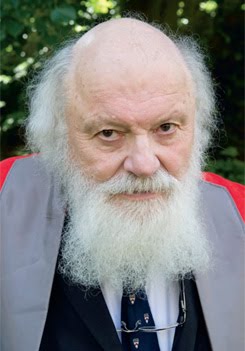 No, it's not Santa Claus, but Geoffrey Hill, as pictured in this Oxford Today feature on his entry as Oxford Professor of Poetry. Not much in the way of news here, but some nice stanzas from a work in progress.
I'm feeling the usual semester's-end weariness; the last grades were turned in this morning after a frantic few days of grading & number-teasing, & now I face the horrors of our department's moving to a new building over the holiday break. My office is probably 60% packed; another day's cursing and throwing books in the general direction of cartons should do it. But whether the new office has enough space for the old office's books, now that's another issue altogether.
To celebrate the end of semester, and to take my mind off of Milton final exams, I went thru a splurge of poetry-reading over the last few days. Quite a number of books, in fact, in no particular order. First, a run of Keith Waldrop chapbooks from all over the last 40 years:
•my nodebook for december (Burning Deck, 1971)I've always been fond of Waldrop's work, which has struck me as falling usually into the category of the spare and precise, a sort of post-Objectivist work that I associate with Cid Corman (most prolifically); but KW is inevitably a far more careful and thoughtful craftsperson – and his work has a muted sense of humor that I enjoy immensely.
•Intervals (Awede, 1981)
•Water Marks (Underwhich, 1987)
•Two-Part Invention (Meeting Eyes Bindery/Poetry New York, 1999)
Then Phyllis Rosenzweig's more substantial (page-wise) chapbook Reasonable Accomodation (Potes & Poets, 1998). I knew PR glancingly when I was a lurker on the fringes of the DC scene a couple of decades ago, but had never really read her work. It's quite good: disjunctive on the order of much Language writing, name-dropping in the best New York School manner (tho the names dropped are usually of DC folks I know), & showing a sometimes surprising sense of closure – ie the poems actually end, rather than simply trail off.
Kenneth Fearing's Selected Poems (Library of America, 2004) isn't as good as its editor Robert Polito would like you to believe. That is, Fearing really isn't the great American hard-boiled poet, the fellow who actually marries the grittiness of James Cain to the social conscience of Muriel Rukeyser. Rather, he's a kind of lefty Whitman which a strong dash of second-hand surrealism. A congenial combination, to be sure, but the catalogues & the socio-political hectoring get old after awhile.
Donald Wellman's A North Atlantic Wall (Dos Madres, 2010) is a welcome new piece from a poet who's more than content to work in the footsteps of Pound and Olson – a "late modernist," that it. Wellman's deep in the culture of contemporary and historical Spain here, drawing from the works of medieval thru contemporary Spanish poets and writers, musing over the ruins both concrete and metaphysical of the Third Reich's "Fortress Europe."
Two from Laura Sims, Practice, Restraint (Fence, 2005) and Stranger (Fence, 2009), exemplify contemporary "elliptical" poetry in its purest form. I'm enraptured by the spareness of Sims's writing, and she has a wonderful lyric ear. I wonder, however, whether the poems' very evanescence won't have them floating off the page entirely at some point. (Even as I write that, I find myself admitting that Stranger, an extended elegy to Sims's mother, has a kind of emotional gravitas that keep the wee stanzas pretty well anchored indeed.)
The great discovery, however, is Linda Russo's Mirth (Chax, 2007). Of all of these books, Mirth is the one I most wish I'd written – and the one I find myself most admitting is beyond my abilities. A first section of excellent, cutting political poems – then extended fantasias on Ovid (among others) exploring, in a theoretically sophisticated & often deeply funny manner, what it means to be a politically engaged female poet in what alas is still too often a man's man's man's world. By the time you're thru with Mirth, however, you've forgotten that the dour Mr Hill is arbiter of poetry & morals at Oxford, & are enthusiastically following Russo into the twenty-first century.
[105-114]
Thursday, December 02, 2010
Peter O'Leary: Luminous Epinoia
 [Peter O'Leary, February 2008]
We were talking at the pub last night about the sensation of reaching a certain age – a certain point at one's life – where one can see the overall "curve" of the careers of one's culture-heroes – musicians, writers, etc. As usual, I took it as an opportunity to lament impending senility etc. But truth to tell, I don't feel particularly old, or even particularly middle-aged. In some senses, I feel that my poetry has only within the past 5 years or so emerged into what I think of as a "mature" voice; & suspect that a decade from now I might dismiss what I'm writing right now as juvenilia.
I'm comfortable watching poets a few years older than me, folks like my friend Norman Finkelstein, emerge from being pretty damned good poets to being really breathtaking, big poets – poets I'd mention in the same breath as the great poets of the 1920s or 1930s generation – as Norman's done with his last two books, Scribe (blogged here) and Inside the Ghost Factory.
It's a little more unsettling – but simultaneously exhilarating – when I see one of my coevals breaking forth into something like "major" status. I've known Peter O'Leary for something over a decade. I suspect we hooked up by means of Ronald Johnson's work: I've been writing on Johnson as long as I can remember, and Peter, after corresponding with him for several years, was named Johnson's literary executor upon his death in 1998. (Since then he's lovingly shepherded thru the press a number of Johnson projects: The Shrubberies, To Do As Adam Did: Selected Poems, and a reissue of Radi Os.
I've followed O'Leary's poetry, both in his first two full-length collections, Watchfulness (Spuyten Duyvil, 2001) and Depth Theology (2006), his chapbooks, and his periodical appearances. I was even, I'm proud to say, a press reviewer for his excellent critical study Gnostic Contagion: Robert Duncan and the Poetry of Illness. But nothing has prepared me for the impact of his brand new collection from the Cultural Society, Luminous Epinoia.
I haven't even tried to reproduce the cover, as I've yet to see a photo that does justice to this book's visual presentation. It's a Quemadura (Jeff Clark) design, but bears no resemblance to Quemadura's typical combination of slurred visuals and hard-edged, sans-serif lettering. Instead, the book's a jacketless hardcover in blinding silver, etched white repeated designs (snakes, crosses, & stars) surrounding a Gothic "L. E." (The insides, equally scrumptuous, are more recognizably Quemaduran: sans-serif running heads, Gothic epigraphs.) It's a book to be immediately struck by – but the real beauties are inside.
I'll admit that I fall back on comparisons when my critical/descriptive skills falter. What's this book like? Well, imagine a poet whose worldview, and whose visionary tendencies, are akin to those of Dante (in the Paradiso) or Henry Vaughan; whose vocabulary is as ornate (tho nowhere near as pretentious) as Edward Dahlberg's; and whose sense of form, of diction, and of general poetic movement is near kin to Charles Olson, Ronald Johnson, and Nathaniel Mackey. Throw in a generous dash of Freud (& even Jung), an outraged political sensibility, & a kind of deep, radiant, tender humanitas, & you have something like Peter O'Leary.
Not being a believer, I do not write religious poetry. But I do appreciate religious poetry (if I didn't, let's face it, this past semester teaching Milton would have been more than unpleasant), and so far as Christian poetry goes I find a clear distinction between Protestant and Roman Catholic poetics. Milton is the great Protestant poet; Geoffrey Hill is the best Protestant poet writing now. Dante is of course the preëminent Roman Catholic poet. (Oddly enough, I read Hopkins, despite his holy orders, as more Protestant than Catholic in his poetics.) Raised as I was in fundamentalist, text-based Protestantism, I relish the wrestle with the law's letter, with the philosophical paradoxes of faith; but I find myself more often than not left cold by the literary manifestations of ecstatic, mystical religious states.
Or rather, I find it hard to mix the religious & the aesthetic. I love visiting ornate churches & cathedrals; but I find myself bulldoggishly resistant to the "beauties" of the service or the mass. I am as low church as low church can be.
But O'Leary's work moves me, and moves me deeply – so deeply I'm puzzled. He is, yes, a Roman Catholic poet, one whose work is redolent of incense and wine, is shot thru with the light of both stained glass windows and the sun; his poems are almost a series of icons, dense with human detail but alight with hammered gold. Like his mentor Johnson, he relishes science's untangling of the physical and chemical bases of our existence – and he finds in them powerful metaphors for the relationship of God to humanity, even – at some head-spinning moments – explanations of that relationship.
These poems are more personal in many ways than O'Leary's earlier books, including a longish "Spiritual Autobiography" towards the end. It is something of a Vita Nuova crossed with The Interpretation of Dreams, embedded within the Paradiso of exploration and praise that is the book as a whole. Luminous Epinoia may be one of the stranger titles you're likely to encounter – roughly speaking, it refers to one's creativity, conceived I take it as an emanation or a reflection of the divine creativity – but it shouldn't put off even faithless readers (like this one). It's a terrific, rich, mysterious & moving book. I'm almost moved to devotion; but alas, am quite certainly moved to envy.
[104]
I'm comfortable watching poets a few years older than me, folks like my friend Norman Finkelstein, emerge from being pretty damned good poets to being really breathtaking, big poets – poets I'd mention in the same breath as the great poets of the 1920s or 1930s generation – as Norman's done with his last two books, Scribe (blogged here) and Inside the Ghost Factory.
It's a little more unsettling – but simultaneously exhilarating – when I see one of my coevals breaking forth into something like "major" status. I've known Peter O'Leary for something over a decade. I suspect we hooked up by means of Ronald Johnson's work: I've been writing on Johnson as long as I can remember, and Peter, after corresponding with him for several years, was named Johnson's literary executor upon his death in 1998. (Since then he's lovingly shepherded thru the press a number of Johnson projects: The Shrubberies, To Do As Adam Did: Selected Poems, and a reissue of Radi Os.
I've followed O'Leary's poetry, both in his first two full-length collections, Watchfulness (Spuyten Duyvil, 2001) and Depth Theology (2006), his chapbooks, and his periodical appearances. I was even, I'm proud to say, a press reviewer for his excellent critical study Gnostic Contagion: Robert Duncan and the Poetry of Illness. But nothing has prepared me for the impact of his brand new collection from the Cultural Society, Luminous Epinoia.
I haven't even tried to reproduce the cover, as I've yet to see a photo that does justice to this book's visual presentation. It's a Quemadura (Jeff Clark) design, but bears no resemblance to Quemadura's typical combination of slurred visuals and hard-edged, sans-serif lettering. Instead, the book's a jacketless hardcover in blinding silver, etched white repeated designs (snakes, crosses, & stars) surrounding a Gothic "L. E." (The insides, equally scrumptuous, are more recognizably Quemaduran: sans-serif running heads, Gothic epigraphs.) It's a book to be immediately struck by – but the real beauties are inside.
I'll admit that I fall back on comparisons when my critical/descriptive skills falter. What's this book like? Well, imagine a poet whose worldview, and whose visionary tendencies, are akin to those of Dante (in the Paradiso) or Henry Vaughan; whose vocabulary is as ornate (tho nowhere near as pretentious) as Edward Dahlberg's; and whose sense of form, of diction, and of general poetic movement is near kin to Charles Olson, Ronald Johnson, and Nathaniel Mackey. Throw in a generous dash of Freud (& even Jung), an outraged political sensibility, & a kind of deep, radiant, tender humanitas, & you have something like Peter O'Leary.
Not being a believer, I do not write religious poetry. But I do appreciate religious poetry (if I didn't, let's face it, this past semester teaching Milton would have been more than unpleasant), and so far as Christian poetry goes I find a clear distinction between Protestant and Roman Catholic poetics. Milton is the great Protestant poet; Geoffrey Hill is the best Protestant poet writing now. Dante is of course the preëminent Roman Catholic poet. (Oddly enough, I read Hopkins, despite his holy orders, as more Protestant than Catholic in his poetics.) Raised as I was in fundamentalist, text-based Protestantism, I relish the wrestle with the law's letter, with the philosophical paradoxes of faith; but I find myself more often than not left cold by the literary manifestations of ecstatic, mystical religious states.
Or rather, I find it hard to mix the religious & the aesthetic. I love visiting ornate churches & cathedrals; but I find myself bulldoggishly resistant to the "beauties" of the service or the mass. I am as low church as low church can be.
But O'Leary's work moves me, and moves me deeply – so deeply I'm puzzled. He is, yes, a Roman Catholic poet, one whose work is redolent of incense and wine, is shot thru with the light of both stained glass windows and the sun; his poems are almost a series of icons, dense with human detail but alight with hammered gold. Like his mentor Johnson, he relishes science's untangling of the physical and chemical bases of our existence – and he finds in them powerful metaphors for the relationship of God to humanity, even – at some head-spinning moments – explanations of that relationship.
These poems are more personal in many ways than O'Leary's earlier books, including a longish "Spiritual Autobiography" towards the end. It is something of a Vita Nuova crossed with The Interpretation of Dreams, embedded within the Paradiso of exploration and praise that is the book as a whole. Luminous Epinoia may be one of the stranger titles you're likely to encounter – roughly speaking, it refers to one's creativity, conceived I take it as an emanation or a reflection of the divine creativity – but it shouldn't put off even faithless readers (like this one). It's a terrific, rich, mysterious & moving book. I'm almost moved to devotion; but alas, am quite certainly moved to envy.
[104]
Thursday, October 07, 2010
reading notes
A veritable maelstrom of work lately, in the wake of an epic birthday party this past weekend. (The recycling bins are full of beer and wine bottles; I hazily remember – with wincing embarassment – that the guitars came out sometime after midnight.) In the intervals of grading (or thinking about grading), reading for classes, taking care of the girls, & other pursuits, I've turned over a few books of poems.
John Taggart's Crosses: Poems 1992-1998 (Stop Press 2005) was the great unfindable book (not) in my library. John & I had been frequent correspondents for a long while, had spent quality time with each other over the years, not least in the DC book and record stores, but had to some extent fallen out of touch after I moved to Florida & became immersed in the LZ biography. We reconnected at the 2004 LZ centenary conference at Barnard/Columbia in 2004, and since then I've deeply enjoyed his Flood Editions books, Pastorelles and There Are Birds – splendid collections both, exploring a newly compressed, rhythmically various idiom. To my delight, the postman the other day brought his brand-new, enormous selected poems, Is Music (Copper Canyon), edited by Peter O'Leary.
But Crosses: after searching futilely for the book online for years (having missed its initial publication announcement entirely), I'd entirely given up on finding the book, only to happen upon a pristine volume in City Lights in SF this past spring. For me, there was an odd kind of time-lag in reading this in 2010, for Crosses is really echt mid-period Taggart, its poetics deeply congruent with the repetition-with-variation of Loop (Sun & Moon, 1991), Standing Wave (Lost Roads, 1993), and When the Saints (Talisman House, 1999), rather than the suppler, more demotic poems of Pastorelles & There Are Birds. These are, however, as with the best of Taggart's work, strange, darkly luminous poems. He writes about music, musicians, and philosophers; he even writes, however obliquely, about film – I note an immersion in The Last Temptation of Christ. But there's no sense of the shallowly ekphrastic or adventitiously occasional here: a painting or a performance or even a movie are for Taggart the levers with which to pry his way into the deep & uncomfortable moral mysteries of life. There's a profound & bloody, quite probably heretical, Christian imagination at work in Taggart's poetry, along with a relentless, merciless musicality.
[102]
***
Turning from Crosses to Robert Creeley's late Life & Death (New Directions, 1998) is like switching from all-Schnittke radio station to a late-night noir jazz program. The idiom is far more comfortable – Creeley's familiar, clipped idiolect, the brief lines & occasionally memorable turns that have been familiar to our ears since For Love – but it's all in a darker, albeit simpler register. I've heard much complaint of the long falling-off of Creeley's work after its peak some 40 years ago (and yes, my favorite of his books remains Pieces), but most of the poems in Life & Death, tho they may not measure up to the bravura experimentation of the early books, are beautifully turned, even graceful. What makes the book hard reading is not the occasional slackness, the moments in which Creeley repeats well-worn moves from his playbook, or even the intentionally awkward rhyming bits, when Creeley betrays his affection for the Fireside Poets he read in his childhood – but the poet's growing obsession with aging and death, the sense that each poem might well be his final valediction.
[103]
John Taggart's Crosses: Poems 1992-1998 (Stop Press 2005) was the great unfindable book (not) in my library. John & I had been frequent correspondents for a long while, had spent quality time with each other over the years, not least in the DC book and record stores, but had to some extent fallen out of touch after I moved to Florida & became immersed in the LZ biography. We reconnected at the 2004 LZ centenary conference at Barnard/Columbia in 2004, and since then I've deeply enjoyed his Flood Editions books, Pastorelles and There Are Birds – splendid collections both, exploring a newly compressed, rhythmically various idiom. To my delight, the postman the other day brought his brand-new, enormous selected poems, Is Music (Copper Canyon), edited by Peter O'Leary.
But Crosses: after searching futilely for the book online for years (having missed its initial publication announcement entirely), I'd entirely given up on finding the book, only to happen upon a pristine volume in City Lights in SF this past spring. For me, there was an odd kind of time-lag in reading this in 2010, for Crosses is really echt mid-period Taggart, its poetics deeply congruent with the repetition-with-variation of Loop (Sun & Moon, 1991), Standing Wave (Lost Roads, 1993), and When the Saints (Talisman House, 1999), rather than the suppler, more demotic poems of Pastorelles & There Are Birds. These are, however, as with the best of Taggart's work, strange, darkly luminous poems. He writes about music, musicians, and philosophers; he even writes, however obliquely, about film – I note an immersion in The Last Temptation of Christ. But there's no sense of the shallowly ekphrastic or adventitiously occasional here: a painting or a performance or even a movie are for Taggart the levers with which to pry his way into the deep & uncomfortable moral mysteries of life. There's a profound & bloody, quite probably heretical, Christian imagination at work in Taggart's poetry, along with a relentless, merciless musicality.
[102]
***
Turning from Crosses to Robert Creeley's late Life & Death (New Directions, 1998) is like switching from all-Schnittke radio station to a late-night noir jazz program. The idiom is far more comfortable – Creeley's familiar, clipped idiolect, the brief lines & occasionally memorable turns that have been familiar to our ears since For Love – but it's all in a darker, albeit simpler register. I've heard much complaint of the long falling-off of Creeley's work after its peak some 40 years ago (and yes, my favorite of his books remains Pieces), but most of the poems in Life & Death, tho they may not measure up to the bravura experimentation of the early books, are beautifully turned, even graceful. What makes the book hard reading is not the occasional slackness, the moments in which Creeley repeats well-worn moves from his playbook, or even the intentionally awkward rhyming bits, when Creeley betrays his affection for the Fireside Poets he read in his childhood – but the poet's growing obsession with aging and death, the sense that each poem might well be his final valediction.
[103]
Thursday, May 13, 2010
progress report
I've completed four 2-page openings of an erasure/overpainting of Bartleby the Scrivener, "Bar by the Riven." I'm no Ronald Johnson, nor even a Tom Phillips, but take an intense joy in the process – exacto-ing apart the pages, gluing them down on heavy waterpaper stock, pulling out phrases and words that catch my eye, and then painting over the whole in vivid acrylic colors & designs (at this point, mostly vaguely Suprematist, but I've got a good deal of the story to go, & look forward to trying out all sorts of graphic styles). The designing is the smallest part of my pleasure: I love the texture of the paints, the sensation of laying down the colors with my smallest brushes – even the final step of embalming it all under a high-gloss varnish, bringing all the colors out into an eye-popping clarity.
***
Lisa Robertson's XEclogue (1993, my copy New Star Books, 1999) is 10 eclogues, more or less. "Nancy" and "Lady M" exchange letters; the "Roaring Boys" sing roisterous adaptations of the Pervigilium Veneris. The pastoral shades here, as it so often does, into the gardening poem, but always remains on the uncultivated side of the hedge. Robertson, as one of the most theoretically sophisticated poets writing, knows the centrality of the pastoral to Western thought (John Taggart said somewhere, recently, "the pastoral is the Western tradition"): it's the most fundamentally political of genres (cf. Empson), the field in which one steps out of the social/urban precisely to take stock of society. Robertson's is a pastoral of gender relations and the socio-psychoanalytic construction of the subject. Oof, that sounds MLA-ish, doesn't it? which doesn't get at how weird and intriguing a book this is, how pitch-perfect her voice is as she veers towards & inevitably avoids the conventionally lyrical.
[101]
***
A copy of Anathem, Neal Stephenson's latest door-stopping epic of speculative fiction, has fallen into my hands. I've turned it over a few times, contemplating all the word-of-mouth intelligence I've received, & the few reviews I've read ("huge," "daunting complex," "too clever by half"), & have compromised: I'll certainly tackle this sometime over the summer, but for now it's China Miéville's The Scar.
***
The people at Otis College of Art and Design are producing some exceeding beautiful books under the Otis Books/Seismicity Editions imprint. I am at the moment enthralled by the first stretch of Ray DiPalma's The Ancient Use of Stone: Journals and Daybooks 1998-2008, a decade's worth of notebooks – so it would seem; one always wonders, reading a published daybook/journal/commonplace book, how much retouching has been applied to the messy pages of the original. Right now I'm still in "The Ancient Use of Stone," the earliest of DiPalma's daybooks here collected – part journal, part commonplace book, part bibliographical checklist (mostly of early modern imprints). It has precisely the miscellaneous character I enjoy in these things, shifting from quotation to observational prose to verse, often in the compass of a single entry. And I can't resist looking ahead: the later daybooks are even more miscellaneous – multiple columns, typefaces, graphics, etc. More later on this large & beautiful book.
The notebook as word-hoard, prose-hoard, treasury of lines & passages. Thoreau's journals as the vast quarry from which he excavated his books; Emerson's as the practice room in which he tried out the various virtuoso passages to be included in his essays. My own shelf of notebooks seems to grow exponentially: I realize, soberingly, that I probably now own enough blank pages to keep me busy for the rest of my life (solution: write more!). The ones I've filled are of distressingly little interest: hundreds of pages of journalizing, repeated drafts of poems (I copy back & forth from notebook to notebook, keeping track – when I don't lose track – by arcane numbering schemes), passages of prose for whatever assignment happens to be on my plate at the moment. Unlined notebooks encourage me to doodle, even to draw, which makes them rather nicer to look at; lined notebooks encourage more voluble word-production.
***
Lisa Robertson's XEclogue (1993, my copy New Star Books, 1999) is 10 eclogues, more or less. "Nancy" and "Lady M" exchange letters; the "Roaring Boys" sing roisterous adaptations of the Pervigilium Veneris. The pastoral shades here, as it so often does, into the gardening poem, but always remains on the uncultivated side of the hedge. Robertson, as one of the most theoretically sophisticated poets writing, knows the centrality of the pastoral to Western thought (John Taggart said somewhere, recently, "the pastoral is the Western tradition"): it's the most fundamentally political of genres (cf. Empson), the field in which one steps out of the social/urban precisely to take stock of society. Robertson's is a pastoral of gender relations and the socio-psychoanalytic construction of the subject. Oof, that sounds MLA-ish, doesn't it? which doesn't get at how weird and intriguing a book this is, how pitch-perfect her voice is as she veers towards & inevitably avoids the conventionally lyrical.
[101]
***
A copy of Anathem, Neal Stephenson's latest door-stopping epic of speculative fiction, has fallen into my hands. I've turned it over a few times, contemplating all the word-of-mouth intelligence I've received, & the few reviews I've read ("huge," "daunting complex," "too clever by half"), & have compromised: I'll certainly tackle this sometime over the summer, but for now it's China Miéville's The Scar.
***
The people at Otis College of Art and Design are producing some exceeding beautiful books under the Otis Books/Seismicity Editions imprint. I am at the moment enthralled by the first stretch of Ray DiPalma's The Ancient Use of Stone: Journals and Daybooks 1998-2008, a decade's worth of notebooks – so it would seem; one always wonders, reading a published daybook/journal/commonplace book, how much retouching has been applied to the messy pages of the original. Right now I'm still in "The Ancient Use of Stone," the earliest of DiPalma's daybooks here collected – part journal, part commonplace book, part bibliographical checklist (mostly of early modern imprints). It has precisely the miscellaneous character I enjoy in these things, shifting from quotation to observational prose to verse, often in the compass of a single entry. And I can't resist looking ahead: the later daybooks are even more miscellaneous – multiple columns, typefaces, graphics, etc. More later on this large & beautiful book.
The notebook as word-hoard, prose-hoard, treasury of lines & passages. Thoreau's journals as the vast quarry from which he excavated his books; Emerson's as the practice room in which he tried out the various virtuoso passages to be included in his essays. My own shelf of notebooks seems to grow exponentially: I realize, soberingly, that I probably now own enough blank pages to keep me busy for the rest of my life (solution: write more!). The ones I've filled are of distressingly little interest: hundreds of pages of journalizing, repeated drafts of poems (I copy back & forth from notebook to notebook, keeping track – when I don't lose track – by arcane numbering schemes), passages of prose for whatever assignment happens to be on my plate at the moment. Unlined notebooks encourage me to doodle, even to draw, which makes them rather nicer to look at; lined notebooks encourage more voluble word-production.
Subscribe to:
Posts (Atom)