Sunday, August 20, 2006

Restoration Nihilism

Samuel Johnson, on John Wilmot, 2nd Earl of Rochester (1647-1680, lately portrayed by Johnny Depp in The Libertine): “in a course of drunken gaiety, and gross sensuality, with intervals of study perhaps yet more criminal, with an avowed contempt of all decency and order, a total disregard to every moral, and a resolute denial of every religious obligation, he lived worthless and useless, and blazed out his youth and health in lavish voluptuousness; till, at the age of one and thirty, he had exhaustered the fund of life, and reduced himself to a state of weakness and decay.” His best poem, according to Johnson, is “Upon Nothing” (1678):

Nothing, thou elder brother even to Shade,
Thou hadst a being ere the world was made,
And (well fixed) art alone of ending not afraid.

Ere time and place were, Time and Place were not,
When primitive Nothing, Something straight begot;
Then all proceeded from the great united what.

Something, the general attribute of all,
Severed from thee, its sole original,
Into thy boundless self must undistinguished fall.

Yet Something did thy mighty power command
And from thy fruitful Emptiness’s hand
Snatched men, beasts, birds, fire water, air, and land.

Matter, the wicked’st offspring of thy race,
By Form assisted, flew from thy embrace,
And rebel Light obscured they reverend dusky face.

With Form and Matter, Time and Place did join;
Body, thy foe, with them did leagues combine
To spoil thy peaceful reign and ruin all thy line.

But turncoat Time assists the foe in vain
And bribed by thee destroys their short-lived reign
And to thy hungry womb drives back the slaves again.

Thy mysteries are hid from laic eyes,
And the divine alone by warrant pries
Into thy bosom, where the truth in private lies.

Yet this of thee the wise may truly say,
Thou from the virtuous nothing tak’st away,
And to be part of thee the wicked wisely pray.

Great Negative, how vainly would the wise
Inquire, define, distinguish, teach, devise
Didst thou not stand to point their dull philosophies.

Is or Is Not, the two great ends of Fate,
And True and False, the subject of debate
That perfects or destroys the vast designs of state,

When they have racked the politician’s breast,
Within they bosom must securely rest
And when reduced to thee are least unsafe and best.

But Nothing, why does Something still permit
That sacred monarchs should at council sit
With persons thought, at best, for nothing fit,

While weighty Something modestly abstains
From princes’ affairs and from statesmen’s brains;
And nothing there like stately Nothing reigns.

Nothing, that dwell with fools in grave disguise,
For whom they reverend forms and shapes devise,
Lawn sleeves, and furs, and gowns, when they like thee look wise.

French truth, Dutch prowess, British policy,
Hibernian learning, Scotch civility,
Spaniards’ dispatch, Danes’ wit are mainly seen in thee.

The great man’s gratitude to his best friend,
Kings’ promises, whores’ vows, to thee they bend,
Flow swiftly to thee and in thee ever end.

Friday, August 18, 2006

Scriptural Tedium

I’ve been buzzing quite happily thru Genesis & Exodus over the past few days, reminding myself just what an absorbing reading experience the Bible can be. Now there are friends of mine – well-read, cultured folks, with finely developed literary sensibilities – who are under the impression that all of the Bible is insufferably tedious. Well that’s certainly not the case – but after about 70 consecutive chapters of mostly rivetting stuff, I’ve run (in the 2nd half of Exodus) into one of those patches that only a masochist could love: the deity’s endlessly detailed instructions to Moses on how to construct the Tabernacle, the Ark of the Covenant (remember Indiana Jones?), & various other doodads the Children of Israel will need in their upcoming travels.

It got me to thinking about scriptural tedium, about how there’s exciting bits and dull bits in the Bible, & that got me thinking (as is my wont) about taxonomies. It seems to me the dull bits of the Bible fall into a limited number of categories. First, there are things that are dull in and of themselves:
•Genealogies, those endless lists of ancestors most of whose names sound alien & indistinguishable to the English-speaking reader – I mean, this could be Commander Whorf reciting his Klingon ancestry, for all I know

•Construction blueprints: it’s bad enough when Ruskin goes off on the proper angles at which the roof is to meet the wall, but at least he has the decency to include illustrations; I have no idea what the Tabernacle or Solomon’s Temple actually looked like, & even if I’ve got a fancy Bible with speculative illustrations, I don’t really need the do-it-yourself instructions, thank you very much

•Specifications for ritual observances: see above on the non-applicability of these instructions (tho it’s nice to know that the priests wore knickers so that they wouldn’t expose themselves as they ascended into the Holy Presence)

Then there are things which are inherently rather interesting, often quite fascinating – but only in moderation; in quantity they become a blur of repetition:
•Psalms – yes, I know, great poetry much of the time, but let’s face it – when you’re spinning 150 of these things out of maybe a half-dozen repeated themes, & recycling the same imagery over and over, it all gets a bit redundant

•Prophecy – ditto; great poetry, grandly delivered, much of the time: but the message is pretty much the same over and over (with different names slotted into the important slots, I grant): “Come back to Me, O Israel, or have your butt kicked in various ways…”

•Wisdom: proverbs are good in moderate doses (fascinating article on Blake’s proverbs this week in of all places PMLA), but heaven knows they start to blur together when you get an entire book of them; and while Job is one of the basic great reads of Western Lit, as Samuel Johnson said of Paradise Lost, “no-one ever wished it longer.”

•Theological disputation, such as you get in the bulk of the New Testament: now there are those who’ll insist that knowing the details of this stuff is crucial to your eternal salvation etc. – & I’m convinced that one is at a real disadvantage in dealing with most English literature from say 1600 – 1900 without a working acquaintance with at least Romans & Hebrews – but if you don’t have a vested interest in the stuff being argued about, much of it is precisely as fascinating as hearing a poetics argument between Robert Lowell and WD Snodgrass.
Somewhere in the morass of my office, I have a copy of the Bible which not merely included a lot of snazzy line drawings and helpful maps, but went to the trouble of printing the really dull stuff – the genealogies, the ritual directions, the construction manuals – in a smaller typeface. Now if we can only get New Directions to do that with The Cantos.

Monday, August 14, 2006

Fool's Gold


Blurb-writing 101: Never Write Your Blurb Before You’ve Read the Book You’re Blurbing. Someone should have told Dan Brown this before he blurbed Mario Livio’s The Golden Ratio: The Story of Phi, the World’s Most Astonishing Number (Broadway, 2002). Writes Mr B, “you will never again look at a pyramid, pinecone, or Picasso in the same way.”

Phi, former math majors & readers of The Da Vinci Code (Salman Rushdie: “a book so bad it makes bad books look good”; Stephen Fry: “complete loose stool-water,” “arse-gravy of the worst kind”) will know, is the number you get when you divide a line into the “Golden Ratio,” so that the line as a whole bears the same proportion to the longer division as the longer division does to the shorter – on line ABC, AC is to AB as AB is to BC (or AC:AB :: AB:BC). Dividing the longer segment by the shorter, you get the irrational number 1.6180339887… (to no end).

The Fibonacci Series of numbers, in which each successive number is the sum of the preceeding two (1, 1, 2, 3, 5, 8, 13, 21, 34, 55, etc.) (& which Ron Silliman made use of in Ketjak) has the remarkable property, as you divide each number by its precedent, of more and more closely approximating Phi.

Brown made much of the Golden Ratio in The Da Vinci Code, much of it – that Leonardo plotted his Vitruvian man according to the GR, that the Pyramids are based on the GR, etc. – dead wrong, as Livio demonstrates marvelously clearly* in The Golden Ratio, one of those rare books by a scientist that are actually compulsively readable. Indeed, one of the things that makes this book so entertaining is the amount of time it spends debunking various applications of Golden Numerology – all of which Brown seems (from my rather foggy memory of Da Vinci Code) to have swallowed whole. In other words, while there are applications of the Fibonacci series to the arrangement of pinecones, anything relating the Pyramids or Picasso to the golden ratio is just so much hooey – as Brown would have realized if he’d read Livio before praising him.

Reading Livio sent me back to one of my favorite artists, Tom Phillips, whose After Raphael [above] was imprinted on me early by being reproduced on the cover of Brian Eno’s Another Green World. (Eno was a student of Phillips’s at art school.) Unfortunately, like Brown Phillips seems to have swallowed all the balleyhoo about the omnipresence of the golden ratio:
Even the most ill-proportioned visitor to Greece will have it in his bones before he leaves: temple and statue, pillar and pavement, speak the same harmony. Its rediscovery as one of the lost truths of antiquity lay at the heart of the Renaissance. As in the paradox of the poet freed by rhyme, the artist can be liberated by a system of great rigidity. The airy, tender and spacious compositions of Piero reveal, under geometrical analysis, that not an eye or elbow has its place but at the conjunction of lines generated by the overall proportions of the picture.
I’m all for being “liberated by a system of great rigidity.” And I suppose the golden section is as good as any other system. But why does everyone have to pretent that the damn thing goes all the way back to the Egyptians, when a little bit of spadework will show otherwise? “Blessed rage for order,” indeed.

I’m just glad LZ never got ahold of the golden ratio; heaven knows he did enough damage with a smattering of second-hand calculus and a fistful of Pythagorean number lore.

*Though not with direct reference to Brown’s book, which didn’t come out until the following year. I suspect Livio’s publisher, which also did the “illustrated” Da Vinci Code, solicited Brown to blurb the paperback of The Golden Ratio.

Among the Democrats

Another weekend over, & that much closer to the beginning of the semester. A headachy day – spent too much time in the sun earlier, at of all things a Palm Beach County Democratic Party picnic. Not, mind you, a fundraiser – just a Party get-together with open invitations encouraging everyone to bring school supplies to donate to local public schools (Jeb Bush being, after all, the “education governor” every bit as much as his brother is a “uniter, not a divider”).

Why’d we go to this thing? Well, Party candidates were gonna be there, & the organizers held out the possibility that the gubernatorial contenders would show. I for one was interested to see what kind of pickings beleaguered Florida Democrats could put up against the loonie who’s the other folks’ front runner right now. But no gubernatorial candidates appeared while we were there, so I was left to conduct a sociological enquiry into the state of Blue politics in South Florida.

One word: old. The average age of the folks there – free food & all – must have been somewhere past retirement age, even with a decent turnout of young people and their children. Seniors mostly white; young people mostly black and Hispanic. Which made it more of a shame that the guy manning the DJ booth was playing what amounted to a golden oldies set. The closest he got to anything with political valence was “Born in the USA” & Fleetwood Mac’s “Don’t Stop” (which as you’ll recall got a good deal of airplay during the 1992 Clinton run). The closest he got to music of color was Ray Charles singing “America.” When I suggested to him that the potential voters for a 2020 election might be a little more fired up if he were to play something on the hip-hop, Latino, or even post-James Taylor side of things, he just rolled his eyes and waved a hand at the ranks of grey panthers piled onto the picnic tables under the pavilion: “They’ve already asked me to turn down the volume like 16 times.”

The good folks at the Dems organization had set up two big bounce houses for the kids, & Pippa spent the better part of two hours jumping up & down in the heat, which was oppressive. When she finally came out, we had one of those wonderful “let me tell you how to raise your child” moments: “Did you put sunscreen on that child?” asked one woman; “She looks awfully red & flushed.” As I suppose you would, if you'd been jumping up & down for the better part of 2 hours.
***
Still a bit dazzled from a first reading of Lisa Robertson's fantastic Debbie: An Epic.

Saturday, August 12, 2006

I might have been a scholar


if I had ever learned to take notes. A few years ago, I got obsessed with trying to connect Ruskin to the art of Byzantine mosaic (especially the mosaics in Ravenna, which Pound was so crazy about). I had in my head his splendid idea of purchasing selected mosaic tiles from the Vatica fabbrica – which had at least 25,000 different colors available – & having them installed in color-gradient friezes in British art museums for the edification of British artists.

But I couldn't find a bit of documentation for that: not in the dozens of Ruskin volumes kicking around the house, nor in the various biographies and critical studies I owned. So tantalizing – to connect JR to the art which was so crucial to parts of high modernism (EP, Yeats), & which perhaps even provides an analogue for LZ.

I was of course misremembering. The man with the mosaic idea was Darwin's cousin the eugenicist Sir Francis Galton (1822-1911), as quoted in AS Byatt's The Biographer's Tale (2001). In Galton's own words:
In the Fabbrica of mosaics at the Vatican in Rome there are no less that 25000 trays or bins, numbered consecutively, and each filled with cakes of mosaic material, each separate bin being devoted to a different colour…It might well be a subject for the subsequent consideration of the authorities of South Kensington whether they should not select by means of the large amount of skill and science at their disposal say one tenth of the Vatican’s series to create what might be called a South Kensington scale of colours and distribute identical copies of it in mosaic, which would occupy a space according to the above…among the art schools of the United Kingdom
Similarly, my last post misremembers what John Latta wrote, or rather rewrites him, drawing upon something else I was reading about the same time. Samuel Delany writes in the essay "Shadow and Ash":
The discursive model through which we perceive the characteristic works of High Modernism – from The Waste Land and Ulysses to The Cantos and Zukofsky's "A" and H.D.'s Helen in Egypt, from David Jones's In Parenthesis and The Anathemata to Charles Olson's Maximus Poems and Robert Duncan's The Structure of Rime and Passages – is that of a foreground work of more or less surface incoherence – narrative, rhetorical, and thematic – behind which stands a huge, and hugely unified, background armamentarium of esoteric historical and esthetic knowledge, which the text connects with through a series of allusions and relations that organize that armamentarium as well as give it its unity.

The educated reading such texts request is always a virtual one. Even somebody who is richly familiar with the commentaries and who has studied both sources and text can only hold onto fragments of both background and foreground, and then only for a more or less limited time.

What has happened, of course, is that eventually poets – if not other readers as well – have noted that, with or without access to the background armamentarium, there is nevertheless an experience of reading these texts. [I argued something similar in LZ & the Poetry of Knowledge.] And numerous poets of the last forty years – in not, indeed, the last hundred – have tried to estheticize this affect directly.
That's nothing at all like what John said; nor is it anything much like what I attributed to him – "High Modernist monumentality sneak[ing] into the post-avant woodpile." But the latter idea, which is something that bears thinking about, seems to me a fusion in my own disordered mind of John's kvetching about "projects" & Chip's large diagnosis of a "post-Modernist" reading experience.

A (Stephen) Dedalian danger, my friends, the curse of "Reading two pages apiece of seven books every night, eh?"*

*Ulysses, Chapter 3 ("Proteus"), followed shortly by this striking forecast of LZ: "Books you were going to write with letters for titles. Have you read his F? O yes, but I prefer Q. Yes, but W is wonderful. O Yes, W."

Thursday, August 10, 2006

My Latest Big Project

Been (re)reading a bit of the Good Book: the first stretch of Genesis (Creation thru Abram), Amos, Judith (you go, girl!). And what I'm told is a very Evil book, Philip Pullman's The Amber Spyglass. And feeling, in the face of greybeards with Big Projects and young people with boundless energy, very middle-aged, fat, & lazy, like a cat in the Florida sun. Can't even write what I've already promised to write, much less plot out enough volumes of poetry for the rest of my life.

John's got it right about those life-plans:
I love how the lingo of twentieth-century big science, all a-doozy amongst the earnestines, comes to invade the poetry circles. Everybody’s got they “project.” They “next” project. Manhattan Project, “lifework” project, same dish. (Wait for the next plausible monicker to out, the avant-garde taking its military nod seriously in the grim “age of hits”: the “operation.” Not as in “chance operation,” no—“Operation Big Chance,” or “Operation Fueled by Flowers,” or “Operation Wrong’d Narcissist.” “I’m in the midst of “Operation Blank Cartridge,” the going’s rough, though I should end up with a chapbook.”)
Methinks he's revised the post, & I liked the earlier one, about how High Modernist monumentality sneaks into the post-avant woodpile: Bruce Andrews rewriting Dante, Ron S. trying to outdo Ez, WCW, Olson, & LZ all at once. Gosh I admire the energy: now who's our Michael Drayton, & who's our Charles Montagu Doughty? (Worthies both, but did they need to write so much?)

Wednesday, August 09, 2006

Old Wine / New Bindings

The last time I visited my mother's house in Tennessee, I spent a number of hours hunting thru bookshelves, boxes, and drawers for one of the great books of my childhood, a vividly illustrated "Children's Bible." I couldn't find the book, but I paged thru a copy in a used bookstore yesterday, & recognized every single one of the paintings I laid eyes on: the blinded Samson pushing apart the pillars of the Philistine temple; the prophet Daniel being hauled out before, & refusing to worship, Nebuchadnezzar's golden image; the rebel Absalom with his Robert Plant-like locks tangled in a tree branch, awaiting the death blow.

I do have in my study, however, a slightly later acquisition: a lavishly annotated & appendicized King James Version published by the John A. Dickson company of Chicago in the sort of leather binding that must be laid flat (on a coffee table, presumably) rather than shelved, presented to me by my parents in January 1975. I never thought I'd ever buy another "presentation" Bible – after all, I've entered all the family genealogical data into this one, & there are a number of other KJVs kicking around the house & the office (the Oxford World's Classics, which I've been teaching out of, a little portable thing in black binding, and an odd "original spelling" edition the Thomas Nelson people put out some years back), not to mention the various others – the New English, an NIV, Everett Fox's Five Books of Moses, various volumes of the Anchor Bible...

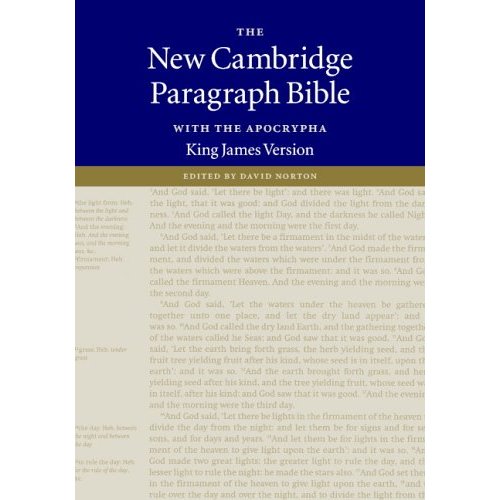
But today Amazon delivered up the presentation copy of David Norton's New Cambridge Paragraph Bible (CUP, 2005). Did I want another huge book that can't really be shelved? Not really, but the regular CUP hardcover seems to be already out of print, & at least this comes in a cardboard slipcover that stands it upright. What's most revelatory, however, is Norton's approach to editing this volume. He's not a theologian or Biblical scholar per se, but a textual critic, & his goal is not to somehow get the KJV closer to the Hebrew & Greek (& Aramaic) texts of the Bible, but to get this KJV closer to what the original translators of 1611 intended.

Most folks who use the KJV aren't aware that the vast majority of King James Bibles out there reproduce the text, not of the 1611 Authorized Version, but of a 1769 revision thereof. In short, the editors & publishers of the AV saw fit to tinker with the text – changing punctuation, wording, spelling – for about 150 years before they decided to settle down and stick with a single version. So the KJV one encounters today is essentially a mid 18th-century version of the 1611 text, with mid 18-th c. spellings & punctuation.

Norton has gone back to the first edition & beyond that to the translators' notes & manuscripts. For the most part, he's returned to 1611 punctuation, which he feels is actually closer to contemporary usage than the 1769 punctuation. At a number of textual cruxes, he's found the KJV translators more convincing than their revisors: when Paul, in 1 Timothy 2.9, urges "that women adorn themselves in modest apparel, with shamefacedness and sobriety" (this is the received AV), Norton points out that the 1611 translators wrote in "shamefastness and sobriety." To be "shamefaced" is to be ashamed; so might "shamefast," but it's more compellingly read as "holding fast to modesty."*

At the same time, this is a modernized text, in the same way that almost all texts of Shakespeare we read are modernized: spelling, especially, has been brought up to date, & some of the more vexing verb tenses have been sorted out (you have no idea how much agony the verb "bear" – as in childbearing, KJV past tense "bare" – routinely causes my students). Weird archaisms have been replaced with clearer cognates: the Philistines in 1 Samuel 5 don't have "emerods" any more, but more prosaic "haemorrhoids." Norton has inserted quotation marks for speeches, & heaven knows how many troubles that'll clear up.

But what's most compelling about this KJV are not the tinkering with text & orthography but the formatting. As its title indicates, it's a "paragraph" Bible, which means that instead of the maddening World's Classics format (each verse a separate paragraph, double columns), this Bible has broad single text columns, divided into real live paragraphs (with verse divisions indicated by teeny superscript numbers). It's this particular innovation (not really new, since the first Cambridge Paragraph Bible came out in 1873 or so) that makes this the most readable KJV on the block.

Of course, I'm not assigning this monster to my Bible as Lit students this fall, & I'm not recommending anyone out there buy this presentation volume, either (for heaven's sake, it doesn't even have a family register!); turns out that the David Norton Cambridge text will be the basis for the forthcoming Penguin Classics Bible, due out in three weeks or so.

*No connection to recent discussion of mammary exposure in 17th-c. portraiture.

fashion update


No nipples this time, but this from Richard B. Schwartz's Daily Life in Johnson's London:
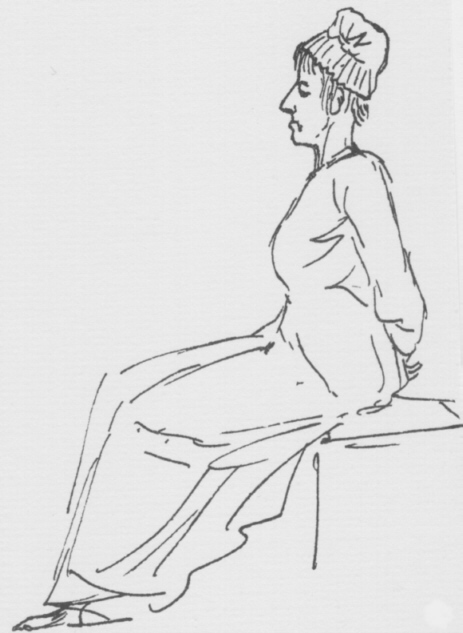
In a period when the bizarre was often commonplace, one of the more striking fashions was the post-Revolution, 1790s technique for imitating the aristocrats who had gone to the guillotine. Englishwomen wore thin crimson ribbons around their necks and had their hair tousled, in a style termed la victime coiffeur.

Tuesday, August 08, 2006

Ex-Prospective Juror

Most of the day burnt up in jury duty, where I learnt that voir dire (OF "to say the truth," the process by which jury pools are interrogated & weeded out) can be pronounced "vaw dar" by a judge of the circuit court around here, & where I was dismissed after several excruciatingly dull hours (without even having to use the words "ambulance chaser" in connection with the civil trial I was trying out for). Rewarded myself by visiting a couple of book- & music-stores. The haul:
The 2-CD Skeleton Crew set from RER (Fred Frith, Tom Cora, Zeena Parkins)
Marc Ribot Y Los Cubanos Postizos, Muy Divertido!
John Zorn/Wayne Horvitz/Elliott Sharop/Bobby Previte, Downtown Lullaby
All in all, a very "downtown" stack. On DVD:
The collector's edition of Monty Python & the Holy Grail
The film of Peter Brooks's production of Marat/Sade
In paper: a nice Penguin Grundrisse, the recent Vintage reissue of Samuel Delany's Fall of the Towers, & the one Lemony Snickett novel that we hadn't yet read.
***
Good news from Connecticut. Be careful whom you kiss, or who kisses you...
***
Goodness, an actual conversation in the comments box! I hasten to say, Henry, that at no point did I want to cast aspersions on your review of John's Breeze – it's just that John's response to the review clicked in my mind with Jessica's comment on wanting her work to be read on its own terms – it started me thinking what a pigeon-holing mind my own is, how I'm always looking for a conceptual folder to file the new things in. Or how I'm always trying to locate things on some sort of conceptual/historical map, so that I can figure out how someone got "there" from "here."

When my maps were getting drawn, there were a certain number of things that got filled in first, while the rest was still "Here Be Dragons," & pace Norman – tho I will defer to your advanced age – they weren't necessarily the "best"; often, the best came later ("I have had to learn the simplest things..." – my motto, courtesy Charley O.). But the things that I encountered first still have the sort of warm spot in memory that one's shitty hometown does, or the lousy diner one ate at every week during college – if only because there weren't any diners in one's s. hometown, & it was the best one in one's rural collegetown.

Is that HW's version of the Mallarmé? I resent his losing the force of the active verb – "j'ai lu tous les livres."

Monday, August 07, 2006

Oh yeah, I meant to cross-reference that last comment to Jessica's post a couple weeks ago, which went something like: Don't tell me who my work's like, don't tell me that it reminds you of this or that or the other, at least make the effort to describe the bits that you like or don't like about it on their own terms.

Poetry is Hard To Talk About

So Henry Gould reviews John Latta's Breeze, a really splendid book of poems that displays the same range of omnivorous interests & wild gaiety of diction as JL's various blogs, & then there's a little blog back 'n' forthing:

JL: Thank'ee much, v. v. honored, perhaps it ain't all Wallace Stevens (dunno if I've read him all), but I did hang out a lot with Archie Ammons in Ithaca, & wonder if some of that foul-mouthed transcendentalism rubbed off?

HG: Thank'ee for the thank'ee, back to the drawing board.

(Love that "Old Peanut-head" – Temple of Zeus, every morning, swapping dirty jokes with Mike Abrams...)

But that's the fallback, isn't it? You read a new book of poems, you compare it with what you've read before – & if you're writing about it, you dress up those comparisons with the finery of "influence" & "artistic genealogy." It's not always lazyany critical procedure, any approach can be lazy, a substitute for thinking – it's not lazy when HG does it with JL. It tells us important things: this reader wants to know exactly how Hart Crane was important to early Olson, how DH Lawrence "influenced" Creeley, what Bishop got from Marianne Moore, usw. (& man was I happy when John Matthias located Anarchy in the same tea party with Geoffrey Hill & Susan Howe, "if one can imagine either one of these poets also taking an interest in Johnny Rotten and the Sex Pistols.")

It's an effect of age, of having read things, innnit? My Theory is that each of us has a half-dozen books or poets that serve as baseline comparisons for almost everything that comes after in our reading: & it's not because they're the best or the first at doing whatever they do, supreme exemplars etc., but because they're the first we encountered doing that thing. They become central reference points that one works backwards & forwards from. So that I for one read the Paradise Lost passages of "A"-14 (1964) and Tom Phillips's A Humument (1970) in the light of Ron Johnson's RADI OS – only because I read RADI OS first, & i had never encountered anything like it before. All "literary" ballads stand for me in some relation to John Crowe Ransom's "Captain Carpenter" (encountered aet. 17 or 18).

One reason I'm so enjoying Martha Ronk's Eyetrouble (Georgia, 1998) & In a Landscape of Having to Repeat (Omnidawn, 2004) – I don't know what to compare 'em to, & have given up trying.

"Willing suspension of disbelief" – give me a willing – willed – temporary – suspension of textual memory.

Friday, August 04, 2006

Louis Zukofsky: Selected Poems (ed. Charles Bernstein)

I make no excuses for only having recently gotten around to reading thru Charles’s selection of LZ for the Library of America’s “American Poets Project” series. Afer all, I have a nodding acquaintance with much of the work included here. What’s new, of course, is Charles’s selection & arrangement. Last year (or was it year before last?) Ron Silliman spent several long blog posts agonizing over what ought to go into a short selected LZ, & I did the same; both of us, of course, were in consultation with Charles – “in on the secret,” as it were. But it’s Charles’s baby, ultimately, & I’m very happy to report that he’s done just a fine job of it.

The problem with selecting LZ for a wide audience – perhaps even an audience that doesn’t turn to poetry on a regular basis, judging by the promotional materials & subscription offers the LOA keeps sending me – is that the bits of LZ most highly valued by those who’ve been reading him for decades are apt to pose really formidable challenges to the casual reader: “A”-9, 80 Flowers, the impacted collages of “A”-22 & -23. At the same time, there’s a good deal of LZ that pays off the reader for whom immediate apprehension is a necessary prequel to pleasure: large swatches of “A”-12, many of the short poems (in particular the valentines). (This is the LZ which most closely resembles Williams on the one hand & parts of Creeley on the other, the LZ which proved so attractive to Cid Corman.) And then there’s the work that hovers between the two extremely of dense hermeticism & graceful lucidity – the majority of the writing, I’d hazard.

Charles, to his credit, devotes the bulk of his selection to this “mid-range” work and to the more obdurate & difficult – at the same time sprinkling the volume with enough well-chosen examples of “easy” LZ to keep a less-committed readership awake. Emblematic are 2 of the 3 long “pivotal” texts Charles includes (the 1st, inevitably, is a long sample from “Poem beginning ‘The,’” in some ways the Transformer* of LZ’s early career – a flashy and quite impressive early work that unfortunately sometimes obscures what comes after): “4 Other Countries” & “A”-23. I think the selection would have been a failure had Charles not included “A”-22 or -23 in its entirety (indeed, I’d love to see the 2 movements reissued in a single volume), because they’re the culmination of “late” LZ, & a fountainhead for a whole range of interesting subsequent writing.

But it’s Charles’s inclusion of the whole of “4 Other Countries,” the longest of LZ’s poems outside of “A”, a poem that could be loosely described as a travelogue tracking the Z family’s 1957 tour of Europe – the 4 countries of the title are England, France, Italy, & Switzerland – that it’s worth drawing attention to. Ron was not particularly enthusiastic about this piece taking up almost 40 pages of the selection. I can’t lay my hand on his specific post, but I seem to recall him regretting how it made LZ seem more Williamsesque than was accurate.

10 years ago, I might have agreed; now, with Charles’s selection in hand, I’m inclined to see including “4 Other Countries” as a pretty canny decision. The poem, that is, is an exemplary transition work in LZ’s corpus, the poem in which the plain-spoken, legible statement drawn over short lines – Williams’s trademark – begins to become the mosaic, the collage of impressions & quotations. And it’s here that the shortlines most exemplarily drive the syntax of the poem thruout, in ways that WCW only accomplished at the top of his form.

If there’s an “argument” to Charles’s selection – and ofcourse everyone who edits such a book is making an argument – then it’s a diachronic one, that one way of reading LZ is to note how his poetry evolves over the course of his career from a straightforward, if “crabbed,” idiom (“Poem beginning ‘The,’” the passages of “A”-12) to reach its fruition in the tangible word-stuff of “A”-23 & 80 Flowers. “4 Other Countries” is indispensible as a snapshot of LZ’s work in the midst of that evolution. The missing link, that is, between “To my wash-stand” & “Zinnia.”

Wednesday, August 02, 2006

Lines from Bruce Andrews’s Ex Why Zee:
Body = society, we think of punishment as refinement, and yet: nothing is natural, body just another android fun machine. Genres are fucked; disturb the creature – we need our own spanking rhetorical body.

I used to be a radical formalist, but now / I’m a derivative spiritual humanist / with better funding opportunities.
***
John Evelyn’s description of the aftermath of the Great Fire of London, 1666:
The fountaines dried up & ruind, whilst the very waters remained boiling; the Voragos of subterranean Cellars Wells & Dungeons, formerly Warehouses, still burning in stench & dark clowds of smoke like hell, so as in five or six miles traversing about, I did not see one loade of timber unconsum’d, nor many stones but what were calcind white as snow, so as the people who now walked about the ruines, appeard like men in some dismal desart, or rather in some greate Citty, lay’d wast by an impetuous & cruel Enemy, to which was added the stench that came from some poore Creaturs bodys, beds, & other combustible goods.
(Vorago, “an abyss, gulf, or chasm.”)
***
Oliver Cromwell (for Steven Moore)

He read of children tossed
at a pike’s end, of cannons
with “God Is Love” scribed round
their barrels. He read of a snake
with garnet eyes, of golden
ringlets curling round the hemp
of a hangman’s noose.
He read of green fields
and mines, of foundries
and factory floors. Pleasures
and game diversions. The tree
which bursts into pink blossoms
of enthusiasm. The trees huddle
suspiciously in the wind, rustle
in green whispers. A village mashed
and shattered under the sun, not one
stone left upon another. Bombers
and fighter jets darkening the sun,
the shop clerk whose weekend sends
him – in militiaman’s uniform –
to take stock – with a bayonet– of a
tentful of refugees. Great men,
whose brows line with the effort
of shaping destiny. Who read old books,
and find their faces there.

(in progress)

Monday, July 31, 2006

Philosophick Candour

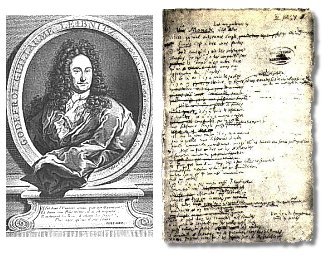
Gottfried Wilhelm Leibniz to Simon Foucher, 1675:

As for myself, although I always liked to meditate, I always found it difficult to read books that cannot be understood without much meditation. For, when following one's own meditations one follows a certain natural inclination and gains profit along with pleasure; but one is enormously cramped when having to follow the meditations of others. I always liked books that contained some fine thoughts, but books that one could read without stopping, for they aroused ideas in me which I could follow at my fancy and pursue as I pleased. This also prevented me from reading geometry books with care, and I must admit that I have not yet brought myself to read Euclid in any other way than one commonly reads novels [histoires]. I have learned from experience that this method in general is a good one; but I have learned nevertheless that there are authors for whom one must make an exception – Plato and Aristotle among the ancient philosophers and Galileo and Descartes among ours. Yet what I know of Descartes's metaphysical and physical meditations is almost entirely derived from reading a number of books, written in a more familiar style, that report his opinions. So perhaps I have not yet understood him well.

Saturday, July 29, 2006

Scottish white slavery


Was thinking about a passage from Paterson, Book I:
Cromwell, in the middle of the sixteenth century, shipped some thousands of Irish women and children to the Barbadoes to be sold as slaves. Forced by their owners to mate with the others these unfortunates were succeeded by a few generations of Irish-speaking negroes and mulattos. And it is commonly asserted to this day the natives of Barbadoes speak with an Irish brogue.
Williams's latest editor (among others) notes that WCW is quoting Seamus MacCall's Thomas Moore (London, 1935). There seems a pattern, as Susan Howe notes in an interview somewhere, of the English imperium practicing upon its Celtic fringe what it will later try on its subjects of darker hues.

After the invasion of Ireland which still leaves his name blackened among the Irish & those of Irish descent (one news story last year or year before last concerned a Massachusetts town which moved to change its 300-year-old coat of arms because someone discovered that one of its quarters were the Cromwell family arms), Cromwell [shown above in Samuel Cooper's famous "warts & all" miniature] invaded Scotland (1650-1). The northern nation had moved to crown the exiled Charles II king after his father's execution in January 1649, & he landed in Scotland in June 1650 – with little popular support in Scotland, and distrusted by various political & religious powers there – to pose a threat to the Parliamentary government in England.

One of the fuller accounts of the 1650-2 Anglo-Scottish war, which I've just read, is John D. Grainger's Cromwell Against the Scots: The Last Anglo-Scottish War, 1650-2 (Tuckwell, 1997). Grainger is a meat & potatoes writer – there are no flourishes here, just straightforward British literacy & dogged chronological storytelling. Tho it's perhaps worth reading the last few pages to find Grainger – who up until that point has seemed entirely lucid – descending into something like anti-devolution paranoia: "independence for Scotland means inevitable conflict with England... This is the real significance of the last war between England and Scotland. For it is only the last war until now. If the countries separate, there will be another." It's this sort of ham-fisted contemporary application that the grand warhorses of Revolutionary history – Maurice Ashley, CV Wedgewood, rarely fall into. (Perhaps at some point in the future I'll mention the oddities of Antonia F/Eraser's account of Gunpowder Plot.)

Grainger does a maps & all analysis of Cromwell's two great victories in the Scottish campaign, Dunbar & Worcester (the former perhaps his single most amazing tactical success). But I'm intrigued by how much time he spends on the disposition of the Scottish prisoners from those battles. Of the prisoners from Dunbar, some were transported to New England and sold for 20-30 pounds apiece: 60 to the Saugus Iron Works at Lynn; 15 to Berwick, Maine; others to nearby York. The bulk of the "cargo" – some 150 men – are unaccounted for: probably dying on the passage over. After Worcester, a large number of prisoners were shipped to Virginia & Bermuda; 300 were sent to New England (of whom 30 died en route), where they began work at Saugus & "were mostly then sold on in smaller groups to farmers and mill owners all over New England."

17th-century England, unlike 21st-century America, had no formal infrastructure for the long-term detention of prisoners of war, no sprawling Guantanamo on the Isle of Man, say.
***
Much of this 17th-century grubbing immediately inspired – tho heaven knows it's a longterm interest – by Neal Stephenson's Quicksilver. I may end up reading Leibniz.
***
For those of you who want to know more about Cromwell – especially for those seeking a quick internet source for term papers – I hasten to recommend Bob Cromwell's site about his illustrious ancestor.

Friday, July 28, 2006

Restoration Pinups

Jessica opines, in connection with yesterday's image of Margaret "Peg" Hughes, "I think it's funny that women could never find clothes that fit in those days," & Michael wonders
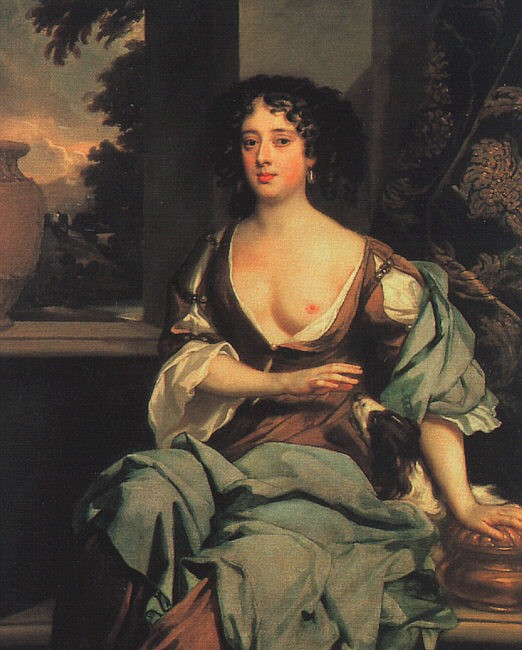
Is this (formally) a portrait of a living person (as opposed to a painting of some historical or genre scene that Peg Hughes happened to model for Lely) and if so what are the social parameters of breast-baring in 17thc female portraiture? Would it be usual for a genteel lady to be painted with a nipple showing? If not (or if so) does it carry some meaning about the sitter's status e.g. as married/unmarried, mother, virgin, mistress, prostitute, bluestocking, actress?
Of course, I'm not the person to ask, since I've always regretted not having studied art history on anything like a formal basis – but my own viewing of Restoration portraiture of women suggests, as Catherine MacLeod writes, that "While in practice there is almost never any distinction between the poses Lely used to portray 'virtuous' women and those with more dubious reputations, portraits that include bare breasts seem exclusively to depict mistresses." (See this lively review of a 2003 exhibition of Restoration portraits of women.)

The graceful Lely portrait of Diana Kirke (left) was reputed banned from the London Underground on the grounds that the exposure of her left nipple might be "distracting" to commuters. Kirke had a 13-year liaison with Aubrey de Vere, Earl of Oxford, & the Yale art historians speculate "It is likely that her lover commissioned the portrait for his private apartments, where it would be seen and admired only by his inner circle of friends." (The Kirke portrait was replaced on the Tube by an equally lovely but more discreet portrait of the Duchess of Richmond.)

Of all of the women painted by Lely, the only one I know of to appear in full undress is of course Nell Gwyn, another actress & the most famous of Charles II's mistresses. (And a woman of considerable spunk: when an angry mob assaulted her carriage, believing it contained a less popular – and Catholic – paramour of Charles's, she said, "Pray good people, be civil; I am the Protestant whore.") Samuel Pepys reputedly kept an engraving of Peter Cross's portrait of Gwyn as Cupid (right) over his desk at the Admiralty.

As to whether their clothes "fit," I suppose they fit as well (or badly) as those of my own undergraduates; and whether something gets exposed (as with my own undergraduates) is a matter of a delicate semiotic – a rather different semiotic, d.g., now than then.

gleanings


Above, Sir Peter Lely's portrait of Margaret "Peg" Hughes, reputed to be the first woman of English theater – that is, the first female actor to break the all-male tradition of early modern performance, with her portrayal of Desdemona in a December 1660 (Drury Lane?) staging of Othello. Pepys knew her – he knew everyone.

In later years, she became the mistress of Prince Rupert of the Rhine [to the left, in very early youth], dashing cavalry commander during the Civil War and admiral during the Dutch Wars. She bore him a daughter, Ruperta, and, it is said, "brought down and greatly subdued his natural fierceness." (A fierceness, according to the Roundheads, only matched by that of his poodle Boye, whom Rupert brought with him into battle and who some of the more superstitious of the Parliamentary soldiers believed was a familiar. Boye died at the battle of Marston Moor.) In Ken Hughes's hilariously inaccurate (yet for me strangely moving) 1970 film Cromwell, Rupert is played by a painfully young Timothy Dalton.

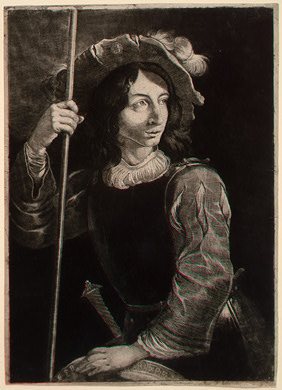
In his years of exile during the Protectorate, Rupert bounced around Germany (the son of James I's daughter Elizabeth & Frederick V, the Elector Palatine, his first language was German – though he was fluent in perhaps four tongues), amusing himself with experiments in natural philosophy and artistic media. He probably did not invent the mezzotint printing process, but he certainly had a hand in perfecting it. His "Standard Bearer," less famous than "Head of an Executioner," is a fine example of the process.

Thursday, July 27, 2006

Interstices


I’m still chiselling my way thru the first volume of The Stones of Venice, which started with a bangup first chapter on the historical & spiritual significance of Venetian architecture, but has shifted to a primer on the elementary basics of architecture in general – not what I was expecting, but if that’s where Ruskin wants to start, I’m sure it’ll come in handy for me later. Report to follow.
***
In the meantime, I’ve discovered YouTube, & in between watching Borat & Ali G I found this video of one of my all-time favorite groups, the sublime Oysterband, along with the Scottish folksinger June Tabor, demonstrating that Joy Division’s “Love Will Tear Us Apart” can be performed as a beautifully moving song. (They demonstrated something similar with New Order’s “Love Vigilantes” some years ago, but you’ll have to hunt up the album Ride for that one.)
***
On the earbuds: Hasidic New Wave and Yakar Rhythms, From the Belly of Abraham, in which a far more electric spin-off of the Klezmatics collaborates with a trio of Senegalese musicians as part of what is billed as Episode 5762 of the "Adventures of the Afro-Semitic Diaspora." Pretty damned cool stuff – cross-cultural fusion music that manages to avoid all of the Banana-Republic-wallpaper levelling of most "world music" projects, thanks largely to the constantly shifting bop and klezmer chops of Greg Wall and Frank London, the subterranean guitar of David Fiuczynski, and the irresistable propulsion of the various drums of Alioune Faye, Ousmann Sali, Adboulaye Diop, & Aaron Alexander.

Wednesday, July 26, 2006

Ralph Maud on "The Kingfishers"

One of the advantages of being an academic is a steady trickle of free books – desk copies, exam copies, payoffs for evaluating manuscripts. And one of the advantages of living with another academic is precisely doubling that advantage. In short, J. read a manuscript from a press the other month, and one of the new haul of freebies was for me – Ralph Maud’s What Does Not Change: The Significance of Charles Olson’s “The Kingfishers” (Fairleigh Dickinson UP, 1998). It’s a nice piece of work: a compact, lucidly-written long essay presenting an old-fashioned explication-du-texte of Olson’s 1949 long poem – a poem which would prove to be a milestone in the foundation of postmodern American poetries. It’s the very first selection in Don Allen’s The New American Poetry, the first thing to jump out of the book at the host of casual backpackers & hitchhikers who carried that anthology in their rucksacks over the first half of the 1960s.

I’d already read Maud’s previous book, Charles Olson’s Reading: A Biography (Southern Illinois UP, 1996), which was sublimely informative, and a great idea, as well: to tell the working life of a famously “bookish” writer by painstaking chronicling what he was reading at any given point, & how it got into his work. What Does Not Change does a certain amount of similar source-hunting, and as far as I’m concerned pins down precisely all of Olson’s sources for “The Kingfishers.” In many ways, Maud’s book is a response to his old grad school colleague Guy Davenport’s “Scholia and Conjectures for Charles Olson’s ‘The Kingfishers’” (1973), which now appears to be composed far more of “conjectures” than of reliable “scholia.” So now we know who “Fernand” is (one John Gernand, whom CO met at a party in 1948 & then misremembered his name), & the source of O’s factoid about the Mongolian louse in pre-Columbian tombs (Frederick Merk’s 1937-8 lectures in History 62, Harvard).*

Maud does a sturdy job of interpreting the poem – he firmly believes, like Robert Von Hallberg, that Olson’s is a discursive poetics, that he has something to say – & he nicely situates the poem in the context of Olson’s early career. I suppose what I’d like to read now is a history of the poem’s life among readers, its afterlife among all those hitchhikers with The New American Poetry wearing corners between their shoulderblades.
***
In re/ that last post about the Academy of American Poets’ website: as per Norman’s suggestion, I copied my sniffy letter to a couple of sympathetic chancellors of the Academy, and by the end of yesterday (Monday) I had spent some time on the phone with an Associate Director, who apologized handsomely; things will be put right. As I’d suspected, there was an intern back of it all. But out of sheer cussedness, I’m gonna keep the post up for a few days before deleting it in the spirit of Xtian (or at least “gearing up for this Fall’s Bible as Lit course”) forgiveness.

*Of course, committed Olsonians have probably known this stuff for ages; but it’s nice to have it all between one set of covers.

Sunday, July 23, 2006

Academy of American Plagiarists

Webmaster
Academy of American Poets Website

Dear Sir or Madam:

As the biographer of the poet Louis Zukofsky, I was pleased to see the Academy of American Poets finally devoting a page on their website to Zukofsky. I was less pleased, however, to discover that the vast majority of the biographical text on that page had been more or less directly lifted without acknowledgement from a biographical article that I wrote on Zukofsky some years ago for the Dictionary of Literary Biography. An expanded version of that article was published in my monograph Louis Zukofsky and the Poetry of Knowledge (University of Alabama Press, 1998), and the text of that chapter (with corrections) was presented on the University of Illinois’s “Modern American Poets” website – which I assume is the proximate source for the AAP’s webpage text.

Of course, whoever redacted my text for the AAP’s webpage seems to have lost interest about halfway through and, after rather closely tracking my own prose describing Zukofsky’s early career, is content to summarize the bulk of Zukofsky’s accomplishment in a few inane sentences: “Zukofsky’s own work never achieved much recognition outside literary circles. His poetry tended to be obscure, experimental, and intellectual.”

I won’t dwell on the other infelicities of the page, except to note that when your writer reduces my sentence
Pound was appropriately impressed, both by "Poem beginning 'The'" and by Zukofsky's critical sense, which he demonstrated in his 1929 essay on The Cantos (one of the very first analyses of Pound's work-in-progress)
to
Zukofsky further impressed Pound by writing the first analyses of Pound’s The Cantos in 1929, which were still unfinished at the time,
she or he gives the impression that Pound’s poem – which would remain unfinished at Pound’s death in 1972 – was on the verge of being completed in 1929; and that the sentence which starts “Begun in 1927, Zukofsky spent the rest of his life working on ‘A'” commits a rather grave grammatical solecism.

I don’t particularly mind having my prose on Zukofsky used to inform casual readers about Zukofsky’s works and career. But I am rather irritated to find my prose appropriated without request or acknowledgement and reduced to gibberish at the hands of anonymous redactors. I would have expected better of an organization as well-established and respected as the Academy of American Poets.

Yours truly,
Mark Scroggins

Friday, July 21, 2006

The aliens have landed!

eBay just disgorged a pair of Pippa's favorite pajamas in a size that actually fits her, so that she can bequeath her old pair to her little sister and she and Daphne can be twin aliens. Is that cool or what?

John Cale: Black Acetate

Now that I’ve killed off three-quarters of my 5 readers by relentlessly blogging Ruskin, I can start writing about the stuff I’m really interested in – no, not Philip Pullman (tho that’ll come in good time), but pop music. In particular John Cale, one of those few of my youthful obsessions that have lasted.

Barely. I bought my first Cale albums a long time ago – I think the first one I got was 1979’s Sabotage/Live, and the first one I bought new, as soon as it hit the shelves, was 1981’s Honi Soit. (That, mes enfants, was back in the day when new records actually existed in corporeal rather than cyber- space; not only that, but they were manufactured out of a petroleum byproduct called “vinyl,” and you had to be careful not to leave a new record in the back of seat of your mom’s car on a hot day…) So let’s say that that’s 25 years, more or less, of buying the new John Cale record and responding in a predictable way:
1) 1st listen: Damn, this is the greatest thing since Never Mind the Bollocks!
2) 2 weeks in: Well, most of it’s no more than alright, but there are some really great tracks on there!
3) 2 months later: Is this guy ever going to make another album like Helen of Troy or Slow Dazzle?

To be fair, Honi Soit, which I listened to earlier today as part of a chronological iPod trek thru the entire Cale catalogue, is still a pretty amazing album – but all of his “pop” albums since then seem to fall into the narrow band between “workmanlike” and “embarassing.” At least I thought so until he released 5 Tracks in 2003. It followed one of his simultaneously most pretentious and embarassing records, Walking on Locusts (which came pretty close to making me sell off the collection). 5 Tracks was signs of life, even if they were signs of a guy down in his basement with ProTools. Even better was the followup, Hobo Sapiens, which had the critic-folks making comparisons with Radiohead. Yeah, right; I think they were mostly relieved that the old chap (Cale turned 60 in 2002) had made a pretty decent pop record with lots of interesting textures, & hadn’t gone entirely over the deep end.

Last year’s Black Acetate, which I bought back in February but haven’t commented on until the thing sank in (see above temporal gradation of responses) is better than either 5 Tracks or Hobo Sapiens. Indeed, it’s his best album since Honi Soit, though it’s not quite in the same category as his early work. Maybe part of that is the grittier textures – more real guitars & basses (creeping rockism on my part, I guess); part of it is the less pretentious lyrics. He’s been reading less Dylan Thomas and listening to more top 40, which is all to the good.

I keep expecting the moon & stars of Cale, which probably comes of having stumbled on his music when he was at the top of his game (& when I was at a particularly impressionable age). I always bracket him with Brian Eno: the second bananas in their original bands who have turned out to be the more interesting ones to watch in the long run. Back in the day when Roxy Music was a powerful hit machine, who would’ve thought that the bald weirdo who’d made those funny noises on the first two records would have longer staying power than Bryan Ferry? Of course, the post-Velvets careers of Lou Reed & Cale let us know who was the real heavyweight within a couple of years: when Cale was making the fantastic run of albums that included Paris 1919, Fear, Slow Dazzle, & Helen of Troy, Lou was giving us Sally Can’t Dance, Coney Island Baby, & Rock and Roll Heart.
***
Noted: Lee Ann Brown’s The Sleep That Changed Everything (Wesleyan, 2003). I’ll be honest – sometimes I’m not entirely comfortable with Brown’s balladeering. Not as poems, but as performances: they seem to often to confirm a certain Beverley Hillbillies stereotype of Southerners in much of their audience that I as card-carrying Southerner have a deeply ambivalent relationship with. But much of this book is dazzling, & in an unexpected way. It’s so funny, so light-hearted, & simultaneously so deeply felt that it puts this prematurely wizened & cynical bastard to shame: as Brown paraphrases Rilke, “Change your tune – change your fate.”

Wednesday, July 19, 2006

new shoes!


These were all the rage among the under-ten crowd in NYC, so when I saw them in the mall down here, how could I resist?

Tuesday, July 18, 2006

Reading Ruskin (pamphlets): JR on the Senate, JR on the MFA

We’re in the midst of the summer here (& have been for maybe six weeks now): steamily hot days, oppressive, close night, at least one drenching cloudburst every day. Everything green seems to grow at least an inch a day – “venereal soil.”
***
I’m gathering my breath for the leap into Ruskin’s very large The Stones of Venice, & so reading a couple of pamphlets out of chronological order (also reading Neal Stephenson’s Quicksilver, the first volume of Philip Pullman’s His Dark Materials, divers poetry and sundry graphic novels): Notes on the Construction of Sheepfolds & Pre-Raphaelitism were both published in 1851, after Ruskin had completed the first volume of Stones of Venice, for which Seven Lamps of Architecture serves as something of a theoretical preamble.

Sheepfolds is an odd little book; it has nothing to do with literal sheepfolds, but instead addresses current divisions with British Protestantism – high church / low church, establishment / dissenters, Anglican / Scottish Presbyterian. JR calls on English & Scottish Protestants to unite into a common front against the Roman Catholic “antichrist.” All in all a pretty typical polemical production for the day, notable now for JR’s remarks on temporal government. He sees three forms of government: executive, which is the “hand” of the nation; democratic, which is the “voice” of the nation; and monarchical, which is the “head” (or mind) of the nation. By monarchical he doesn’t necessarily mean a single monarch, but some sort of ruling body which does the thinking for the nation:
All true and right Government is Monarchical, and of the head. What is its best form, is a totally different question; but unless it acts for the people, and not as representative of the people, it is no government at all; and one of the grossest blockheadisms [nice word, that] of the English in the present day, is their idea of sending men to Parliament to “represent their opinion.” Whereas their only true business is to find out the wisest men among them, and send them to Parliament to represent their own opinions, and act upon them. Of all puppet-shows in the Satanic Carnival of the earth, the most contemptible puppet-show is Parliament with a mob pulling the strings.
Nasty stuff, on several levels, but one sees echoes of Ruskin’s reasoning in the Founders’ decision for a bicameral legislature, in which the Senate would have some degree of immunity from the passing winds of their constituents’ moods.
***
In Pre-Raphaelitism, JR is reacting to the bad press received by the early paintings of the artists who somewhat pretentiously signed their work with the initials “PRB” – “Pre-Raphaelite Brotherhood.” Despite his close association with some of the P-Rs (Millais especially), & despite (or perhaps because of) the fact that he had already become known as a supporter of theirs, Ruskin can’t be bothered to defend their work in detail in this little pamphlet supposedly devoted to that very purpose. Instead, he reaffirms the major point of Modern Painters I – that the painter does his “function” best who faithfully records appearances (which indeed, he asserts, the P-R’s do more carefully than any other group of painters working in England) – and then gives, for the bulk of the pamphlet, a summary of the career of JMW Turner, then at the close of his life.

One notable quotation near the beginning seems to me to have specific applicability to the contemporary American creative writing industry:
who among us now thinks of bringing men up to be poets? – of producing poets by any kind of general recipe or method of cultivation? Suppose even that we see in youth that which we hope may, in its development, become a power of this kind, should we instantly, supposing that we wanted to make a poet of him, and nothing else, forbid him all quiet, steady, rational labour? Should we force him to perpetual spinning of new crudities out of his boyish brain, and set before him, as the only objects of his study, the laws of versification which criticism has supposed itself to discover in the works of previous writers? Whatever gifts the boy had, would much be likely to come of them so treated? unless, indeed, they were so great as to break through all such snares of falsehood and vanity, and build their own foundation in spite of us; whereas if, as in cases numbering millions against units, the natural gifts were too weak to do this, could any thing come of such training but utter inanity and spuriousness of the whole man? But if we had sense, should we not rather restrain and bridle the first flame of invention in early youth, heaping material on it as one would on the first sparks and tongues of a fire which we desired to feed into greatness? Should we not educate the whole intellect into general strength, and all the affections into warmth and beauty, and look to heaven for the rest?
I’ve had to restrain myself from interjecting illustrative comments, drawn from the MFA industry, between every sentence. Suffice it to say that Ruskin could have had no inkling of the degree to which minting poets would become an industry, in the English-speaking countries, on a par with the manufacture of cast-iron building ornaments or the construction of railroads. Ah, but none of us came out of that milieu – though we can all point to the poems written by those who did (the other folks!).

Monday, July 17, 2006

Reading Ruskin (The Seven Lamps of Architecture)

The second volume of Ruskin’s Modern Painters, published in 1846, might as well have ended “To be continued…,” given the number of places where he apologizes for treating something too briefly, & promises to get back to it at greater length. But while JR could write with enormous concentration (& at enormous length) on whatever interested him at the moment, his interests were pretty easily distracted, & he wouldn’t get back to Modern Painters for another ten years. (His lack of concentration becomes pretty intense in later works, where following his line of thought from subject to subject becomes something like playing Whack-a-Mole at the arcade.)

His interest had turned to architecture, one of the fields in which he had no formal training, & his first production in architectural theory, The Seven Lamps of Architecture (1849), turned out to be by far his most publically successful and popular work (though he described it in the 1880 reprint as “the most useless [book] I ever wrote”). It’s a pretty good read, once you understand that by “architecture” Ruskin doesn’t mean what we understand by the term: as far as the design of buildings, from the ground up, the arrangement of space & materials & so forth – all that he dismisses as “building.” Instead, by “architecture” he understands the skin of the building, its ornamented and otherwise aesthetically figured surface.

The “lamps” themselves – the lights by which architects ought to operate – are straightforward enough: the lamp of “sacrifice” – architecture should be an offering to the deity; of “truth” – it should offer honest workmanship and openly display its materials, remain true to its medium; of “power” – the building should be thought of as a shape, a structure of masses; of “beauty” – its ornamentation (and it ought to be ornamented) should be from nature, rather than geometrical or abstract; of “life” – the building itself should be planned and constructed by human hands, making the allowances and alterations for which contingency calls, and stamping the finished work with their own mark; of “memory” – buildings, which inevitably embody the culture out of which the proceed, should be constructed for the ages; and of “obedience.”

This last lamp is a touchy one, & brings to the fore the political Ruskin, which is inseparable from the religious Ruskin (at this point still a confirmed evangelical). “There is no such thing as Liberty,” he proudly proclaims: human beings only fulfill themselves by obedience to laws under which they live – not political laws, but moral and spiritual laws. (He’s closer to Spinoza than to the young Coleridge, in other words.) Ruskin is a confirmed, “violent Tory” as he once called himself, an advocate of “subordination” as much as his precursor Dr. Johnson.

But while one could compile a list of quotations from Ruskin that make him seem the most conservative thinker possible, one can also come up with a series of sentences that make him a visionary social reformer (William Morris certainly thought of him thus). What he isn’t, never ever, is a vile capitalist like the figures behind Thatcher or the despicable forces piloting our present administration. Ruskin thinks things are deeply askew in the world of industrializing Victorian England: but it’s the free market as much as anything else at fault. One money quote (and read this one thru to the passage I have italicized, before you dismiss JR as a vile reactionary):
All the horror, distress, and tumult which oppress the foreign nations [he’s writing in the wake of the 1848 revolutions], are traceable, among the other secondary causes through which God is working out His will upon them, to the simple one of their not having enough to do. I am not blind to the distress among their operatives; nor do I deny the nearer and visibly active causes of the movement: the recklessness of villany in the leaders of revolt, the absence of common moral principle in the upper classes, and of common courage and honesty in the heads of governments. But these causes themselves are ultimately traceable to a deeper and simpler one: the recklessness of the demagogue, the immorality of the middle class, and the effeminacy and treachery of the noble, are traceable in all these nations to the commonest and most fruitful cause of calamity in households – idleness. We think too much in our benevolent efforts, more multiplied and vain day by day, of bettering men by giving them advice and instruction. There are few who take either: the chief thing they need is occupation. I do not mean work in the sense of bread – I mean work in the sense of mental interest….
Ruskin has a very Marxian sense, it seems to me, of the dignity of labor, and of the way in which too much of what Victorian England imposes on its laborers – navvies moving dirt for railways, workmen slapping up hastily-planned, ugly tenements, women and children working repetitive factory jobs – is ultimately dehumanizing, allows no space for the craft and imagination that he sees displayed at every facet of the gothic cathedrals he venerates. It’s the cash nexus, stupid, as Ruskin’s later “master” Carlyle would say.
***
Of course, it’s hard to read any of Ruskin’s impassioned pages on the beauties and graces of medieval architecture without reflecting on the architectural waste land within which one lives, a vast asphalted and topiaried series of buildings slapped up at the cheapest possible expense, faced over with anonymous stucco and roofed with clay tiles in order to serve up some faint soupçon of “regional” flavor – to make some far-fetched allusion to Tuscany or the Iberian peninsula. Ruskin would have loathed the modernism of the Bauhaus and Van Der Rohe, and he would have even less time for “postmodern” eclecticism – “Parody,” he says, is “the most loathsome manner of falsehood” – but there’s very little in a two-county radius of here that even has the virtues of those styles. And the “lamp of memory”? Please – granted they’ve only been building down here for the better part of a century, but South Florida ought to patent the term “disposable architecture.” Several building put up over the last two decades on the campus of Our University – at the time headed by a president who professional credentials were as an architect – have already been demolished to make way for newer, shinier concoctions of stucco and glass where students might poke their pencils through the beaverboard walls & faculty can figure out where to put books in offices designed without bookcase space.

I’ve said somewhere that it’s impossible to drive an hour in any direction here and find a building that wouldn’t make Ruskin puke – maybe that’s an overstatement, but I’m not betting on it.

Wednesday, July 12, 2006

Reading Ruskin (Modern Painters, Volume II)

Before I launch into the next Ruskin installment, let me draw your attention to the latest issue of Parnassus: Poetry in Review (that is, 29.1 & 2), which includes both Eric’s wonderful essay on novels with poets as characters (originally titled “Buffy the Poetry Slayer,” until some spoilsport made him tone it down) and my own “Still Diving the Mauberley Trench,” an omnibus review of big books by the very excellent John Matthias. (Oddly enough, I had spent some minutes in NYC at the Met staring at Gustave Moreau’s “Oedipus and the Sphinx,” only to find it waiting for me when I got home, reproduced on the magazine’s cover in far clearer definition than would seem possible.)
***
Ruskin was all of 24 when Modern Painters I was published (anonymously) in 1843. He published Volume II in 1846. The book marks a huge shift in both approach and evaluation. The big catalyst is an 1845 trip to Italy, where he becomes closely acquainted with a bunch of painters he’d either not known or known only cursorily when writing MPI – Tintoretto, Luini, Botticelli, Carpaccio, 4 of the 5 artists (with Turner) who would become his great “discoveries” and the subject of his promotional energy. Clearly, his 1845 Italian tour showed him that a thorough assessment of greatness in art required more than the emphasis on visible “truth” of MPI – required, in short, an entire theory of what the “beautiful” consisted of, & how the artistic imagination worked.

Modern Painters II, then, begins a far more ambitious and far-reaching project than the first volume, nothing short of a global theory of art: a description of what the beautiful consists of; why we find it beautiful; & precisely what are the operations of the human imagination in producing beautiful works of art. JR doesn’t call this “aesthetics,” because the word implies that what we find beautiful is primarily or ultimately a matter of aisthesis, of sensory perception, & Ruskin firmly believes that the perception & production of the beautiful is a fundamentally moral or spiritual matter. George Landow sums it up nicely: “All beauty, if properly regarded, is theophany, the revelation of God. Contemplating beauty, like contemplating the Bible, God’s other revelation, is a moral and religious act.”

Landow is also good in showing how the mechanics of Ruskin’s theory of the beautiful and sublime are a marriage of Neoclassical and Romantic aesthetics; that there’s really not a lot particularly new here, tho as always its beautifully expressed. Ruskin describes his own writing method in his autobiography Praeterita:
My own literary work… was always done as quietly and methodically as a piece of tapestry. I knew exactly what I had got to say, put the words firmly in their places like so many stitches, hemmed the edges of the chapters round with what seemed to me graceful flourishes, touched them finally with my cunningest points of colour, and read the work to papa and mama at breakfast next morning, as a girl shows her sampler.
The “edged hems” mean in effect that JR tends to conclude each chapter with a bit of high rhetoric, so that one may lay down the book with a feeling of being emotionally stirred & uplifted.

One money quote: Ruskin is concluding his discussion of the “superhuman ideal” – how painters represent angels, saints, the deity – & asserts that pre-Christian societies simply cannot depict a spiritual reality to which they have no access:
The Greek could not conceive a spirit; he could do nothing without limbs; his God is a finite God, talking, pursuing, and going journeys; if at any time he was touched with a true feeling of the unseen powers around him, it was in the field of poised battle; for there is something in the near coming of the shadow of death, something in the devoted fulfilment of mortal duty, that reveals the real God, though darkly.

My own edition is a 1904 version of a reprint JR saw thru the presses in the 1880s, & one of its most interesting aspects is the constant notes the older Ruskin inserts, commenting on his earlier errors & excesses. A second money quote is one of these notes, notable not merely for R’s sense of how strident his tone in MPII looks in 40 years’ retrospect, but for his own immense sense of self-worth & consciousness of his critical powers:
How the public ever pardoned, as they did, the steady self-confidence and general “I would have” (it so) of this book, is extremely difficult for me now to conceive: and yet they were right; for at the root of this simplicity of egotism, there was a natural consciousness of my real power of discrimination which I no more cared to assert than a good dog his power of scent; and on the other hand, – and this I wish I had more distinctly asserted – there was in me as firmly rooted conviction of my own littleness, in relation to the men whom I loved and praised.

pretty


One cool thing I picked up in NYC – in a couple of stationery stores on Madison Ave, to be precise – was a couple of these. Ever since the relaunching of the "brand" in 1998, the little "Moleskine" notebooks – highly portable, beautifully designed, & eminently fetishizable – seem to have become scribble-fodder of choice for lots & lots of people. Me, I've been using them for five or six years, & will be for the foreseeable future, since I invested in a big lot of them on eBay a month or so back.

But there's nothing quite as fetishizable as these Van Gogh Museum specials, with their eye-popping, rich colors & their wonderful silk textures. I even bought a little sketchbook – which means that I'll have to start drawing again!

Tuesday, July 11, 2006

Interstices

Some new movements in blogland: Eric Selinger has launched (or co-launched) a new blog devoted to romance novels, Teach Me Tonight. Ooh la la… And the most exciting movement in the ether is that John Latta, late of Hotel Point, then Rue Hazard, has launched yet another vehicle for his fine photographs, his baroque prose, & his mordant wit – Isola di Rifiuti. I’m gonna translate that as “Dumpster Island.”
***
Alex Davis writes in from Cork, commenting on the “Slave Ship” passage from Ruskin’s Modern Painters I:
Much as I admire this passage too, Mark, it's extraordinary that Ruskin argues--in effect--that the horrific subject matter is merely a footnote to the painting's style. There's a fine poem by David Dabydeen, _Turner_, that focuses on this dimension to the painting (and his Preface is well worth reading too). You might also want to look at the relevant pages in Lee M. Jenkins's _Boundaries of Expression_, in which she discusses this issue.
I don’t have immediate access to Dabydeen’s poem, which I’ll certainly check out, as well as Jenkins’s book.

It’s true that Ruskin only mentions the painting’s “horrific subject matter” in his own footnote – there’s no overt note of it in the long description I quoted below. But I don’t think I’m the first to notice that Ruskin’s description isn’t strictly a formalistic one, that his rhetoric is deeply inflamed (sorry) by what reads to me like indignation about what the painting depicts. The ship’s “thin masts [are] written upon the sky in lines of blood, girded with condemnation” – and what could that be but moral condemnation? – “in that fearful hue which signs the sky with horror, and mixes its flaming flood with the sunlight, and, cast far along the desolate heave of the sepulchral waves, incarnadines the multitudinous sea.” The very word “incarnadines” – not just a $5 term for “makes red,” but Lady Macbeth’s coinage in the depths of her guilt and self-accusation – would seem to inject more than an undercurrent of fierce evangelical rage into the description.

As I read it, then, Ruskin’s description, more than just being a set piece of “purple” oratory (and it does read as if it were composed to be recited), is pretty deeply inflected by moral indignation; indeed, Turner’s own composition doesn’t particularly draw attention to its horrific subject – except in its title, and once one knows the title, then the flaming redness of the waves becomes all the more significant.
***
Next: Modern Painters, Volume II
***
Did I mention that I wasted a couple of hours over the vacation reading (for what I suspect was the first time) CS Lewis's The Lion, the witch etc.? Far more enjoyable were the two hours spent last night re-reading The Wizard of Oz, which isn't written down to kids.

Sunday, July 09, 2006

Reading Ruskin (Modern Painters, Volume I)

Okay, so we’re back, as of this afternoon. An exhausting but on the whole pleasant trip. I didn’t manage to work in much literary visiting, but we did get in visits with friends including the archivist at the Kurt Weill Foundation; a couple who are an art historian/poet & a children’s book illustrator; another who are a sociologist who writes gay-themed murder mysteries & an astonishing quilt artist; a disability studies critic; & various family friends including an artist & some political activists. And even a couple of play dates for the girls.

Yes, I made it to the Strand, where I picked up a big stack of poetry books (I only do this once or twice a year, so guilt at overconsumption is minimal). Let me know what I should read first:
Stephen Rodefer, Mon Canard
Lissa Wolsak, Pen Chants
Anne Waldman, Marriage: A Sentence
Allen Grossman, How to do Things with Tears
Martha Ronk, In a Landscape of Having to Repeat
---, Eyetrouble
Mervyn Peake, A Book of Nonsense
Carla Harryman, Baby
Ann Lauterbach, Before Recollection
John Kinsella, Visitants
Dan Featherston, Into the Earth
Fanny Howe, Gone
Barbara Einzig, Distance Without Distance
CD Wright, Steal Away: Selected & New Poems
Plus a bunch of criticism & allsorts. (Among the allsorts, in the Bryn Mawr bookshop in New Haven, a very cool find: Adorno & Hanns Eisler’s Composing for the Films.)
***
In a foolish moment I said something about blogging my way thru Ruskin. So here goes, keeping in mind that these are personal notes, impressions, etc, & should not be taken for serious critical assessments (much less informed assessments):

Ruskin began Modern Painters as an essay in response to the bad press JMW Turner was receiving from British art critics, & that essay metastasized into a 350-page book on the principles of landscape painting. The book’s basic thesis is pretty simple: the landscape painter has a moral obligation to remain true to the visual appearances of what he paints – that truth is the measure of his value as a witness to the visible creation (& therefore to the work of a divine creator).

The “ancients” – by which JR means the “old masters” of the Renaissance & the French & Dutch schools of the 17th and 18th centuries – flagrantly disregarded how nature actually looks, instead relying upon painterly convention to represent mountains, rocks, clouds, trees, etc. Only a few contemporary painters, preëminent among them Turner, have truly captured nature on their canvases. So far as the painting of landscape goes, Turner is the greatest painter who has ever lived, tho his work has been consistently attacked by critics & audiences who base their evaluation, not on the actual appearance of nature, but upon the conventionalities of received art.

2 aspects of Modern Painters I stand out in my mind:
•How JR makes me aware of the degree to which our perceptions of things are conditioned by representations of these things, by the paintings we have seen & lingered upon.
•The enormous care & acuity with which Ruskin describes – the bulk of the book – the way things actually look: how the diameter of a tree trunk never diminishes unless a bough has laterally budded from it; how the reflection of the sun on the water is broken up into fragments in the direction of the waves’ movement; how no two clouds follow precisely the same lines, tho they may be driven by the same wind; how (for pages & pages) foam forms upon waves & breakers (tho JR concedes this phenomenon is ultimately uncapturable on canvas).

The money quote, describing Turner’s famous 1840 Slave Ship, which depicts a slaver casting overboard its human cargo in the face of a storm (this sort of thing, by the way, is what gets JR’s prose labelled “purple” – but it’s a gorgeous color indeed):
It is a sunset on the Atlantic, after prolonged storm; but the storm is partially lulled, and the torn and streaming rain-clouds are moving in scarlet lines to lose themselves in the hollow of the night. The whole surface of the sea included in the picture is divided into two ridges of enormous swell, not high, nor local, but a low broad heaving of the entire ocean, like the lifting of its bosom by deep-drawn breath after the torture of the storm. Between tehse two ridges the fire of the sunset falls along the trough of the sea, dyeing it with an awful but glorious light, the intense and lurid splendour which burns like gold, and bathes like blood. Along this fiery path and valley, the tossing waves by which the swell of the sea is restlessly divided, lift themselves in dark, indefinite, fantastic forms, each casting a faint and ghastly shadow behind it along the illumined foam. They do not rise everywhere, but three or four together in wild groups, fitfully and furiously, as the under strengh of the swell compels or permits them; leaving behind them treacherous spaces of level and whirling water, now lighted with green and lamp-like fire, now flashing back the gold of the declining sun, now fearfully dyed from above with the undistinguishable images of the burning clouds, which fall upon them in flakes of crimson and scarlet, and give to the reckless waves the added motion of their own fiery flying. Purple and blue, the lurid shadows of the hollow breakers are cast upon the mist of night, which gathers cold and low, advancing like the shadow of death upon the guilty ship as it labours amidst the lightning of the sea, its thin masts written upon the sky in lines of blood, girded with condemnation in that fearful hue which signs the sky with horror, and mixes its flaming flood with the sunlight, and, cast far along the desolate heave of the sepulchral waves, incarnadines the multitudinous sea.

Saturday, July 01, 2006

en passant...

I want to paste in one of those cheesy "Greetings from NYC!" postcard images, but am using an unfamiliar computer etc. Any way, greetings from New York... Little to report here, outside of the purely personal vacationesque; the Dada show at MOMA (which Tom Orange posted some excellent reports on when it was at its originating venue of the National Gallery) is fantastic; that's the only word that describes it. And P., God bless her, is at four already showing excellent taste in films. She sat thru all 20 minutes of the wonderfully disjunct Entr'acte without a peep, & was chatting about it the rest of the day.

For those of you worrying about my packing, I decided against both von Doderer & Middleton, & took the (rash?) step of packing John Peck's Collected Shorter Poems & the 1st 2 volumes of Ruskin's Modern Painters, volume 1 of which I finished earlier today. Prompted by Quentin Bell's reminiscence of reading nothing but Ruskin for a year, & Guy Davenport's experience of rereading the entire corpus while reviewing the Tim Hilton biography, I've decided to make a good-faith effort at reading through the 75-85% of Ruskin's works that currently bow my shelves; & from the beginning. I'm tempted to blog Ruskin, or at least post a set of observations on each text as I finish it.

John Peck - now there's something else indeed. Superlatives fail me, so I'll wait till I'm at home with a comfy keyboard before I try to do this guy justice.