Friday, June 23, 2006

My Life in Publishing i

My Philip K. Dick-writing grad student, who’s doing what I’m convinced is groundbreaking work untangling the various uses & misuses of the concept of entropy in 1960s science fiction (she has the advantage of actually being a scientist, & knowing what she’s talking about) gave me a copy of Thomas M. Disch’s Camp Concentration. Very good book – Disch writes well, and thickly seeds his work with literary references. (It helps that he’s himself a poet, & his narrator – “Louis Sacchetti,” a name that strikes me as a cross between LZ and Sacco & Vanzetti – is a poet as well.) The novel, to put it vulgarly, is a cross between Mann’s Dr. Faustus & Flowers for Algernon – but much better than that sounds. I will have to ruminate a while before I decide how I feel about the snatched-out-of-the-fire-in-the-last-3-pages “happy” ending.
***
Jessica has posted one of the most level-headed & straightforward defenses of self-publishing that I’ve read in ages. I hope it’s read by thousands of young poets, & taken to heart.

There’s one problem, however, which I think can be summed up in that single nasty word “professionalism.” (And here I speak only of the somewhat weird & self-contradictory professionalism of the academy, & its perhaps most zany wing the creative writing industry.) It is indisputable that almost every notable ground-breaking, innovative poet in the last 2 centuries at some point availed her- or himself of some combination of self-publication, paid publication, or coterie publication. And just to remind everyone, since we keep forgetting that very few poetic career paths resemble those of Elizabeth Bishop or Robert Lowell:
William Blake
Edgar A. Poe
Walt Whitman
Emily Dickinson (what were the fascicles but the ultimate in author-controlled self-publication?)
William Carlos Williams
Gertrude Stein
Ezra Pound
TS Eliot
Louis Zukofsky
Lorine Niedecker
George Oppen
Charles Reznikoff
Lyn Hejinian
Charles Bernstein
James Merrill
WH Auden
–need one go on? A list like this, however, carries precisely zero weight in the assesssment procedures – fellowships, grants, hirings, tenure – of the academic poetry industry. The implied logic goes something like this:
Sure, William Blake & Walt Whitman & Gertrude Stein published themselves, but that was back in the bad old days, before Poetry & Prairie Schooner & Fence arrived, journals which are so in touch with what is truly alive in contemporary letters that their editors are able – largely unerringly – to select the grain from the chaff, & thereby to confer professional legitimacy upon the poems they choose to publish. & the same goes for the small presses & university presses & trade publishers who collect said poems into new slim volumes of verse & publish them at their own expense.
It's hard not to see the holes in this logic – that "their own expense" these days often amounts to "the take from the thousands of $25-a-pop contest entries"; that for most of its history since Tottel's Miscellany, poetry book publication has been largely a matter of the poet's knowing the editor or underwriting her or his own book; that basing an assessment of poetry, even implicitly, by its success in a "marketplace" (of ideas, of aesthetics, of whatever) is to buy in wholesale to a market logic that poetry implicitly and explicitly rejects.

But the illogic doesn't matter: so far as I can see, this is still the majoritarian logic within the academic poetry industry, & it accounts for much of the hand-wringing about self-publication & its variations that I see among my own MFA students & in the poetry world in general. I'm tempted to say, as Jessica does in several thousand words, "get over it, girl/boyfriend!, get out there and put your stuff into the world!" But I know that the rewards of self-publishing depend on the work itself, & the self-assurance of the self-publishing poet; it won't get you a job, & it won't get you tenure. (This assuming, of course, that you've got your heart set on settling down in academia on the basis of your poetry, rather than something else. Student from a few years back, on learning that Geoffrey Hill didn't teach poetry writing: "But what else does a poet do in the university?")
***
But what I meant to write about was my own short-lived venture into being a publisher, something called Diaeresis Press. Some six or seven years ago, a non-academic friend & I decided to launch a chapbook series, which we called "diaeresis," what turned out to be a wonderfully suggestive name the my friend Bill picked up from a bunch of printer-output garbage one day.

This was total DIY, samizdat-style chapbook-making. We did our own desktop typesetting, our own xeroxing (which involved lots of cutting & taping & many trips to Kinko's), and our own mailing. Publicity consisted mostly of posts to the Buffalo poetics listserv & word of mouth.

Over the course of two years, we published 7 chapbooks. For your bibliographies:
1: Hank Lazer, As It Is (1999)
2: E.A. Miller, The Underbrush of Abundance (1999)
3: C.S. Giscombe, Two Sections from Practical Geography (1999)
4: Bill Burmeister, The Gunner’s Daughter (1999)
5: Norman Finkelstein, Hineni (TRACK, continued) (2001)
6: Eric Baus, The Space Between Magnets (2001)
7: Meredith Quartermain, Spatial Relations (2001)
In retrospect I'm very proud of the press's output. Norman's Hineni was later incorporated into Powers (Spuyten Duyvil) and Eric's Space Between Magnets turned up as half of his wonderful The To Sound (Verse).
[to be continued]

Wednesday, June 21, 2006

torpid, part ii

Still few signs of life. Got a nice comment from Steve Shoemaker, who has begun his own blog, Laguna Lacuna. Check it out for, among other things, a chillingly accurate account of what it's like to be on vacation with preschoolers – how much depends on getting that naptime in, how one's restaurant evaluations begin to be based, not on how extensive their wine cellar is or how fresh the halibut is, but whether they have crayons & kids' menus that can be colored, how days start getting rated on the basis of how many diversions one found to fill up the time between wakeup and lullaby... Kids are great; vacations are great; but during a certain stretch of childhood, the two can sometimes seem like mutually exclusive terms. (I write this on the verge of our trip to NYC – we'll be there from the 28th thru the 9th; anybody want to hook up, just drop me a line.)
***
My parents were both from Western Kentucky, & I did a good deal of growing up there, enough to know that the current state administration – led by Republican Governor Ernie Fletcher – is, in its good-old-boy corruption, really nothing new for the bluegrass state. Turns out one of the sites doing the most to rake the muck of the Fletcher organization (something like 15 indictments at last count) is BluegrassReport.org, who were quoted in a front page New York Times article yesterday. Today, the State of Kentucky has blocked access to BluegrassReport.org on all state-owned computers, & as a tidal wave of indignation has spread across the left blogosphere, they've begun blocking other sites as well (Atrios, etc. – but not Fox News, or various right-wing blogs). Pretty sad.
***
A few curious readers inquire: what's that "big [Ronald] Johnson piece" of which you speak? Well, it's an omnibus review for Parnassus: Poetry in Review, of RJ's last three volumes: To Do As Adam Did, the selected poems, The Shrubberies, and the new Flood edition of Radi Os. Now that's a lot of stuff to cover, and I'm even going to stretch it a bit: since Parnassus hasn't run an RJ review since William Harmon reviewed ARK: The Foundations over 20 years ago, I see no reason why I shouldn't also cover the complete ARK (Living Batch, 1996). So really a career overview of all of RJ's work. In some ways it feels like the big RJ essay I've been building up to over the last 2 decades-plus of reading his work, & it's gonna be good.

A premium at Parnassus on the snappy and telling sentence, so while I'm at work on one of these things I tend to lie awake at night and craft zingers. A couple of fumbles theretoward:
It's unfortunate, given Johnson's twinned mythological obsessions, that Orpheus and Theseus were not a single myth: the poet-magician Orpheus, rather than descending into Hell to retrieve Eurydice in an awkwardly Jungian search for his own anima, should have navigated the treacherous labyrinth, a task instead parcelled out by the ancients to the bully-boy warrior Theseus.

Often Johnson seems like a precocious, wide-eyed, goofy teenager, pushing his tape-mended glasses up on his nose so he can seize you by the arm and make you admire the latest set of Mars photos beamed back by some NASA probe. Or a twelve-year old who's just discovered the mechanics of sex, and can't resist making smutty little jokes about the the baguette and dozen eggs you've brought in from the grocery.

Monday, June 19, 2006

torpid

Pretty apathetic days. Father's Day – yesterday – was alright – I tend to have a tough time with holidays which are supposed to be centered on me, & this was no exception. We didn't do one of these big Bérubé mini-golf-and-water-park extravaganzas, & didn't even go out to eat, but had a nice evening at a friend's "Father's Day Party," where P. & D. were the token kids, along with our friends' little boy.
***
It's two days before it's official, but Summer is already here in force; it's pretty much unbearable to be outside anytime before 1.00 AM, with the humidity crowding your lungs and the heat pressing down like a big hand (or like the Monty Python 16-ton weight or Foot Of God). Hard to think. The house needs painting.
***
Josh jogged my memory, & I've started rereading a book I bought about 20 years ago in Ithaca: Elizabeth Sewell's The Orphic Voice: Poetry and Natural History. Not the sort of thing I'd be reading on my own, for better or worse, but it was terrifically important to Ronald Johnson in his early years (and, I sense, thruout his career), & I've got a big Johnson piece to crank out over the summer. (Where's Compostition Marble? I thought I had a subscription? Everybody's raving over the chap, & I feel like the one kid who didn't get invited to the birthday party...)
***
Daphne (aet. 2) gave me the new album by this Austin band The Gourds, Heavy Ornamentals (I suspect her mother had a hand in that...). Pretty cool – really deep twang, the Blasters meet Exile on Main Street meet the Derailleurs. Great band motto: "Music for the Unwashed and Well Read."
***
Evals for Spring semester came back. Surprisingly positive: I must be doing something wrong; way too many people commend me for a sense of humor that I'm not sure I actually possess.
***
Basta. More later.

Saturday, June 17, 2006

Bloomsday, I suppose

Did precisely nothing to celebrate Bloomsday today, except buy a copy of yet another book of Joyce criticism. Jessica suggests that we ought to rather be reading Mrs Dalloway, which is “obviously the superior modernist work.” Oh, I’m not into horse races or weight-lifting contests. I find Mrs D a trifle too neat, too closely worked and archly written (tho I adore Woolf’s prose) – and not nearly as consistently funny as Ulysses. I guess I’m with the “Eric” Jessica quotes:
"what kind of ____ do you like?":
Books?
Easy.
Madame Bovary.
Read another book?
Read Madame Bovary again.
Other people can like other books
Fine
I like one.
Madame Bovary.
Me, I like Ulysses. And Moby-Dick. And a half-dozen others. And whatever the 40 other things I’m reading at any given time. And Ulysses.
***
On ACTA’s “How Many Ward Churchills?” report, there’s a wonderful in-depth series of discussions on Tim Burke’s blog Easily Distracted (scroll down, and don’t miss the exhaustive comment pages). A lot of meaty thinking going on on this blog.
***
Erratum:
I appear to have overstated, or was working from years-old knowledge, when I wrote about the state of Ulysses editions; Amazon shows that Yale UP will release a Ulysses edited by the ubiquitous Lawrence Rainey later this year, and it looks like there’re between a half-dozen and a dozen editions for sale that aren’t the standard Gabler & pre-Gabler Vintage.
***
The weather has gone too hot & humid down here for real thinking. Makes you think, particularly since J. & I went to see An Inconvenient Truth tonight. Two movies in one week, both on ecological themes (took Pippa to see Over the Hedge Monday).
***
Random 10 (but be sure & check out Tony Tost’s offhanded top 25 C&W songs of all time, & Jane Dark’s dozen):

1) “Showtime, Valentine,” Gang of Four, Shrinkwrapped
2) “The Cocktail Party,” Mark Ribot, Rootless Cosmopolitans
3) “Lod,” Elliott Sharp, Nots
4) “Velouria,” Pixies, Bossanova
5) “Taking Islands in Africa,” Japan, Gentlemen Take Polaroids
6) “Barzel (Iron Fist),” John Zorn, Kristallnacht
7) “Lathe of God,” Painkiller, Guts of a Virgin
8) “The Bitter and the Sweet,” Naked City, Radio
9) “Ship of Fools,” John Cale, Fear
10) “Understand U,” New Model Army, The Love of Hopeless Causes

Thursday, June 15, 2006

Noted

Ange Mlinko has a rousing appreciation of Christopher Middleton’s Tankard Cat on Bachelardette; it’s one of the books that’s been glaring down from my shelves (“Read Me! Read Me!”) since the last time I was in New York, & I’m even more fired up about it now.
***
In the New Yorker, a longish profile of Joyce grandson & Literary Estate Stephen James Joyce & his relationship with the Joyce scholarly industry.* (LZ makes a cameo appearance near the middle of the piece.) It seems that finally Joyce scholars, led by among others the Joyce-scholar-turned-copyright-lawyer Bob Spoo, are challenging the Estate’s grip on JJ material. Surprisingly for me, the epicenter of the case is Carol Schloss’s 2003 FSG book, Lucia Joyce: To Dance in the Wake.

SJJ, it is reported, pressured Schloss to remove some of the material relating to Lucia Joyce, JJ’s troubled daughter – much of which SJJ did not hold the copyright for – from her book by threatening to withold permissions to quote JJ’s writings. Schloss went ahead and published a truncated version of her study (which got roundly wallopped in the reviews I read); but she’s followed it up by posting all of the deleted material on a supplemental (and not yet publically accessible) website. The Estate’s attorney’s have made threatening noises. Schloss’s attorney’s, among them Spoo, have responded by filing a lawsuit asserting the right to scholarly fair use. Some fun.

I say this is “surprising” to me, for while I had been expecting a major Joyce Estate-related piece of litigation to hit the fan any day now, I’d expected it to center on the copyright status of Ulysses itself, rather than on the even more difficult & complicated issue of scholarly use of unpublished JJ material. When the Hans Walter Gabler edition of Ulysses came out in 1986, rumor had it that one of the motivations for the Estate finally allowing a new edition was in order to revitalize their soon-to-expire copyrights. At any rate, now that the EU Berne Convention and the Sonny Bono (“Mickey Mouse”) US copyright extension have slammed a “death + 70 years” lifespan onto copyrights, the big question on this side of the Atlantic – and it’s a big question indeed – is whether the clock started ticking for Ulysses in 1922, when it was published in Paris (but when Joyce failed to secure US copyright) or in 1934, when the Ulysses “ban” was lifted in the US and the book was published over here. If it’s the latter, then Ulysses is still under copyright until 2012; if the former, then Ulysses is public domain like The Waste Land, which has come out in a half-dozen different editions – Norton Critical, a new Yale UP annotated, Dover Thrift, even a pretty decent Barnes & Noble version – over the last few years.

The Estate is fighting tooth & nail to assert that the book’s still copyrighted, which is why the various scholarly editions that would provide an alternative to the controversial (& mostly misunderstood) Gabler edition haven’t appeared. (A Norton was underway, as was a ground-breaking hypertext version; all are on ice for the nonce.) Spoo himself, in an article in the Yale Law Review, argued the case for Ulysses never having secured US copyright, in essence throwing down the gauntlet & laying down the legal groundwork for any enterprising publisher who wants to undertake a new edition & thereby take on the litigational wrath of the Estate. Nobody’s bitten, so far as I know.**

A true mare’s nest: but it’ll be interesting to watch how the least popular man in Joyce circles reacts over the next few years.

*I suspect that the New Yorker will be receiving more than one letter in the next few days remarking that D.T. Max, the article’s editor, has gone a bit far in asserting that Joyce “drank and smoked himself to death.” JJ died of an untreated perforated ulcer – perhaps a side effect of drink and cigarettes, but just as much an effect of avoiding medical attention.
**A couple of little presses, however, have gone ahead with facsimile editions of the 1922 Shakespeare & Company edition.

Wednesday, June 14, 2006

Tony Tost: Invisible Bride

Hurricane – I mean, Tropical Storm – Alberto passed us by leaving only a couple of days of heavy rains & some gusty winds. At this point, it looks like last month’s roofing job is going to prove watertight. Keeping my fingers crossed. It’s awfully early to be worrying about hurricanes. Ora pro nobis.

Ugly thing:
Everybody in the blogosphere involved in the American academy ought to read this report, “How Many Ward Churchills?” promulgated by something called the American Council of Trustees and Alumni. The report’s seemingly dispassionate tone can’t hide that what it amounts to is a set of “evidences” to support the vile David Horowitz’s nefarious “Academic Bill of Rights.” Of course, the ACTA entirely ducks out of presenting any solid alternative to the entire body of critical thinking that it attacks – leaving Horowitz to seize the role of knight-on-white-horse.

Pretty thing:
I’ve only known Tony Tost from a few emails, from his always thoughtful blog, & from his editing of the excellent Fascicle. I was very pleased, then to get ahold the other day of his excellent first book, Invisible Bride (LSU, 2004). The book reminds me intensely of Eric Baus’s similarly excellent The To Sound (Verse, 2004). Invisible Bride consists of prose poems in a personal, conversational voice that is at the same time distanced, historicized – the speaker reflects on the events of a life as if he were Robert Lowell or Adrienne Rich recalling his childhood & personal circumstances, but the events & impressions recalled are surreal, aestheticized: seemingly random, incoherent tho cohering at a larger scale. A dream-like logic operates from sentence to sentence, paragraph to paragraph.

There are moments of wonderful mathematical obsessiveness (see Beckett’s Watt), like “Unawares,” in which “Tony” contemplates the best method of measuring the average distance between plums on a plum-tree, & speculates on how one might measure the distances between letters in the alphabet & work out the relationship between their sounds & their positions.
Some folks are unable to talk on the phone in a noisy office or airport while others can make a call from anywhere. Some folks break the phone because they are afraid it will ring. My father feared the ferry-boat that took us to our summer vacation home; when the horn blew he would throw himself on an imaginary sword. During my lifetime, I’ve made at least 200, 000 observations. for example, clouds often just disappear.
The preferred mode is the observational, the statement of “fact”; preferred verb tenses are the present and the simple past. This lends the book an air of great calmness, of deceptive lucidity – the straight-faced recitation of a grade-school primer, rather than the balanced subordinations of a Samuel Johnson or Sir Thomas Browne. I think of the “ambient” poetry which Adalaide Morris theorized in her talk at Louisville back in February, a poetry of an even, calm surface whose individual bits of mosaic – the sentences, the paragraphs – pulse with differentiation, pull themselves in gently opposed & eyebrow-raisingly surprising directions.
What I hear are the somnambulists coming down the hall. About eight of them. They’re quick. Right now everything smells like buttermilk, but the world is still distant to me, like a cloud to its shadow. I’m the shadow. Of something bigger. I think. Like the memo says: the world is merely a path made visible and we are allotted only so much time to be strangled by it. So my advice is to go out there and raise some hell. Like the somnambulists. The fat one dreams he’s cutting a dangerous path through Arkansas back before anyone even bothered calling it Arkansas, when everyone stayed up all night smoking and worrying about the new shit popping up on the maps, when a disease could spread across a city like coffee spilled on a map. This fat one moves quickly because in his dream there’s less history to drag around. I find this genuinely moving. [….]

I love trivia.

Did you know that Rick James and Neil Young played together in a band called The Mynah Birds? Did you know that Thomas Jefferson was once given a 1,235-pound hunk of cheese, giving us the term “the big cheese”? That sleepwalkers are not allowed int eh armed services because of the threat they pose when they have access to dangerous equipment and are unaware of what they are doing? I have razors hidden throughout my room, so I’m curious as to what will happen when all the somnambulists get in here.

Friday, June 09, 2006

Week’s End

Some of this week’s errata:

•John Matthias’s Twenty-Three Modern British Poets was published, not by John Martin’s Black Sparrow Press, but by the Swallow Press of Chicago, editor Michael Anania. (What’s with animals and presses? – Penguins, Puffins, Peregrines, Borzois, Wolfhounds, etc.)

•Ruskin’s Modern Painters is not in 7 volumes, but in 5 (with a 6th of indices). Plenty long enough.
***
Why Young Poets Ought To Read Ruskin, according to Quentin Bell:
Ruskin, early decorated, luxuriant Ruskin, complete with crockets and crenellations is I am convinced, a model which all those of us who are learning to write should study, imitate and learn to love. I say this despite the fact that in doing so I shall find that, amongst teachers of English eyebrows will be raised, lips will probably be pursed and a variety of clucking noises will be clearly audible. ‘What’, you will say: ‘is that gold and purple prose that cloying sweetness of language to be considered wholesome fare for the young? We live in the late Twentieth Century and what style could possibly be less appropriate for us than that of the eighteen forties? The suggestion is absurd, it is as though some girder-bending, concrete-mixing, polyvinylurinated art student were told to copy Bernini.’

This of course is just what such an art student ought to do (and in saying this I am looking straight at you Jane Doe and at you, Richard Roe, both of you now majoring in creative writing at the University of Labrador). Ruskin can help you, he cannot harm you. The authors who can do you a mischief are those whom you would naturally admire, those whose writings ‘make sense’ within the context of your own age, those who are still new and smart and popular and ‘relevant’. These you copy at your peril for they are saying the kind of things that you want to say, in using their phrases you may be cozened into believing that they are your own, their style is so close to yours that yours may become infected by theirs. Then indeed you may grow into a sedulous ape, a wind bag blown tight with the stale phrases of other people and then indeed you will be damned.

But the modern student who will never celebrate the glorious agonies of St Teresa, who will never be bothered by the question: how best are we to construct sheepfolds? will soon learn to look beyond those Ruskinian exclamations which at first may fill his timid twentieth century soul with confusion and alarm and he will find in the utterances of one who at first sight seems so alien, a science and a strength well worth his study. He will learn what amazing things may be done by the English Language when it is manipulated by strong and skilful hands.
***
Random 10:

1) “Sex Goddess,” Jon Hassell and Bluescreen, Dressing for Pleasure
2) “The Band Played Waltzing Matilda,” Pogues, Rum, Sodomy and the Lash
3) “Death of a Train,” Daniel Lanois, For the Beauty of Wynona
4) “Act 5, Scene 1,” Chris Cutler & Fred Frith, 2 Gentlemen in Verona
5) “The Tree,” John Zorn & Fred Frith, The Art of Memory
6) “Peppermint Rock,” French Frith Kaiser Thompson, Invisible Means
7) “Poseidon,” Judith Owens & Richard Thompson, RT Box Set
8) “When I’m Up I Can’t Get Down,” Oysterband, Holy Bandits
9) “Hazor,” Masada, Live in Sevilla
10) “Wilson Joliet,” John Cale, Helen of Troy

Thursday, June 08, 2006

Ruskin v. Beowulf

So Jessica’s decided to drop this fall’s Ruskin seminar in favor of an Old English course. Now how, if I were inclined to argue with what after all is totally her decision, would I argue between the two? First off, I’d say good on you for taking the Old English; I never did – the medievalists were pretty hardcore at Cornell (tho they also had more fun than anyone else) & I was intimidated – & I’ve regretted it ever since. But how often does one get to read Ruskin in a formal setting? (I’m of course discounting J’s prof’s zany requirement that everyone read Tim Hilton’s 900+ page biography of Ruskin over the summer – it’s a grand book, but that’s overkill; read John Batchelor or John Dixon Hunt.)

Some of the blog’s 8 readers know I have a thing for Ruskin, and perhaps I’m just being totally jealous that Jessica’s having this educational opportunity that I never had. But I am fascinated by Ruskin, & if I had to put the case for him in five points or less, it’d go something like this:
•Some of the very best, perhaps the best, English prose of the 19th century. Call it occasionally “purple,” call it overwrought, it’s still magnificent.

•Wonderfully perceptive and thought-thru art criticism; you may think he’s dead wrong about what he values and what he disses, but you can’t dismiss his discussions.

•Along with Karl Marx, the most biting social critic of the 19th century (yes, he takes it in a totally different direction than Marx, but he recognizes the cash nexus and alienated labor as the main problems in contemporary society, & he writes about them more eloquently than anyone else).

•The beginnings of cultural criticism as we know it: someone’s got to write the book that links Ruskin to Pound (who called JR a “goose,” but who owed him pretty much everything), to Benjamin, and to the rest of the Frankfurt School.

•The crucial link between Victorianism and Modernism (which I gather is the theme of the course, & which I’d give my eye-teeth to be sitting in on – can I get a syllabus when Fall comes around, Jessica?).
And of course I’m leaving aside the sheer weirdness of the guy: begins his career writing a book on Turner that morphs into a 7-volume celebration of Venetian Renaissance painting; becomes promoter-in-chief for the pre-Raphaelites; after his wife walks out of their (unconsummated, because of some hangup he had with female anatomy) marriage, becomes a confirmed (but never active) pedophile; invents, with Fors Clavigera, the weblog (only about 120 years before the internet) in between bouts of sheer barking madness.

Now doesn't that sound like more fun than the Battle of Malden and The Owl and the Nightingale?

Eaten by Media

So I spent much of yesterday building shelf-things for the big closet in my study – that is, there’re already shelves there, some of them built-ins and some of them ancient Ikeas, but I was building little supports so I could shelve two rows of CDs on the deep shelves, and thereby restore some sort of order to my life. It’s not like I buy a lot of music (consciously), but somehow I’d accumulated about 9 feet of stacked CDs all over the study (and all over the house). Anyway, after a couple hours of sawing and nailing and cursing when I hammered my thumb, then several more hours of alphabetizing and categorizing (obsessive-compulsive? moi?) I have the whole collection in order. Next comes the books, then the files.
***
Been reading Peter Middleton’s Distant Reading: Performance, Readership, and Consumption in Contemporary Poetry (U of Alabama P, 2005). Smart guy; I’m not so compelled by his account of the phenemenon of the poetry reading – where’s an analysis of the sheer socialized boredom of the thing? – but I’m taken with his opening chapter on “proleptic” reading. The classic literary critic, he explains, is like Jesus in the Gospel According to Luke, who reads from the prophet Isaiah in the synagogue at Nazareth, then explains that the prophecy has been fulfilled in his own person. In other words (Susan Noake’s, to be precise), Jesus “affirms in the present that he is the future to which the (past) text looked forward,” while the other (assumedly more Talmudic) reader “looks to the (past) text in hopes of understanding it at some moment in the future.” Middleton:
The contrast between these two types of reading illuminates the limitations of most contemporary interpretations of literary modes, because the standard model of literary interpretation similarly assumes that it can transcend the distance between itself and the inception of the text in a fulfillment of the meaning of the text. The other type of reading represented in Luke’s narrative (by the ordinary disputants) corresponds to what I shall call “distant reading,” an interpretation that acknowledges that it is only one moment of the text’s future, and only one of many “interpretants”…

Wednesday, June 07, 2006

Prescient

A few things waiting for me when we got back from up North/down South: Paul Edwards’s monumental Wyndham Lewis: Painter and Writer (Yale UP, 2000), nifty new items from Johns Matthias and Wilkinson, and a not-so-new Matthias production, courtesy of eBay – a copy of his 1971 anthology 23 Modern British Poets (Sparrow). I’m always interested in yesteryear’s anthologies, an interest which often amounts to wondering how successful a gambler the anthologist has been: how many of the book’s picks are still current property, how many of these poets have turned out to be “winners”? Matthias’s choices, given his stated intention to chart contemporary British poets writing in a modernist tradition, might seem a trifle on the tame side to some of the alt-poetry crew – there’s Ted Hughes, Charles Tomlinson, George MacBeth, D. M. Thomas – but he lays an exceedingly solid foundation by starting out with the elder modernist trio of MacDiarmid, Bunting, and David Jones, and there’s a startlingly high proportion of “hits” in the remainder of the book. Who else on this side of the Atlantic, in 1971, was promoting Gael Turnbull, Roy Fisher, Ian Hamilton Finlay, Christopher Logue, Anselm Hollo, Lee Harwood, Nathaniel Tarn, and Tom Raworth?*

*Yes, there’s no Prynne, but Matthias notes that JHP was doing a pretty good job of “making himself invisible” back then.

Monday, June 05, 2006

G-d's Country

We got back from God’s Country earlier this evening, all wrung out & exhausted. A weird week, alternating between great fun & pretty deep depression. The weather at least was nice: tho it started out with South Florida-style basting heat, after a long rainy day midweek it turned perfect – cool nights and mornings, moderately warm & clear days. We may a few forays into the world, notably to the excellent Cheekwood Botanical Gardens and the self-consciously pomo Opryland Hotel, which aims to simulate various outdoor environments under its vast glass domes (there’s a “Delta” room which wants to be something like a micro-New Orleans), all the while revelling in the artificiality of the process. Nothing like walking through a rainforest in air-conditioned comfort.

“Opryland,” of course, is a name that evokes the Grand Ole Opry, the locus classicus of Nashville’s country music. For a long time – at least thru my own youth – there was a real Opryland, a country-music based theme park in Northwest Nashville. I must have visited it a dozen times growing up: it had all the usual ferris wheels, flume rides, and roller coasters, but it also had a half-dozen theaters, where variously-themed country music shows (not to mention soft pop and jazz) were more or less constantly being presented.

The Opryland Hotel was established in synergy with the theme park and with the Grand Ole Opry (which had relocated from the classic Ryman auditorium to a venue between the two), but eventually outgrew the relationship; the Hotel, that is, is the largest non-casino hotel in the country, while Opryland itself was but a modest amusement park. Perhaps more crucially, the Hotel was what passes in the South – and pretty much everywhere else – as a catholically interesting place to visit or to stay (you can marvel at it as the Victorians did the Crystal Palace or you can spend your time analyzing its postmodern cultural significance), while to really enjoy Opryland you had to either be 13 years old or really dig country music.

Opryland (the park) shut down about a decade ago; the site is now occupied by Opry Mills, one of the ubiquitous giant mall-things (cf. Potomac Mills in Northern Virginia, or Sawgrass Mills a few miles from Culture Industry Headquarters). The only evident connection to the Opry tradition in the mall – which is mostly populated by the familiar gothic mall-rats and tired tourist shoppers – is that one of the major “anchor” stores is a fantastically large Gibson guitar showroom.
***
Read a lot in the cool evenings: some poetry (mostly very good) – Liz Waldner’s wonderfully playful A Point Is That Which Has No Part, Lance Phillips’s exceedingly oblique Cur aliquid vidi, and Tom Raworth’s Clean & Well Lit: Selected Poems 1987-1995; am I alone in becoming more and more convinced that Raworth’s unit of composition is the line, and that his lines are as percussive as those of any poet working?

I also dipped into the ancient science fiction on my shelves, much of it inherited from my father. I have no idea why I never got around to reading Walter E. Miller, Jr.’s A Canticle for Leibowitz before now: an excellent book. A. E. Van Vogt’s Slan, which is universally hailed as one of the classics of old school SF, left me cold. The first half struck me as a fascinating allegory of pre-war European anti-Semitism; the second half fell swiftly into a Tom Swiftian mode of fantastic technology – unbreakable steel, disintegrating beams, etc.

Two Gerald Kersh paperbacks from the 1950s drew me, tho it was evident as soon as I’d covered a few pages that their American marketing as science fiction was a hoax: the man was a cold-blooded English thriller writer, no more or less. The stories in On an Odd Note are reminiscent of Wilkie Collins, Chesterton, & RLS, & never less than readable, even when eminently disposable. The Secret Masters (UK title The Great Wash), on the other hand, is a compulsively readable thriller in the mode of John Buchan, and pretty much as good as any of the 15 or 20 Buchan novels I’ve read. Hard to know why Kersh isn’t better known.

A weird moment: turning over the last page of the brittle, yellowed 1958 Ballantine paperback of On an Odd Note, I find in blue fountain pen, in my father’s youthful handwriting, “Read 6/19/58.” Almost half a century ago.

Friday, May 26, 2006

The road beckons

I'm off on something resembling "vacation" tomorrow, with no prospect of internet access beyond the occasional email checking, if that. So Culture Industry will be going on vacation as well for a while.
***
A valedictory random 10:

1) "You & Me," John Cale, The Island Years
2) "Tanah," Masada, Live at Mittelheim
3) "Who Is That," Ralph Stanley, Mountain Gospel
4) "The Sins of a Family," Oysterband, Ride
5) "Etude 28," John Zorn/Marc Ribot, The Book of Heads
6) "Master-Dik," Sonic Youth, Sister
7) "Interlude," Miles Davis, Agharta
8) "Pink," John Zorn, Elegy
9) "For the Beauty of Wynona," Daniel Lanois, For the Beauty of Wynona
10) "Blackwaterside," Oysterband, Rise Above

Monday, May 22, 2006

mechanical production

Two bits of data crossing the screen lately. On the one hand, this rather cool compositional tool – "Erasures" – brought to you by the folks at Wave Books (incorporating what was Verse Press): I was being conservative, it turns out, when I speculated some months ago that the compositional process Ronald Johnson used to produce Radi Os – erasing most of a previous text (in his case Paradise Lost) in order to "reveal" the minimalist poem within – might become a workshop tool. No, it's gone beyond that: it's become a hip, handy, & above all easy method, now codified as a computer program. I guess the next step will be a version of "Erasures" that lets you pour whatever source text you want into the program, which then dishes it up to you for erasing.

I don't regret so much the dissemination of Johnson's (or Lucas Foss's, or Tom Phillips's, whoever you want to name the "originator") method – tho there's always the inevitable slope of interest (when the Sex Pistols have blazed a trail, can Fear and the Anti-Nowhere League be far behind?) – as I do the loss of the sheer labor involved in Johnson's and Phillips's practice: those hundreds of hours pencilling out and erasing options in RJ's chance-acquired copy of Milton, followed by the hundreds more of typing up mock-up pages of spare, scattered words, testing how they look; for TP's Humument, the many more thousands of hours spent painting over the original pages – hours that will soon be abridged by some nifty combination of Erasures and Photoshop.
***
On the other hand, there's this, from the new Chicago Review:
18:54:16

I am able to, and
carried on at great
speed. Marriage is broken.
They break the ice at these two

creatures, united by the
way in which you must take it for
me to be overcome before the
meeting. That people who

come to take leave of him to put
it in his breast the little
door, where they do not regret the
equilibrium.
Not bad, you're thinking – tho not too great, either. The beginning has a whiff of J.H. Prynne, while the syntax of the middle almost strides into Geoffrey Hill territory, until that cheeky Jeff Clark reference ("the little door") in the final stanza. What does it mean? Who knows, but that's a pretty passé question to be asking of much contemporary verse.

Turns out this poem is the product of Eric P. Elshtain (proprietor of the excellent Beard of Bees ePress) feeding some passages from A. Maude Royden's Sex and Common Sense (1922) into Jon Trowbridge's Gnoetry 0.2, a program that generates poetry in much the same way the Laputan's word-loom of Gulliver's Travels III did.

CR editor Joshua Kotin raises questions in a "note" on the poems:
Because Gnoetry replicates and refines a period style, instantly, ad infinitum, it threatens to render that style obsolete. For why write poems a computer can generate more efficiently? Why labor over unsolicited submissions when you can fill a journal over lunch? Gnoetry evacuates craft of meaning. When every MFA graduate has Gnoetry on his or her desktop, verbal pyrotechnics will no longer indicate a creative, skilled mind at the end of the poem. By flooding the market with linguistically innovative poetry, Gnoetry asks us to reconsider what we value in the period style, in poetry. And as it satisfies our appetite for surprising syntax and brilliant word combinations, it challenges poets to invent a new style that means, a style that cannot be replicated by a computer.
Hmmmm. I wonder. Elshtain's experiments, it seems to me, must be placed in the Duchamp/Warhol camp – bits of language that challenge the ontology of the poem as traditionally conceived, ie the production of a single creative intelligence. But does Gnoetry really do so in any way beyond that of such modernist experiments as "automatic" writing, or Burroughsian cut-ups, or the collaborative writings of the Surrealists? I'm tempted to respond in bullet points:

•Dunno about you folks out there, but Gnoetry doesn't at all satisfy my appetite for "surprising syntax and brilliant word combinations"; there are some neat turns in the handful of Gnoems in CR, & if I had the software on my computer I bet I'd be using it to generate some "seed" texts, but on the whole these strike me as rather limp bits of imitation LangPo.

•Therefore, one still labors over poems because it hasn't been demonstrated to one's satisfaction that the computer is yet able to generate anything that pleases one as much as what one comes up with oneself, even in terms of the disjunctions and surprises that Gnoetry does indeed seem to produce.

•While I don't think I want to spend the rest of my life reading nothing but Gnoems, I very much admire the project itself, insofar as it serves the same purpose that Warhol and Kostabi did for easel painting: it questions the relationship between traditionally formulated product and means of production; the product of such projects is nugatory – everyone knows that everything Warhol did from that late 70s on was mechanical, & that Kostabi was crap from the start.

Perhaps most importantly, as Josh K rightly implies, the existence of Gnoetry – aside from the amusing and sometimes interesting texts it produces – means that one can no longer take striking disjunction as the mark of experimentation (or, in that hoary old military metaphor, the "avant-garde"), or as the mark of anything in particular. Alt-poetry reading habits, already as slack as the ones IA Richards castigated in Practical Criticism, will have to tighten up. A "return to meaning"? Depends on what you mean by "meaning," I guess; but this post has gone on long enough already.
****
Gilbert Sorrentino, 1927 – 2006. Ron Silliman comments on GS's Something Said, which includes one of the most hilariously vicious essays I've read since Mark Twain on Fenimore Cooper, "John Gardner: Rhinestone in the Rough."

Friday, May 19, 2006

In haste...

In-laws are in town with attendant demands on time, as is a dear friend who's packing and liquidating his stuff in preparation for moving to Seattle. The weather, after a day of depressingly incessant rain, has veered towards Florida summer. And everybody's talking about the hurricane season. So there are lots of reasons to be depressed.
***
Random 10:

1) "Distance Equals Rate Times Time," Pixies, Trompe Le Monde
2) "First Riddle," Fred Frith/Ensemble Moderne, Traffic Continues
3) "The Saint," John Zorn, Locus Solus
4) "Mahshav," Masada Chamber Ensemble, Bar Kokhba
5) "Blackleg Miner," Richard Thompson, 1000 Years of Popular Music
6) "Etude 17," John Zorn/Marc Ribot, The Book of Heads
7) "Baby Don't Know What to Do With Herself," Richard Thompson, You?Me?Us?
8) "Wheels," Fred Frith, Art Bears (remix record)
9) "You Don't Know What Love Is," Anthony Coleman, Selfhaters
10) "Never Real," Waco Brothers, Electric Waco Chair

(I'm beginning to wonder how truly random the "Party Shuffle" function on iTunes actually is; I mean, jeez, three Zorn-related and three-Frith related tracks in a single 10-song shuffle? But then again, I never took statistics...)

Wednesday, May 17, 2006

Monastic Modernisms

Bob Archambeau fantasizes that my life in South Florida consists of long sessions of "jamming out like a crazed sasquatch on obscure stringed instruments " – would that it were so! – and reproduces a droll photo of me from of all places my wedding reception, when I sat in with the band ("The Big Shillelaghs") on Irish bouzouki for a couple of numbers.

It's nice to be able to look back on one's wedding with warm memories. It took place in a site down in North Miami called the Ancient Spanish Monastery, a set of actual 12th-century cloisters that William Randolph Hearst had imported from Spain to serve as a pool surround or some damn thing for San Simeon. The cloisters – disassembled into individual stones and bits of statuary & packed in crates with straw padding – got held up when they arrived in New York due to an outbreak of foot & mouth disease in Segovia (the customs people destroyed all the straw packing, & with it the assembly instructions!), Hearst fell into financial troubles and sold the lot, & the whole thing languished in a Brooklyn warehouse for a quarter-century until somebody bought it with the bright idea of putting it together as a tourist attraction in Miami.

Really quite a magical place, like The Cloisters in NYC transported into the midst of Mowgli's jungle (vines, creepers, big tropical trees), & a perfect place for a (rather heterodox) Jewish wedding. Serves the Inquistion right, if you ask me.
***
Turns out I misspelled Michael Horovitz's name (that's Horovitz with a "v," not Horowitz) when I cited his 1969 Penguin anthology Children of Albion. Tho I wasn't trying to be exhaustive, I ought to have mentioned Adrian Clarke & Robert Sheppard's excellent Floating Capital: New Poets from London (Potes & Poets, 1991), something of a "London" counterpoint to the "Cambridge" A Various Art. Helpful readers Alex Davis and Edmund Hardy point me to Nicholas Johnson's anthology Foil: Defining Poetry 1985-2000 (Etruscan, 2000) and, for those who want some pointers in contemporary Irish writing, Alex's article "The Irish Modernists and Their Legacy" in Matthew Campbell's Cambridge Companion to Contemporary Irish Poetry.

I can't help mulling over the differences between contemporary British/Irish & American alt-poetry, however much my mulling serves simply to expose my ignorance. One thing that strikes me is how often one finds contemporary British poets/anthologists/critics referring to such work as "modernist" – for example in the title of Rod Mengham & John Kinsella's anthology, Vanishing Points: New Modernist Poems (Salt, 2004), a collection that includes John Ashbery, Lyn Hejinian, Peter Gizzi, Susan Howe, Marjorie Welish, & a bunch of other people that most American critics would be labelling "post-" at the drop of a hat. (I'll confess that I haven't seen the anthology, either, so I don't know how much – if any – time Mengham & Kinsella spend justifying that adjective "modernist.") Or in Anthony Mellors's Late Modernist Poetics: From Pound to Prynne (Manchester UP, 2005), which treats not merely Prynne but Charles Olson himself, Mister Post-Modernism.

On the one hand, I suspect what's going on is a variation of the argument Marjorie Perloff makes in Twenty-First Century Modernisms, that there is a deep stylistic and conceptual continuity between early 20th-century modernisms & contemporary alt-poetry (an argument with which I have a great deal of sympathy – why not leave the "postmodernist" tag to the social theorists, the philosophers, & the popular pundits, since it's such a squishy signifier anyway?).

But on the other hand – and here I'm speculating – I wonder if there isn't a difference between the literary experiences of Britain/Ireland & of the US that leads poets of the former lands to put rather more stock in "modernist" as a term: That is, perhaps the suppression of modernism that took place over the 1940s & 50s – the Movement, the lemming-like following of the late, tame TS Eliot – was rather more successful either than similar tendencies in US poetry, leading innovative British/Irish poets of the 1970s on to spend rather more energy asserting their continuity with the ruptures of early 20th-c. modernism: As opposed to the successive waves of American experimentalists, from the "groups" in Donald Allen's New American Poetry to the Language Poets, each of which sought in various ways to distance themselves from aspects of a modernist heritage which, while it may have been in disrepute in New Yorker circles, still seemed very much alive and dangerously alluring to younger poets. Maybe. I really do have to read Robert Sheppard's The Poetry of Saying, and a buttload of new things coming out from Salt and Manchester. Too effing many books out there.

Sunday, May 14, 2006

High Lonesome

Mother's Day, of course, & part of the "celebration" consisted of driving down to Hollywood Beach to take in, of all things, a bluegrass festival. The high lonesome sound is not the single most popular musical genre in South Florida – in fact, I'd rank it somewhere near the very bottom of the music scene down here, along with Celtic, polka, German oompah band, and traditional "classical." A far cry from when I lived in Northern Virginia / suburban DC, where one of the best public radio stations programmed about five hours of bluegrass/old-timey every weekday and it was a rare weekend when there wasn't a "roots" music festival within easy driving distance or an excellent band appearing at the Birchmere in Alexandria.

Bluegrass in South Florida was a weird thing. All of these pasty-white, slightly tubby folks with the accents of my childhood, playing in front of a (smallish) crowd distinguished largely by their leathery tans, tasteful tattoos, & bemused expressions. I didn't have high hopes for the show, either, since the first ensemble we heard (a local group, I gather) had lots of enthusiasm but a paucity of chops, especially in the vocal department. Bluegrass, like bebop or contemporary metal, is a genre that puts a great premium on virtuosity, and a bluegrass band that can't quite keep up with their own beat is a spectacle about as leaden & embarassing as a violinist playing a Bach partita with shaky intonation.

So we opted out of the last bit of that set & the whole of the second set in order to get dinner – which, with the kids, is an undertaking that ought only to be entrusted to NASA or some other highly organized group. But we got back in time for the headliners, the Lonesome River Band, a group that I'd heard a bit of back in the day but whom I'd largely forgotten. They reminded me a just how exhilarating well-played bluegrass can be, with one driving, rattling tune following hard on the heels of another – the percussive sound of an overdriven banjo, the piercing whine of a Southern tenor, joined by his bandmates on the choruses in a sound that put me back into the Church of Christ pew of my early days.

Of course – at the risk of alienating some diehard fans – bluegrass can be the most boring music on earth, as any genre that trades on the same tempos and chord progressions can begin to seem pretty samey after a while: how many Telemann pieces can you listen to in a row? One dear friend of my grad school days used to call it "sewing machine music" on account of the degree to which bluegrass solos rely on running lightning-fast scales, over and over – first the banjo, then the guitar, then the mandolin: repeat in a different order on the next song, etc. She played old-timey guitar, old-time music being essentially the "roots" version of bluegrass, with a greater emphasis on archival tunes and songs, a deëmphasis of virtuosity, and a concomitant valorization of "feel." Sort of John Clare to bluegrass's Crabbe, but good stuff on the whole.

(For my money, the "house band" of Ithaca during my time there was the very wonderful Horseflies, an old-timey band with a bent sense of humor and a strong propensity to turn post-punk. They wrote the ultimate anthem to Ithaca, New York: "I Live Where It's Grey." During my time there, they signed with MCI and had a short-lived "pop" career, before drifting back to Ithaca and soldiering on. Check 'em out.)

Lately I've been watching from a distance & with some amusement the rise of Old Crow Medicine Show, a group of young old-timers who seem to have grown up listening to Nirvana and Public Enemy. They've become regulars on "Prairie Home Companion," without losing their ragged edges. I saw them once, when J. & I – probably a half-dozen years ago – were visiting Nashville & went to a huge bluegrass festival on the grounds of the Grand Ole Opry. There was a phalanx of bluegrass stars playing that festival (Doc Watson, most notably, still in fine voice), but what struck us most about the whole thing was the chaotic energy of five none-too-well-washed, extremely young, extremely scruffy skinny guys whaling away at various old-timey tunes, busker-style, in the interstices between the big stages. I wondered whether security was going to come & cart them away, fiddle, banjo, double bass and all, at any minute. And that was Old Crow Medicine Show.

Friday, May 12, 2006

British Matters

Well, what promised to be a relaxed & productive 1st week of summer break has turned out to be nothing of the sort, thanks to one child's mystery virus / succession of traumatic boo-boos, the other's decision that this particular month was the most propitious time to start trying out the "terrible" part of being two, & a minor catastrophe in an air conditioning outflow line. Not dull at all.
***
Bob Archambeau, similarly dug out from under the semester's wreckage, has a must-read "open letter" in response to Stephen Burt's recent review of Scottish & Northern Irish poetry in the Times. Bob makes the very accurate point – certainly not a new one to the 6 readers of this blog, but news to the readers of the Times and various other mass circulation periodicals – that British & Irish poetry is a far more variegated & rambunctious realm than one might anticipate if one's only points of reference are Seamus Heaney and the various lost-wax-process replicas of Philip Larkin who publish in the TLS.

Indeed, there's a lively alt-poetry scene in Great Britain & Ireland, & one that's been documented pretty well in a series of big anthologies: Michael Horowitz's Children of Albion (1969), John Matthias's 23 Modern British Poets (1971), Andrew Crozier & Tim Longville's A Various Art (1987), Eric Mottram et al.'s The New British Poetry (1988, and its spinoff volume, Future Exiles: 3 London Poets, 1992), Iain Sinclair's Conductors of Chaos (1996), Ric Caddel & Peter Quartermain's Other: British and Irish Poetry Since 1970 (1999), & Keith Tuma's Oxford Anthology of Twentieth-Century British and Irish Poetry (2001).

Interestingly enough, all of these later anthologies (save Tuma's, which takes a kind of Oxonian high ground) employ much the same rhetoric as the roughly contemporaneous American alt-poetry anthologies – Silliman's American Tree, Weinberger's Innovators and Outsiders, Messerli's From the Other Side of the Century, etc.: a simultaneous valuing of the innovation represented in the works of the poets included & vigorous assertion of their institutional (public, academic, etc.) marginalization. What's interesting is that these British anthologies, quite unlike their American counterparts, were published by fairly mass-market presses: Penguin, Paladin, Picador and the poetry press Carcanet. I suppose the US equivalent might be seeing In the American Tree published by Vintage, rather than by the University of Maine's National Poetry Foundation.

That's one thought. Another thought – and this perhaps to explain the general impression that British & Irish contemporary poetry is somehow more formally & conceptually conservative than American poetry, or that it lacks the vigorous alt-poetry component: Often it's just a matter of what's available on the other side of the ocean. Up until very recently indeed, the only UK or Irish poets the average American reader was likely to encounter were either a) published in American magazines or b) published by American publishers. Bloodaxe Books have only started making inroads into American bookstores in the last 10 years or so, & their distribution is still lousy; Carcanet, so far as I know, sells nothing over here; small presses like Reality Street and Shearsman can be found at the better small press bookstores (Bridge Street in DC, Talking Leaves in Buffalo), but not at even the very best independent bookstores in (say) Austin or Miami. Which leaves one reading the British & Irish poets who have American publishing contracts, folks like Larkin, Muldoon, Heaney, Hughes, etc. In some ways this has always been the case: though we share (more or less) a common language with the British, that's no reason to expect that there should be any significant overlaps in the institutional structures of our literary production.

(The problems of "translating" literary "scenes" across national borders are of course exacerbated when there's a language difference. I know a half-dozen contemporary French poets' work pretty well, but I have no idea whether my sense of contemporary French poetry is any more accurate than Baudelaire's, who thought Poe was a divine genius. Conversely, I'm told on good authority that the Italians consider John Ciardi and Gregory Corso to be the top rank of American poets.)

I have to confess a bunch of ignorance here: I've probably only read 50 or 60 books of British & Irish poetry published in the past 20 years, & I have only a vague notion of the issues at state when speaking of the "experimental" or "innovative" or "postmodernist" wing of those poetries (for convenience, shall we say "Brit-alt-poetry"?). For instance:
•This whole "modernist/postmodernist" business; I get the sense the Brits would rather use the term "modernist" rather than positing some ill-defined "post" – which seems to me eminently sensible. Perhaps it comes out of the experience of a modernism which was more thoroughly repressed (by the Movement, the neo-late-Eliotians, whomever) & is now being reinvigorated – as opposed to the New American Poets, who in some sense are trying to work their way out from under what they see as an oppressive modernism?
•The various regional groupings: who's a "Cambridge" poet (apart from the obvious suspects – Pope Prynne and the Various Art folks), and who's loosely connected with some other group?

Methinks I should be reading Andrew Duncan's and Robert Sheppard's books, & soon. What I'd really like would be an old-fashioned literary history of post-war British poetry, the sort of thing promised but not realized in Perkins's History of Modern Poetry & Michael Schmidt's Lives of the Poets.
***
Just finished John Xiros Cooper's Modernism and the Culture of Market Society, & struck by this exchange from Wyndham Lewis's Tarr:
"Art is merely the dead, then?"
"No, but deadness is the first condition of art... The second is the absence of soul, in the sentimental human sense. The lines and masses of the statue are its soul. No restless, quick flame-like ego is imagined for the inside of it. It has no inside. This is another condition of art; to have no inside, nothing you cannot see. Instead, then, of being something impelled like an independent machine by a little egoistic fire inside, it lives soullessly and deadly by its frontal lines and masses."
***
Week's random 10:

1) "The Slave," Art Bears, Winter Songs
2) "The World Turned Upside Down," Oysterband, The Shouting End of Life
3) "Valerie," Richard Thompson & Danny Thompson, Live at Crawley
4) "Imperial Thorn," Death Ambient (Hideki/Mori/Frith), Death Ambient
5) "Piram," John Zorn/Masada, First Live 1993
6) "Frownland," Captain Beefheart and the Magic Band, Trout Mask Replica
7) "I Know Why the River Runs," Julie Miller, Broken Things
8) "Here He Comes," Brian Eno, Before and After Science
9) "Portent," Painkiller, Guts of a Virgin
10) "Funk in Deep Freeze," John Zorn/George Lewis/Bill Frisell, News for Lulu

Wednesday, May 10, 2006

Noah Eli Gordon: The Frequencies: A Poem

Noah Eli Gordon's The Frequencies (Tougher Disguises, 2003) is a long sequence of prose poems, each them titled with a radio frequency – 106.3, 104.1, 98.7, and so forth. Familiar enough territory, especially if you've spent as much of your life on the road as I have, memorizing distances by when one station fades out and another starts coming in clearly, associating particular places with particular sets of numbers on the radio dial. (Tho a particularly contemporary experience – when I was a little kid, in the antedeluvian days before digital tuners became standard equipment in cars, you only knew approximately where the radio was tuned.) The root metaphor is I think Jack Spicer's notion of the poet as "radio receiver," passing on the signals he receives from the "Martians" or whomever.

The sources of the signals in Gordon's poem vary widely, tho surprisingly enough there's not as much as one might expect of overtly musical material in The Frequencies: Doc Watson & Waylon Jennings make appearances, as does "California Dreaming," but by the long, last virtuosic stretch of the book it had become clear to me (a slow learner at best) that what the radio primarily represents in the poem is the pressure of outside voices & idioms upon the poet: the pressure, that is, of intertextuality, of tradition. Spicer & Robert Duncan can be heard, fo course, but also those warhorses of "high" modernism, William Carlos Williams, T.S. Eliot, & Ezra Pound – which rather surprised me, popping up in a book published in 2003. I'd thought myself an anomaly for still – ten years older than Gordon – feeling the influence of the folks of 1914 as a heavy hand, both facilitating & hampering new directions. But apparently, unless I'm misreading The Frequencies, this splendid & varied book, I'm not at all alone.
87.7

"I'm hitting a brick wall here," the producer said, handing me the playlist. "ON the one hand, we've got to make it new," he went on, "on the other, we don't want to alienate our audience – they expect certain things from radio, you know." The way everything he said seemed to be an allegory was a bit unnerving, not to mention the fact that he continued to call me Kenneth no matter how often I corrected him. "A little autonomy would be nice," I said, forcing a half-smile. "Look, this isn't an art gallery," he answered. "It doesn't matter what you like; there's big money driving the music." I couldn't help thinking this is where the strings come in, where the plot starts to swell, but the only applause sign I'd respond to would be one that goes off at random, without rhythm – the blinking light burning up an expectation of an irreducible outcome, the American idiom like a new penny wrapper, meaningless & empty & somehow more than itself.

Sunday, May 07, 2006

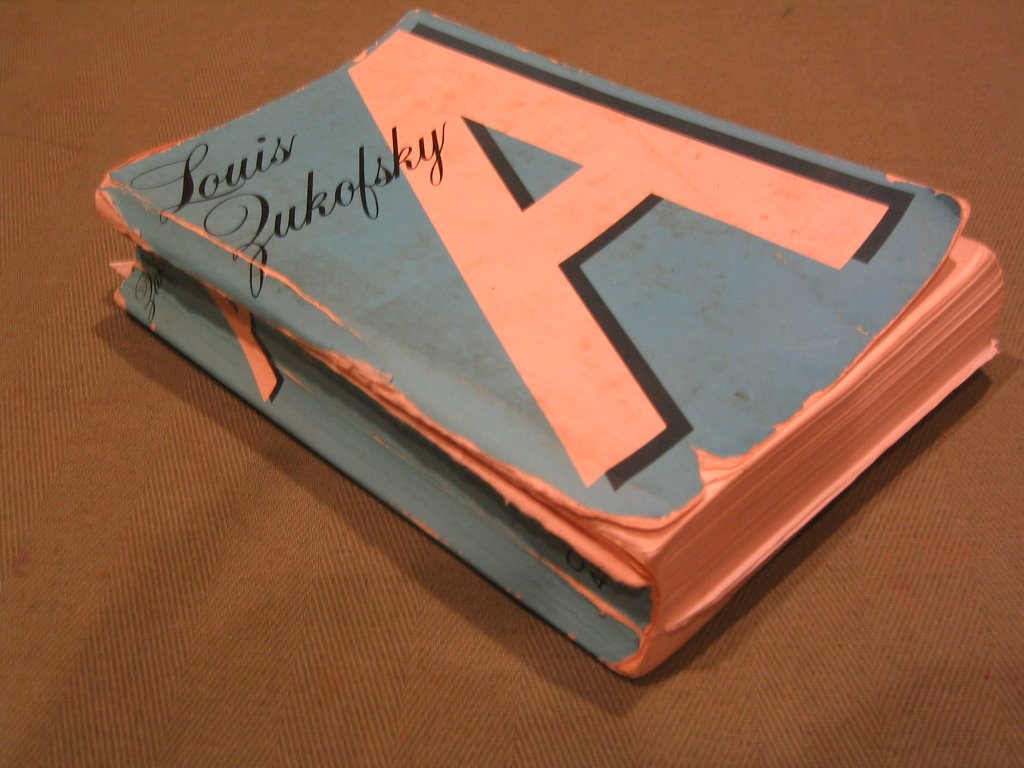
Louis Zukofsky: "A"

Grades are in.
***
So I'm fairly well launched on one of the summer's big reading projects, Hegel's Phenomenology of Spirit, taking as guides a small stack of (randomly-happened-upon) secondary works & the syllabus for Steve Evans's Hegel seminar this past semester. I have to admit that one of the things that intrigued me most about Steve's little encomium to Robert Pippin, his former teacher (here; scroll down a bit), was the shot of (what I take to be) Steve's own Hegel shelf, with its disintegrating copy of the Phenomenology. It reminded me a book that I'm again in the middle of reading – Zukofsky's "A".


I don't know how many times I've read "A". The very condition of my working copy of the book testifies to that. I can still recall unpacking it out of a big box from the University of California Press in my dorm room in Barringer Hall at Virginia Tech, a box containing a hardcover of The Maximus Poems, George Butterick's Guide to same, Prepositions, & Barry Ahearn's Zukofsky's "A". (U of C was having a really big sale...) That was 20 years ago, almost half my life, & I had no idea that I'd be devoting so much of it to LZ.

I've picked up several copies of "A" since then: a hardcover of the U of C edition, similar to the powder-blue paperback except for the fact that its cover is in pink & includes the quotation marks around A that LZ insisted upon; library discards of the Doubleday/Paris Review "A" 1-12 and "A" 13-21; the Grossman "A"-24; both American (Viking/Compass) & English (Trigram) editions of "A" 22 & 23; and a jacketless copy of the signed, limited edition Turret "A"-14. Not to mention a second printing of the Johns Hopkins republication of the complete "A", in a slightly larger format but with identical contents to the U of California edition.

I have a deep fondness for my paperback California "A", despite – or probably in part because of – its dilapidated condition. The notch at the bottom comes from the time in Ithaca I grew so frustrated with the book that I threw it across the room. There are of course my own marginalia – pencil marks so worn that they've become illegible, fountain pen underlinings that have bled thru to the next page, three or four different colors of ballpoint. It's not that I find much wisdom or insight in those markings: indeed, many of them are the conventionally puzzled, dopey scribblings of an ignorant 25-year-old (or an ignorant 30-year-old, or...): in short, pretty embarassing.

But I suppose I find this ratty book comforting in that it's evidence that there's at least one book in the world that I've read almost to pieces, even if I make no great claims as to how well I understand it or how much of it I can quote off the top of my head. Somewhere in Ways of Seeing, Berger comments on how frequently 19th-century boardrooms were decorated with lavish paintings of nude women, so that when a man of state or business was outwitted, he might look up "for consolation. What he saw reminded him that he was a man." When I've met defeat on my third attempt to make sense of a paragraph of Hegel's, I can cast my eye on my bookcase and think, "at least I've read 'A'."

Saturday, May 06, 2006

Thises & thats

A brief note before the weekend – which is gonna be way gnarly, what with the stack of papers still to be graded & the final marks to be crunched. Largely heartened, however, by the final seminar papers from "Poetry & Theory," some of which were little short of dazzling.
***
Read Gillian Conoley's Profane Halo (Verse, 2005), & found it very, very good. Why haven't I heard of this poet before? I don't get out enough. Still welcoming suggestions for recent (last 3 years or so) absolutely dazzling books of poetry for my fall course.
***
Random 10:

1) "Cold Light," Yeah Yeah Yeahs, Fever to Tell
2) "Loisaida," Elliott Sharp, Nots
3) "Lantern Marsh," Brian Eno, Ambient 4/On Land
4) "Lonely Are the Dumb," John Zorn, Filmworks XIII: Invitation to a Suicide
5) "Deusa do Amor," Moreno Veloso +2
6) "Hair Pie: Bake 1," Captain Beefheart and the Magic Band, Trout Mask Replica
7) "Chusen Kale Mazel Tov," David Krakauer's Klezmer Madness!, The Twelve Tribes
8) "Beatrice," Daniel Lanois, For the Beauty of Winona
9) "I Will Be a Good Boy," Gang of Four, Songs of the Free
10) "There Will Never Be Another You," Alex Chilton, Set

Friday, May 05, 2006

Eric's back!...

so hie thyselves over to Say Something Wonderful and give him tips about how to teach Tender Buttons and Lifting Belly – and make 'em like it!

Thursday, May 04, 2006

Various

Quote of the month (so far) – Donald Rumsfeld: "I'm not in the intelligence business." You don't say.
***
All of you folks in the 40-and-under demographic should be submitting to Jessica Smith & John Sakkis's Anthology; you know who you are. I fear I just miss the cutoff, & am feeling too grey & tired (exam week, right?) to make the "young at heart" argument.
***
I'm beginning the slow process of cooking my fall syllabi, & have my antennae up for outstanding books of poetry published over the past 3 years or so. Anybody got any favorites that they think ought to be kicked around a seminar room by a bunch of hungry young poetry writing students?

Zukofsky abroad...

in Botswana, of all places (thanks to Croissantfactory). Interestingly enough, Tshireletso Motlogelwa, the article's author, quotes from the early, unrevised version of "A"-8, rather than the versions which appeared from 1959 onward (compare pp. 48-9 of the U California/Johns Hopkins editions). So either he found the poem in a late-1930s New Masses (where this "workers' song" first appeared), or he's stumbled upon New Directions in Poetry and Prose 1938 (which printed all of "A"-8), or he's seen my LZ and the Poetry of Knowledge. For my part, I like to imagine contemporary Botswanan progressives finding sustenance in the back files of New Masses.

Tuesday, May 02, 2006

Sleeping Arrangements


Long bedtimes at the Scroggins-Low household these days. We're trying, that is, to move both of the girls into a single room, thereby freeing up the larger of their bedrooms to serve as a playroom/ toy-storage-area/ guestroom. Luck has been sporadic thus far. Daphne (to the left, in full pirate/ hula girl outfit) is all for the idea, since she admires her sister to nothing less than idolatry. Getting to sleep in a pack 'n' play (that's a portable crib, for those of you who haven't been totally indoctrinated in the product industry associated with American infancy) – and eventually, in her own permanent crib – in the same room with Pippa is for her the equivalent of your average Young Republican getting to sit at the high table with Karl Rove.


Pippa (brunching with her friend Maddie, on left), on the other hand, approaches the whole matter with far more circumspection. Okay, so it's nice to have my sister in my room, especially since she's confined & can't get at any of my stuff. And it's kind of fun to swap giggles for a while after bedtime, and to make our talking Teletubbies talk to one another across the room. But do I really want to bunk down with a party animal who just doesn't know when to stop? I've got to get up for preschool in the morning, but my sister's happy to keep laughing, squawking, and playing fort-da with stuffed animals till the moon is high in the sky. What's in this for me?

The big answer: A Bunk Bed. A Bunk Bed With A Slide. Mind you, I think we're asking for trouble – aside from the whole issue of broken collarbones etc., I have a sneaking suspicion that importing playground equipment to the bedroom is going to push actual sleeping time all the way into the ante meridian. It's all an adventure.

Monday, May 01, 2006

Take yr stinkin' May Day...

May Day, of course, has for a long time been associated with unsavory and unAmerican Leftism, movements to liberate workers, to provide equal rights, to improve working conditions, and to do other nefarious things that go against everything that our current Congress and administration stand for. Thank heavens, this truly unChristian, unAmerican, and (most importantly) unCapitalist celebration has been replaced by what the Dauphin and his Capitol Hill supporters have named "Loyalty Day." All together now, let's take the oath...


(With thanks to Jesus' General.)

Saturday, April 29, 2006

Noted, received, audited

With amusement: Michael Blumenthal's farewell letter to his poetry writing students, which puts paid to much of the mushiness all too prevalent in creative writing programs.

And Stephen Budiansky's Times op-ed piece on the branding of American higher education.
***
An influx of bookage: from Jeff Twitchell (proprietor of the absolutely essential Z-Site for Zukofsky research) a bundle of recencies by J. H. Prynne, including the pamphlets (that's English for chapbooks) Acrylic Tips and Biting the Air, and a copy of the hard-to-find lectures Stars, Tigers and the Shapes of Words. I can't wait to read, once I get through this stack of papers.

Perhaps most surprisingly, the local used bookstore divulged a copy of the 1967 Pennant Key-Indexed Study Guide to Homer's The Odyssey, by Guy Davenport, Ph.D. I won't tell you what I paid; look it up on abe.books, and rest assured that what it cost me would make a bookseller weep. (That's okay – these good folks have gotten enough of my money in the past, & will get enough in the future.) I'm always fascinated by the spectacle of a really interesting writer taking on scutwork – LZ's Index of American Design writing, for instance, or Pound's music reviews. And this one even has the advantage of Guy's own drawings of Achaian armor & suchlike.
***
& the weekly random 10:

1) "Lathe of God," Painkiller, Guts of a Virgin
2) "Lanterns," Killing Joke, Democracy
3) "Hal-an-Tow," Oysterband, Trawler
4) "St. Valentine's Day," Mekons, I Love Mekons
5) "The River," Brian Eno
6) "Tincans," Oysterband, Ride
7) "Sixteen Dances X," John Cage
8) "Coney Island Baby," Tom Waits, Blood Money
9) "My Lady Careys Dompe," Philip Pickett with Richard Thompson, The Bones of All Men
10) "One of These Days," Velvet Underground, Gold

Thursday, April 27, 2006

The home stretch

Okay, so now it's all over but the grading, which I was puttering at today as I nursed a hangover from last night's last meeting of my "Poetry & Theory" seminar. Now that was fun: I nattered on for a while trying futilely to tie together some of the ideas in play during the last few weeks of class, then we kicked back to watch the second half of The Ister, all well-lubricated by many bottles of wine, some choice Belgian cherry beer, and Pernod with Perrier. Very decadent. And then off to the local "English" pub, where we bemused various antipodean rugby-playing regulars by talking at great length about Celan and Heidegger.

The course, which I'd been contemplating for some time, didn't quite come off as I'd planned (tho of course they never do). I'd foreseen the whole thing pivoting as it were around the materialist readings I'd programmed towards the middle – Antony Easthope, Adorno, Bernstein – but it turned out that the Celan unit at the end (Celan, Szondi, Gadamer, Derrida, Lacoue-Labarthe) captured my own imagination (and evidently the imaginations of some of the seminar members) even more than I'd expected. "Primary" texts: "The Meridian," "Du liegst," "Todtnauberg," and a handful of other Celan poems and talks, read thru the progressive prisms of Szondi's "Eden" essay fragment, the afterword to Gadamer's Who Am I and Who Are You?, bits of Derrida's "Shibboleth," and Lacoue-Labarthe's Poetry as Experience. Key themes: the poem's occasion; the "date" inscribed in the poem; the poem as "dialogue," "message in a bottle"; the status of extratextual reference (in a poetry PC himself always insisted was "ganz und gar nicht hermetisch" – yeah, right).

As if we didn't have enough balls in play over the past few weeks, midway thru the semester I got a brand new book which threatened to play the "archival research trumps speculative theory" card: James K. Lyon's Paul Celan and Martin Heidegger: An Unresolved Conversation, 1951-1970 (Johns Hopkins UP, 2006).* I'm looking forward to the reviews and responses to this one, which goes a really long way towards undermining a reading of the poem "Todtnauberg" as a record of Celan's bitter disappointment with his 1967 meeting with Heidegger at the philosopher's Black Forest cabin at Todtnauberg. It's a record of the meeting, all right, but Lyon shows – in a manner which looks pretty damned scrupulous – that when the poem was written, six days after that meeting, Celan by all reports was on a Heidegger high: he wasn't disappointed at all by what MH had told him about his (MH's) involvement with the Nazis, nor was he bitter about MH's silence concerning the Holocaust; on the contrary, he appeared to be well pleased with what he'd gotten out of his face-time with Heidegger.

All this, of course, contra the received reading of "Todtnauberg" (cf. Lacoue-Labarthe, and Pierre Joris in various places, & lots of other people). It all appears to be a matter of various readers reading Celan's disappointment and bitterness – oh yes, he changed his mind about Heidegger, tho he never stopped reading him, and even met him a couple more times before his death – back into a poem which was written before that reaction set in, and which – on its face – seems to bear few marks of anything other than a dispassionate note-jotting about a serious and much-anticipated meeting.

But I'm convinced, even tho one might have to scrap a reading of "Todtnauberg" that attributes bitterness and disappointment to its original occasion – to find that "date" inscribed in that particular manner – that there's still a good deal of truth in Lacoue-Labarthe's assessment of the poem as "an extenuated poem, or, to put it better, a disappointed one. It is the poem of a disappointment; as such, it is, and it says, the disappointment of poetry." Somewhere percolating in the depths of my mind, and sparking among these various texts, is the material for a proleptic theory of poetry, in which the poem rises up to meet the conditions for its future reception. But it'll have to wait until I get thru all these papers.

*This is not a book I'd recommend either for its stylistic flourishes – none, on the contrary a kind of dogged, repetitive presentation of facts and documents – nor for its theoretical sophistication; but it is an example of the sort of strenuous (almost "Germanic"?) archival scholarship that's perhaps a bit too rare today.

Tuesday, April 25, 2006

Noted

Jane/Joshua's "Cut 'n' Paste Poetics Blogwar," which is almost too accurate to be funny.
***
Lori Jareo, a big Star Wars fan, has advertised her "non-canonical" print-on-demand SW novel, Another Hope, on Amazon.com; unfortunately, she never got around to asking the Lucas people for permission to write about their "universe." Cease and Desist orders have gone out.

I would say "ho-hum," with a bit of the raised eyebrow at the genre of "fan fiction," about which I knew precisely nothing before this crossed the radar screen, except for the fact that Jareo, it turns out, is also one of the proprietors of the WordTech Communications poetry publishing outfit, a POD unit that on its face seems to be making a good faith effort to provide a book outlet for poets who are entirely unplugged from the "scene." And she's published her Stars Wars thing, it seems, under the same imprint. Oh dear. Kids, remember the old school punk adage? If the labels won't bite, then DIY.
***
[Of interest only to academics – and those who don't want American universities entirely subcontracted out to WalMart and Halliburton:] An "issue paper" from the Department of Education on why college costs so much: it's the faculty, of course. Only room for a few choice morsels of this business-school produced piece o' crap:
The time-honored practice of tenure is costly. Tenure was originally conceived as a means to protect “academic freedom.” [dig those scare quotes] It has evolved into a system to protect job security. A combination of institutional practice and emerging case law has resulted in a situation where institutional flexibility is reduced in two key ways. First, if student demand for academic programs shifts [of course, the life of the mind has always been demand-driven], faculty capacity to deliver it cannot. Tenured faculty members are not interchangeable parts (a physics professor can’t usually teach journalism, and vice versa). [duh]

Colleges are not managed with efficiency as the primary value. [where in God's name did this fellow get the idea that they should be?]
a. Colleges maintain large physical infrastructures that often include libraries, computing centers, academic and student-oriented buildings, power plants, research facilities, theatres and stadiums. This infrastructure is rarely used to capacity.

To understand the management of a college one must understand the unique culture and extraordinary power of the faculty. [Where does this guy teach? I want a job there!] To many faculty, they are the university. [I don't believe this, entirely: in my mind, the university is first its students; then its faculty; then the staff who support the teaching and research that goes on in the institution; I imagine I disagree with Robert Dickeson (the report's author) in seeing administration – what he calls "management" – as little more than a necessary evil. "That government governs best that governs least," said somebody wiser than either of us.] This tenet explains a number of practices that distinguish college management from most other forms of management. Among these practices are: the keen importance of process in undertaking decision-making on campus, a factor that explains the slow-moving pace of change that characterizes most institutions; the assumption that the faculty “own” all curricular decisions, and the concomitant reluctance to challenge that authority when meaningful reform is indicated
The ultimate solution? Scale universities back to internet-based vocational programs serving only the skills students demand the most in order to become happy, profit-making parts in the great industrial machine. No more tenure – those online courses can be taught entirely by adjuncts; no more physical libraries – after all, they can get any data they need on the internet; no more wasteful "research" "releases" for the folks chained to their keyboards grading exams.

Comments on this abomination on Inside Higher Ed and Michael Bérubé.

Boxing Duchamp


In all my excitement over The Ister, I forgot to mention a new arrival in the household that will probably hold my attention much longer: an anniversary present, the big book Marcel Duchamp: The Box in a Valise (de ou par Marcel Duchamp ou Rrose Selavy): Inventory of an Edition, by Ecke Bonk (Rizzoli, 1989). I've always been fascinated by Duchamp, & convinced that his ideas about art probably have a lot of bearing on contemporary poetry. (For instance, his early and repeated rejection of "retinal art" – art that provides immediate sensual pleasure to the eye – in favor of an art of ideas, an art that appeals to the mind rather than the senses, is probably of some relevance to the discussion of the relationship between intellectuality and immediate apprehensibility in alt-poetry going on over on Josh Corey's blog these days.)

The Box in a Valise is an exhaustive and loving chronicle, with pictures and diagrams of every detail, of Duchamp's monumental-miniature "late" work, the Boîte-en-valise, a handy wooden carrying case containing reproductions – most of them made thru painstaking and enormously time-consuming handicraft methods – of all of his major works, and most of his minors. There's a wee clay model of "Fountain," the signed urinal; there are hand-colored reproductions of all of the paintings; there are precise simulacra of his odder projects (the fake checks, the Monte Carlo investment "bonds" Duchamp had made for his own attempt to break the bank at roulette; there are photos of most of the ready-mades).

It's an amazing, and amazingly obsessive project. It took Duchamp over five years of full-time labor to produce the reproductions of his works for the approximately 350 copies of the Box, and he would release the finished products in "homeopathic doses" of maybe 20 to 30 over the last 27 years of his life.

It's a gesture I really love: a pocket "canon," as it were, an artist assembling – on his own idiosyncratic terms – the sort of catalogue raissoné that most artists have to wait a lifetime to see published. Or perhaps I'm just drawn to it by my own longstanding obsession with miniaturization, with shrinking the big down into the little. Zukofsky claims somewhere that 80 Flowers – a book that totals 648 lines of verse – was the compact version of his entire life's work. Something to be said for shriking it all down into something you can tuck under an arm and walk away with. Thoreau would approve.