Friday, September 14, 2007

unlikely source

Happened upon this bit of sub-Kipling schoolboy good cheer, as writen in an autograph book:
When a bit of sunshine hits you
After passing of a cloud,
And a bit of laughter gets you
And your spine is feeling proud,
Don't forget to up and fling it
At a soul that's feeling blue,
For the moment that you sling it
It's a boomerang to you.
The author? Samuel Beckett. As biographer Anthony Cronin comments, the boy in whose book Beckett inscribed these lines "thought that they were an accurate reflection of his attitude. It is fairly safe to say that no one would ever think so again."
Hamm: Go and see is she dead.
[Clov goes to bins, raises the lid of Nell's, stoops, looks into it. Pause.]
Clov: Looks like it.
[He closes the lid, straightens up. Hamm raises his toque. Pause. He puts it on again.]
Hamm: [with his hand to his toque] And Nagg?
[Clov raises lid of Nagg's bin, stoops, looks into it. Pause.]
Clov: Doesn't look like it.
[He closes the lid, straightens up.]
Hamm: [letting go his toque] What's he doing?
[Clov raises lid of Nagg's bin, stoops, looks into it. Pause.]
Clov: He's crying.
[He closes lid, straightens up.]
Hamm: Then he's living.
Poetics of the pause.

Monday, September 10, 2007

Shax?

Now that I'm just pissing blood & tiny pointy shards, as opposed to writhing prostrate in full-flank agony, I can get back to actual blogging. I'm pleased to see my colleague Emily over at Incertus getting exercised by the silliness of the anti-Stratfordians again – always a healthy workout for the cardio-vascular system, I think. Like 6-day Creationists & Holocaust deniers, those who deny Wm Shakespeare's (or as they style it, thinking they're saying something significant, "Shakespere's") authorship of "Shakespeare" will always be with us – indeed, I encourage Creationists & Holocaust deniers to look into the authorship "controversy," since they're liable to do a great deal less harm in that little wing of the grand crank factory than in the world at large.

The whole business is only irritating when celebrities get involved – as with this latest Derek Jacobi/Mark Rylance business, or earlier with John Gielgud & Kenneth Branagh, or Walt Whitman & Charlie Chaplin – because then public attention starts getting drawn to the whole non-question. The problem, of course, is that if there were any real controversy over who wrote Shakespeare, the people capable of solving it would be clear-sighted scholars with an encyclopedic knowledge of Renaissance literature & a firm grasp of early modern culture – the culture of the playhouse, of the literary marketplace, of the publishing industry, & so forth.

It's pretty hard to find such animals among actors & creative writers, I'm afraid. Indeed, a 1st-rate analytical mind, tho it never hurts, is far from necessary equipment for acting well or writing well: Do you want Johnny Depp to do your taxes? To edit your term paper? I adore Yeats & Whitman as poets, but I'm the 1st to admit that their intellects were serious effing muddles. So, frankly, who gives a rat's ass what Derek Jacobi or Mark Rylance think about the authorship question?

Culture Industry has visited the authorship "controversy" at least once before, in connection with an Oxfordian book; it sprang to my mind the other day, when I was googling Henry Peachum & anagrams (don't ask) & fell afoul of a whole nest of mind-bendingly obtuse websites on the subject. In my random moments, I keep coming up with lists of questions to ask the anti-Stratfordians:

1) Since you wonder at the fact that Shax of Straford didn't leave any books in his will, what's the data on books in the wills of other dramatists of the period: Middleton, Chapman, Heywood?

2) No letters in Shax's hand? How many letters do we have from Middleton, Chapman, Fletcher, Ford?

[The problem with demanding of Shakespeare the whole written trail that characterizes someone like Goethe or Wordsworth – autographs in people's notebooks, recounted table-talk, laundry-lists, etc. – is that Shax lived before the author became a celebrity. The William Shakespeare who wrote the plays was not the deified Shakespeare of the 19th & 20th centuries, or even the proto-deified Shakespeare of the 18th. He was simply WS, a player & playwright, a script doctor & collaborator, a guy who worked up old stories into playable scripts & rolfed antiquated plays for a contemporary audience.]

3) If there is really such a paucity of information about Shakespeare – a fairly prolific early modern playwright, though by no means among the most prolific – then name one other early modern playwright (other than Ben Jonson, an indefatigable self-promotional machine) about whom we know as much. Thomas Heywood, who claimed to have had a hand in over 200 plays, but whose birth date we don't know? George Chapman? Thomas Middleton?

4) If, as Derek Jacobi is so convinced, "an author writes about his own experience" – a simple-minded equation essential to the thought-processes (generously so-called) of at least the Oxfordians – please explain Sir Walter Scott's 27 novels, not one of which is based on events of his life. Then explain the personal roots of Robert Browning's dramatic monologues, Alfred Tennyson's Idylls of the King, & Edmund Spenser's Faerie Queene.

Unlike Amy & Emily, I'm not inclined to get worked up over the elitism inherent in claiming that a person of Shakespeare's social background couldn't have written the plays. The elitism's certainly there, & just as ugly as such elitism always is. But everyone who knows literature knows that social elitism simply has no force in the world of letters, that far too many great writers came from the working or middling classes (John Clare, Ben Jonson, Louis Zukofsky, James Joyce) for class origin to be an ultimate bar to the imagination.

Instead, I sympathize and pity the anti-Stratfordians. They love their "Shakespeare" – or some plaster Jesus of a Shakespeare: I've yet to read an anti-Stratfordian book (& I've read way too many of them) that goes beyond a kind of muzzy high-school-level affectionate appreciation of the dramas – so much that they want to know everything about his life. But there is just so little to know about him. So they spend their time constructing Dumas-like conspiracy theories that give the man who wrote the plays an existence as exciting as Lawrence of Arabia's. If they need a new thrill, maybe they should try reading The Seven Pillars of Wisdom.
***
The real scandal in the BBC story, by the way, comes in the last section, where we learn that a copy of the Jacobi/Rylance declaration has been "presented to Dr William Leahy, head of English at London's Brunel University and convenor of the first MA in Shakespeare authorship studies, to be launched later this month." This is, mind you, the equivalent of Georgia Tech announcing that they will be offering an MA in Intelligent Design studies; or MIT announcing a chair in Phlogiston Theory. Isambard Kingdom Brunel – great architect of suspension bridges, chief engineer of the Great Western Railway, builder of the Thames Tunnel – is spinning in his railway-gauge grave.

Friday, September 07, 2007

Embodiment, ii

[Guy Davenport, from the introduction to Montaigne's Travel Journal:]

He is, in a surprisingly modern sense, a tourist, with a tourist's interest in the amenities of the table and the bedroom. He is also, as we are never allowed to forget, a man in pain looking for a cure. His body cannot use certain minerals, such as calcium, which accumulate as pellets in his kidneys and bladder. The pain of a kidney stone is fierce, and in a male can be comparable to a woman's labor. The frequent "colic" in this journal (assuming that to be Montaigne's word for an attack of the stone) is a severe nausea in combination with the feeling that one's back is broken and that one's bowels need to move. Montaigne was fortunate in being able to pass his kidney stones. Another sufferer, Sir Walter Scott, could not, and abided pain of excruciating intensity for as long as two weeks at a time, helplessly screaming and hearing the New Testament read to him. Montaigne's constant scrutiny of his urine in a chamber pot, his colics and dizzy spells, his ability to drink heroic amounts of hot sulfurous water, locate his journal in a time when the body was still part of personality. Later, it would disappear. Dickens' characters, for instance, have no kidney stones because they have no kidneys. From Smollett to Ulysses, there is not a kidney in English literature.

Monday, September 03, 2007

Embodiment

My own relationship with my body is at best an equivocal one – & by body I mean the whole apparatus, from fallen-arched feet to mostly-bald head, including my face, the only aspect of my embodiment to make a regular appearance at this address in cyberspace. Even when I was young, thin, & by some accounts not actively ugly, I regarded my physical body as less me than as a kind of container or sheath by which I presented myself to others.

I suspect such residual Cartesianism is fairly widespread among those in the scribbling trades or doing other intellectual labor. We identify our selves with our minds, with our words. We have no trouble identifying Mikhail Baryshnikov squarely with his physique, with an exquisite overall coordination among brain, talents, skills, & toning. But who would associate the agile graces of Wallace Stevens's lyrics with the portly, hypertensive animal from which they emanated?

And the virtual community of the blogosphere, where one can circulate for years without attaching a face even to the bloggers whose writing you most admire, conduces to a kind of self-disembodiment even as one blogs.

This particular Labor Day Weekend, however, will go down for me as The Weekend Of The Kidney Stone; & nothing about it – save for a few rather pleasant but unfortunately brief opiate-fuelled reveries – has been remotely disembodied.

This is pain, my friends – in long, dull stretches; in concentrated, savage waves; sometimes easily quelled with Percocet or prescription-strength doses of Aleve; sometimes entirely ignoring all pharmacologies – this is pain like I've never experienced. And it make me aware of my dear old flabby, greying, obtuse body with a kind of horrifying intensity.

Thursday, August 30, 2007

Cambridge Companion!


After the usual delays, I'm happy to announce that the Cambridge Companion to Modernist Poetry – edited by the estimable Alex Davis & Lee M. Jenkins – has just turned up in my mailbox. It's a substantial volume, covering poetic modernisms of all stripes, British, American, Irish, African American, and post-colonial. The contributors' list, which reads like a who's who of modernist poetry scholarship, includes Peter Nicholls, Christanne Miller, Lawrence Rainey, Rachel Blau DuPlessis, Drew Milne, Bonnie Costello, & Jahan Ramazani.

And surprisingly enough, yr. humble blogger has an essay in there as well, bearing the snappy (?) title "US modernism II. The other tradition: Williams, Zukofsky, Olson." (It's odd to see one's prose in British clothing – punctuation, capitalization, etc.; but still gratifying.) American shoppers can buy this terrifically valuable volume here.

Tuesday, August 28, 2007

Yellow Zukofsky


Or, another set of artist's supplies down the tubes...

Monday, August 27, 2007

L'Affaire Finkelstein

I too have suffered from being an homonymous author. There is a Mark Scroggins out there who is the author of a biography of Hannibal Hamlin, Abraham Lincoln's first running mate. For a while the Library of Congress was convinced we were the same person, & apparently the other MS's publisher has no better idea of where he is than I do, since they've been sending me correspondence relating to Hannibal: The Life of Abraham Lincoln's First Vice President. & this is not to mention the Mark Scrogginses out there who are lawyers, professional bowlers, Baptist ministers, & deer hunters.

My discomfort is nothing compared to that of my old friend Norman Finkelstein, poet, literary scholar, and professor of English at Xavier University in Cinncinnati. Norman's sorrow is that he is always in danger of being mistaken for Norman G. Finkelstein, the ragingly controversial political scientist who until recently has taught at DePaul University in Chicago. My Norman Finkelstein – henceforward "the uncontroversial NF" – and I have been friends & co-conspirators for many years now, & in the days to come I will blog his newest book of poems, the limpid Passing Over. (Please go buy it, nu?)

[On the left: the poet Norman Finkelstein]

I don't want to cause my NF – the "uncontroversial NF" – any further discomfort (he's gone so far as to post a "disambiguation page" on A Big Jewish Blog, the wonderful conversation on matters Jewish & poetic that Eric Selinger started some time ago). But the latest turn in Norman G.'s tenure battle at DePaul has gotten me so riled up this morning that I'm unable to concentrate on my syllabi, to answer my e-mails, to do anything but splenetically blog.

The story is long and complex – Wikipedia has a not unfair summary of its earlier twists & turns on its NF page, & here, & a comprehensive collection of documents from both sides can be bound on Norman G's own website. Suffice it to say that Norman G. has written forcefully & at length about Palestinean/Israeli relations, about what he sees as the "exploitation" of the Holocaust for self-serving reasons by various groups, & about the Israel lobby in Washington. His work is controversial in its arguments & premises, & even moreso in its modes of argument, which combine withering sarcasm, angry invective, & even occasional ad hominem attacks.

His first four books drew accusations of Holocaust denial & anti-Semitism (both rather silly, I think); his critics were more accurate in finding Finkelstein a fair representative of a kind of left-leaning anti-Zionism. The fat truly hit the flame, however, when Norman G. tangled with Alan Dershowitz, who, when he's not defending celebrity clients like OJ Simpson & Claus von Bulow or figuring out circumstances under which torture is actually okay ("get a warrant"), is the Felix Frankfurter Professor of Law at Harvard Law School. Norman G. attacked Dershowitz's 2003 book The Case for Israel, calling it "a collection of fraud, falsification, plagiarism and nonsense." Dershowitz responded by attempting to stop the publication of Finkelstein's next book, Beyond Chutzpah: On the Misuse of Anti-Semitism and the Abuse of History (Dershowitz went so far as to send a letter to Arnold "the Governator" Schwartzenegger asking him to intervene & get the University of California Press to kill the book).

This past academic year Norman G. went up for tenure in the Poly Sci department at DePaul. In September 2006, Dershowitz sent a weighty "dossier" of anti-Finkelstein material to DePaul poly sci & law faculty members & DePaul administrators (and, by some accounts, to DePaul boosters), urging them to deny Finkelstein tenure. The case bounced back & forth; his department voted 9-3 in favor of tenuring NGF; the college personnel committee voted 5-0 in favor of tenuring him; this past June, by a 4-3 vote, a university committee voted to deny him tenure. The University's president, the Rev. Dennis Holtschneider, affirmed the decision, & held out no possibility of appeal.

In one of the more spectacular displays of disingenuousness I've encountered, Holtschneider & others in the DePaul administration have repeatedly denied that Dershowitz's campaign against Finkelstein had anything to do with his denial of tenure. (The stated reason was that Finkelstein's scholarly work, while largely unimpeachable in terms of content and scholarly methodology, was just plain not very nice to those who disagreed with him – a violation of "Vincentian ethics," whatever those may be.) Let's be serious: Finkelstein is right on the money when he notes wearily that the validity of his work has nothing to do with the tenure decision: since he's become a target of one of the most prominent "centrist" talking heads in the country, he's become a liability to DePaul, someone who's unfortunately apt to get in the way of the University President's primary job – fundraising.

The final indignity has just come down the pike: After one is denied tenure, one usually has what's known as a "terminal year," a final academic year in which to teach, to wind up one's affairs, & to look for work. DePaul is paying Norman G. for a terminal year – but they've cancelled his classes & locked him out of his office. Shame on DePaul; shame on Fr. Holtschneider. Of all of the shabby tenure tales I've heard over the years, this is the shabbiest.

[On the right, Norman G. Finkelstein, man without an office]

Sunday, August 26, 2007

Summer reading, 2007

Summer break is officially over tomorrow, tho I've a couple more days before my first classes. A moment to recap some of the highlights of the summer reading (none of it, alas, at the beach):

•Great bales of Virginia Woolf, early late & middle. Of the early ones (the ones I knew least), it's safe to say that I found The Voyage Out very moving, & beautifully written – Woolf finding her way to a modernist idiom, not quite getting there, but forging something quite lovely sui generis. Night and Day, on the other hand, seems a step back: a Victorian novel about 20th century problems, but structurally still a Victorian novel, with all the attendant bric-a-brac (& very little of the humor).

•Of the various wee books of poetry, Myung Mi Kim's Commons (U California P, 2002) & Erica Carpenter's Perspective Would Have Us (Burning Deck, 2006) grabbed me by the lapels & shook me. Carpenter, especially, has a wonderful lyric gift.

I'm in the middle of Benjamin Friedlander's The Missing Occasion of Saying Yes (Subpress, 2007), which is more good short poems than anybody has a right to have written. Somehow I'd missed his last big collection, A Knot Is Not a Tangle, & The Missing Occasion reminds me just how wry & simultaneously moving Ben's poems can be. (More later on this one...)

•Joseph Donahue's Incidental Eclipse (Talisman House, 2003) has one of those blurbs from John Ashbery – you know what I mean, "one of the major American poets of this time" etc. But y'know what? – while I'm not a race-horse kinda guy (my father-in-law used to try seriously to rank the top 10 writers of the 20th century), & I find myself just as keen on the fascinating "minor" as the imposing "major," Incidental Eclipse is a fascinating, incredibly moving book. I've stopped to read Joe's work whenever I've come upon it for some time now; this is the moment where he turns into something big.

•Things Davenportian: On the one hand, the Guy Davenport / James Laughlin letters. Frankly, I didn't understand why these got published – okay, Guy was one of the great letter-writers, but Laughlin was kind of a late friend for him, the publisher who stepped into the gap when North Point went down, but who only put out 4 or so of 20+ books. Then it hit me – of course, Norton has a series of volumes of selected Laughlin correspondences (Pound, WCW, Delmore Schwartz, Rexroth, etc.). Lots of discussions of book publishing. Too many anecdotes, too much Laughlinian skirt-chasing.

On the other hand, a bare beginning into Andre Furlani's Guy Davenport: Postmodern and After. I'll be damned – a critical book that approaches its subject with nothing less than admiration. How quaint! Furlani writes forthright sentences, & strives to knit his subjects together in an echt Davenportian manner. We'll see how well he keeps it up over the long haul of this study.

Friday, August 24, 2007

Our Fair University on the blogosphere, again

Margaret Soltan at University Diaries has a knack for picking up on the most embarassing news items relating to Our Fair University. Today she's fastened upon the proposed new "fitness center"; I think she's a bit savage, at least in the comments box, but you decide.

Thursday, August 23, 2007

marketing modernism


Somewhere in my mother's house in Tennessee are great stashes of 40s- & 50s-era paperbacks of modern classics – Faulkner, Fitzgerald, Aldous Huxley – with lurid, ripped-bodice paintings on the covers. But they don't come anywhere near the cheekiness of this Russian item stumbled upon on eBay. Yes, that's a Virginia Woolf omnibus volume, including Jacob's Room, Mrs Dalloway, To the Lighthouse, and Orlando. Funny thing, I've read all of those books, & I don't remember the illustrated scene taking place in any of them. (Tho there's a Tilda Swinton moment in the movie of Orlando that comes close.)
***
By all means scroll down to the last entry & take the informal poll. I've got the itch to buy books, even if only on the library's dime.

Wednesday, August 22, 2007

informal poll

My mind these days, as so often at this end-of-summer, feels like an unmoving swamp. I hanker for new things, new sounds, new poets. So, an informal poll: who, among that vast sea of talented & interesting writers out there, is exciting you these days? Let's leave the honored dead out of the reckoning; send me – backchannel or in the comments box – a list of the dozen or half-dozen contemporaries whose poetry seems most alive to you at the moment. Help MS jumpstart his joie de vivre.

housekeeping

In the interests of keeping visitors provided with diverting reading, I've done some pretty significant beefing-up of the blogroll – a number of the poetry-ish sites I visit regularly, but also a few academic blogs that I've been dropping by lately. By "academic blogs," I don't mean blogs on which folks who happen to be in the academy spend serious time discussing issues within their discipline (tho that happens, as well), but blogs by people (usually graduate students, adjuncts, untenured faculty, & other members of the vast exploited brain-proletariat) who're thinking about & tracking the experience of living within the academy. How do you recognize such a blog? Well, it's usually got an at least semi-clever, often ironical title ("Academic Wasteland," "Not of General Interest"); the author is usually anonymous (no doubt in acknowledgment of the various "blog & you won't get hired/get tenure" scares across the web over the past couple of years); and the blogger tends to do a good deal of agonizing these days over syllabi, class numbers, & room assignments. Like I'm doing right now.

And reading Will Eisner's The Contract With God Trilogy, which is damned fine stuff. More fun than Henry Roth, any day of the week.

Monday, August 20, 2007

Jessie Sheeler: Little Sparta

When we honeymooned in Scotland, J. & I visited Sir Walter Scott's Abbottsford, we walked the Castle battlements, we saw Hugh MacDiarmid's stomping grounds in Biggar. But we didn't make it to Ian Hamilton Finlay's astonishingly rich poet's garden, Little Sparta. Gael Turnbull gave us Alec Finlay's number, counselling us that it would be better to contact Eck than to phone his father directly, but it turned out the younger Finlay was out of the country, and one thing succeeded another in the usual flurry of touristing.

So my "experience" of the garden has been limited to illustrated articles in places like Architectural Digest & various books on contemporary landscape architecture, & to Yves Abrioux's sumptuous and indispensible Ian Hamilton Finlay: A Visual Primer. Jessie Sheeler & Andrew Lawson's Little Sparta: The Garden of Ian Hamilton Finlay, then, is a welcome & enlightening guide to Finlay's major life-work.

Like no other text I've yet seen, Sheeler & Lawson's coffee-table book manages to give one a sense of what it might be like to walk thru the garden, to experience it in situ, rather than as a series of snapshots. The pictures – Lawson, I gather, is a top-notch garden photographer – are uniformly beautiful, everything in eye-popping color and crisp focus. And Sheeler's text is doggedly informative, translating every Latin inscription into English & explaining every classical reference in the patient voice of a young person's Latin teacher (which, it turns out, she is*).

If anything, it's the coffee-table book aspect of Little Sparta that I find a trifle off-putting. On the one hand, among Lawson's beautiful photographs of various aspects of the garden – columns, inscriptions, statues, bridges – are a number of very pretty pictures of foliage & flowers: nice enough, but the sort of thing that could be slotted into pretty much any book about any garden in the British Isles. I'd have appreciated a few more close-ups of IHF's inscribed plaques. And Sheeler's text, while it's thoroughly informed & always informative (if sometimes irritatingly basic for this overeducated reader – I suppose somebody out there needs to have the story of Apollo & Daphne, or of Aeneas & Dido's cave, retold them), tends to render anodyne the more troubling aspects of IHF's ideological art. We're told time & again how Robespierre & Saint-Just were apostles of purity & order; there's all too little mention of how the primary agent of that order was the guillotine. IHF is not interested in aestheticizing the guillotine when he compares it to the classical column or the birch tree: rather, he underlines by shocking juxtaposition the coexistence, the imbrication of terror & the pastoral.

Sheeler's Little Sparta is Sparta as order apotheosized, drained of its concomitant terror. (For a dose of the latter, go watch 300 – which one of my students last semester called his "favorite movie," sending a chill down this 4-eyed wimp's spine.) Dig Sheeler's last sentence:
Those who come prepared to find in Little Sparta works whose essence is poetic, not decorative or horticultural, will find find subsequently that the way they see the world is changed and made more wonderful.
The only word I would quibble with here is the last (& most important): Little Sparta changes the world, and makes it more unsettled, more terrible.

But the heart of this book is its wonderful photographs & interpretive commentary. Anyone interested in landscape architecture, in concrete & conceptual poetry, & in their intersection, should buy this volume posthaste.

*Keen eyes might recognize Sheeler as the Jessie McGuffie who was Finlay's companion in the early 1960s, & who co-founded the Wild Hawthorn Press with him. "Sheeler" is the surname of one of Zukofsky's Brooklyn Polytech students, who visited Finlay & McGuffie in Edinburgh at LZ's suggestion – but therein hangs a painful tale whose outlines can be read in my The Poem of a Life: A Biography of Louis Zukofsky.

Thursday, August 16, 2007

whom you ought to be reading

I sense my blogging has become sclerotic lately, that I'm giving in to my tendency to wait until I have almost the beginnings of an essay on hand before writing anything. (Or I post continual promotional snippets for forthcoming things – nothing wrong with that of course, but not the best reading...) I got no desire to turn Culture Industry into a diary (resounding yawns from potential former readers), but I hanker for something a trifle more off-the-cuff, casual. Like, for instance, Jonathan Mayhew's consistently casual, consistently rivetting Bemsha Swing. You might argue with JM, but it's rare that what's passing across his mind isn't interesting.

Or you could check out the lively discussion – Alicia Ostriker, Charles Bernstein, Norman Finkelstein (the other NF), Eric Selinger – on "What Is a Jew" over at A Big Jewish Blog.

Maybe it's just the end-of-summer blues/blahs.

Tuesday, August 14, 2007

Cold Pastoral: Camouflage

The Pastoral: the realm of the shepherd, his sheep; idealized love & longing, played out in a setting deliberately removed from the city, the polis in which trade & politics are carried out, the realm of urbanism, urbanity. Why begin Some Versions of Pastoral, as Empson does, thusly: "It is hard for an Englishman to talk definitely about proletarian art, because in England it has never been a genre with settled principles, and such as there is of it, that I have seen, is bad"? "I think good proletarian art," the maker of the ambiguities continues, "is usually Covert Pastoral."

Pastoral, in Empson's sense, is any work about the people but not by or for them. A literature, in some sense – by no means necessarily Marxian – of exploitation. For Empson, the Pastoral is always bound up with the political, with the relationships between classes, & therefore the question of proletarian literature ("socialist realism" as Gorki called it) & the whole issue of what was to become of literature under the Soviet experiment, color his entire discussion of the Pastoral in English writing. The Pastoral is written, at least proleptically, under the sign of the hammer & sickle (especially, one supposes, the sickle.)
***
[Dr Johnson, on Lycidas: "Its form is that of a pastoral; easy, vulgar, and therefore disgusting."]
***
Ian Hamilton Finlay's 1978 "Some Versions of Pastoral: Homage to William Empson" (with Gary Hincks) is on its face a series of variations on the cover design of the 1960 New Directions paperback of Some Versions of Pastoral. That latter book's design is a prime example of the flaccid abstractionism into which ND's designers so often fell when at a loss for a proper image: grey blobs on a black ground on the top half, black blobs on a grey ground on the bottom. Finlay seizes those blobs for what they most immediately resemble to a post-war eye: camouflage patterns.

"Some Versions" is of a piece with Finlay's other two-sided, superimposed works, from the 1989 print "Two Landscapes of the Sublime" (a waterfall & a guillotine, of identical shapes & dimensions) to the 1984 "Terror/Virtue" medal, whose face (a classical column) is mirrored on its reverse (a guillotine). These works present hard but not unfamiliar truths about 18th-century thought & history: that the mechanized terror of the guillotine is implied both within the proto-Romantic theories of the Sublime & within the cult of neo-classical, "Roman" virtue. (For more, see my "Piety of Terror.")

The pastoral is still very much alive for Finlay, but it is not the truth of fields, trees, sheep, nymphs & shepherds that compels him; nor is it the classic allegory of pastoral, by which the poet may comment upon current events (cf. Spenser's Shepheardes Calender). Rather, it is the sense in which history has rendered all nature camouflage, a deceptive surface behind which lurk post-modern killing machines, cloaked in the finest products of abstract expressionism.
***
In Manhattan, people dress with a utilitarian flair – clothes for comfort, clothes in which one can walk from place to place even in the baking heat, but still show the form to advantage. (The great fashion faux pas of Summer 2006 – clam-diggers for men – was still in evidence, but more often on tourists than natives.) In Boca Raton, the fashion is for camouflage. (I'm reminded of the first camouflage moment at the turn of the 1970s/80s, largely inspired by Joe Strummer & co.) Standard olive jungle camouflage, of course – though that is usually worn by laborers & small children of the affluent – and the various "desert" and "urban" varieties developed over the past three decades, but more often in the glittering malls & arcades one sees young women in camouflage patterns of eye-popping turquoise & pink. There is no overt commentary being pursued – when one wore camouflage pants in 1981, one was practically overtly calling for the downfall of the Reagan monarchy – as likely as not, these are Bush voters. A semiotic I have yet to decipher.

Thursday, August 09, 2007

Virginia Woolf & life-writing


Today, "working up" VW, happen'd upon these sentences from her fragmentary memoir, "A Sketch of the Past," dabbled at while she was writing a formal biography of her friend Roger Fry:
this throws light not merely on my own case, but upon the problem that I touched on the first page; why it is so difficult to give any account of the person to whom things happen. The person is evidently immensely complicated. Witness the incident of the looking-glass. Though I have done my best to explain why I was ashamed of looking at my own face I have only been able to discover some possible reasons; there may be others; I do not suppose that I have got at the truth; yet this is a simple incident; and it happened to me personally; and I have no motive for lying about it. In spite of all this, people write what they call 'lives' of other people; that is, they collect a number of events, and leave the person to whom it happened unknown. [...]

[My mother] was one of the invisible presences who after all play so important a part in every life. This influence, by which I mean the consciousness of other groups impinging upon ourselves; public opinion; what other people say and think; all those magnets which attract us this way to be like that, or repel us the other and make us different from that; has never been analyzed in any of those Lives which I so much enjoy reading, or very superficially.

Yet it is by such invisible presences that the 'subject of this memoir' is tugged this way and that every day of his life; it is they that keep him in position. Consider what immense forces society brings to play upon each of us, how that society changes from decade to decade; and also from class to class; well, if we cannot analyse these invisible presences, we know very little of the subject of the memoir; and again how futile life-writing becomes. I see myself as a fish in a stream; deflected; held in place; but cannot describe the stream.
How neatly, yet how despairingly, Woolf pinpoints the deepest problems of the memoirist, & shows how that biographer's problems are the same – only multiplied, for the biographer does not have the autobiographer's access to her subject's memory.

Thinking about my own biography seminar this coming spring, determined to do some of my own genre policing: ie, this will be a seminar on biography, deliberately excluding autobiography & memoir. Reasoning?:

•sheer incompetence, for starters: I have never written memoir/autobiography for anyone but my desk drawer, as a personal aide-memoire, & I've never made a close study of the genre.

•picking one's struggles: over the years, I've come to see one of the biographer's central tasks as that of sorting, ranking, weighing, prioritizing evidence (once, of course, evidence has been scrupulously gathered); memory, conventional wisdom has it, trumps all other sorts of evidence. (& this is certainly true of memoir-writing as it's practiced by writers more scrupulous than James Frey.) But in biographical writing, memory – as presented in after-the-fact letters, in interviews, in – yes – memoirs – becomes one among many other sorts of evidences, & in my experience not the most reliable.

If I were to allow memoir's foot into the door, I'd be attracting a bunch of folks who'd be much better served by working with my colleague Bradley, who's worked with & thought about the genre in much greater depth than I; & I'd be opening cans of worms that I don't particularly want to sort thru – as they'd distract from the very particular cans of worms I do want to untangle.

But Woolf's words haunt me with a sense of the ultimate inadequacy of any life-writing. What she's lamenting here, surprisingly enough, isn't the accuracy or inaccuracy of memory, but the incompleteness of memory – and by implication the incompleteness of any view of the past we might construct. (Striking, as well, her shift from the personal – the importance of her mother to her formation – to the social: our inadequacy at sorting out the influences on a life of society, of class, of public opinion, etc. The biographer is perhaps better equipped to address the latter class of influences [ie the social], while memoirist is best at addressing the former [the personal], tho at the same time may perforce may be more blinkered as to the latter.)

[Woolf's own "solution," for those who want to know how the struggle "comes out," lies in casting memory into a fictive artifact (specifically the portrait of her own family life in To the Lighthouse); the biographer's – having to tread the shaking line betweeen invention & "truth" – is rather more complicated.]
***
Latest bit of self-promotion: if you care to see what yr humble blogger looks like among much more distinguished company, check me out on Shoemaker & Hoard's authors page.

Monday, August 06, 2007

William Bronk: Metaphor of Trees; Claire Tomalin: Samuel Pepys


When I was a pup in grad school & working on the staff of Epoch magazine, my one epistolary encounter with William Bronk taught me a little something about literary politics. I was reading Bronk's collected poems, Life Supports (1981), and his Manifest; and Furthermore (1987), & enjoying them very much. I thought Epoch ought to publish him, & with the permission of CS Giscombe (then the head editor) I wrote Bronk asking for poems. Since he might not know Epoch, I sent along a copy of one of my favorite issues, featuring a clutch of cool poems by John Taggart.

I don't remember the precise wording of his chilly reply, something like I don't think Epoch would be interested in anything of mine. It was several years later that someone gave me the heads-up that Taggart & Bronk, tho they might be living in roughly in the same neighborhood of the alt-poetry cosmopolis, had been little short of actual enemies, since Taggart's 1978 Ironwood essay "Reading William Bronk." In other words, I had chosen precisely the wrong issue of Epoch to send my potential contributor.

There's lots of praise in Taggart's essay on Bronk (reprinted in Songs of Degrees, U Alabama P 1994), but also a good deal of honest reserve (something in too short supply among poets writing about their peers). One conclusion one might draw from Taggart's analysis is that Bronk has built his career on an exploration of a set of epistemological themes – "reality" & the "imagination," the role of the poet in constructing the poet's world, etc. – that have "Wallace Stevens" written all over them, & that as he has delved more deeply into those themes (sometimes in remarkably powerful & moving ways), his focus has become more narrow, his voice more cynical and cranky.

I've read a number of Bronk's books over the past two decades, tho I'm by no means a huge fan (as some of my friends are), & his last collection – Metaphor of Trees and Last Poems (Talisman House, 1999) – hasn't won me over. I admire these poems, admire their clean & spare phrasing, their occasional mordant wit. But the book as a whole is a remarkably monochromatic collection. Open at any point and you find a grim meditation on our place in the world: a world which is not "real," but which we must behave as if it were. For instance (at random):
Information

The forms of gods are not God nor the forms
of men, man. Studying the forms
of the world won't find the world anywhere.
or:
Fleshing Out

None of us is; and those people who thought
they were never were. They made out
to be and some of us were fooled who
wanted to be too and pretended to be
hoping to be believed. Something is.
There is much to admire in this lapidary idiom. Over 140 pages, with few poems reaching beyond 8 or 10 lines, I find it ultimately wearying, like a 500-page collection of haikus. Stevens without the "gaiety" of language; Beckett without the outrageous humor.
***
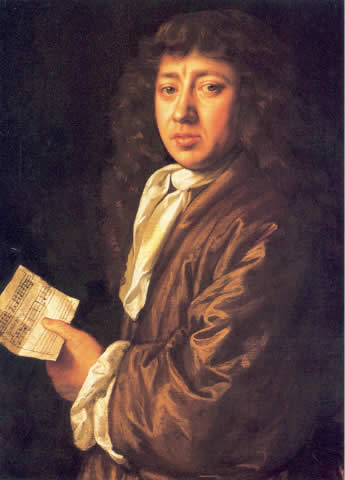
While there's so much else that needs to be read, I can't keep myself away from Claire Tomalin's Samuel Pepys: The Unequalled Self (Knopf, 2002) – it seems to fly by in fascinating 40- or 50-page chunks. She makes a very good case for the inherent interest of Pepys's life, the importance of his role in reforming & administering the British Navy, his closeness to some of the great intellectual fire-sources of his day (Hooke, Wilkins, Newton). Of course, Pepys would be only a footnote to history, a half-column in the DNB, were it not for his Diary, the 10-year shorthand record of the 1660s, which traces both Pepys's public & professional accomplishments & the most embarassing details of his private life – his rocky but on the whole satisfactory marriage, his career-related hopes & fears, his relentless busy-handed philandering.

I'm about 2/3 thru Tomalin's not overlong account of Pepys's life, but I've become so assured of her biographical skill that I'm confident she'll be able to surmount the greatest challenge before her: the 100 pages of The Unequalled Self that cover the last 33 years of Pepys's life – the years after he ceased keeping the Diary. It's the Diary of course that makes Pepys a great figure in English literature, & it's the diary that makes him the first subject susceptible to a truly modern biography, one that aims to tell both the external & the internal facts of its subject's life.

Yes, I've been thinking about biography as genre again. For a rather mordant perspective, fuelled by two recent books on the practice of biography, check out Louis Menand's "Lives of Others: The Biography Business" in the New Yorker. (Does Menand have a small child? I note a Sesame Street reference in his discussion of John Coltrane.)

Sunday, August 05, 2007

housekeeping

I've spent a little bit of time, not actually blogging, but cleaning up the blogroll & list of links on the right. So everything should work these days – no more listings of blogs that haven't been up for months & months, no more outdated URLs. At least I hope. Let me know if you click on some duds.

I also pumped up the "Scroggins online" links list, even as I scratched my head (still sticky with sunscreen) & wondered if these things are worth the trouble. Of course they are! Random visitors* will bounce in droves from this weblog straight over to Amazon.com to buy The Poem of a Life: A Biography of Louis Zukofsky. (Did I mention that it's available for preorder? & at a huge discount?)

Yeah. right. But who knows? And for my 7 readers who might actually be interested, I think I now have a fairly comprehensive set of links to my poems online.

*I am proud to announce that Culture Industry is at present the #1 Google hit for the search "nipple portraiture." Now how in hell do you beat that?

Saturday, August 04, 2007

self-promotional department

It's nice to find one's own face staring out at one from the internets, particularly in as astonishingly flattering a photograph as Shannon O'Brien's. Shoemaker & Hoard, in short, have put up a page for the forthcoming The Poem of a Life: A Biography of Louis Zukofsky. (Note handy link to the amazon.com page for the book, in case you have $20 burning a hole in your pocket.)

Wednesday, August 01, 2007

Policing the Fourth Genre

Okay, so enough ribbing – yes, I’ve spent (wasted? consumed?) a number of hours that could have been devoted to more serious activities to reading Harry Potter & the Healthy Fellows, & of course I couldn’t put it down, & of course I won’t remember a single detail of the plot a week from now. Which says nothing about the book’s merits or lack thereof – it’s just one of my own hardwired shortcomings, being unable to remember what happens in a work of fiction. I have to reread effing Moby-Dick every time I teach it, after all.

I won’t add anything to Josh Corey’s (congratulations, Josh! – welcome to the great world of the sleep-deprived) kind words about the Potter phenomenon, except to note that these are books that draw you in by the force of what happens, rather than by the strength of their prose. I read a stack of novels in New York – Virginia Woolf’s The Voyage Out & Night and Day, Jean Rhys’s Wide Sargasso Sea, Sterne’s Sentimental Journey, The Great Gatsby, Paul Auster’s Oracle Night. It’s hard to admire any else’s prose after reading Woolf, who’s incapable of writing an intentionally graceless sentence, & Rhys is almost as good. Fitzgerald looks rather thin & tawdry beside them, & Auster little better than sturdy, workmanlike. In all this company, JKR comes across as a engineer rather than an artist, a maker of intricate contraptions that amuse and intrigue, but which in the end don’t really resonate very deeply. Each to his or her own – the HP industry has gotten my money, & my time, & now back to Jacob’s Room.
***
My chums at Incertus, which has swollen into an almost Kos-like group blog, are posting so quickly that it’s difficult to keep up. I was taken by a recent triad of posts (scroll & scroll again) by my colleague & Lucius Malvoy-lookalike William Bradley, venting much spleen at James Frey & his fictionalized “memoir” A Million Little Pieces, a controversy whose 15 minutes I’d thought had passed long since. At the time, I’d thought this was a tempest in a teapost. Of course one expects a memoirist to tell the truth in his work, or at least the truth as he remembers it or – & this is a crucial distinction – wants it remembered. And when somebody deliberately alters details & sexes up his story, as Frey did, then it’s perfectly appropriate to yank off the codpiece & reveal the true dimensions of the organ. (And to have a good laugh, & to ostracize the malefactor, etc.)

There’s always a spectrum of truth-telling in memoir. Ruskin’s Praeterita, which is one of his most beautiful & affecting books, sort of manages to leave out any mention of Ruskin’s first, ill-fated marriage; William Carlos Williams’s Autobiography is chock-full of inaccuracies and downright distortions, most of them due to WCW’s failing memory; & one can rest assured that most political autobiographies, from Richard Nixon’s down to Bill Clinton’s, are full of outright lies. We forgive all of those omissions & distortions (save for the last category), because we’ve entered into a readerly contract that the memoirist will be trying to give us a narrative which dovetails with reality.

Now I’m one of those tiresome people who likes to read the fine print on contracts before signing them, & when I’m told that a writer is going to give me the “truth” – or as William puts it, “Truth” – I’m inclined to quote Pontius Pilate: “What is truth?” Or to recall the sentence from Aristotle’s Poetics on how poetry (read “fiction”) is “graver and of more philosophical import” than history. Which doesn’t mean that William & I don’t agree that James Frey is a knave for trying to pass off an embellished narrative as literal fact. But I read this as a single case – among many other cases – of a writer on the make. It’s not an affront to the genre of the memoir, any more than the Milli Vanilli scandal undermined the “foundations” of dance-pop music or Ted Kooser’s being named poet laureate means the end of American poetry.

In short, I find one of William’s sentences particularly interesting:
Here's a man who got caught lying in a piece of creative nonfiction, but rather than admitting his wrong-doing, he tried to destroy an entire genre of literature by claiming that "everyone else is doing it"; anyone who claims to be writing about his or her own life is just as big a liar as James Frey.
Okay, so this is part of the intro to an “open letter” to Oprah Winfrey, & we ought to allow room for hyperbole. But how do you “destroy an entire genre of literature”? The logic is inescapable, & William argues it eloquently: there’s this genre of literature – call it “memoir,” call it more broadly “creative nonfiction” – & it has a single differentium that sets it apart from the other genres: it tells the truth (Truth).

I read an awful lot of things that aren’t fiction or poetry, & that have definite “literary value.” But I don’t know a hell of a lot about Creative Nonfiction as an academic discipline. I taught an undergraduate course in it 7-8 years ago & used maybe the 2nd edition of that anthology The Fourth Genre (plus a hell of a lot of supplemental stuff, since I found most of the pieces in the anthology pretty thin), but I’m pretty ignorant of the critical discourse that’s grown up around it. I’m not even quite sure what gets included & what doesn’t. The ad copy for the latest edition of The Fourth Genre describes “the full range of contemporary creative nonfiction” as “personal narrative, essay, memoir, literary journalism, and personal cultural criticism.” Is biography CNF? (guess not) Essayist book reviews? (that must be “literary journalism” – maybe?) Event history? (probably not – but what if it’s beautifully written, like Simon Schama’s Dead Certainties?) As with most genres, there seem to be things that are near the center of the genre – in this case, memoir and the personal essay – but the fringes are less well defined. (The Wikipedia entry on Creative Nonfiction, as one might expect, is a model of incoherence. I suspect I ought to trot to the library & read the latest issue of Creative Nonfiction, where this stuff is no doubt being thrashed out as we speak.)

Genres are notoriously difficult to define, in part because writers are always pushing at limits (prose poetry, anyone? the nonfiction novel? some of Beckett’s late drama, without characters, action, or speech?) & in part because the recognized genres haven’t grown up in logical, philosophically coherent ways. They’re not logical categories, but what Wittgenstein called “family resemblance” categories, “network[s] of similarities overlapping and criss-crossing,” of affinities shared among some members and not others. (What does Tender Buttons have in common with the Odyssey, or the Odyssey in common with a Shakespeare sonnet – save that they’re all “poetry”?)

In the case of CNF, what one has is a fairly young generic classification. People have been writing things for centuries that one could retroactively call CNF, but it’s only in the last few decades that it’s been given a name – or, more crucially, that it’s been given a place in the academy: and with that place in the academy comes the obligation to define and defend one’s practice.

William’s emphasis on the truth-value of CNF is a clear instance of genre-defining, & genre-policing. (And as usual, whenever a writer starts defining his own genre, what’s he’s really doing is defining his ideal view of his own writing.) For my part, I’m as little fond of the genre police as I am of the dream police, the canon police, or any other police force. Pronouncing what is & what isn’t a member of X genre smacks of weeding out the Mudbloods & the Muggle-borns, & I’ve always found the most interesting spots of writing are where the genres get blurred & start to overlap. And while I whole-heartedly agree with William’s scorn for standards of accuracy & decency in the contemporary political & cultural climate, I fear that I’ve imbibed way too much post-structuralism (not to mention good old fashioned American Pragmatism) over the years to take a call for “transcendental Truth” without more than a dash of salt & suspicion.