Saturday, September 22, 2007

Stardust / The Historical Record

Stardust. What's not to like? Stunning visual effects; Claire Danes transformed over the years since the last thing I saw her in – Romeo + Juliet – into a grown-up actor more lambently beautiful for her utter lack of conventional beauty, & able to turn in a convincing imitation of Gwyneth Paltrow; Michelle Pfeiffer reprising her role in Witches of Eastwick & Peter O'Toole his in Caligula; Robert DeNiro as a cross-dressing, can-can-dancing aerial pirate. The Princess Bride on special effects steroids. Yes, as we're told, a great "date film."

An exercise in both nostalgia & "world elsewhere" wish-fulfillment. Tristan makes it to the way interesting fantasy realm of Stormhold, defeats the witches & the ineffectual but nasty princes, gets the girl – a "star" in every sense – & discovers to boot (in a Shakespearean Romance-like turn) that he's the heir to the throne.

But what's he left behind? Nothing more onerous or constraining that a filmmaker's fantasy of a turn-of-the-century English agrarian town, a kind of Shire, where his object object of desire has the hots for the local Flashman (closeted, we learn). The contemporary fairy-tale, in which not merely the realm of faery but the realm of "reality" has been emptied of all true discomfort or social conflict. At least the dire film version of CS Lewis's dire Christian screed The Lion etc. had the decent idea of showing its children in flight from the Blitz.
***
The splendid British poet & bookdealer Peter Riley posts the following on the UK Poetry Listserv under the title "The Historical Record (I hope he doesn't mind me copying him):
After a small amount of rather scrappy research, I am beginning to think that possibly all or most of the poetry books published by print-on-demand presses since about 2000, are not getting into the copyright libraries. (It is a statutory obligation for all publishers to deliver six free copies of all books on publication to the British Library, [the National Libraries of Scotland and Wales, and the Oxford, Cambridge, & Trinity College libraries]).

It's difficult to be certain because it can take libraries a long time to get a book catalogued and sometimes some (e.g. poetry) items are classed as "secondary" and do not show in the main catalogue . But I've looked for about 25 books published between 1999 and 2002 in the on-line catalogue of Cambridge University Library and I've only found two of them. The books not there included two entitled "Collected Poems". For comparison I looked up five books published by Carcanet post 2002, and they were all there.

I tried to compare this with the British Library, and they do seem to have more, but their on-line catalogue is such hell I had to abandon the search.

I find this rather worrying. They really should be there, it is the historical record of our activity. The print-on-demand "boom" has been in many ways a saviour of the situation for poets, able at last to get real books out without submitting themselves to the "big" publishing machine. But many of these books are probably produced in small quantities and the copyright system is some kind of guarantee that they won't disappear for ever. I know from my experience as a bookseller that it is quite possible for a book published in, say, 1870 in several hundred copies, to have vanished without trace by 1990.
There's a similar provision in place under US copyright law, tho many of us seem unaware of its provision requiring that two copies of each book published in the US be deposited with the Library of Congress. And while Riley speaks of the print-on-demand phenomenon, I think this is a problem endemic to all small press publishing. A spotcheck reveals no copies of Jessica Smith's Organic Furniture Cellar, nor of Henry Gould's most recent books, nor of either of the two excellent Cultural Society books – Zach Barocas's Among Other Things and Joel Bettridge's That Abrupt Here – but their holdings of Bruce Andrews's books seem remarkably spotty, as well (at least four titles missing, including I Don't Have Any Paper So Shut Up), & Tina Darragh has published far more than the three titles they hold.

Perhaps the LOC is a kind of time-capsule, a last-ditch stand against oblivion. But I wonder that we aren't taking more care of our legacy in the alt-poetry world. Send your books to the Library of Congress; make your university (or public) library order your books, & books by the poets you admire; donate your books to collections that ought to have them (Buffalo, San Diego, etc.).

Wednesday, September 19, 2007

Git yerself some kulchur

There's a brand new update at Zach Barocas's always excellent Cultural Society, including work by Joseph Bradshaw, Derrick Buisch, Cary Conover, Jon Curley, Tom Fisher, Roberto Harrison, Philip Jenks, Joseph Massey & Jess Mynes, Amanda Nadelberg, Peter O'Leary, Gregory J. Ott, John Phillips, Christopher Rizzo, Cindy Savett, Kate Schapira, Melissa Severin, Sandra Simonds, Shannon Tharp, Bronwen Tate, Jen Tynes, & Tyrone Williams. (Click on "texts.")

And a (longish) poem by me, "Of Systems Subject, Political, and Private." Do go read; tokenish prize to whoever can first identify the source of the title.

Tuesday, September 18, 2007

Nit-pickery

Just finished Michael North's Reading 1922: A Return to the Scene of the Modern (OUP, 1999). Not bad at all; does a fine if uninspiring job of putting the grand warhorses of 1922 (Ulysses, The Waste Land, etc.) back into their contemporary context, pulls some interesting threads together. Provocative rebuttals of Huyssen's high culture/low culture "great divide" & Jameson's modernism/postmodernism schematizations. But doesn't have the same satisfyingly chewy theoretical density of Marc Manganaro's Culture, 1922: The Emergence of a Concept (Princeton UP, 2002), which is one of those critical books that enables you (as somebody at Cornell, acc. to the dire David Lehmann, said of de Man's "Rhetoric of Temporality") to save yr dope money for a week.

But the book immediately at hand is North's Norton Critical Edition of The Waste Land (2001), which I keep assigning to classes largely for its critical essays (& of course to support independent publishing). Problem with these Critical Editions – & here I include every Norton CE I've ever used – is that you can't really trust the explanatory notes. Not TS Eliot's notes – everybody knows they're whacked – but North's notes: you know, the ones at the foot of the page, the ones most students take as gospel truth. (After all, they were written by this UCLA professor, he knows so much more than I do...)

I can't claim to have checked every note, but here's a few flyspecks in the notes to the poem itself:

•In a note to the Petronius epigraph ("NAM Sibyllam quiden Cumis" etc.), we're told that the quotation is "(Greek)." Well, 5 words of it are; but obviously the rest is in Latin.

•The battle of Mylae (1st Punic War) took place in 260BCE, not "206" as the note has it. (Okay, that's a typo – but who's reading proof here?)

•Headnote to "A Game of Chess": "Eliot takes the title of this section from a satirical play of the same name by Thomas Middleton (1570?-1627). First produced in 1625, A Game of Chess was suppressed because of the way in which it allegorized English conflict with Spain as a chess match." How many howlers can North fit into one note? Middleton was born in 1580, not "1570?"; the title of his play is A Game at Chess, not A Game of Chess; and the play was first produced in 1624, not 1625. These are well-documented matters.

•Headnote to "What the Thunder Said": "Eliot's headnote to this section helps us to see these lines as a description of the betrayal, arrest, interrogation, and crucifixion of Christ..." Eliot's headnote – "In the first part of Part V three themes are employed: the journey to Emmaus, the approach to the Chapel Perilous (see Miss Weston's book) and the present decay of eastern Europe" – does nothing of the sort.

Everybody thinks they're an editor, I guess; but who's editing the editors?

Culture Industry's 400th Post...

simply marks Culture Industry's 400th post.

Sunday, September 16, 2007

All of Beckett (almost)


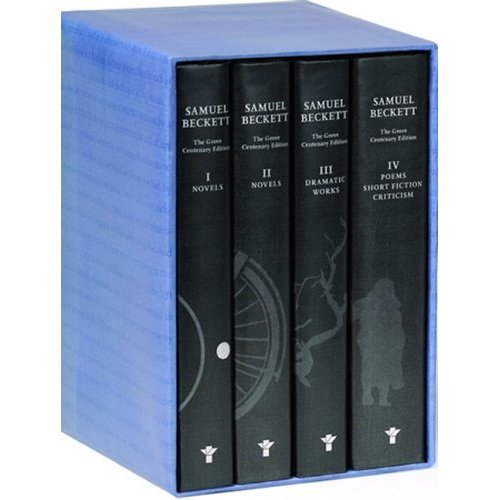
So far as I can tell, there's no European equivalent to Grove Press's 4-volume Centenary Edition of Samuel Beckett's works (published last year, & which I have been carrying about, reading thru, & generally caressing ever since I received my copy for Christmas). No Pleiade Beckett in French, as one might expect, nor has Calder, his English publisher, issued a set analogous or identical to Grove's American enterprise.

Mind you, this is a lovely edition. It brings together almost everything (I'll get back to that "almost") that Beckett ever published in English, or translated into English himself. (A very few of his translations, early on, were done in collaboration with other translators, I assume before Beckett realized the aesthetic potential in the act of self-translation.) The omission of works existing only in French is quite deliberate, according to Paul Auster, the Grove Centenary Edition's (henceforward GCE's) series editor, & he concedes that this means that, however definitive it may be in presenting the works upon which Beckett's vast reputation rests, the edition "does not constitute a Collected Works."

Auster has for the most part chosen wisely in assigning superstar writers to introduce each volume: Colm Tóibín's introduction to the 1st volume of "Irish" novels is excellent; Salman Rushdie's introduction to the 2nd volume of novels – the Trilogy and How It Is – is luminous; & JM Coetze's introduction to the final volume of poetry, short fiction, & criticism is wonderfully hard-nosed & critically uncompromising. (Only Edward Albee's introduction to the Dramatic Works falls short, amounting to a page & a half of noting how really cool Beckett's plays are. Was Harold Pinter, Wole Soyinka, or Tom Stoppard otherwise occupied?)

But I fear, with my own obsessive anality coming to the fore, that I'm still dissatisfied with this edition, despite its lovely design & really wonderful typography – such an improvement over the hodge-podge of mostly dreadfully designed Grove paperbacks in my office. It's about the text, in part. The Grove website claims that "Typographical errors that remained uncorrected in the various prior Grove editions of Beckett's work have been corrected in consultation with Beckett scholars C.J. Ackerley and S E. Gontarski," but the books themselves make no note of textual matters save for the following: "Design and textual supervision by Laura Lindgren." She's done a lovely job of the design, for sure: but I'd feel much better about the texts – Watt is almost legendary for its longstanding corruption – if I'd been at least assured somewhere in the books themselves that real textual editors were on the job. (Ideally, of course, there'd be 20 or 30 pages of textual notes at the end of each volume detailing corrections & variations, but perhaps that's asking too much.)

And then there's the contents themselves: I can entirely understand the GCE's leaving out Beckett's posthumously published works, the novel Dream of Fair to Middling Women & the play Eleuthéria (which was written in French, & which SB himself didn't translate). But Auster is a trifle disingenuous when he claims that all that has been omitted from the 4 volumes are "a number of untranslated French poems and short critical essays." "Those with a knowledge of French," he continues helpfully, "can find them in Collected Poems in English and French and Disjecta, both available from Grove Press." (My inner copyeditor adds that those without a knowledge of French can find them there as well, tho they won't be able to read them.)

A glance at the contents of Disjecta, however, shows one that more than just a few French-language essays have been omitted from the GCE. (For the record, the GCE's "criticism" section consists of precisely 3 items: the Finnegans Wake essay "Dante...Bruno.Vico..Joyce," the book Proust, & the "Three Dialogues" with Georges Duthuit.) Leaving aside the Disjecta pieces in French & German, & leaving aside the various excerpts from letters, there remain almost 20 reviews & notes on writers, poets, & painters – all in English – that for some reason passed thru the GCE's editorial sieve. Reviews & notes on Mörike, on Rilke, on Ezra Pound; on such Irish modernists as Denis Devlin & Thomas McGreevy; on painters Jack B. Yeats & Avigdor Arikha. And finally, a 12-page fragment of Human Wishes, SB's play about Samuel Johnson.

I'm all in favor of honoring authors' posthumous desires about what to publish & what to leave unpublished (tho I suspect Grove's decision not to include Dream of Fair to Middling Women and Eleuthéria had more to do with the fact that they're in print from other publishers than with Beckett's wishes). But these pieces in Disjecta – written in English or translated into English by SB, published in his lifetime with his (grudging) permission – seem to meet all possible criteria for inclusion in the big 4-volume set. It would be silly to claim they're essential bits of the Beckett oeuvre, but I for one would like their exclusion to be explained a bit more clearly.

But enough grousing. Despite its teeny omissions, & despite the "black box" nature of its textual editing, this is my working Beckett from here on out: an extraordinary collection, beautifully produced & wonderfully readable to boot. Nothing like being brought face to face with the emptiness & inanity of human existence thru a nice piece of bibliographic art.

Saturday, September 15, 2007

1st Review!

So I learn, from Bob Archambeau, Charles Bernstein, & various others in far-flung places, that The Poem of a Life: A Biography of Louis Zukofsky, has gotten its first review – by Marjorie Perloff in the 7 September TLS. Well, I'm chuffed, even tho I haven't seen the thing yet, having gooberishly let my subscription lapse.

An appeal then: any of you out there who get the TLS & wouldn't mind passing the issue – or the clipped review therefrom – along to me when you're done? [There are at least 6 nail parlors & 4 posh gyms within a five-mile radius of Culture Industry central, but I've phoned every bookshop & newstand in the book, & nobody carries the damned thing.]

Friday, September 14, 2007

unlikely source

Happened upon this bit of sub-Kipling schoolboy good cheer, as writen in an autograph book:
When a bit of sunshine hits you
After passing of a cloud,
And a bit of laughter gets you
And your spine is feeling proud,
Don't forget to up and fling it
At a soul that's feeling blue,
For the moment that you sling it
It's a boomerang to you.
The author? Samuel Beckett. As biographer Anthony Cronin comments, the boy in whose book Beckett inscribed these lines "thought that they were an accurate reflection of his attitude. It is fairly safe to say that no one would ever think so again."
Hamm: Go and see is she dead.
[Clov goes to bins, raises the lid of Nell's, stoops, looks into it. Pause.]
Clov: Looks like it.
[He closes the lid, straightens up. Hamm raises his toque. Pause. He puts it on again.]
Hamm: [with his hand to his toque] And Nagg?
[Clov raises lid of Nagg's bin, stoops, looks into it. Pause.]
Clov: Doesn't look like it.
[He closes the lid, straightens up.]
Hamm: [letting go his toque] What's he doing?
[Clov raises lid of Nagg's bin, stoops, looks into it. Pause.]
Clov: He's crying.
[He closes lid, straightens up.]
Hamm: Then he's living.
Poetics of the pause.

Monday, September 10, 2007

Shax?

Now that I'm just pissing blood & tiny pointy shards, as opposed to writhing prostrate in full-flank agony, I can get back to actual blogging. I'm pleased to see my colleague Emily over at Incertus getting exercised by the silliness of the anti-Stratfordians again – always a healthy workout for the cardio-vascular system, I think. Like 6-day Creationists & Holocaust deniers, those who deny Wm Shakespeare's (or as they style it, thinking they're saying something significant, "Shakespere's") authorship of "Shakespeare" will always be with us – indeed, I encourage Creationists & Holocaust deniers to look into the authorship "controversy," since they're liable to do a great deal less harm in that little wing of the grand crank factory than in the world at large.

The whole business is only irritating when celebrities get involved – as with this latest Derek Jacobi/Mark Rylance business, or earlier with John Gielgud & Kenneth Branagh, or Walt Whitman & Charlie Chaplin – because then public attention starts getting drawn to the whole non-question. The problem, of course, is that if there were any real controversy over who wrote Shakespeare, the people capable of solving it would be clear-sighted scholars with an encyclopedic knowledge of Renaissance literature & a firm grasp of early modern culture – the culture of the playhouse, of the literary marketplace, of the publishing industry, & so forth.

It's pretty hard to find such animals among actors & creative writers, I'm afraid. Indeed, a 1st-rate analytical mind, tho it never hurts, is far from necessary equipment for acting well or writing well: Do you want Johnny Depp to do your taxes? To edit your term paper? I adore Yeats & Whitman as poets, but I'm the 1st to admit that their intellects were serious effing muddles. So, frankly, who gives a rat's ass what Derek Jacobi or Mark Rylance think about the authorship question?

Culture Industry has visited the authorship "controversy" at least once before, in connection with an Oxfordian book; it sprang to my mind the other day, when I was googling Henry Peachum & anagrams (don't ask) & fell afoul of a whole nest of mind-bendingly obtuse websites on the subject. In my random moments, I keep coming up with lists of questions to ask the anti-Stratfordians:

1) Since you wonder at the fact that Shax of Straford didn't leave any books in his will, what's the data on books in the wills of other dramatists of the period: Middleton, Chapman, Heywood?

2) No letters in Shax's hand? How many letters do we have from Middleton, Chapman, Fletcher, Ford?

[The problem with demanding of Shakespeare the whole written trail that characterizes someone like Goethe or Wordsworth – autographs in people's notebooks, recounted table-talk, laundry-lists, etc. – is that Shax lived before the author became a celebrity. The William Shakespeare who wrote the plays was not the deified Shakespeare of the 19th & 20th centuries, or even the proto-deified Shakespeare of the 18th. He was simply WS, a player & playwright, a script doctor & collaborator, a guy who worked up old stories into playable scripts & rolfed antiquated plays for a contemporary audience.]

3) If there is really such a paucity of information about Shakespeare – a fairly prolific early modern playwright, though by no means among the most prolific – then name one other early modern playwright (other than Ben Jonson, an indefatigable self-promotional machine) about whom we know as much. Thomas Heywood, who claimed to have had a hand in over 200 plays, but whose birth date we don't know? George Chapman? Thomas Middleton?

4) If, as Derek Jacobi is so convinced, "an author writes about his own experience" – a simple-minded equation essential to the thought-processes (generously so-called) of at least the Oxfordians – please explain Sir Walter Scott's 27 novels, not one of which is based on events of his life. Then explain the personal roots of Robert Browning's dramatic monologues, Alfred Tennyson's Idylls of the King, & Edmund Spenser's Faerie Queene.

Unlike Amy & Emily, I'm not inclined to get worked up over the elitism inherent in claiming that a person of Shakespeare's social background couldn't have written the plays. The elitism's certainly there, & just as ugly as such elitism always is. But everyone who knows literature knows that social elitism simply has no force in the world of letters, that far too many great writers came from the working or middling classes (John Clare, Ben Jonson, Louis Zukofsky, James Joyce) for class origin to be an ultimate bar to the imagination.

Instead, I sympathize and pity the anti-Stratfordians. They love their "Shakespeare" – or some plaster Jesus of a Shakespeare: I've yet to read an anti-Stratfordian book (& I've read way too many of them) that goes beyond a kind of muzzy high-school-level affectionate appreciation of the dramas – so much that they want to know everything about his life. But there is just so little to know about him. So they spend their time constructing Dumas-like conspiracy theories that give the man who wrote the plays an existence as exciting as Lawrence of Arabia's. If they need a new thrill, maybe they should try reading The Seven Pillars of Wisdom.
***
The real scandal in the BBC story, by the way, comes in the last section, where we learn that a copy of the Jacobi/Rylance declaration has been "presented to Dr William Leahy, head of English at London's Brunel University and convenor of the first MA in Shakespeare authorship studies, to be launched later this month." This is, mind you, the equivalent of Georgia Tech announcing that they will be offering an MA in Intelligent Design studies; or MIT announcing a chair in Phlogiston Theory. Isambard Kingdom Brunel – great architect of suspension bridges, chief engineer of the Great Western Railway, builder of the Thames Tunnel – is spinning in his railway-gauge grave.

Friday, September 07, 2007

Embodiment, ii

[Guy Davenport, from the introduction to Montaigne's Travel Journal:]

He is, in a surprisingly modern sense, a tourist, with a tourist's interest in the amenities of the table and the bedroom. He is also, as we are never allowed to forget, a man in pain looking for a cure. His body cannot use certain minerals, such as calcium, which accumulate as pellets in his kidneys and bladder. The pain of a kidney stone is fierce, and in a male can be comparable to a woman's labor. The frequent "colic" in this journal (assuming that to be Montaigne's word for an attack of the stone) is a severe nausea in combination with the feeling that one's back is broken and that one's bowels need to move. Montaigne was fortunate in being able to pass his kidney stones. Another sufferer, Sir Walter Scott, could not, and abided pain of excruciating intensity for as long as two weeks at a time, helplessly screaming and hearing the New Testament read to him. Montaigne's constant scrutiny of his urine in a chamber pot, his colics and dizzy spells, his ability to drink heroic amounts of hot sulfurous water, locate his journal in a time when the body was still part of personality. Later, it would disappear. Dickens' characters, for instance, have no kidney stones because they have no kidneys. From Smollett to Ulysses, there is not a kidney in English literature.

Monday, September 03, 2007

Embodiment

My own relationship with my body is at best an equivocal one – & by body I mean the whole apparatus, from fallen-arched feet to mostly-bald head, including my face, the only aspect of my embodiment to make a regular appearance at this address in cyberspace. Even when I was young, thin, & by some accounts not actively ugly, I regarded my physical body as less me than as a kind of container or sheath by which I presented myself to others.

I suspect such residual Cartesianism is fairly widespread among those in the scribbling trades or doing other intellectual labor. We identify our selves with our minds, with our words. We have no trouble identifying Mikhail Baryshnikov squarely with his physique, with an exquisite overall coordination among brain, talents, skills, & toning. But who would associate the agile graces of Wallace Stevens's lyrics with the portly, hypertensive animal from which they emanated?

And the virtual community of the blogosphere, where one can circulate for years without attaching a face even to the bloggers whose writing you most admire, conduces to a kind of self-disembodiment even as one blogs.

This particular Labor Day Weekend, however, will go down for me as The Weekend Of The Kidney Stone; & nothing about it – save for a few rather pleasant but unfortunately brief opiate-fuelled reveries – has been remotely disembodied.

This is pain, my friends – in long, dull stretches; in concentrated, savage waves; sometimes easily quelled with Percocet or prescription-strength doses of Aleve; sometimes entirely ignoring all pharmacologies – this is pain like I've never experienced. And it make me aware of my dear old flabby, greying, obtuse body with a kind of horrifying intensity.

Thursday, August 30, 2007

Cambridge Companion!


After the usual delays, I'm happy to announce that the Cambridge Companion to Modernist Poetry – edited by the estimable Alex Davis & Lee M. Jenkins – has just turned up in my mailbox. It's a substantial volume, covering poetic modernisms of all stripes, British, American, Irish, African American, and post-colonial. The contributors' list, which reads like a who's who of modernist poetry scholarship, includes Peter Nicholls, Christanne Miller, Lawrence Rainey, Rachel Blau DuPlessis, Drew Milne, Bonnie Costello, & Jahan Ramazani.

And surprisingly enough, yr. humble blogger has an essay in there as well, bearing the snappy (?) title "US modernism II. The other tradition: Williams, Zukofsky, Olson." (It's odd to see one's prose in British clothing – punctuation, capitalization, etc.; but still gratifying.) American shoppers can buy this terrifically valuable volume here.

Tuesday, August 28, 2007

Yellow Zukofsky


Or, another set of artist's supplies down the tubes...

Monday, August 27, 2007

L'Affaire Finkelstein

I too have suffered from being an homonymous author. There is a Mark Scroggins out there who is the author of a biography of Hannibal Hamlin, Abraham Lincoln's first running mate. For a while the Library of Congress was convinced we were the same person, & apparently the other MS's publisher has no better idea of where he is than I do, since they've been sending me correspondence relating to Hannibal: The Life of Abraham Lincoln's First Vice President. & this is not to mention the Mark Scrogginses out there who are lawyers, professional bowlers, Baptist ministers, & deer hunters.

My discomfort is nothing compared to that of my old friend Norman Finkelstein, poet, literary scholar, and professor of English at Xavier University in Cinncinnati. Norman's sorrow is that he is always in danger of being mistaken for Norman G. Finkelstein, the ragingly controversial political scientist who until recently has taught at DePaul University in Chicago. My Norman Finkelstein – henceforward "the uncontroversial NF" – and I have been friends & co-conspirators for many years now, & in the days to come I will blog his newest book of poems, the limpid Passing Over. (Please go buy it, nu?)

[On the left: the poet Norman Finkelstein]

I don't want to cause my NF – the "uncontroversial NF" – any further discomfort (he's gone so far as to post a "disambiguation page" on A Big Jewish Blog, the wonderful conversation on matters Jewish & poetic that Eric Selinger started some time ago). But the latest turn in Norman G.'s tenure battle at DePaul has gotten me so riled up this morning that I'm unable to concentrate on my syllabi, to answer my e-mails, to do anything but splenetically blog.

The story is long and complex – Wikipedia has a not unfair summary of its earlier twists & turns on its NF page, & here, & a comprehensive collection of documents from both sides can be bound on Norman G's own website. Suffice it to say that Norman G. has written forcefully & at length about Palestinean/Israeli relations, about what he sees as the "exploitation" of the Holocaust for self-serving reasons by various groups, & about the Israel lobby in Washington. His work is controversial in its arguments & premises, & even moreso in its modes of argument, which combine withering sarcasm, angry invective, & even occasional ad hominem attacks.

His first four books drew accusations of Holocaust denial & anti-Semitism (both rather silly, I think); his critics were more accurate in finding Finkelstein a fair representative of a kind of left-leaning anti-Zionism. The fat truly hit the flame, however, when Norman G. tangled with Alan Dershowitz, who, when he's not defending celebrity clients like OJ Simpson & Claus von Bulow or figuring out circumstances under which torture is actually okay ("get a warrant"), is the Felix Frankfurter Professor of Law at Harvard Law School. Norman G. attacked Dershowitz's 2003 book The Case for Israel, calling it "a collection of fraud, falsification, plagiarism and nonsense." Dershowitz responded by attempting to stop the publication of Finkelstein's next book, Beyond Chutzpah: On the Misuse of Anti-Semitism and the Abuse of History (Dershowitz went so far as to send a letter to Arnold "the Governator" Schwartzenegger asking him to intervene & get the University of California Press to kill the book).

This past academic year Norman G. went up for tenure in the Poly Sci department at DePaul. In September 2006, Dershowitz sent a weighty "dossier" of anti-Finkelstein material to DePaul poly sci & law faculty members & DePaul administrators (and, by some accounts, to DePaul boosters), urging them to deny Finkelstein tenure. The case bounced back & forth; his department voted 9-3 in favor of tenuring NGF; the college personnel committee voted 5-0 in favor of tenuring him; this past June, by a 4-3 vote, a university committee voted to deny him tenure. The University's president, the Rev. Dennis Holtschneider, affirmed the decision, & held out no possibility of appeal.

In one of the more spectacular displays of disingenuousness I've encountered, Holtschneider & others in the DePaul administration have repeatedly denied that Dershowitz's campaign against Finkelstein had anything to do with his denial of tenure. (The stated reason was that Finkelstein's scholarly work, while largely unimpeachable in terms of content and scholarly methodology, was just plain not very nice to those who disagreed with him – a violation of "Vincentian ethics," whatever those may be.) Let's be serious: Finkelstein is right on the money when he notes wearily that the validity of his work has nothing to do with the tenure decision: since he's become a target of one of the most prominent "centrist" talking heads in the country, he's become a liability to DePaul, someone who's unfortunately apt to get in the way of the University President's primary job – fundraising.

The final indignity has just come down the pike: After one is denied tenure, one usually has what's known as a "terminal year," a final academic year in which to teach, to wind up one's affairs, & to look for work. DePaul is paying Norman G. for a terminal year – but they've cancelled his classes & locked him out of his office. Shame on DePaul; shame on Fr. Holtschneider. Of all of the shabby tenure tales I've heard over the years, this is the shabbiest.

[On the right, Norman G. Finkelstein, man without an office]

Sunday, August 26, 2007

Summer reading, 2007

Summer break is officially over tomorrow, tho I've a couple more days before my first classes. A moment to recap some of the highlights of the summer reading (none of it, alas, at the beach):

•Great bales of Virginia Woolf, early late & middle. Of the early ones (the ones I knew least), it's safe to say that I found The Voyage Out very moving, & beautifully written – Woolf finding her way to a modernist idiom, not quite getting there, but forging something quite lovely sui generis. Night and Day, on the other hand, seems a step back: a Victorian novel about 20th century problems, but structurally still a Victorian novel, with all the attendant bric-a-brac (& very little of the humor).

•Of the various wee books of poetry, Myung Mi Kim's Commons (U California P, 2002) & Erica Carpenter's Perspective Would Have Us (Burning Deck, 2006) grabbed me by the lapels & shook me. Carpenter, especially, has a wonderful lyric gift.

I'm in the middle of Benjamin Friedlander's The Missing Occasion of Saying Yes (Subpress, 2007), which is more good short poems than anybody has a right to have written. Somehow I'd missed his last big collection, A Knot Is Not a Tangle, & The Missing Occasion reminds me just how wry & simultaneously moving Ben's poems can be. (More later on this one...)

•Joseph Donahue's Incidental Eclipse (Talisman House, 2003) has one of those blurbs from John Ashbery – you know what I mean, "one of the major American poets of this time" etc. But y'know what? – while I'm not a race-horse kinda guy (my father-in-law used to try seriously to rank the top 10 writers of the 20th century), & I find myself just as keen on the fascinating "minor" as the imposing "major," Incidental Eclipse is a fascinating, incredibly moving book. I've stopped to read Joe's work whenever I've come upon it for some time now; this is the moment where he turns into something big.

•Things Davenportian: On the one hand, the Guy Davenport / James Laughlin letters. Frankly, I didn't understand why these got published – okay, Guy was one of the great letter-writers, but Laughlin was kind of a late friend for him, the publisher who stepped into the gap when North Point went down, but who only put out 4 or so of 20+ books. Then it hit me – of course, Norton has a series of volumes of selected Laughlin correspondences (Pound, WCW, Delmore Schwartz, Rexroth, etc.). Lots of discussions of book publishing. Too many anecdotes, too much Laughlinian skirt-chasing.

On the other hand, a bare beginning into Andre Furlani's Guy Davenport: Postmodern and After. I'll be damned – a critical book that approaches its subject with nothing less than admiration. How quaint! Furlani writes forthright sentences, & strives to knit his subjects together in an echt Davenportian manner. We'll see how well he keeps it up over the long haul of this study.

Friday, August 24, 2007

Our Fair University on the blogosphere, again

Margaret Soltan at University Diaries has a knack for picking up on the most embarassing news items relating to Our Fair University. Today she's fastened upon the proposed new "fitness center"; I think she's a bit savage, at least in the comments box, but you decide.

Thursday, August 23, 2007

marketing modernism


Somewhere in my mother's house in Tennessee are great stashes of 40s- & 50s-era paperbacks of modern classics – Faulkner, Fitzgerald, Aldous Huxley – with lurid, ripped-bodice paintings on the covers. But they don't come anywhere near the cheekiness of this Russian item stumbled upon on eBay. Yes, that's a Virginia Woolf omnibus volume, including Jacob's Room, Mrs Dalloway, To the Lighthouse, and Orlando. Funny thing, I've read all of those books, & I don't remember the illustrated scene taking place in any of them. (Tho there's a Tilda Swinton moment in the movie of Orlando that comes close.)
***
By all means scroll down to the last entry & take the informal poll. I've got the itch to buy books, even if only on the library's dime.

Wednesday, August 22, 2007

informal poll

My mind these days, as so often at this end-of-summer, feels like an unmoving swamp. I hanker for new things, new sounds, new poets. So, an informal poll: who, among that vast sea of talented & interesting writers out there, is exciting you these days? Let's leave the honored dead out of the reckoning; send me – backchannel or in the comments box – a list of the dozen or half-dozen contemporaries whose poetry seems most alive to you at the moment. Help MS jumpstart his joie de vivre.

housekeeping

In the interests of keeping visitors provided with diverting reading, I've done some pretty significant beefing-up of the blogroll – a number of the poetry-ish sites I visit regularly, but also a few academic blogs that I've been dropping by lately. By "academic blogs," I don't mean blogs on which folks who happen to be in the academy spend serious time discussing issues within their discipline (tho that happens, as well), but blogs by people (usually graduate students, adjuncts, untenured faculty, & other members of the vast exploited brain-proletariat) who're thinking about & tracking the experience of living within the academy. How do you recognize such a blog? Well, it's usually got an at least semi-clever, often ironical title ("Academic Wasteland," "Not of General Interest"); the author is usually anonymous (no doubt in acknowledgment of the various "blog & you won't get hired/get tenure" scares across the web over the past couple of years); and the blogger tends to do a good deal of agonizing these days over syllabi, class numbers, & room assignments. Like I'm doing right now.

And reading Will Eisner's The Contract With God Trilogy, which is damned fine stuff. More fun than Henry Roth, any day of the week.

Monday, August 20, 2007

Jessie Sheeler: Little Sparta

When we honeymooned in Scotland, J. & I visited Sir Walter Scott's Abbottsford, we walked the Castle battlements, we saw Hugh MacDiarmid's stomping grounds in Biggar. But we didn't make it to Ian Hamilton Finlay's astonishingly rich poet's garden, Little Sparta. Gael Turnbull gave us Alec Finlay's number, counselling us that it would be better to contact Eck than to phone his father directly, but it turned out the younger Finlay was out of the country, and one thing succeeded another in the usual flurry of touristing.

So my "experience" of the garden has been limited to illustrated articles in places like Architectural Digest & various books on contemporary landscape architecture, & to Yves Abrioux's sumptuous and indispensible Ian Hamilton Finlay: A Visual Primer. Jessie Sheeler & Andrew Lawson's Little Sparta: The Garden of Ian Hamilton Finlay, then, is a welcome & enlightening guide to Finlay's major life-work.

Like no other text I've yet seen, Sheeler & Lawson's coffee-table book manages to give one a sense of what it might be like to walk thru the garden, to experience it in situ, rather than as a series of snapshots. The pictures – Lawson, I gather, is a top-notch garden photographer – are uniformly beautiful, everything in eye-popping color and crisp focus. And Sheeler's text is doggedly informative, translating every Latin inscription into English & explaining every classical reference in the patient voice of a young person's Latin teacher (which, it turns out, she is*).

If anything, it's the coffee-table book aspect of Little Sparta that I find a trifle off-putting. On the one hand, among Lawson's beautiful photographs of various aspects of the garden – columns, inscriptions, statues, bridges – are a number of very pretty pictures of foliage & flowers: nice enough, but the sort of thing that could be slotted into pretty much any book about any garden in the British Isles. I'd have appreciated a few more close-ups of IHF's inscribed plaques. And Sheeler's text, while it's thoroughly informed & always informative (if sometimes irritatingly basic for this overeducated reader – I suppose somebody out there needs to have the story of Apollo & Daphne, or of Aeneas & Dido's cave, retold them), tends to render anodyne the more troubling aspects of IHF's ideological art. We're told time & again how Robespierre & Saint-Just were apostles of purity & order; there's all too little mention of how the primary agent of that order was the guillotine. IHF is not interested in aestheticizing the guillotine when he compares it to the classical column or the birch tree: rather, he underlines by shocking juxtaposition the coexistence, the imbrication of terror & the pastoral.

Sheeler's Little Sparta is Sparta as order apotheosized, drained of its concomitant terror. (For a dose of the latter, go watch 300 – which one of my students last semester called his "favorite movie," sending a chill down this 4-eyed wimp's spine.) Dig Sheeler's last sentence:
Those who come prepared to find in Little Sparta works whose essence is poetic, not decorative or horticultural, will find find subsequently that the way they see the world is changed and made more wonderful.
The only word I would quibble with here is the last (& most important): Little Sparta changes the world, and makes it more unsettled, more terrible.

But the heart of this book is its wonderful photographs & interpretive commentary. Anyone interested in landscape architecture, in concrete & conceptual poetry, & in their intersection, should buy this volume posthaste.

*Keen eyes might recognize Sheeler as the Jessie McGuffie who was Finlay's companion in the early 1960s, & who co-founded the Wild Hawthorn Press with him. "Sheeler" is the surname of one of Zukofsky's Brooklyn Polytech students, who visited Finlay & McGuffie in Edinburgh at LZ's suggestion – but therein hangs a painful tale whose outlines can be read in my The Poem of a Life: A Biography of Louis Zukofsky.

Thursday, August 16, 2007

whom you ought to be reading

I sense my blogging has become sclerotic lately, that I'm giving in to my tendency to wait until I have almost the beginnings of an essay on hand before writing anything. (Or I post continual promotional snippets for forthcoming things – nothing wrong with that of course, but not the best reading...) I got no desire to turn Culture Industry into a diary (resounding yawns from potential former readers), but I hanker for something a trifle more off-the-cuff, casual. Like, for instance, Jonathan Mayhew's consistently casual, consistently rivetting Bemsha Swing. You might argue with JM, but it's rare that what's passing across his mind isn't interesting.

Or you could check out the lively discussion – Alicia Ostriker, Charles Bernstein, Norman Finkelstein (the other NF), Eric Selinger – on "What Is a Jew" over at A Big Jewish Blog.

Maybe it's just the end-of-summer blues/blahs.

Tuesday, August 14, 2007

Cold Pastoral: Camouflage

The Pastoral: the realm of the shepherd, his sheep; idealized love & longing, played out in a setting deliberately removed from the city, the polis in which trade & politics are carried out, the realm of urbanism, urbanity. Why begin Some Versions of Pastoral, as Empson does, thusly: "It is hard for an Englishman to talk definitely about proletarian art, because in England it has never been a genre with settled principles, and such as there is of it, that I have seen, is bad"? "I think good proletarian art," the maker of the ambiguities continues, "is usually Covert Pastoral."

Pastoral, in Empson's sense, is any work about the people but not by or for them. A literature, in some sense – by no means necessarily Marxian – of exploitation. For Empson, the Pastoral is always bound up with the political, with the relationships between classes, & therefore the question of proletarian literature ("socialist realism" as Gorki called it) & the whole issue of what was to become of literature under the Soviet experiment, color his entire discussion of the Pastoral in English writing. The Pastoral is written, at least proleptically, under the sign of the hammer & sickle (especially, one supposes, the sickle.)
***
[Dr Johnson, on Lycidas: "Its form is that of a pastoral; easy, vulgar, and therefore disgusting."]
***
Ian Hamilton Finlay's 1978 "Some Versions of Pastoral: Homage to William Empson" (with Gary Hincks) is on its face a series of variations on the cover design of the 1960 New Directions paperback of Some Versions of Pastoral. That latter book's design is a prime example of the flaccid abstractionism into which ND's designers so often fell when at a loss for a proper image: grey blobs on a black ground on the top half, black blobs on a grey ground on the bottom. Finlay seizes those blobs for what they most immediately resemble to a post-war eye: camouflage patterns.

"Some Versions" is of a piece with Finlay's other two-sided, superimposed works, from the 1989 print "Two Landscapes of the Sublime" (a waterfall & a guillotine, of identical shapes & dimensions) to the 1984 "Terror/Virtue" medal, whose face (a classical column) is mirrored on its reverse (a guillotine). These works present hard but not unfamiliar truths about 18th-century thought & history: that the mechanized terror of the guillotine is implied both within the proto-Romantic theories of the Sublime & within the cult of neo-classical, "Roman" virtue. (For more, see my "Piety of Terror.")

The pastoral is still very much alive for Finlay, but it is not the truth of fields, trees, sheep, nymphs & shepherds that compels him; nor is it the classic allegory of pastoral, by which the poet may comment upon current events (cf. Spenser's Shepheardes Calender). Rather, it is the sense in which history has rendered all nature camouflage, a deceptive surface behind which lurk post-modern killing machines, cloaked in the finest products of abstract expressionism.
***
In Manhattan, people dress with a utilitarian flair – clothes for comfort, clothes in which one can walk from place to place even in the baking heat, but still show the form to advantage. (The great fashion faux pas of Summer 2006 – clam-diggers for men – was still in evidence, but more often on tourists than natives.) In Boca Raton, the fashion is for camouflage. (I'm reminded of the first camouflage moment at the turn of the 1970s/80s, largely inspired by Joe Strummer & co.) Standard olive jungle camouflage, of course – though that is usually worn by laborers & small children of the affluent – and the various "desert" and "urban" varieties developed over the past three decades, but more often in the glittering malls & arcades one sees young women in camouflage patterns of eye-popping turquoise & pink. There is no overt commentary being pursued – when one wore camouflage pants in 1981, one was practically overtly calling for the downfall of the Reagan monarchy – as likely as not, these are Bush voters. A semiotic I have yet to decipher.

Thursday, August 09, 2007

Virginia Woolf & life-writing


Today, "working up" VW, happen'd upon these sentences from her fragmentary memoir, "A Sketch of the Past," dabbled at while she was writing a formal biography of her friend Roger Fry:
this throws light not merely on my own case, but upon the problem that I touched on the first page; why it is so difficult to give any account of the person to whom things happen. The person is evidently immensely complicated. Witness the incident of the looking-glass. Though I have done my best to explain why I was ashamed of looking at my own face I have only been able to discover some possible reasons; there may be others; I do not suppose that I have got at the truth; yet this is a simple incident; and it happened to me personally; and I have no motive for lying about it. In spite of all this, people write what they call 'lives' of other people; that is, they collect a number of events, and leave the person to whom it happened unknown. [...]

[My mother] was one of the invisible presences who after all play so important a part in every life. This influence, by which I mean the consciousness of other groups impinging upon ourselves; public opinion; what other people say and think; all those magnets which attract us this way to be like that, or repel us the other and make us different from that; has never been analyzed in any of those Lives which I so much enjoy reading, or very superficially.

Yet it is by such invisible presences that the 'subject of this memoir' is tugged this way and that every day of his life; it is they that keep him in position. Consider what immense forces society brings to play upon each of us, how that society changes from decade to decade; and also from class to class; well, if we cannot analyse these invisible presences, we know very little of the subject of the memoir; and again how futile life-writing becomes. I see myself as a fish in a stream; deflected; held in place; but cannot describe the stream.
How neatly, yet how despairingly, Woolf pinpoints the deepest problems of the memoirist, & shows how that biographer's problems are the same – only multiplied, for the biographer does not have the autobiographer's access to her subject's memory.

Thinking about my own biography seminar this coming spring, determined to do some of my own genre policing: ie, this will be a seminar on biography, deliberately excluding autobiography & memoir. Reasoning?:

•sheer incompetence, for starters: I have never written memoir/autobiography for anyone but my desk drawer, as a personal aide-memoire, & I've never made a close study of the genre.

•picking one's struggles: over the years, I've come to see one of the biographer's central tasks as that of sorting, ranking, weighing, prioritizing evidence (once, of course, evidence has been scrupulously gathered); memory, conventional wisdom has it, trumps all other sorts of evidence. (& this is certainly true of memoir-writing as it's practiced by writers more scrupulous than James Frey.) But in biographical writing, memory – as presented in after-the-fact letters, in interviews, in – yes – memoirs – becomes one among many other sorts of evidences, & in my experience not the most reliable.

If I were to allow memoir's foot into the door, I'd be attracting a bunch of folks who'd be much better served by working with my colleague Bradley, who's worked with & thought about the genre in much greater depth than I; & I'd be opening cans of worms that I don't particularly want to sort thru – as they'd distract from the very particular cans of worms I do want to untangle.

But Woolf's words haunt me with a sense of the ultimate inadequacy of any life-writing. What she's lamenting here, surprisingly enough, isn't the accuracy or inaccuracy of memory, but the incompleteness of memory – and by implication the incompleteness of any view of the past we might construct. (Striking, as well, her shift from the personal – the importance of her mother to her formation – to the social: our inadequacy at sorting out the influences on a life of society, of class, of public opinion, etc. The biographer is perhaps better equipped to address the latter class of influences [ie the social], while memoirist is best at addressing the former [the personal], tho at the same time may perforce may be more blinkered as to the latter.)

[Woolf's own "solution," for those who want to know how the struggle "comes out," lies in casting memory into a fictive artifact (specifically the portrait of her own family life in To the Lighthouse); the biographer's – having to tread the shaking line betweeen invention & "truth" – is rather more complicated.]
***
Latest bit of self-promotion: if you care to see what yr humble blogger looks like among much more distinguished company, check me out on Shoemaker & Hoard's authors page.

Monday, August 06, 2007

William Bronk: Metaphor of Trees; Claire Tomalin: Samuel Pepys


When I was a pup in grad school & working on the staff of Epoch magazine, my one epistolary encounter with William Bronk taught me a little something about literary politics. I was reading Bronk's collected poems, Life Supports (1981), and his Manifest; and Furthermore (1987), & enjoying them very much. I thought Epoch ought to publish him, & with the permission of CS Giscombe (then the head editor) I wrote Bronk asking for poems. Since he might not know Epoch, I sent along a copy of one of my favorite issues, featuring a clutch of cool poems by John Taggart.

I don't remember the precise wording of his chilly reply, something like I don't think Epoch would be interested in anything of mine. It was several years later that someone gave me the heads-up that Taggart & Bronk, tho they might be living in roughly in the same neighborhood of the alt-poetry cosmopolis, had been little short of actual enemies, since Taggart's 1978 Ironwood essay "Reading William Bronk." In other words, I had chosen precisely the wrong issue of Epoch to send my potential contributor.

There's lots of praise in Taggart's essay on Bronk (reprinted in Songs of Degrees, U Alabama P 1994), but also a good deal of honest reserve (something in too short supply among poets writing about their peers). One conclusion one might draw from Taggart's analysis is that Bronk has built his career on an exploration of a set of epistemological themes – "reality" & the "imagination," the role of the poet in constructing the poet's world, etc. – that have "Wallace Stevens" written all over them, & that as he has delved more deeply into those themes (sometimes in remarkably powerful & moving ways), his focus has become more narrow, his voice more cynical and cranky.

I've read a number of Bronk's books over the past two decades, tho I'm by no means a huge fan (as some of my friends are), & his last collection – Metaphor of Trees and Last Poems (Talisman House, 1999) – hasn't won me over. I admire these poems, admire their clean & spare phrasing, their occasional mordant wit. But the book as a whole is a remarkably monochromatic collection. Open at any point and you find a grim meditation on our place in the world: a world which is not "real," but which we must behave as if it were. For instance (at random):
Information

The forms of gods are not God nor the forms
of men, man. Studying the forms
of the world won't find the world anywhere.
or:
Fleshing Out

None of us is; and those people who thought
they were never were. They made out
to be and some of us were fooled who
wanted to be too and pretended to be
hoping to be believed. Something is.
There is much to admire in this lapidary idiom. Over 140 pages, with few poems reaching beyond 8 or 10 lines, I find it ultimately wearying, like a 500-page collection of haikus. Stevens without the "gaiety" of language; Beckett without the outrageous humor.
***
While there's so much else that needs to be read, I can't keep myself away from Claire Tomalin's Samuel Pepys: The Unequalled Self (Knopf, 2002) – it seems to fly by in fascinating 40- or 50-page chunks. She makes a very good case for the inherent interest of Pepys's life, the importance of his role in reforming & administering the British Navy, his closeness to some of the great intellectual fire-sources of his day (Hooke, Wilkins, Newton). Of course, Pepys would be only a footnote to history, a half-column in the DNB, were it not for his Diary, the 10-year shorthand record of the 1660s, which traces both Pepys's public & professional accomplishments & the most embarassing details of his private life – his rocky but on the whole satisfactory marriage, his career-related hopes & fears, his relentless busy-handed philandering.

I'm about 2/3 thru Tomalin's not overlong account of Pepys's life, but I've become so assured of her biographical skill that I'm confident she'll be able to surmount the greatest challenge before her: the 100 pages of The Unequalled Self that cover the last 33 years of Pepys's life – the years after he ceased keeping the Diary. It's the Diary of course that makes Pepys a great figure in English literature, & it's the diary that makes him the first subject susceptible to a truly modern biography, one that aims to tell both the external & the internal facts of its subject's life.

Yes, I've been thinking about biography as genre again. For a rather mordant perspective, fuelled by two recent books on the practice of biography, check out Louis Menand's "Lives of Others: The Biography Business" in the New Yorker. (Does Menand have a small child? I note a Sesame Street reference in his discussion of John Coltrane.)

Sunday, August 05, 2007

housekeeping

I've spent a little bit of time, not actually blogging, but cleaning up the blogroll & list of links on the right. So everything should work these days – no more listings of blogs that haven't been up for months & months, no more outdated URLs. At least I hope. Let me know if you click on some duds.

I also pumped up the "Scroggins online" links list, even as I scratched my head (still sticky with sunscreen) & wondered if these things are worth the trouble. Of course they are! Random visitors* will bounce in droves from this weblog straight over to Amazon.com to buy The Poem of a Life: A Biography of Louis Zukofsky. (Did I mention that it's available for preorder? & at a huge discount?)

Yeah. right. But who knows? And for my 7 readers who might actually be interested, I think I now have a fairly comprehensive set of links to my poems online.

*I am proud to announce that Culture Industry is at present the #1 Google hit for the search "nipple portraiture." Now how in hell do you beat that?

Saturday, August 04, 2007

self-promotional department

It's nice to find one's own face staring out at one from the internets, particularly in as astonishingly flattering a photograph as Shannon O'Brien's. Shoemaker & Hoard, in short, have put up a page for the forthcoming The Poem of a Life: A Biography of Louis Zukofsky. (Note handy link to the amazon.com page for the book, in case you have $20 burning a hole in your pocket.)

Wednesday, August 01, 2007

Policing the Fourth Genre

Okay, so enough ribbing – yes, I’ve spent (wasted? consumed?) a number of hours that could have been devoted to more serious activities to reading Harry Potter & the Healthy Fellows, & of course I couldn’t put it down, & of course I won’t remember a single detail of the plot a week from now. Which says nothing about the book’s merits or lack thereof – it’s just one of my own hardwired shortcomings, being unable to remember what happens in a work of fiction. I have to reread effing Moby-Dick every time I teach it, after all.

I won’t add anything to Josh Corey’s (congratulations, Josh! – welcome to the great world of the sleep-deprived) kind words about the Potter phenomenon, except to note that these are books that draw you in by the force of what happens, rather than by the strength of their prose. I read a stack of novels in New York – Virginia Woolf’s The Voyage Out & Night and Day, Jean Rhys’s Wide Sargasso Sea, Sterne’s Sentimental Journey, The Great Gatsby, Paul Auster’s Oracle Night. It’s hard to admire any else’s prose after reading Woolf, who’s incapable of writing an intentionally graceless sentence, & Rhys is almost as good. Fitzgerald looks rather thin & tawdry beside them, & Auster little better than sturdy, workmanlike. In all this company, JKR comes across as a engineer rather than an artist, a maker of intricate contraptions that amuse and intrigue, but which in the end don’t really resonate very deeply. Each to his or her own – the HP industry has gotten my money, & my time, & now back to Jacob’s Room.
***
My chums at Incertus, which has swollen into an almost Kos-like group blog, are posting so quickly that it’s difficult to keep up. I was taken by a recent triad of posts (scroll & scroll again) by my colleague & Lucius Malvoy-lookalike William Bradley, venting much spleen at James Frey & his fictionalized “memoir” A Million Little Pieces, a controversy whose 15 minutes I’d thought had passed long since. At the time, I’d thought this was a tempest in a teapost. Of course one expects a memoirist to tell the truth in his work, or at least the truth as he remembers it or – & this is a crucial distinction – wants it remembered. And when somebody deliberately alters details & sexes up his story, as Frey did, then it’s perfectly appropriate to yank off the codpiece & reveal the true dimensions of the organ. (And to have a good laugh, & to ostracize the malefactor, etc.)

There’s always a spectrum of truth-telling in memoir. Ruskin’s Praeterita, which is one of his most beautiful & affecting books, sort of manages to leave out any mention of Ruskin’s first, ill-fated marriage; William Carlos Williams’s Autobiography is chock-full of inaccuracies and downright distortions, most of them due to WCW’s failing memory; & one can rest assured that most political autobiographies, from Richard Nixon’s down to Bill Clinton’s, are full of outright lies. We forgive all of those omissions & distortions (save for the last category), because we’ve entered into a readerly contract that the memoirist will be trying to give us a narrative which dovetails with reality.

Now I’m one of those tiresome people who likes to read the fine print on contracts before signing them, & when I’m told that a writer is going to give me the “truth” – or as William puts it, “Truth” – I’m inclined to quote Pontius Pilate: “What is truth?” Or to recall the sentence from Aristotle’s Poetics on how poetry (read “fiction”) is “graver and of more philosophical import” than history. Which doesn’t mean that William & I don’t agree that James Frey is a knave for trying to pass off an embellished narrative as literal fact. But I read this as a single case – among many other cases – of a writer on the make. It’s not an affront to the genre of the memoir, any more than the Milli Vanilli scandal undermined the “foundations” of dance-pop music or Ted Kooser’s being named poet laureate means the end of American poetry.

In short, I find one of William’s sentences particularly interesting:
Here's a man who got caught lying in a piece of creative nonfiction, but rather than admitting his wrong-doing, he tried to destroy an entire genre of literature by claiming that "everyone else is doing it"; anyone who claims to be writing about his or her own life is just as big a liar as James Frey.
Okay, so this is part of the intro to an “open letter” to Oprah Winfrey, & we ought to allow room for hyperbole. But how do you “destroy an entire genre of literature”? The logic is inescapable, & William argues it eloquently: there’s this genre of literature – call it “memoir,” call it more broadly “creative nonfiction” – & it has a single differentium that sets it apart from the other genres: it tells the truth (Truth).

I read an awful lot of things that aren’t fiction or poetry, & that have definite “literary value.” But I don’t know a hell of a lot about Creative Nonfiction as an academic discipline. I taught an undergraduate course in it 7-8 years ago & used maybe the 2nd edition of that anthology The Fourth Genre (plus a hell of a lot of supplemental stuff, since I found most of the pieces in the anthology pretty thin), but I’m pretty ignorant of the critical discourse that’s grown up around it. I’m not even quite sure what gets included & what doesn’t. The ad copy for the latest edition of The Fourth Genre describes “the full range of contemporary creative nonfiction” as “personal narrative, essay, memoir, literary journalism, and personal cultural criticism.” Is biography CNF? (guess not) Essayist book reviews? (that must be “literary journalism” – maybe?) Event history? (probably not – but what if it’s beautifully written, like Simon Schama’s Dead Certainties?) As with most genres, there seem to be things that are near the center of the genre – in this case, memoir and the personal essay – but the fringes are less well defined. (The Wikipedia entry on Creative Nonfiction, as one might expect, is a model of incoherence. I suspect I ought to trot to the library & read the latest issue of Creative Nonfiction, where this stuff is no doubt being thrashed out as we speak.)

Genres are notoriously difficult to define, in part because writers are always pushing at limits (prose poetry, anyone? the nonfiction novel? some of Beckett’s late drama, without characters, action, or speech?) & in part because the recognized genres haven’t grown up in logical, philosophically coherent ways. They’re not logical categories, but what Wittgenstein called “family resemblance” categories, “network[s] of similarities overlapping and criss-crossing,” of affinities shared among some members and not others. (What does Tender Buttons have in common with the Odyssey, or the Odyssey in common with a Shakespeare sonnet – save that they’re all “poetry”?)

In the case of CNF, what one has is a fairly young generic classification. People have been writing things for centuries that one could retroactively call CNF, but it’s only in the last few decades that it’s been given a name – or, more crucially, that it’s been given a place in the academy: and with that place in the academy comes the obligation to define and defend one’s practice.

William’s emphasis on the truth-value of CNF is a clear instance of genre-defining, & genre-policing. (And as usual, whenever a writer starts defining his own genre, what’s he’s really doing is defining his ideal view of his own writing.) For my part, I’m as little fond of the genre police as I am of the dream police, the canon police, or any other police force. Pronouncing what is & what isn’t a member of X genre smacks of weeding out the Mudbloods & the Muggle-borns, & I’ve always found the most interesting spots of writing are where the genres get blurred & start to overlap. And while I whole-heartedly agree with William’s scorn for standards of accuracy & decency in the contemporary political & cultural climate, I fear that I’ve imbibed way too much post-structuralism (not to mention good old fashioned American Pragmatism) over the years to take a call for “transcendental Truth” without more than a dash of salt & suspicion.

Monday, July 30, 2007

George Benjamin: Into the Little Hill

Last week I was perfectly reconciled to my role as bathgiver & putter-of-children-to-bed while J. worked her way thru a formidable program of theater & performance in Manhattan (after all, it’s her business to keep up with this stuff). But a happy in-lawal intervention made it possible for both of us to take in a Lincoln Center Festival performance of a new “opera,” Into the Little Hill, with music by British composer George Benjamin and libretto by British playwright Martin Crimp.

[First, unfortunately, we had opted to take the girls to one of those al fresco Shakespeare productions that spring up all around New York in the summer months, this one a Romeo & Juliet put on by a group of local amateurs – god bless ‘em – in a neighborhood park. It was a good thing it was an abbreviated production, only an hour, for if it had run the full 3 they might have found my cold and self-dispatched body right there beside those of the rather histrionic Juliet and the admittedly quite dishy Romeo. Thank god for amateur theater – and thank god for fine little Afghan restaurants & Dutch beers (yes, Heineken – shut up, Brian) to ease the aftershock.]

Into the Little Hill is an adaptation of the Pied Piper of Hamelin story, sung by a soprano (the very short Finn Anu Komsi) & a contralto (the very tall Hilary Summers, whose voice seemed oddly familiar; only later did I realize that I knew her from a half-dozen Michael Nyman recordings). The set was rigidly abstract, & the small orchestra – the excellent Ensemble Modern, under the baton-free direction of Franck Ollu – was disposed about the stage itself, so that the 2 singers came forward on brilliantly lighted catwalks between the strings, brass, & woodwinds.

Now, I’ll freely admit that I don’t know much about music – but I know what I like. I’ve probably seen a dozen operas in performance, & I know that I don’t care much for 19th century lyric opera. Alas, I found Tosca and La Boheme unutterably silly. The Magic Flute (with Maurice Sendak sets & costumes) was grand, but The Barber of Seville did nothing for me. My benchmark for opera experience still remains the production of Wozzeck J. & I saw in Florence (dir. Zubin Mehta), which seems a lifetime ago.

So I’m not the ideal opera-goer: but I was absolutely rivetted by Benjamin’s Into the Little Hill. The music bears traces of minimalism (more the British Bryars/Nyman variety than the American Adams/Glass Reich), but is far more jagged & expressionistic. In his own revolt against what he calls the “gray” tonalities of serialism, Benjamin has fastened on the unworldly harmonies of his teacher the French composer Olivier Messiaen – evident as much in Komsi’s singing, which often often approached the condition of birdsong or rat-squeak, as in the rich use of harmonies in the strings.

The timbres of the music, as much as the harmonies, were striking. In some of the louder passages, the blatting brass was joined by banjo, mandolin, and clacked sticks; for 2 very memorable stretches, pizzicatto strings accompanied a mesmerizing bass flute – an instrument I had never (knowingly) heard before, but which I’m now a big fan of.

Perhaps best of all was being in an auditorium with a mixed bag of people – college students, seniors, lots of artsy types in the inevitable black artsy-type uniform (yes, I wear it too) – who were there to hear the music, rather than to get the best deal off of their season tickets to some South Florida version of “high culture.” Imagine that! – a full hour of rather challenging, sometimes quite abrasive music, unrelieved by histrionic arias or breathtaking scenery, nobody shifting uneasily in their seats, nobody grunting with boredom of dissatisfaction, nobody loudly whispering “wake up, Harold!” (In South Florida, it’s difficult at the end of a performance to distinguish between a “standing ovation” & a “leaving ovation” – the latter being when the audience rises to clap so they can get out to their cars in the parking garage more quickly.)

So that’s the music tip for the day: Benjamin’s Into the Little Hill. I think it’s fab, & you ought to go see it – that is, if you live in a major metropolitan area. Me, I’m back in Palm Beach County for the foreseeable future.

Tuesday, July 24, 2007

spaceholder

No, I'm not really posting – for one thing, I'm stealing somebody's wireless right now, & I'm confined to Safari, which means I (still!) can't use most of the formatting tools Blogger has these days.

Noted in NYC:

1) Don't wear long pants to The Strand, even if it's been a chilly, rainy day, and the store has been decently air conditioned for over a year now. You're still gonna be sweating like a pig by the end of your two-hour browse-fest.

2) Never let an in-law know that you're familiar with the new computer operating system to which she's been contemplating switching: you will become in-house, unpaid tech consultant dead meat.

3) Noveau / nostalgias noted on the subway:

a) Converse All-Stars, both high- & low-tops: back in in a big way
b) sideburns
c) acid-washed jeans, especially with those vertical line-like things

4) New York women remain the most attractive in the country for my money. South Florida fashionistas take note: in NYC, women manage to look much better than you, despite lacking (a) prosthetic enhancement (b) deep tans (c) large quantities of jewelry. Er, perhaps replace "despite lacking" "in part on account of eschewing..." No sexier accessory than a book, you know. I'm even willing to forgive the fact that every 3rd book one sees this week is friggin' Harry Potter & the Flatulent Bellows.

Saturday, July 14, 2007

en attendant

Points northeast beckon – tho, thanks to Delta Airlines, they're beckoning some two hours later than originally planned. Happily, their automated notification system has made it so that we can do our heel-cooling at home, rather than in the purgatory of the Ft. Lauderdale/Hollywood Airport. I will be entirely out of e-mail & internet range for the next week, & then only intermittently wired for the last week of the month. By all means, carry on without me.

Thursday, July 12, 2007

the glooms

It’s worth checking out the comments box of a recent post on Incertus, a collective blog run by four of my colleagues at Our University. The prompt was a post by Brian noting the recent eco-turn of Our Governor, Charlie Crist (not to be confused with Christ, tho many of his newspaper-comments-posting supporters in the last election seemed to regularly do so). As you can see, the comments rapidly shifted from a discussion of Our Governor’s greenishness to a reminder of his expressed stance against academic freedom ("Academic freedom is the final refuge in which professors hide when confronted with the absurdity and arrogance of their decisions....It is a wasteland entirely unmoored from standards, where any activity can be justified…") & tenure for academics.

It’s on my mind, among other reasons, because Our University, along with all the other state university system units, has just entered (for maybe the 3rd or 4th time since I’ve been here) fiscal crisis mode: across-the-board cuts, freezes on hiring, travel, etc. But that’s far from being big news around here – there seems to be a budget cut or hiring freeze every time one turns around.

Now it seems that state revenue shortfalls are primarily to blame here, tho Our Governor has done his bit recently by vetoing a tuition increase. But I’m interested in how Crist – admittedly, some years ago, when he was not yet OG, but merely the State Commissioner of Education – bought in so enthusiastically to the anti-higher education rhetoric so popular in conservative circles over the past decade or so. You know what I mean: the David Horowitz-talk, which in its most vulgar form (but without the humorous exaggeration I & the Incerti indulged in) goes something like this:
The academy, & the humanities & social science sectors thereof especially, are largely dominated by a professoriate deeply out of step with the moderate-to-conservative mainstream of American political, social, & cultural thought. These professors tend to be on Left; many of them are outright Marxists. They express scorn for the capitalist foundations of American society; many of them harbor ideological sympathies for America’s enemies, sympathies that border upon treason. However, that professoriate is allowed to exert an undue influence on impressionable youth, & is protected in so doing by a set of archaic firewalls – “academic freedom,” the ability to say pretty much what they please in the classroom, & tenure, iron-clad job security of a sort that workers in no other industry enjoy – that are wholly anachronistic in an era of global capitalism.
(Phew! You have no idea how hard it was to write that without sliding into snarky professorial irony & outright sarcasm, which I’m confident Brian, William, Emily, & Amy will be happy to supply in the comments.) Of course, this portrait of the political leanings of professors, & of what they aim to do in the classroom, is to some degree accurate. No, I’ve never sodomized a chicken in class (or anywhere else), but I have begun a course on modernist fiction by reading long passages from Marx’s Preface to the Critique of Political Economy, & I’ve made no secret of the fact that I adhere more to Adorno than Keynes, more to Lenin than Lennon. My favorite Marx brother is the guy with the big beard (tho Groucho comes in a close second). I’ve taught fiction that presents same-sex relationships in a polemically positive manner; I’ve taught books that are by most person-on-the-street measures outrightly pornographic. And while I have colleagues who probably answer the description of “mainstream moderate” or “thoughtful conservative,” I suspect the majority of my department & my college is closer to me than to Hilary Clinton.

It makes perfect sense to me: no-one with a highly developed entrepreneurial spirit & a real desire to make the big bucks goes into university teaching – the financial rewards simply aren’t there. In their place, there are other rewards: a flexible work schedule, the always renewing experience of working with interested younger people, & most importantly the sheer fact of doing what one loves the most – manipulating and exploring ideas & texts, thinking about language & writing, pondering the social, aesthetic, & political issues embodied in culture itself. (With a few changes of terminology, I think the same holds true for teacher/scholars in other humanities & social sciences fields.)

The problem lies in justifying what we do to the people who pay the bills – the students & their families, who pay tuition, and the taxpayers, who fork up the lion’s share of the university’s operating expenses. The students are the easy ones: no-one’s forcing them to take classes in the arts & letters (aside from the core requirements), but with the fairly sure instincts of the young a certain number of them gravitate to our courses because they enjoy them, because they’re learning something that’s inherently interesting, even if it doesn’t directly translate into a post-graduation paycheck.

The taxpayers – well, let’s be frank – or the legislators in Tallahassee, who are playing up to whatever voting bloc they think is most numerous at the moment, & who are inevitably inclined to simplify things past the point of stupidity, are somewhat harder to convince. They read society in the simplest capitalistic market terms, and most of them see the universities as serving a very few utilitarian functions within the state’s economy: training people in various needful vocations – nurses, teachers, physicians, architects, administrators, businesspeople; and generating discoveries in the applied and hard sciences that can serve to advance the economy.

What’s missing here? You got it – the humanities and the social sciences. Frankly, if the state legislature had its way, I suspect all the tenured & tenure-track faculty in these departments would be phased out and replaced with multi-year instructors, teaching heavy course loads – many of them thru “distance” learning, taped & repeatable – & utterly free of any expectations of scholarship or research. After all, the ability to write clearly and a smattering of knowledge of Western history & culture have proven beneficial to business, but anything beyond that is unnecessary ornamentation.

We find ourselves, then, in an uneviable position, at best an ornament to the university’s real structure, more often a kind of foreign body within an organization that more and more seeks to recast itself on a corporate model. English departments’ valiant attempts to justify themselves on the basis of “critical thinking” skills – folks who can “think outside of the box” are useful to IBM – are to my mind misguided. Capital only wants so much critical thinking: once you begin to analyze & critique the bases upon which societal norms are founded – as you’re forced to do in any comprehensive examination of literature or culture – you’ve been ruined as a potential productive element in the machinery.

We are here on suffrance of our lords & masters, my friends – & here I address my colleagues at other 3rd- & 4th-tier state institutions – & we’re condemned for the rest of our careers to scramble for the crumbs that get overlooked when they bus the tables of the truly-profit making enterprises within the academy. And when one’s seat is at the back banquette in a state whose fiscal house is in as deep disorder as that of Florida, the prospect is grim indeed.
***
Oh, but that was a sunny post, no? Surprisingly enough, I'm in a kind of grimly happy mood. We're off to points northeast in a couple of days, where it's just as hot but there's reliable public transportation and lots of bookstores.

unsystematic

“The ship wherein Theseus and the youth of Athens returned had thirty oars, and was preserved by the Athenians down even to the time of Demetrius Phalerus, for they took away the old planks as they decayed, putting in new and stronger timbers in their place, insomuch that this ship became a standing example among the philosophers, for the logical question of things that grow; one side holding that the ship remained the same, and the other contending that it was not the same.”
–Plutarch’s Life of Theseus
***
Those lovely circular movements: like when I began reading Plutarch earlier this summer in order to refresh my memory & choose some texts for next spring’s graduate seminar on the poetics theory & practice of biography, then wandered by circuitous paths thru some very bad pulp science fiction, some Ronald Johnson, then – by way of comparison with RJ’s concrete poetry – my old obsession Ian Hamilton Finlay (expect a book one of these days, I’m sure of it), who led me to histories of the French Revolution (into which flowed a parallel stream of reading on the Enlightenment) & accounts of Revolutionary neo-classicism – i.e., back to Plutarch. “What splendour, it all coheres…”
***
Shaftesbury: “The most ingenious way of becoming foolish, is by a System.”

Friday, July 06, 2007

sore

Oh yes, lots of busyness within and outwith the household this past week, & oddly not moved to blog much. Which is okay, since my synapses have been firing only at random moments lately, & I’ve had nothing much anybody would want to read. Cassirer’s Philosophy of the Enlightenment wound up, with a luminous account of 18th-century aesthetics from Shaftesbury (almost) to Kant; a nice weighty contrast to the celeb-snapshots of Nicolson’s The Age of Reason and Norman Hampson’s sturdy but hasty (in that Penguin series) way The Enlightenment. Who wouldn’t find etwas to ponder in Goethe’s maxims?:
The smallest hair casts its shadow.

When a man reflects on his physical or moral state, he usually decides that he is ill.

All that is lyrical must be very reasonable as a totality, and in its detail a little bit unreasonable.

The world is a bell that is cracked: it clatters, but it does not ring out clearly.

We really only learn from books we cannot judge. The author of a book we could really judge ought surely to be learning from us.

There is nothing more dreadful than active ignorance.
Shaftesbury’s Characteristicks, I find, is written in such a wonderfully breezy, high-spirited style that it’s difficult to get the attention to sit still and attend properly to his aesthetics. Lessing’s Laocoön beckons.
***
On the poetry front, Susan Wheeler’s Source Codes, Melanie Nielson’s Civil Noir, and (once again) poor dead Ronald Johnson’s The Shrubberies.
at Satyr’s campground
Rainbow’s saturnalia
offering scapegoat
capering around firepit
Glossage: Ron belonged to (was founder of?) The Rainbow Motorcycle Club, a group of guys into collecting motorcycle leathers – boots, chaps, jackets, who knows what – and gathering out in the woods, where much beer was drunk and food barbequed; capering ensued. No-one actually owned a motorcycle.
***
Our Independence Day celebration – beer, barbeque, nor really capering… – was mostly rained out, leaving the adults to sit around kvetching about the depths into which the Republic has fallen, while four cranky pre-schoolers deconstructed the upstairs.
***
I am too old, too awkward, and by far too zaftig to have taken up rollerblading, even if P. has acquired her first set of skates & demands that Daddy accompany her. Tuesday I was sure I was concussed; yesterday I bought a helmet. I have bruises in places upon which the sun doesn’t shine.